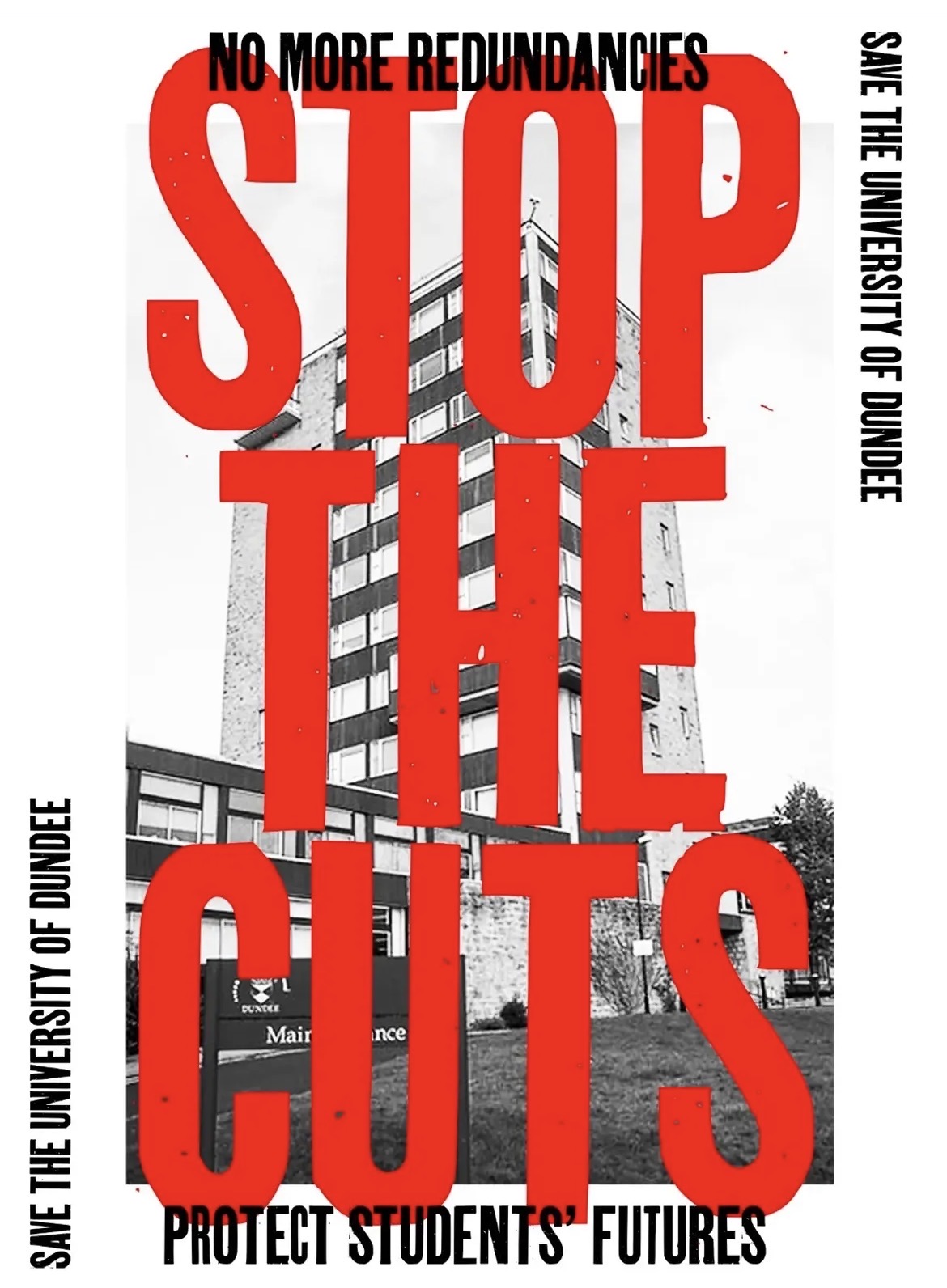
On 17.6.26, University of Dundee announced plans for a further 190 FTE [1] staff job cuts, with people finding out if their roles were at risk of redundancy. At this point, the Executive had already decided which courses and areas would not be cut and which areas would be put forward as part of the proposal, automatically placing those academic and professional support roles in the latter category in a ‘risk of redundancy pool’.
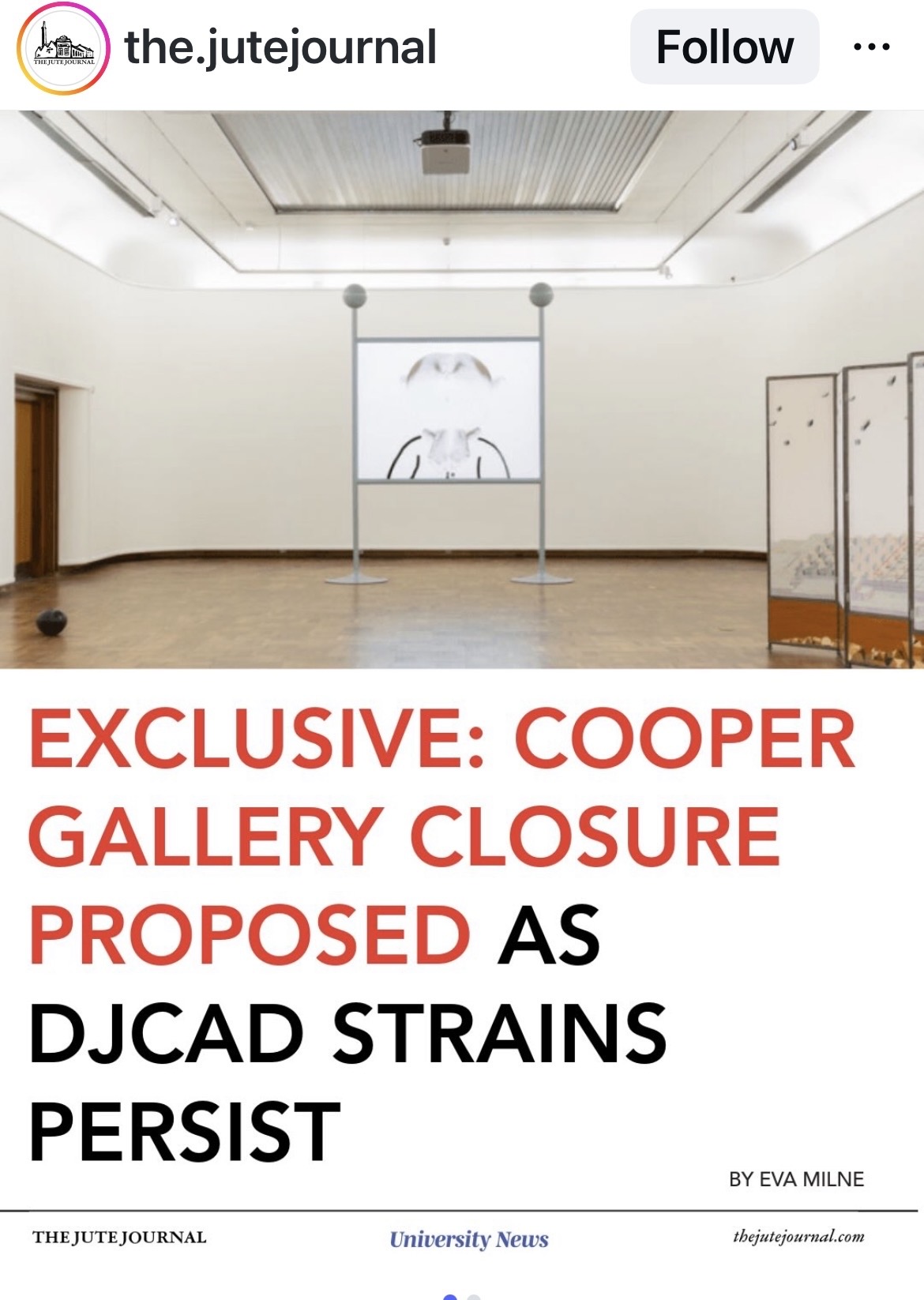
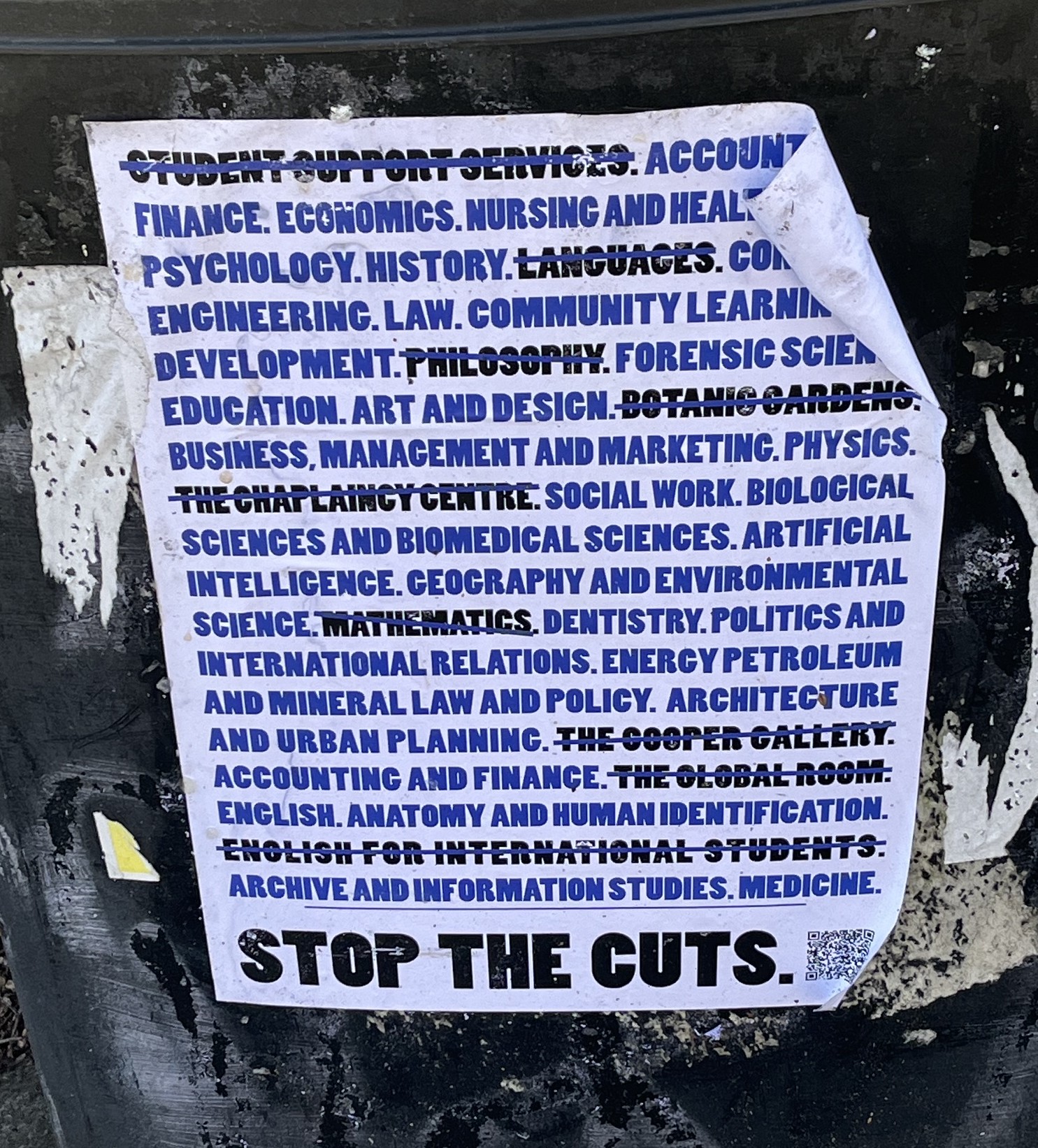
This current round of proposed cuts is ‘despite already cutting about 675 jobs through voluntary redundancies’ (BBC News) since Nov 2024. It also follows a series of restructuring of eight schools into four faculties, with Duncan of Jordanstone College of Art and Design now part of the Faculty of Arts and Social Sciences. ‘Non essential’ services – defined by University of Dundee as services not directly teaching or research, rather linked to enhancement of experience- are also on the proposals also to be cut. This includes University of Dundee Botanic Garden, Cooper Gallery (The Jute Journal broke the news (18.6.26) that ‘Dundee University has proposed the closure of Cooper Gallery by July 2027 as part of major restructuring’), the Chaplaincy, the university’s children’s nursery and Student Services (including Disability Support and pre-sessional English). The corporate definition of ‘non essential’ however is essentially a non sequitur. On the proposed cut of the Chaplaincy, Dame Sue Black, former Professor of Anatomy and Forensic Anthropology at the University of Dundee said ‘There is no doubt that the university is facing a period of profound challenge, but one of the clearest lessons from crisis management is that frontline pastoral and humanitarian support should be protected, not diminished. (‘Dame Sue Black speaks out against Dundee University proposals to make chaplaincy staff redundant’ Connor Bertie 21.6.26). The Cooper Gallery has a research remit. Student Services are essential to supporting access to education.
Whilst other struggling UK Universities cite the downturn of international student numbers as a key issue in financial crises, the key cause at University of Dundee was different. The Gillies Report, commissioned by Scottish Funding Council (SFC), the University’s main funder, found ‘at the heart of the financial failure at the University of Dundee were failures in governance and leadership and failures in financial management’. The SFC went on to outline ‘… what needs to happen to ensure that the University not only survives but continues to make a distinctive and valuable contribution to the local community, national economy and international reach of Scotland’ (27.11.25, ‘University of Dundee Funding Conditions’, sfc.ac.uk).
Roll on from this agreement and a year after a £40 million bailout from Scottish Government (June 2025), University of Dundee is in a further period of proposed collective redundancy.
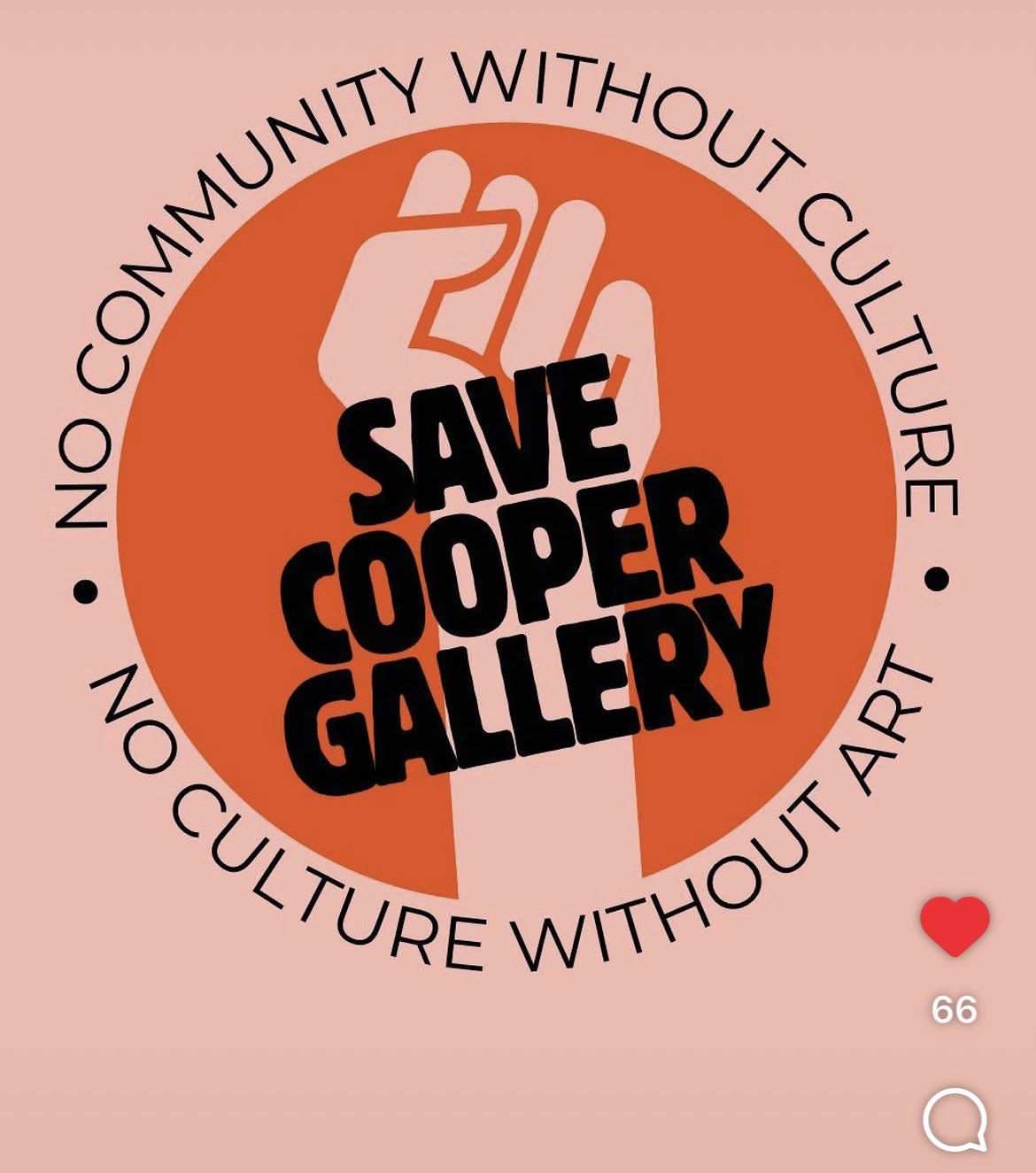
Cooper Gallery, University of Dundee
University of Dundee is proposing, amongst numerous cuts, to close Cooper Gallery, despite the exhibitions programme having a track record which mirrors exactly the qualities the Scottish Funding Council has asked the University deliver on. Indeed, the Cooper Gallery also links to University of Dundee’s own strategic plan 2022-27, where there is much emphasis on the University’s role in public engagement and delivering cultural benefits: ‘Our strategy will develop new approaches for creating economic, civic and cultural benefits’. In 2020 the University was the first university in Scotland to receive gold watermark in recognition of its commitment to public engagement in all aspects of its work.
With the plan to jettison cultural and public engagement assets, the question arises if the University of Dundee can deliver on public engagement and cultural benefits, and meet with key funders requirements? The University outlines in its strategy the special relationship it has with V&A Dundee, UNESCO City of Design and Dundee Science Centre. It should not overlook the particular place Cooper Gallery, as a public facing part of the University, has in the city’s cultural contribution alongside V&A Dundee, Dundee Contemporary Arts, Generator Projects, McManus, Creative Dundee and other artist-led initiatives such as Nomas Projects or Drawing Projects UK. These organisations make up the unique cultural offer in Dundee. In the case of V&A Dundee, University of Dundee cites ‘As a founding partner of the project we retain strong links with V&A Dundee.’ (V&A and the University of Dundee’, 11.9.18 )
In the next crucial period, it could be vital the ways in which these neighbouring institutions, including Dundee City Council [2], can show or continue to give their support to Cooper Gallery, and the wider institution facing job cuts, during the consultation period of 30-45 days that the University takes as part of its Redundancy process. It should be noted that advocacy has already occurred behind the scenes. DCA wrote to University of Dundee Executive back in February 2026, expressing strong support of Cooper Gallery, and their concern regarding the then, reduction of budget and staffing. Worryingly, DCA never received a reply to their letter. Silence seems at odds with University of Dundee’s Strategic Plan 2022-27 statement which outlines an understanding of its links with neighbours:
‘The city locates us in a network of dynamic relationships: its natural resources, its culture and imagination, social institutions and knowledge networks’.
The Strategy goes on to state ‘We actively learn from and work with communities and partner organisations to ensure we deliver our shared priorities in a sustainable, inclusive and socially responsible manner.’ Why does University of Dundee appear to be not listening?
Cooper Gallery’s track record can also be tracked in its consistent funding from Creative Scotland who value quality and ambition. Again, it is in national interests to advocate for the role of the visual arts in Scotland’s society, so it would be key for Creative Scotland to contribute to this conversation with University of Dundee and with Scottish Government on advocating for and retaining cultural assets.
As University of Dundee makes its move towards losing yet more staff and student culture [3], the institution requires to be held to account. This needs to be more robust than last year’s Meeting of Parliament (24.6.25) when at the ‘University of Dundee Finances (Gillies Review)’ session, The (then) Cabinet Secretary for Education and Skills, Jenny Gilruth, [4] in her closing remarks said: ‘A line must now be drawn under the mistakes of a collective few’. It is now apparent, following the much delayed publishing of University of Dundee’s 2023-24 financial accounts, that those ‘mistakes’, did not, on the face of it, act detrimentally on those ‘collective few’, with, ‘Two former principals at a crisis-hit university received payments totalling more than £290,000 after leaving their posts, despite a financial and governance crisis plunging the institution into turmoil’. (The Independent, ‘Dundee University principals paid nearly £300,000 after stepping down’, Craig Meighan, 1.7.26). This current situation of proposed job cuts does not lack in opportunity, nor inside knowledge, to be discussed at Scottish Government level. The University of Dundee Rector is Maggie Chapman, a Scottish Green Member of the Scottish Parliament for North East Scotland. The Rector sits as a key member on University Court. As she stated, in the Herald (‘New Dundee University Rector recently critical of operations’, Garrett Stell, 21.3.25):
‘We must shine a light on university governance and decision-making, ask challenging and sometimes uncomfortable questions and ensure we bring the voices of students and the staff who support their education, into every conversation we have.’
Worryingly, a year later, Dundee University and College Union (UCU) in their evaluation ‘Dundee UCU Finds University’s Strategy for Recovery Lacking’ (16.6.26) stated amongst its key findings that the ‘Strategy to Recovery’ submitted by the University of Dundee had not met most of the Scottish Funding Council’s Conditions of Grant’ including, ‘The University has not undertaken meaningful engagement with staff, students or campus union’. However, as reported in The Courier (‘Funding council waved through Dundee University £20m cuts plan despite own concerns’, Sean O’Neil, 3.7.26), SFC had already ‘considered compliant’ the University’s Strategy to Recovery with November 2025’s terms and conditions, at a SFC Board sub-group meeting on 12 June 2026 which allowed the next tranche of rescue funds to be paid. SFC minutes state:
‘It was nevertheless noted that concerns around meaningful engagement with key stakeholders remained and it was suggested that further assurance around the model of engagement at the University of Dundee should be reviewed independently in six months with the outcome of the review of to be submitted to SFC.’
However, will this independent SFC review be too late in Dec 2026?
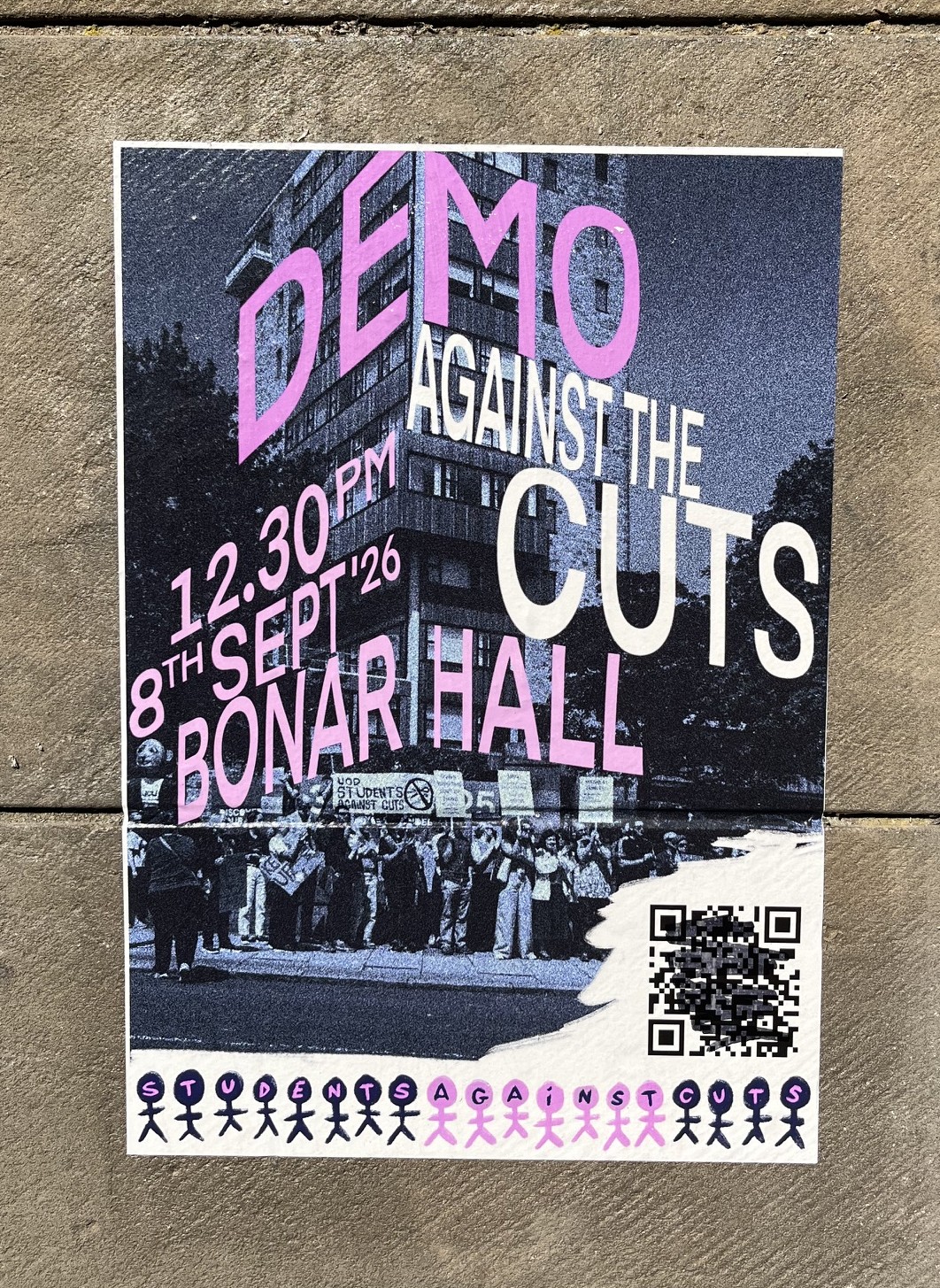
Following the Consultation period, the University of Dundee Court (8.9.26) approved both Voluntary and Compulsory Redundancies, with proposed staff cuts moving from 190 to 154 FTE. Court members, as reported in the Jute Journal, had been ‘told to accept decisions passed by court or have the option to resign’ (7.9.26). This appears a draconian approach, given one of University Court’s primary responsibilities states it will ‘… ensure that it is responsive to the interests of its stakeholders, including students, staff, graduates, the local community and funding bodies'[5]. Cooper Gallery has been given an extension to ‘propose an alternative financial plan in order to ‘develop a new operational and funding model'[6]. The University similarly will fund Botanic Gardens operationally until July 2027, expecting ‘key stakeholders and the local community to develop alternative proposals for its future’.[7]
University of Dundee UCU branch enters 5 weeks of strike action from Monday 21st September until 23rd October 2026.
Footnotes
[1] FTE full time equivalent means more than 190 jobs could be lost, with part-time roles counting towards the total.
[2] Indeed, all four political groups on Dundee City Council signed a letter expressing ‘deep concern regarding the proposed further job losses and potential closure(s)’ (‘Council leaders call a halt to university job losses’, Dundee City Council website, 24.6.26.)
[3] The loss of the word ‘Cultural’ has already taken place, with one of the Directorates moving from being called ‘Library, Academic & Cultural Services’ to ‘Library & Academic Services’. This is at odds when externally, the Museums service that is part of that same Directorate has recently had ‘The Duncan of Jordanstone College of Art & Design Collection, managed by University of Dundee Museums … formally recognised as a collection of national significance.’ (Press release, University of Dundee, ‘Artwork collection receives “recognised” status’, 19.5.26)
[4] Jenny Gilruth is now the Deputy First Minister of Scotland and the Cabinet Secretary for Finance and Local Government.
[5] University of Dundee University Court’s ‘Statement of primary responsibilities of Court’ (updated January 2023).
[6] ‘Update on change across the University – August 2026’, University of Dundee press release.
[7] Ibid.
For more information on proposed losses view The Jute Journal https://thejutejournal.com
There is an Open Letter that can be signed via @savecoopergallery on Instagram
DUCU has compiled a list of petitions and campaign material here