Unknown's avatar

Thisssssss: Sound and Silence

image

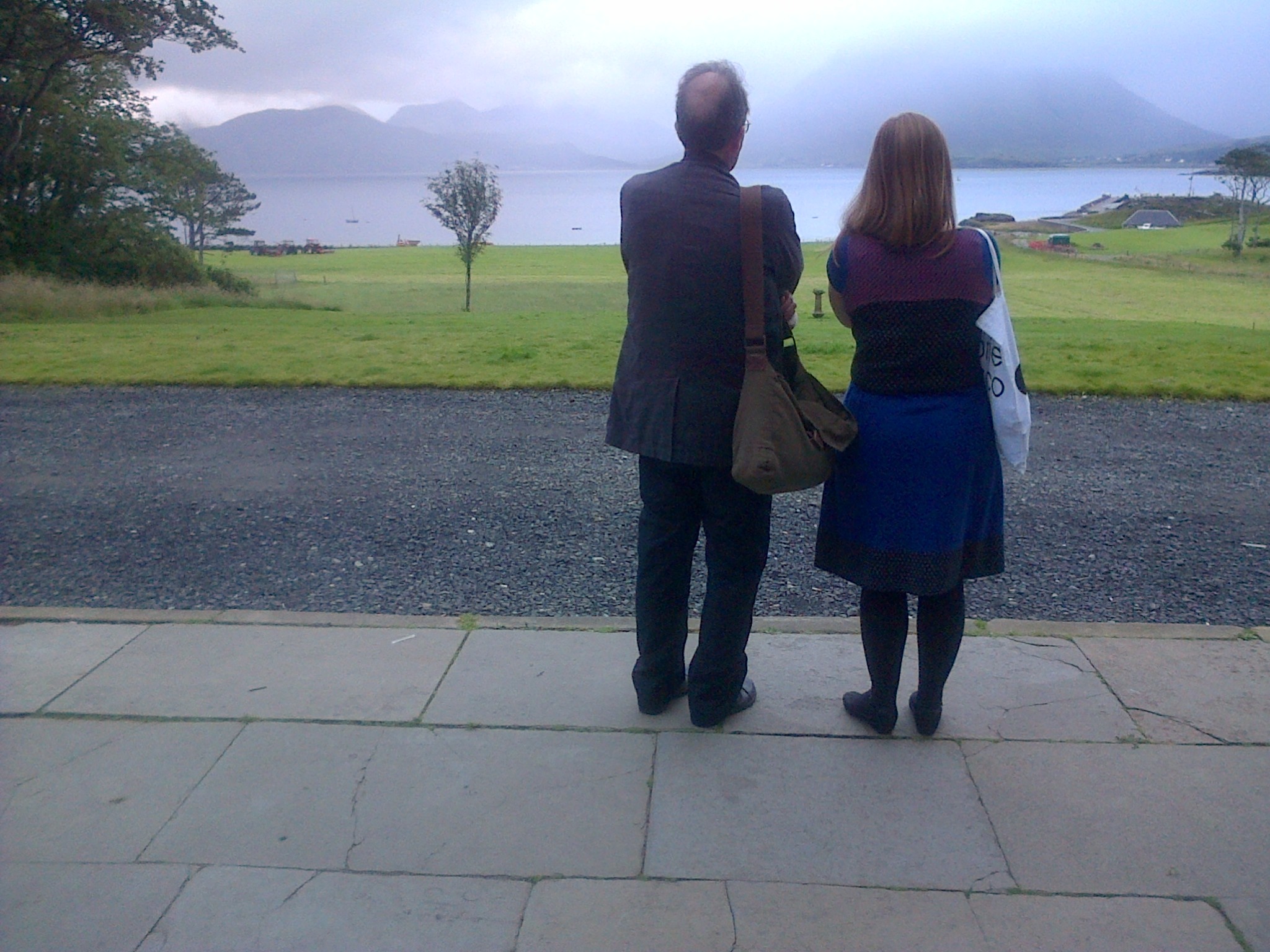
Jessica Ramm and Emma Nicolson


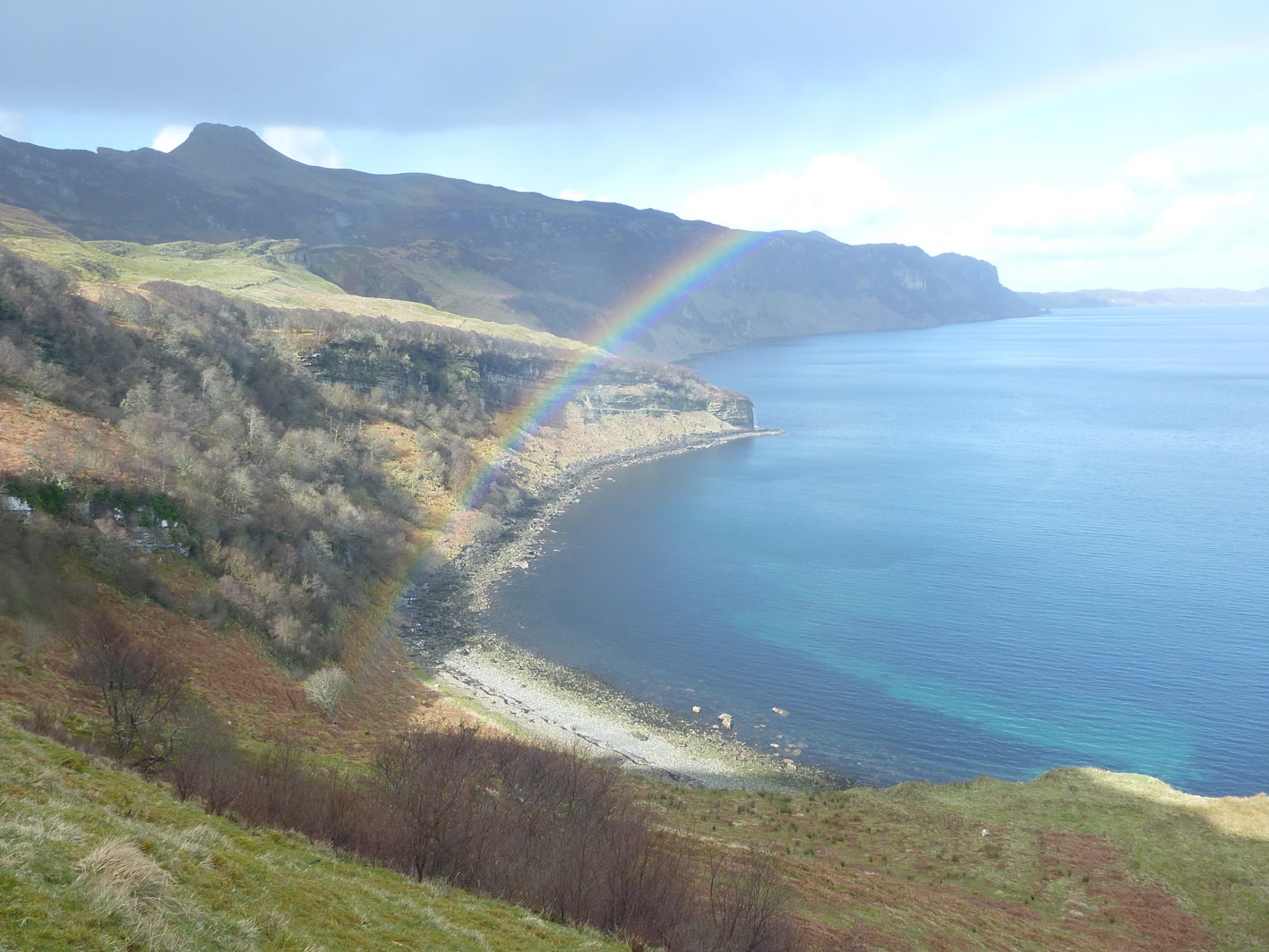
Hallaig


Yesterday was bookended with both a real and a transmitted experience of the same place, Hallaig. In the morning, Emma Nicolson led the group on a walk to this cleared village situated in the south-east of Raasay. In the evening we watched we watched Francis Mckee’s copy of ”Hallaig: The Poetry and the Landscape of Sorley MacLean’ 1

‘Back through the gloaming to Hallaig,
Through the vivid and speechless air,
Pouring down the steep slopes,
Their laughter misting my ear.’ 2

Emma Balkind, one of our illuminators, has been recording the sound of our field trips and conversations. When we interviewed her for the short film we are making about the residency, she said, “I felt I was switched on all the time”. She and her microphone have captured the layers of words and movement of the group, alongside the land and the sea around us. I asked her if she has managed to record silence at Hallaig and she said no. Even when Johnny Rodger, one of the most ebullient in our group, asks for silence on the hill, the put-put-put of a boat out on the Sound can be heard, followed by the musical tone of a button on a digital camera.

In the evening, the cadence of Sorley MacLean’s voice and his delivery of the word ‘Thisssssss….’ sticks in my mind. The letter ‘s’, a spiral in form, fizzes in his mouth, shaping the word into a new sound and entity.

How can something, as Sorley MacLean has it, be ‘vivid and speechless’ at the same time? Much of our discussions have circled around pairs of words that come from different realms but are interwoven in order to exist: Faith and Doubt. Rational and Spiritual. Discipline and Devotion. History and Present. Interior and Exterior. Both Clare Lees and Kathryn Maude from King’s College London talked of the desire for dates in their field to evidence an occurrence or event versus the reality of the gaps that exist. As Clare put it, “My career is half-knowing things”. There are many different ways of learning, from the academic to the intuitive. In our discussions over Raasay, “The landscape has unsettled the theory”. 3 We have referred to the remoteness of the past whilst being surrounded by three billion year old rock.The Spiral is still turning, but it is important to acknowledge “Thisssssss”; that the disjoints, impossibilities, gaps and unknowns occurring are as important as the entities that surround them.

1 ‘Hallaig: The Poetry and the Landscape of Sorley MacLean’, originally produced by The Island House Film Workshop, Alva (1984), a film by Timothy Neat.

2 ‘Hallaig’ by Sorley MacLean, translated by Seamus Heaney.

3 Francis McKee’s observation
Unknown's avatar

Vision on Raasay

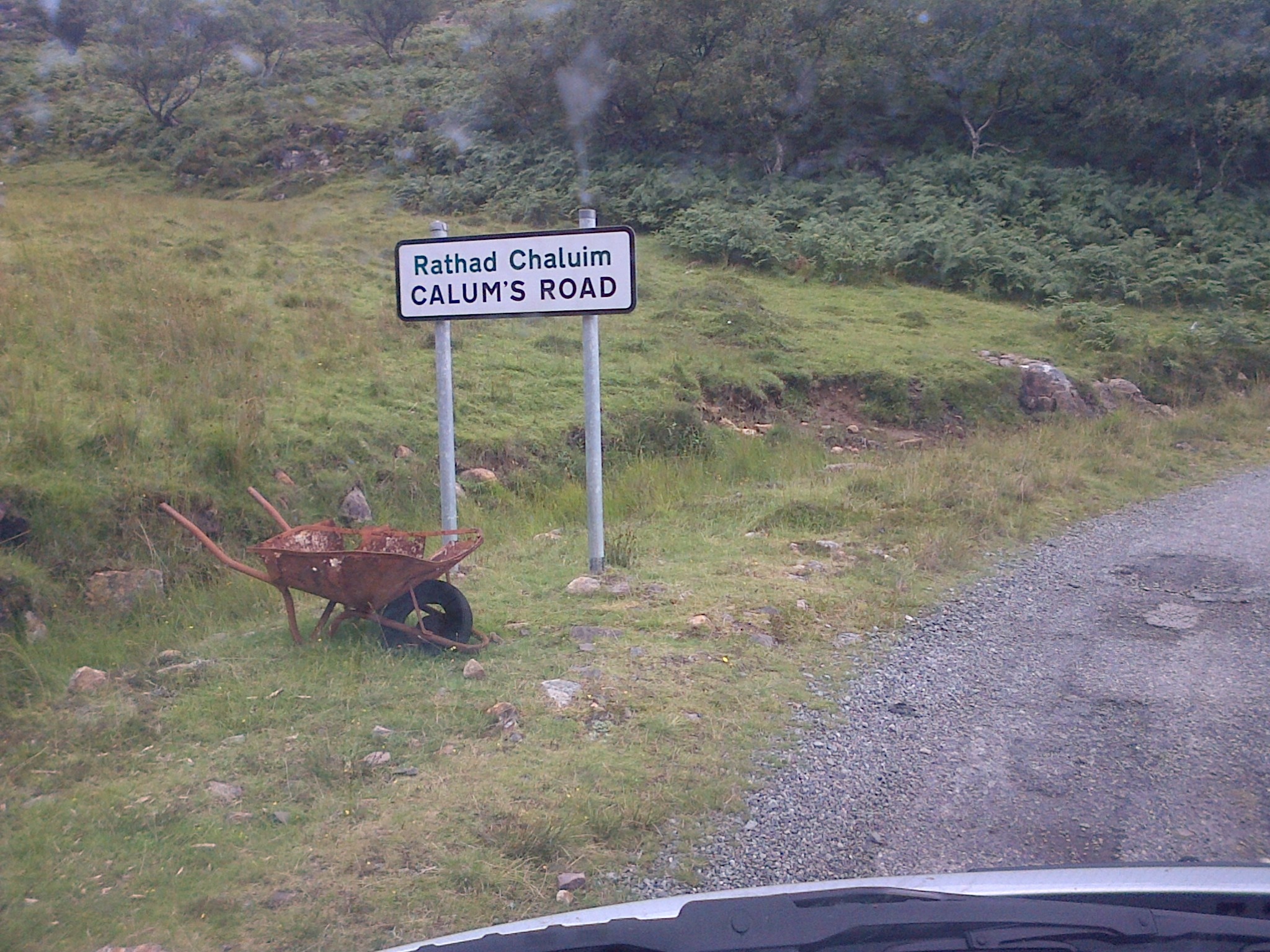
Calum's Road

“It’ll be like an Autobahn” 1

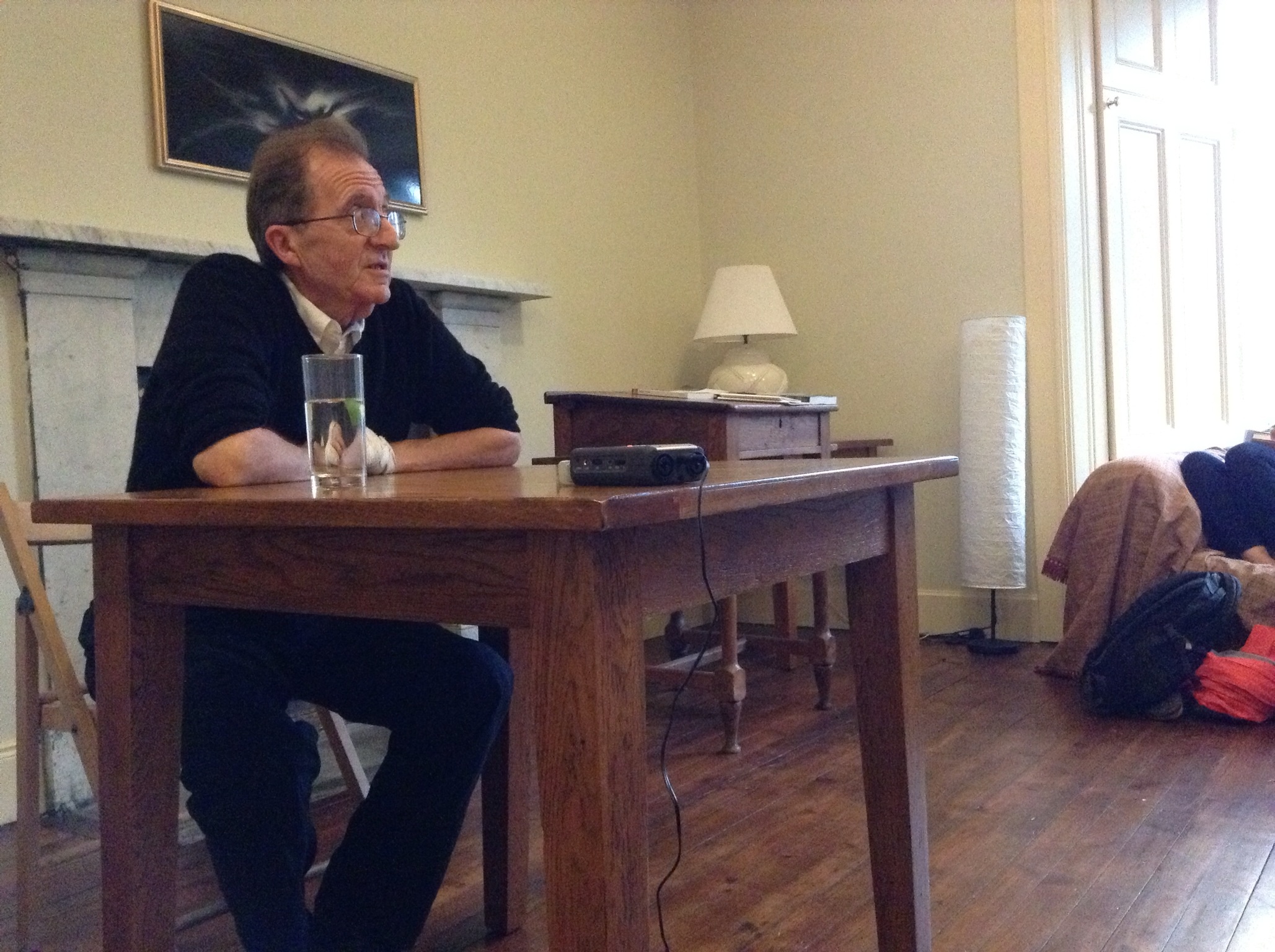
Emma Nicolson, Director of ATLAS Arts, joined the Spiral. Her input on the shaping of the project, her choice of Raasay as location and suggestion of Skye artists Caroline Dear and Jessica Ramm, has proved invaluable. Emma invited local author Roger Hutchinson to meet the group and talk about ‘Calum’s Road’, which tells the true story of a road built over ten years by one man on his time off, Calum MacLeod, to link up to his declining community of Airnish at the north of Raasay.

MacLeod wanted a ‘motor road’, using a 1901 book about building roads for motor vehicles to act has his guide. Using a pick, wheelbarrow, spade and hammer to make the road from stones, his friends also got him dynamite, which he used to blow up a local landmark, a stack that was in the way of the road. He completed the road in 1979, at a point when it was only he and his wife remained in Airnish.

Roger Hutchinson covered the ‘practical sphere and metaphorical sphere’ of this true story. He said that MacLeod was aware he was ‘building a metaphor’ as he fully realised that the migration from his home community was terminal. As the local council, Inverness County Council, had always refused to build the road, latterly citing their decision in view of unsustainable costs for such an enterprise, for such a low population, MacLeod also knew he was building something subversive. Hutchinson said that the Raasay islanders he interviewed said, “Just how he did it was beyond belief to all of us”.

Hutchinson proved to be a great storyteller. He concluded that Calum Macleod died in 1988, found by his wife in his wheelbarrow, presumed to have had a heart attack. Calum MacLeod was posthumously awarded a British Empire Medal, not for the feat of building singlehanded this two mile stretch of road, but for his work as an assistant lighthouse keeper.

1 Vision of Calum MacLeod, Oct 1982, ‘Calum’s Road’, Roger Hutchinson, 2008, Birlinn Limited

Roger Hutchinson and Emma Nicolson

Roger Hutchinson

Unknown's avatar

Disperse and Distill

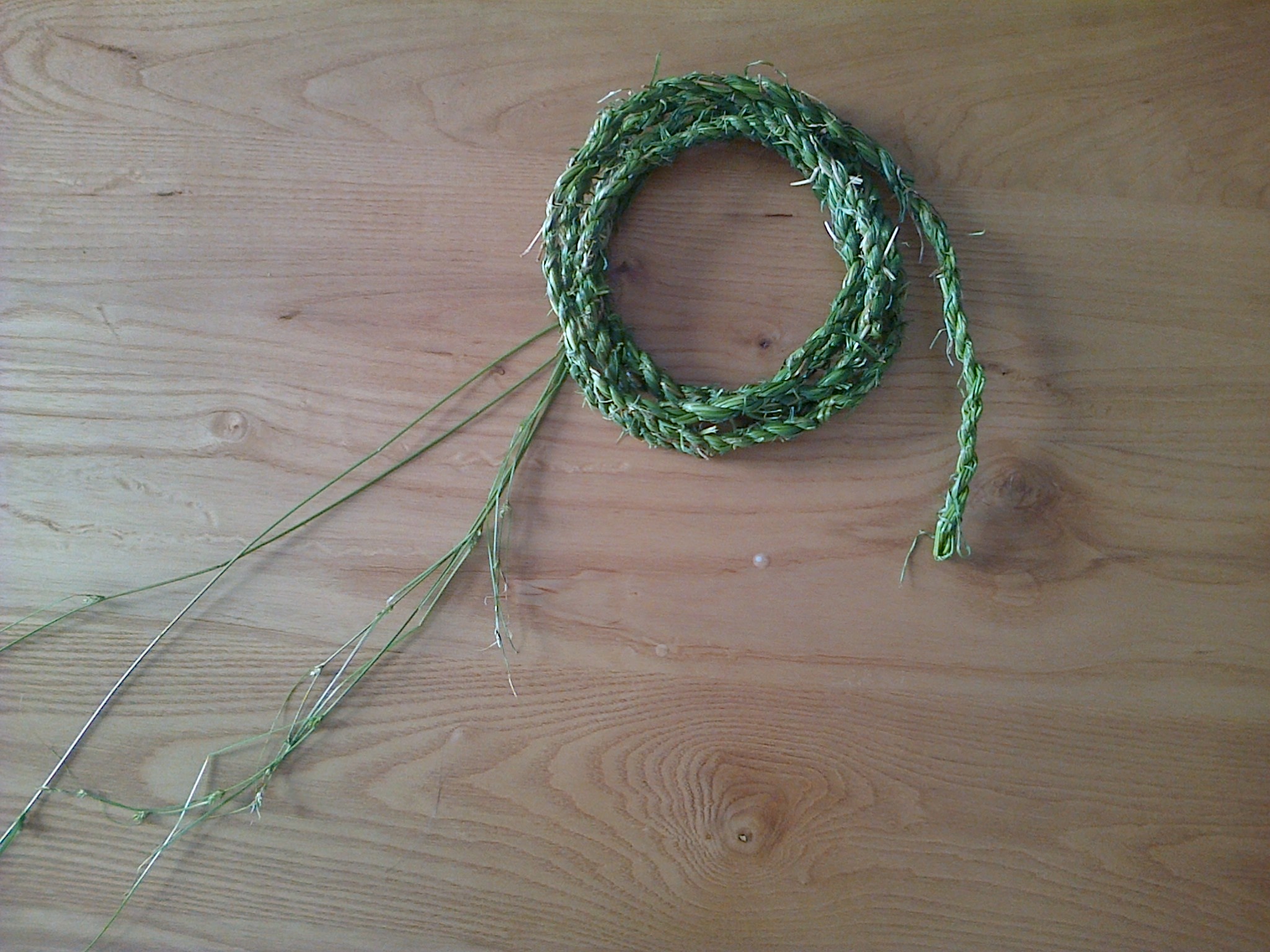
Rope by Edwin Pickstone

The rhythm of the residency has changed.

After saying goodbye to the Medievalists, the day became one of ‘Disperse and Distill’ for the group, allowing time for ideas to form and information to settle. Artists set out both individually and in small groups, to swim, walk, and cycle across the island. Some sat with Skye artist Caroline Dear to learn how to make ropes from the reeds near the beach. Jessica Ramm went in search of a local resident who still cut peat, meeting Jennifer, who showed her a Viking burial mound and discussed the Celtic spirit along the way to the peat bank. Hardeep Pandhal found two containers of Camp Coffee in Raasay House’s library, and thought one of us had placed them there on purpose. He is currently making work back in Glasgow about this coffee originating from the same city, bearing its picture label of a Sikh servant serving a British soldier with a cup.

Augustus Veinoglou summed up the type of endeavour many have at this point, by saying “I want to extract wisdom from this space”. What is this space formed from? We have the book, our conversations with each other and the Medievalists, our past work, this location, experiments, serendipity and the unknown we are yet to encounter.

A number of artists have previously explored aspects of extraction, dispersal or distillation in their work. Edwin Pickstone, one of our illuminators, runs the Letterpress at The Glasgow School of Art. He gave us a summary of the Letterpress at the artists’ presentations, focusing on what this form of production had historically meant, speeding up the hand printing process by ‘the equivalent of 300 years’. Edwin said that learning about the placement of type, helps computer-literate students to understand the weight of space between words. He showed us an image of a close-up of the edge of an 8pt letter ‘e’, the black ink seeping into the white pulp of the paper. This view pushed the physical matter of language into an unknown territory. In his work ‘The Components of the Complete Compact English Dictionary’, Edwin distilled the dictionary ( a book already condensed from twenty-six books into one, through the use of 1pt font) into the sum of its parts – namely 1123 sheets of bible paper and a concentrated poured blob of 128.8 grams of black ink equalling the exact weight of its words. For Convocation, Edwin plans to distill ideas, activity and information of the residency onto the surface of a Raasay map.

In ‘Life of St Columba’, Book Two, there is a story of a knife, which following St Columba’s blessing, has the sacred property that it cannot harm man nor beast. ‘Having discovered this fact…. the monks melted down the iron of that knife and then coated the liquid metal on to all the other iron tools in the monastery. From then on, these tools were unable to harm any flesh…’.

Michail Mersinis has been mixing liquid silver to coat photograph plates, for his series of Raasay landscapes he is making, taking each image at the same times of day and night when the monks prayed.


Unknown's avatar

How do we navigate the Spiral?

Swimming on Raasay

Whoever wishes to explore the Way,

Let him set out, what more is there to say?”
In Sue Brind’s presentation today, she referenced our question of Peregrinatio, through Farid ud’din Attar’s C13th poem, ‘The Conference of the Birds’, where, as she outlined, “The Hoopoe tries to lead all the birds of the world on a journey to find the Simorgh- the Persian name for a benevolent flying creature-who appears in Attar’s poem as the illusive King of the whole World. It will be an arduous journey, over deserts, mountains and through valleys, gaining knowledge along the way. Only 30 birds have the courage to complete. They finally arrive at the land of Simorgh and what they discover is a mountain lake in whose surface is revealed a reflection of their true selves”. 1
In our journey of ideas and expedition for new knowledge, as we explore the histories behind ‘Colm Cille’s Spiral’ then hear about the group’s own work as individuals, what is our objective? Do we wish the group to find St Columba, and what he means for our times, by peering at history through the mountain lake’s calm surface, or instead to have the ‘sea churning and lashing itself, in maniacal states’? 2
‘The Spiral’ is a common form in manuscripts and monuments, which amongst various meanings represents the dialectic; a method of debate for resolving disagreement. The discursive nature of this project is intended to mirror this dialectic. Where do you enter and exit the Spiral, if it has no beginning or end? The ongoing discussions at different times of the day, both formally in the allotted time at different points of the island, and informally over meals, travel and sharing each others’ space, have allowed us to enter into the debate at diverse points. Through strange alignments of place, repetition, language, mirroring, dislocation, thought and reflection, we are beginning to circle Colm Cille’s Spiral. At times we move away, only to return to the anchor of the book ‘The Life of St Columba’. Where one person finishes speaking, another loops in with the next point or observation.
If you unravel a spiral you will always find a circle. I can recognise Convocation’s structure as made up of three interlocking circles. At the beginning of the project, the working group debated and discussed ideas for the structure. This has been developed until it could be a feasible form to be opened up and made public to the group of artists and scholars participating in the residency on Raasay. The final circle occurs in October, when in the exhibition and event opens up and presents the first two circles for public engagement with a new audience.

History has proved to be a spiral for the group, at times running parallel only to slip out of reach. Yesterday we saw, at a distance, disturbances on the water of the Sound, and birds hovering, then two whales coming out of the water. Professor Clare Lees from King’s College London had, before to this event, spoken of, “The past surfacing like a whale in the present”.

The Spiral is turning each day of the residency. Yesterday, the medievalists successfully illuminated the historical background to the questions. The day was intense with information, with so much of a rich oral resource created it would be impossible to capture it as a whole. Today, the next turn on the Spiral occurred, with the morning’s focus on presentations by each of the group on their practice. Like links in the knot, hearing about each other’s processes and ideas allowed connections to be made between each other and also to begin to see connections to this project.

In the morning Francis McKee observed that the default of yesterday’s discussions had been on the rational, looking at the geo-political aspects of the text, whereas in essence this book is equally about the spiritual, with much emphasis on miracles and prayer. This afternoon’s discussion, on the beach of stones near Raasay House, allowed us to begin with reference to mystery and spirit. As the group unconsciously sat in a spiral formation, in this open landscape and often in a light rain, we saw the other side of the Spiral, and the that the rational and the spiritual exist at the same time. Francis talked of the tradition of immersive prayer, taking place in water. We had originally gone to the beach, as members of the group had wanted to swim there. At the end of the discussion, it seemed fitting that the work of the mind gave way to the embodied experience of the water.

Footnotes
1 Susan Brind and Jim Harold, presented at CCA, Glasgow, for ‘What we make with words’, Artists’ Readings, 10.12.11

2 This quote comes from Johnny Rodger’s presentation, where he quoted from ‘The Long Ship of Clan Ranald’, by Gaelic poet Alasdair MacMhaighstir Alasdair.

Unknown's avatar

Three Points of Contact Artist Residency

Three Points of Contact is a new roving residency and evolving network that creates the opportunity for curators to work together, bringing international artists into contact with UK artists at contrasting locations.

The residency sets up as an experimental space in each participating gallery, where the artists can research and develop ideas through collaborative experiments, dialogue and public interaction.

In the pilot year, the three month residency started in York at New School House Gallery and York St John University (13–23 Nov 2012), moved to The Glasgow School of Art (3–14 Dec 2012) and finished in Penzance at The Exchange (15–26 Jan 2013). The residency is also online at http://www.threepointsofcontact.info . Images of the residency can be viewed at http://www.flickr.com/photos/tpcresidency/sets/ A film of the Glasgow leg of the residency, shot by Christopher Quinn can be viewed at https://vimeo.com/57599492

Three Points of Contact was devised by Judit Bodor, Blair Todd and Jenny Brownrigg. It was funded by Calouste Gulbenkian Foundation.

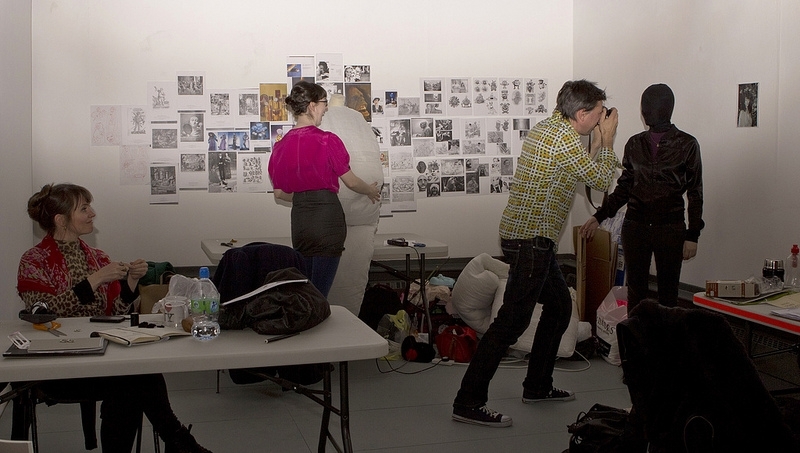
Three Points of Contact Residency (2012), Mackintosh Museum, the Glasgow School of Art

Three Points of Contact Residency (2012), Mackintosh Museum, the Glasgow School of Art

Unknown's avatar

Convocation: Colm Cille’s Spiral

‘Convocation’ sees a group of scholars and artists on residency on Raasay, an island off Skye, responding to the legacy of 6th Century Irish monk Colm Cille. This is part of the Derry~Londonderry City of Culture project ‘Colm Cille’s Spiral’, led by Difference Exchange and Kings College London. To read more on ‘Convocation’, the Scottish knot on the Spiral please go to http://www.colmcillespiral.net/category/a_convocation/ . ‘Convocation’ has been curated by Jenny Brownrigg at The Glasgow School of Art Exhibitions and is in partnership with CCA, Atlas Arts and University of Glasgow. The residency takes place August 2013, whilst a subsequent exhibition runs 12 Oct – 1 Nov 2013 at Mackintosh Museum, The Glasgow School of Art, with an event at CCA Fri 11 Oct 2013 2-5pm. The work will go onto be presented at London St Gallery, Derry~Londonderry, 30 Nov – 15 Dec 2013. ‘Convocation’ is funded by Creative Scotland ‘Creative Futures’ Fund and by the partners involved.

Photo: Emma Nicolson

Photo: Emma Nicolson