Unknown's avatar

Research note 12: Violet Banks, University of Edinburgh Heritage Collections

ECA/3/2/1/1, Student Record Book, 1908 – 1920, University of Edinburgh

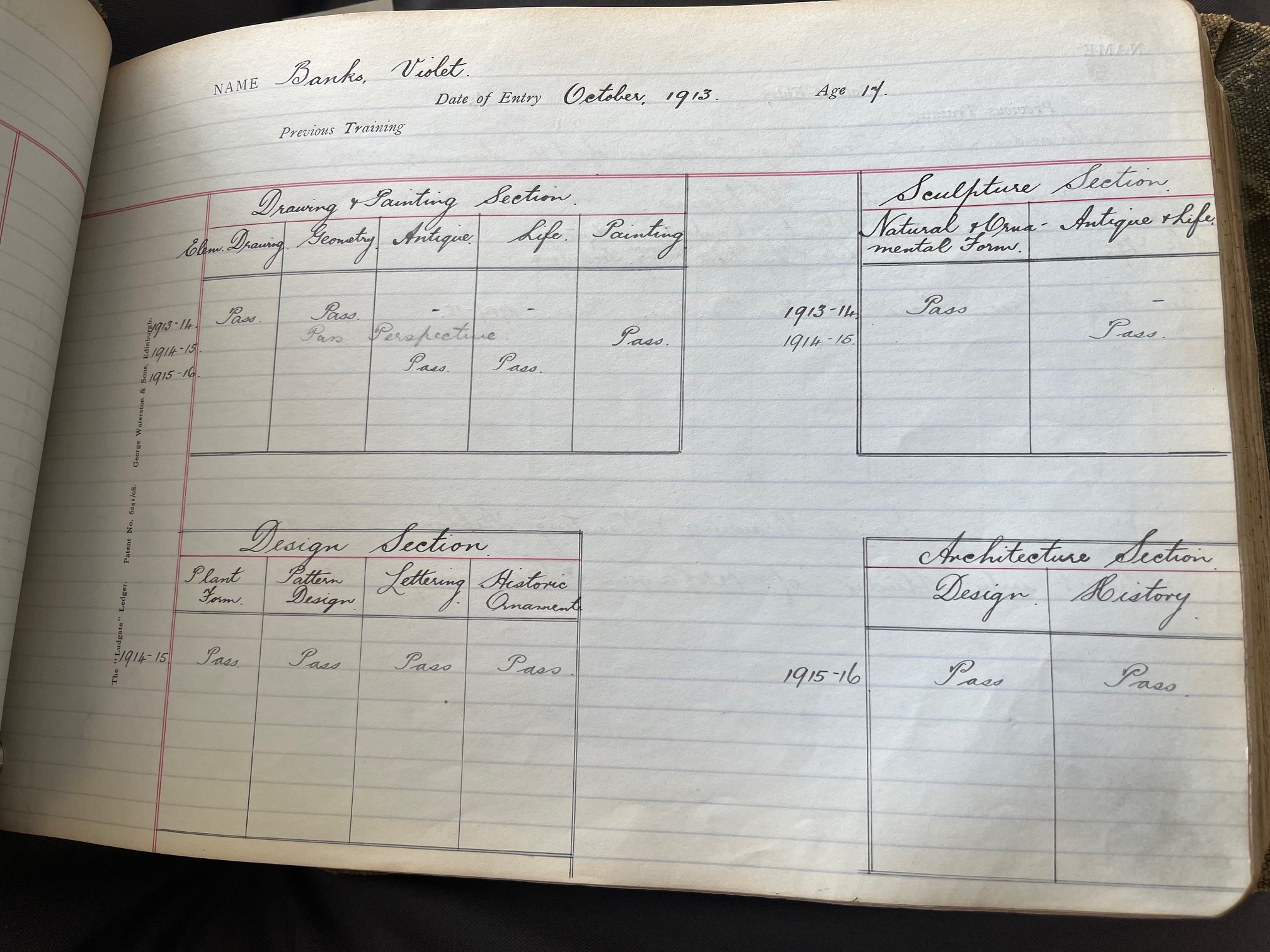
This visit has allowed for further work on Violet Banks’ (1896-1985) timeline. The Edinburgh College of Art Student Record book (1908-1920)[1] records Banks studying there from 1913-1916 then 1917-1918. Her date of entry is listed as October 1913 at age 17. Banks was predominantly in the Drawing and Painting section. It is listed that she also studied aspects of Design from 1914-15 and Architecture in 1915-16. She received her diploma in Drawing and Painting in June 1918. Two of Banks’ peers who received a diploma in same year were Anne Redpath (1895-1965) and Dorothy Nesbitt (1895-1971).

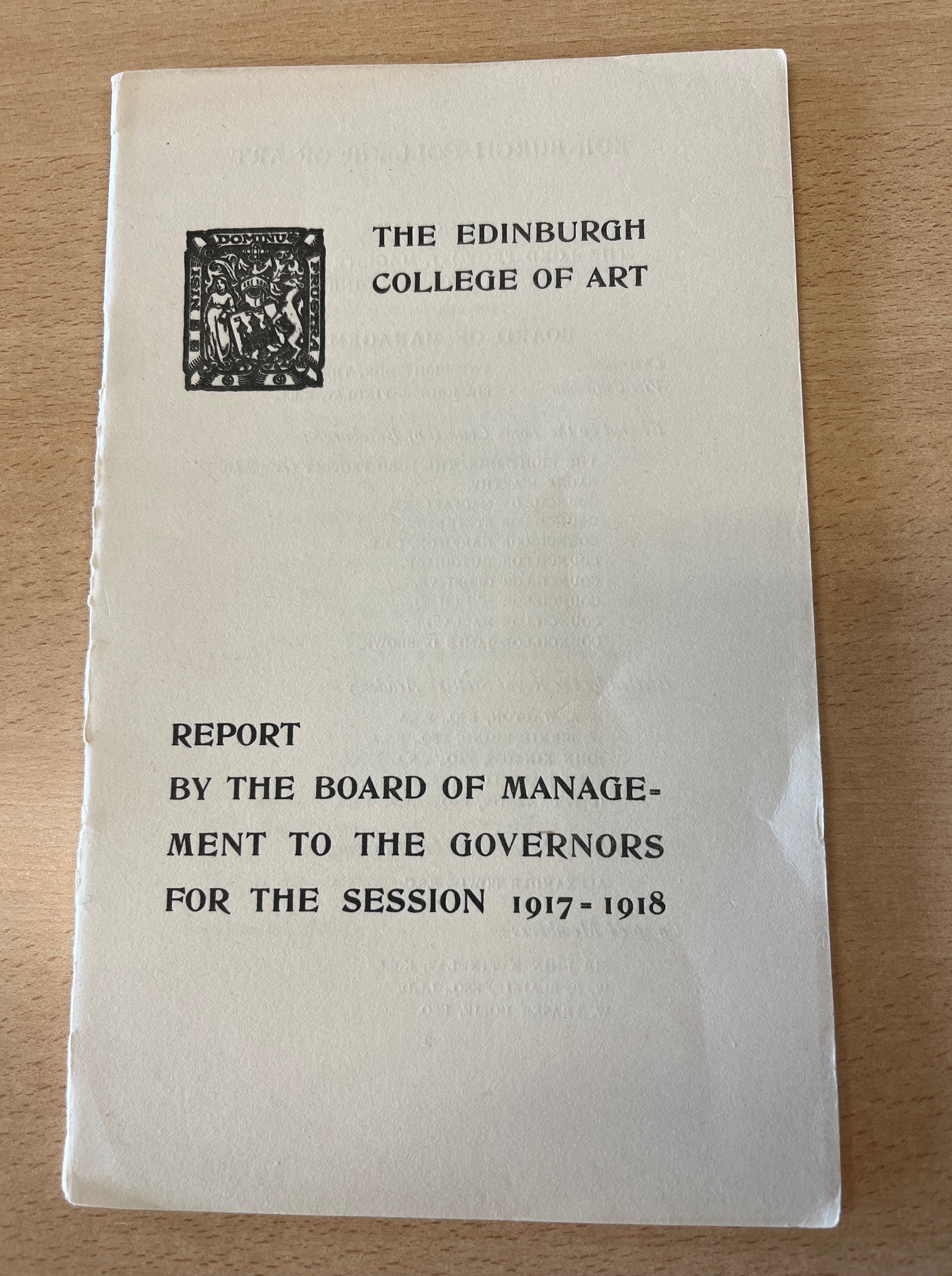
Image: ECA/1/1/1/10, ‘The Edinburgh College of Art, Report by the Board of Management to the Governors for the session 1917 – 1918’, University of Edinburgh. Photo: Jenny Brownrigg


In the ‘Edinburgh College of Art Report by the Board of Management to the Board of Governors 1917-18’, Banks is recorded as one of two students who received a minor travelling bursary of £15. The minor travelling bursary appears to have allowed the recipient to undertake visits to art collections, with a stipulation to present drawings from those on return. In the 1917-18 report, the quality of Banks’ work is recorded as follows:


The Head of Section reports that although conditions in regard to closed Galleries and sketching restrictions were as is, in the previous year, a creditable amount of work was done, thoroughly justifying the award. He states that the work of Anne Redpath while less in quality than that of Violet Banks, was of a very high standard, probably the highest yet reached by any Minor Travelling Bursary.‘[2]


In the Report from the following year, it shows Banks’ fellow students Redpath and Nesbitt go onto get their post-graduate qualification[3]. However, under the heading ‘Appointments to Students of College During Session 1918-19’, Violet Banks has been listed as ‘Art Mistress, Brondesbury House, Kingsgate, Thanet, Kent’.[4] This is the first record of her having spent time out with Scotland. Barry J. White’s ‘Thanet’s Private Schools 19th and early 20th Century’ (2004) lists Brondesbury House as a small girls’ boarding school in Margate, at 2 Eastern Esplanade. It is not currently known how long she stayed, but it looks like her first art mistress position before she was a senior art mistress at St Orans, Edinburgh[5].


To return to the Student Record book, in Banks’ entry it states she ‘Went into the studio of McLagan & Cumming 1928.‘ This was a printers, lithographers and photography studio in Edinburgh.[6] It is interesting to consider whether this experience of potentially working in photography studios gave her the experience to establish her own photography studio in 1930.


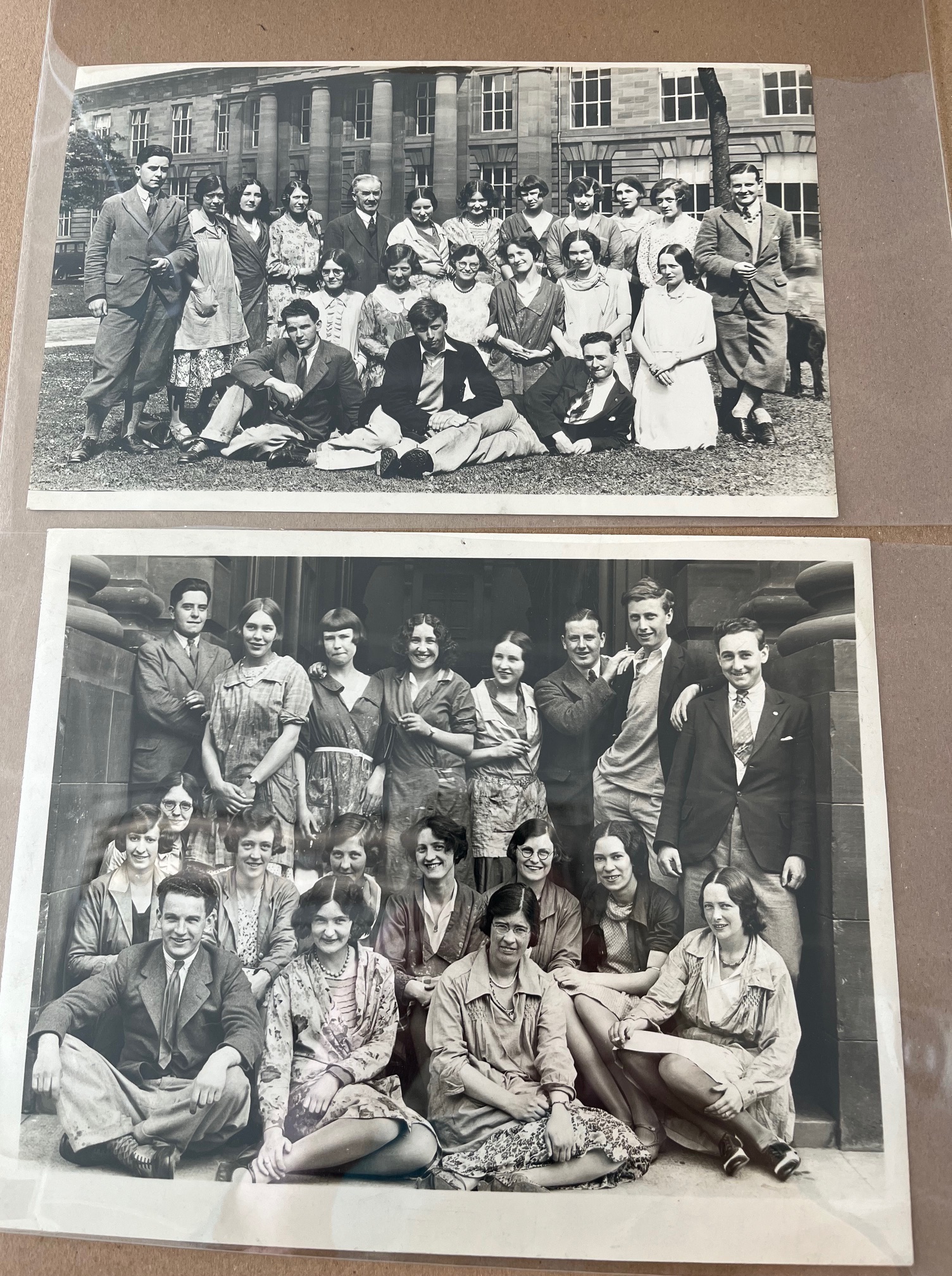
The final items relating to Banks held at University of Edinburgh Heritage Collection are seven photographs, stamped on the back with ‘Copyright Violet Banks A.R.P.S. 11 Randolph Place Edinburgh‘. They are noted as being Diploma Photographs, ranging from 1930-1933, showing students from Edinburgh College of Art Design group and Drawing and Painting as well as Design sections. On the back of the 1933 photograph there is a note of costs: ‘Copies 2/- each / Copies matt and mounted 2/6′. This suggests copies were for sale, potentially to the graduating students and their families. These photographs show that 12 years after her own graduation, Banks had returned to Edinburgh College of Art as a jobbing photographer for a commercial opportunity.

Top: 2/1/3/14, ‘Possibly design group’, 1932, Violet Banks, University of Edinburgh. Bottom: 2/1/3/11, ‘Diploma 1930’, Violet Banks, University of Edinburgh Photos: Jenny Brownrigg


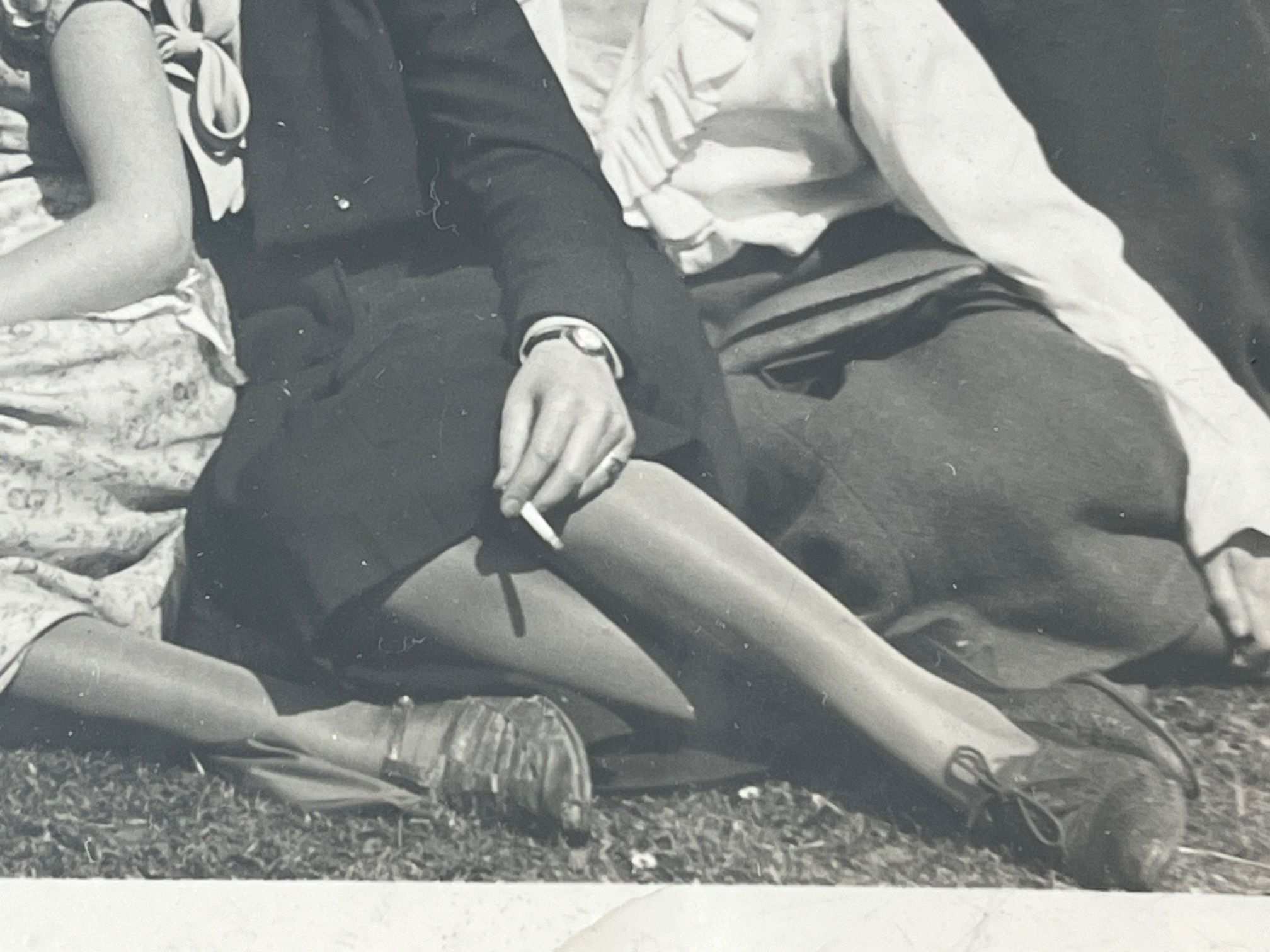
The photographs of the students are informal. Whist the students are in rows, in the 1930 photograph the women students are mostly still wearing their overalls. Banks captures the group’s camaraderie, with their arms around shoulders of peers. In 1932’s class photograph, one of the women is smoking. When contrasted with a formal class photograph by Drummond Sheils depicting the 1932 Architecture Diploma group, there is a marked difference in photographers’ approaches. Whilst Banks’ class photographs are outdoors and natural, the Sheils grouping sees the students formally sat in chairs. All are wearing gowns and are unsmiling.

Violet Banks Collection is at Historic Environment Scotland. Her work is also part of the IF Grant Collection at Edinburgh Central Library, The Museum of Childhood, Edinburgh and National Galleries of Scotland. Out of the 14 women photographers and filmmakers in ‘Glean: Early 20th Century women filmmakers and photographers in Scotland’[7] she is only one of three to have had an art school education[8]. Banks’ trace in the student records and reports at University of Edinburgh has given further crucial information on her biography.  

Footnotes

[1] ECA/3/2/1/1, Student Record Book, 1908 – 1920, University of Edinburgh.

[2] ECA/1/1/1/10, ‘The Edinburgh College of Art, Report by the Board of Management to the Governors for the session 1917 – 1918′, University of Edinburgh.

[3] ECA/1/1/1/11 P.26, the ‘Edinburgh College of Art Report by the Board of Management to the Board of Governors 1918-19’, University of Edinburgh.

[4] P.27, Ibid.

[5] https://www.nationalgalleries.org/art-and-artists/artists/violet-banks

[6] Glasgow Museums collections navigator.

[7] City Arts Centre, Edinburgh (2022/23), curator Jenny Brownrigg.

[8] Margaret Watkins (1884-1969) studied with Clarence H White at his schools in New York and Maine. Helen Biggar (1909-1953) studied textile design at The Glasgow School of Art.

With thanks to Heather Jack for providing the catalogue references and steer to visit University of Edinburgh Heritage Collection.

Detail, Diploma group 1932, Violet Banks, University of Edinburgh. Photo: Jenny Brownrigg
Unknown's avatar

Research Note 11: Violet Banks postcards, Isle of Barra

Violet Banks (1896-1985) was born near Kinghorn, Fife and educated at Craigmont, Edinburgh, and at Edinburgh College of Art. In 1928 she was senior arts mistress at St. Oran’s, a private school at Drummond Place, Edinburgh.[1] In 1935, Violet Banks established her own commercial photography studio in Edinburgh, taking photographs of Scotland’s capital city. The Violet Banks Collection is held by Historic Environment Scotland and can be viewed digitally on Canmore. Banks’ collection also holds nine photographic albums of the Hebrides. These photographs were the result of tours she made during the late 1920s / early 1930s.

I first became aware of Banks’ postcards through a research visit to Eigg History Society in 2016. Three of Banks’ photographs of Eigg, from her photograph album ‘The Small Isles’, appear as facsimiles of postcards in Eigg History Society’s archive. The postcards are distinctive in layout, always bearing black capital lettering ‘Photo: Violet Banks’ at the bottom right of the white border. Since that first encounter, I have slowly been purchasing her original photograph postcards via eBay. All the images Banks selected for her postcards are from her photograph albums at Historic Environment Scotland.

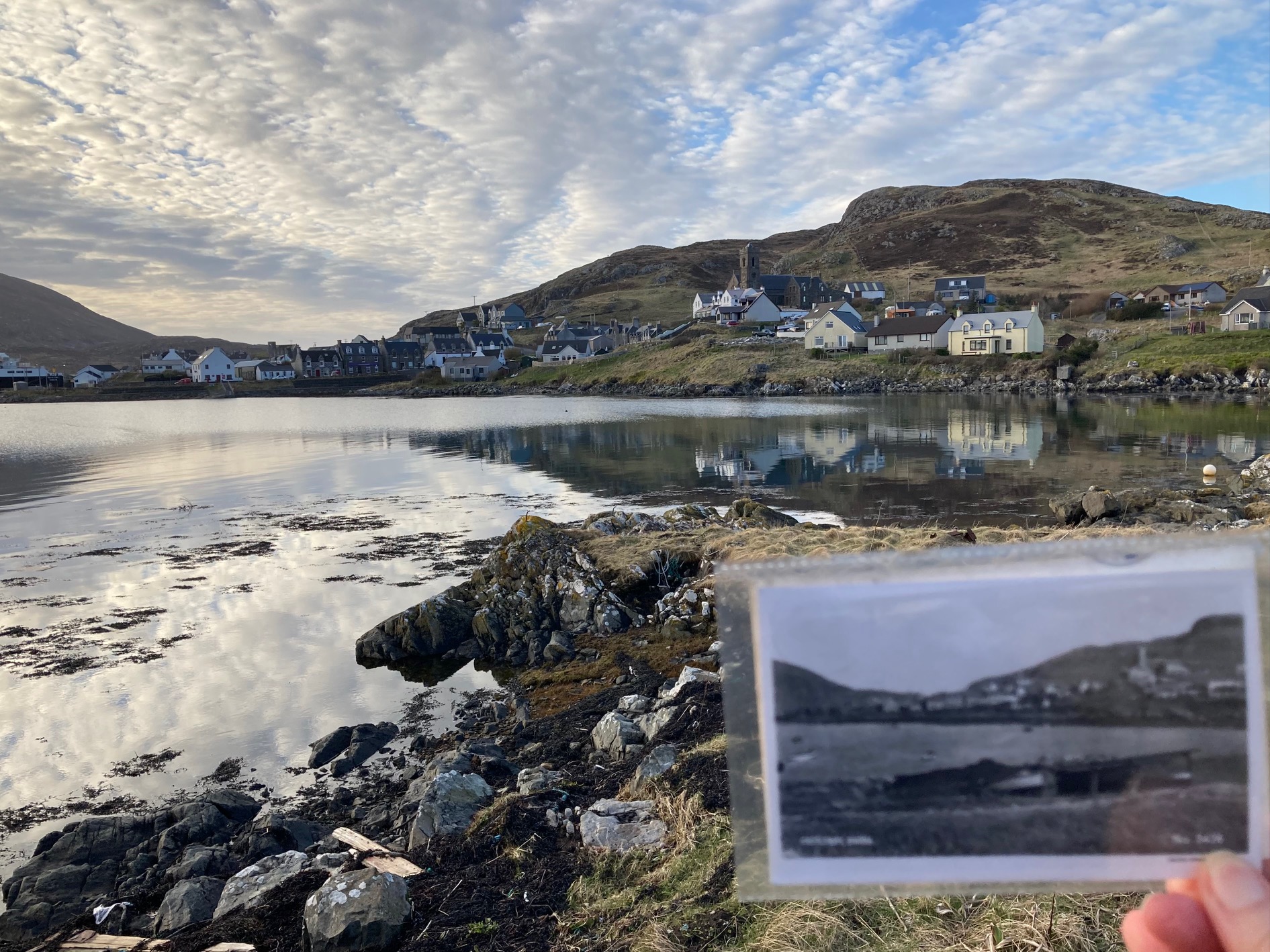
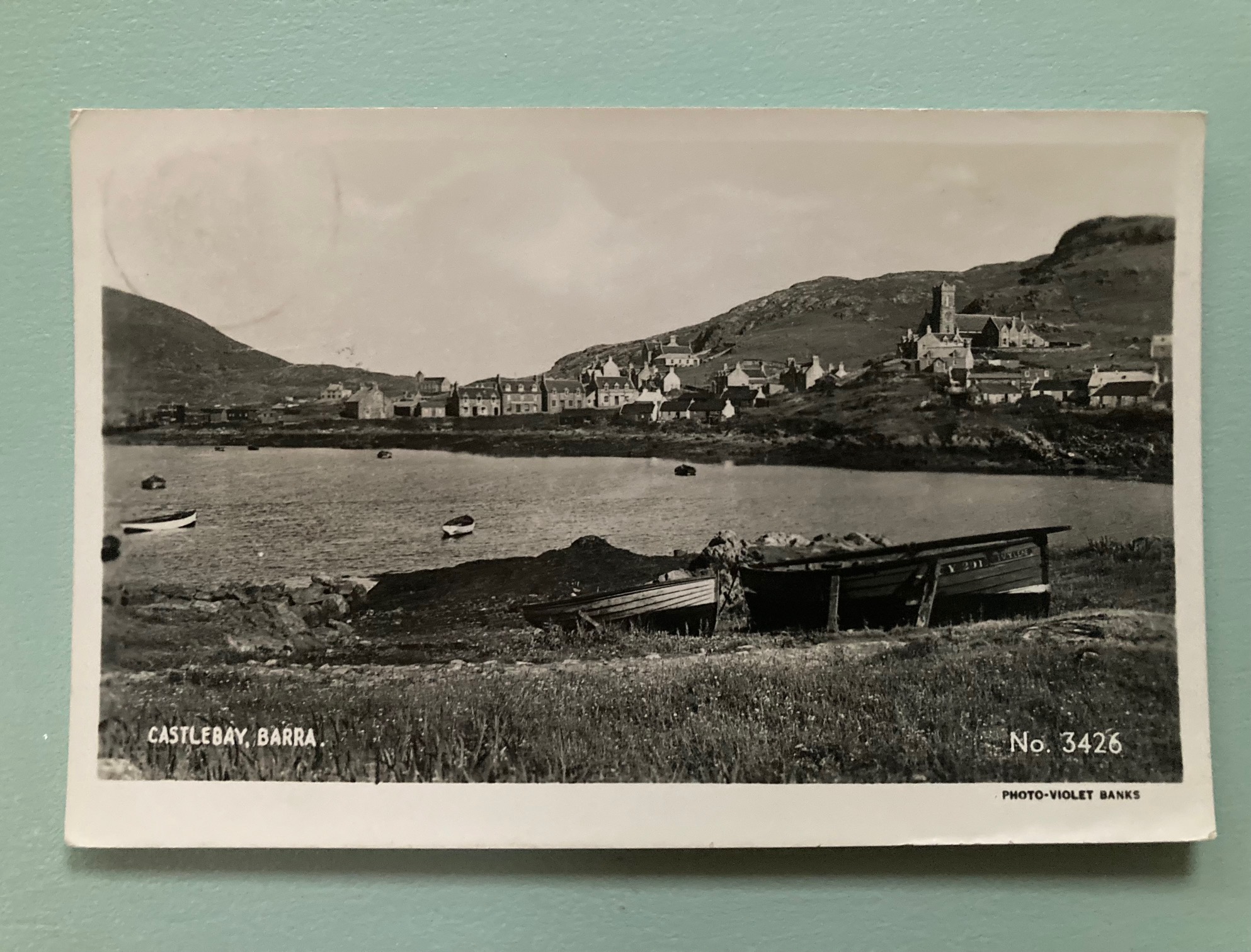
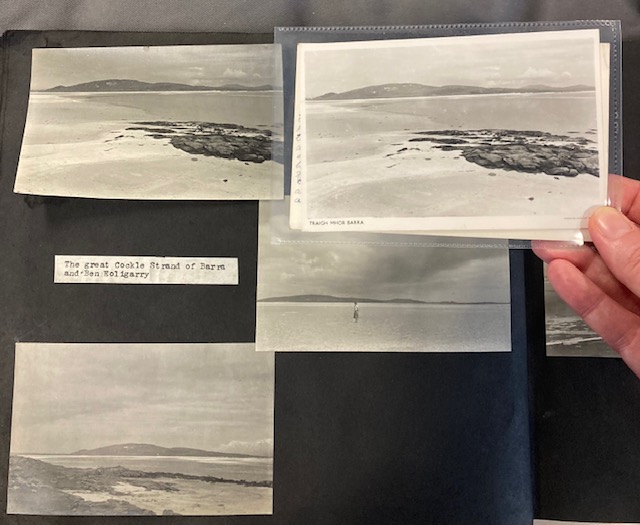
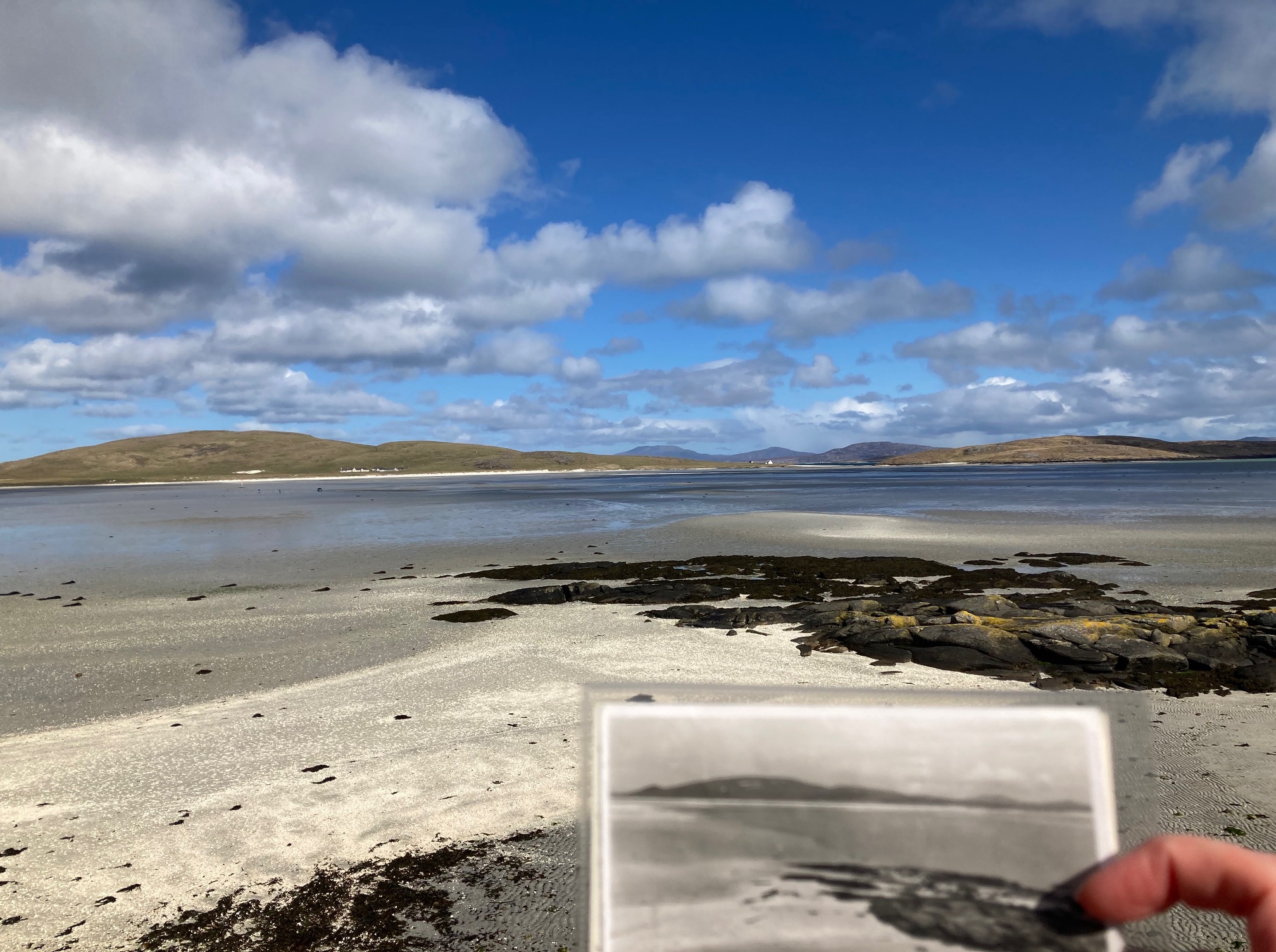
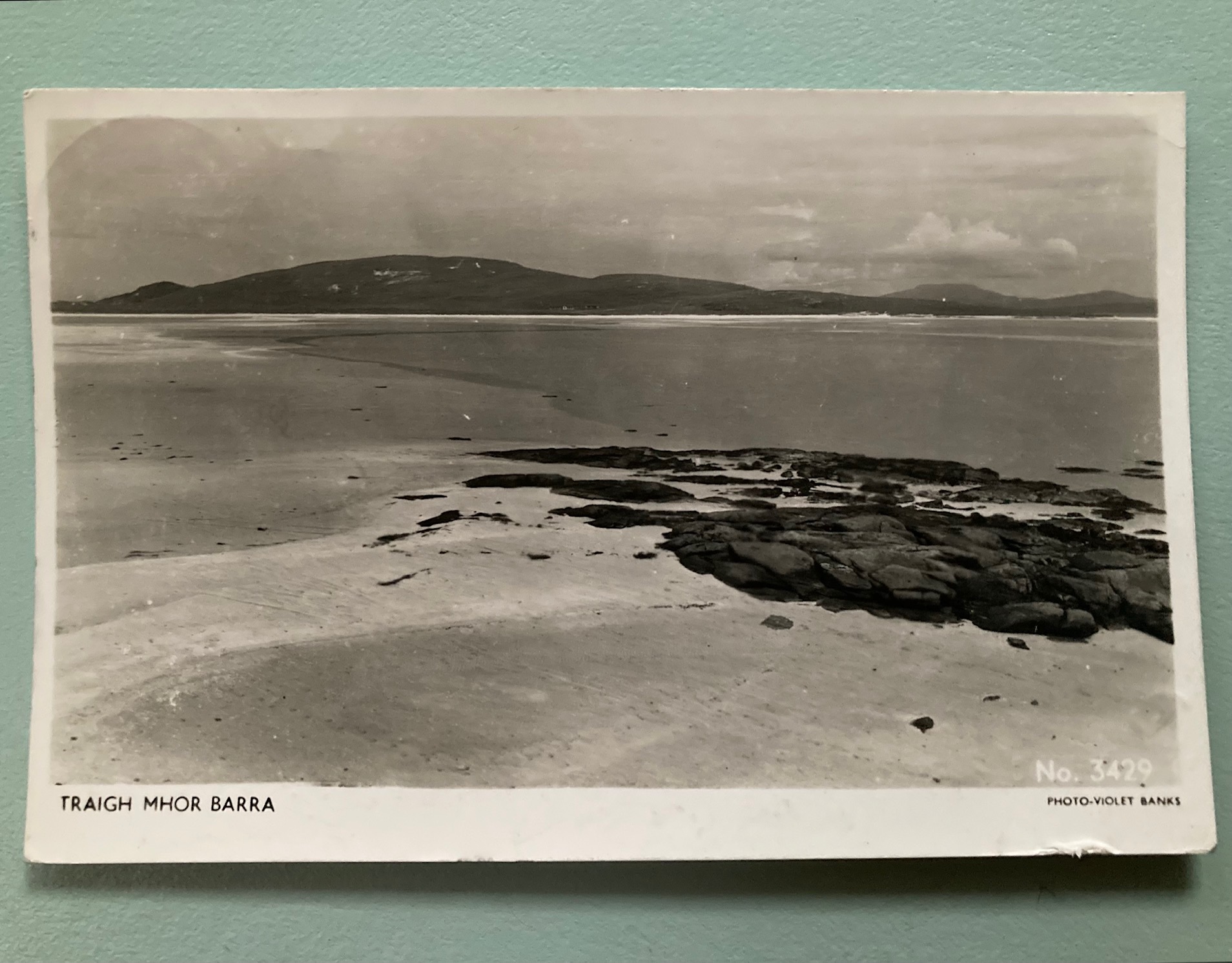
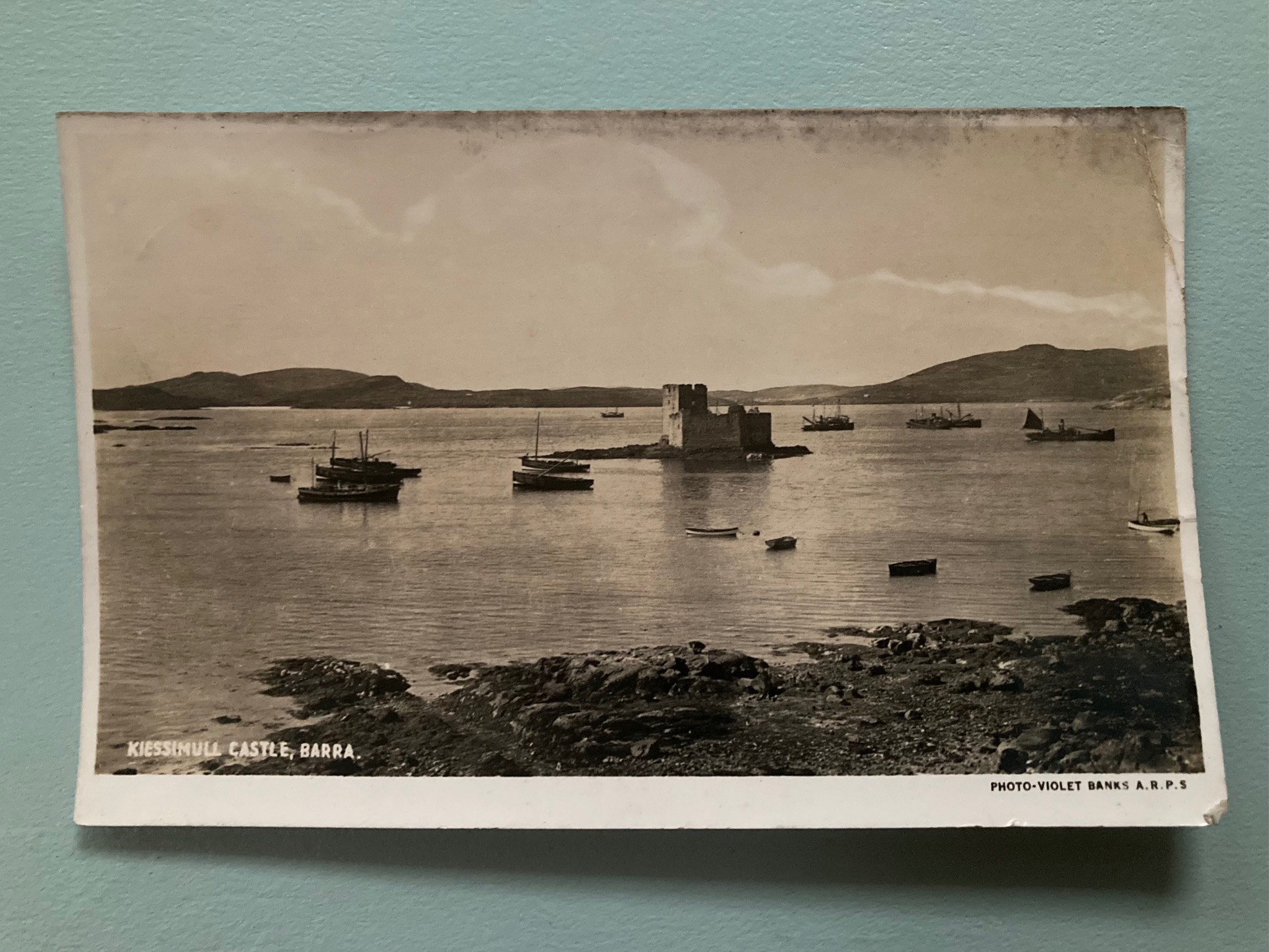
From the postcards I’ve collected to date, Barra has been the main subject. All have their originals in her album ‘A Book of Barra’. Photographic locations include Castlebay, Kisimul Castle, Loch An Duin, Traigh Mhòr, Traigh Eais and Northbay. Messages on the back of postcards show that the latest was posted in 1966, around 30 years after Banks’ visit. Banks’ Traigh Mhòr postcard in particular has had several reprints. The beach name appears mostly in Gaelic on the postcard title, but also as ‘Cockle Strand, Barra’. This postcard’s popularity could be due to this particular beach being famous as the landing strip for Barra Airport, which opened in 1936.

I visited Barra in March 2024. I began to look for the locations where Banks had stood to take her photographs. This method allows for serendipity as well as encountering local knowledge. For example, a local driver, parked in the spot at Traigh Mhòr where I had stopped to take the photograph, recounted that there had been a recent discussion on The Isle of Barra and Vatersay Appreciation Society Facebook Group relating to one of Banks’ photographs of Traigh Mhòr. Several people commented on the location as possibly being the burial site of an old woman where the grave had been lost with the road being built to the airport.

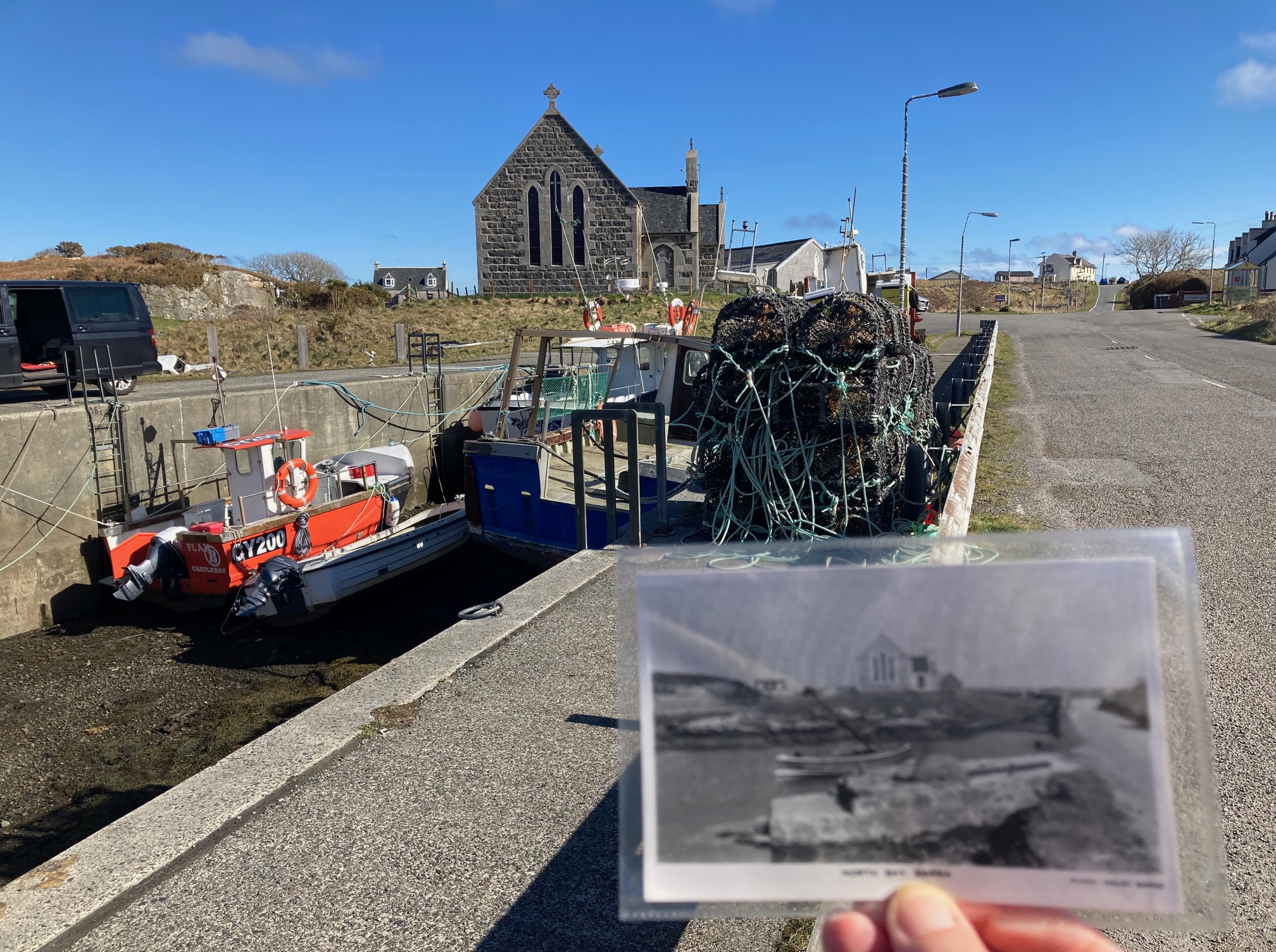
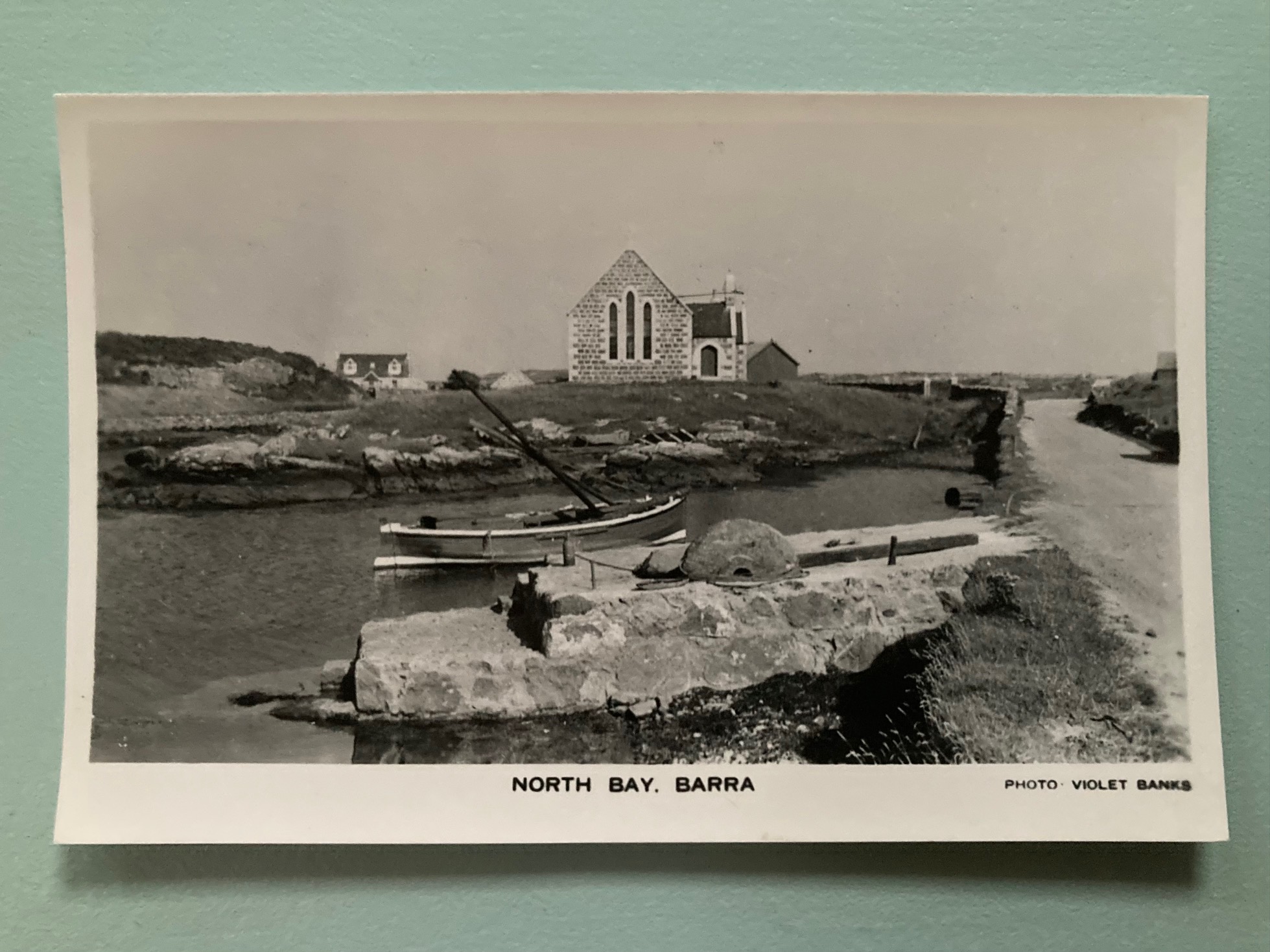
Less than an hour’s walk away from Traigh Mhòr is Northbay and St Barr’s Church, the subject of another of Banks’ photographs and postcards. The church was completed in 1906[2]. Whilst the old pier, a prominent feature in Banks’ composition has been replaced by a modern, concrete version, there is still the presence of boats. The addition of the cross to the church occurred after Banks’ photograph.

In the case of Banks’ postcard of St Barr’s Church in Northbay, Barra, this particular church, bay and road was also the subject of a number of American photographer, folklorist and author Margaret Fay Shaw’s photographs. Shaw (1903-2004) moved to Northbay and Bridge House[3] in 1935. This was the first home she had with her husband, the historian, folklorist and Gaelic scholar John Lorne Campbell (1906-1996). There is a small bridge at the road junction at the corner of the bay which may indicate the former location of Bridge House. There are a number of photographs in Margaret Fay Shaw photographic collection, held at The National Trust for Scotland Canna House, showing the view from that particular point over the bay towards St Barr’s Church, which would seem to corroborate the location of their home. However, the corrugated iron version of Bridge House as it appears in Shaw’s photographs, no longer exists.

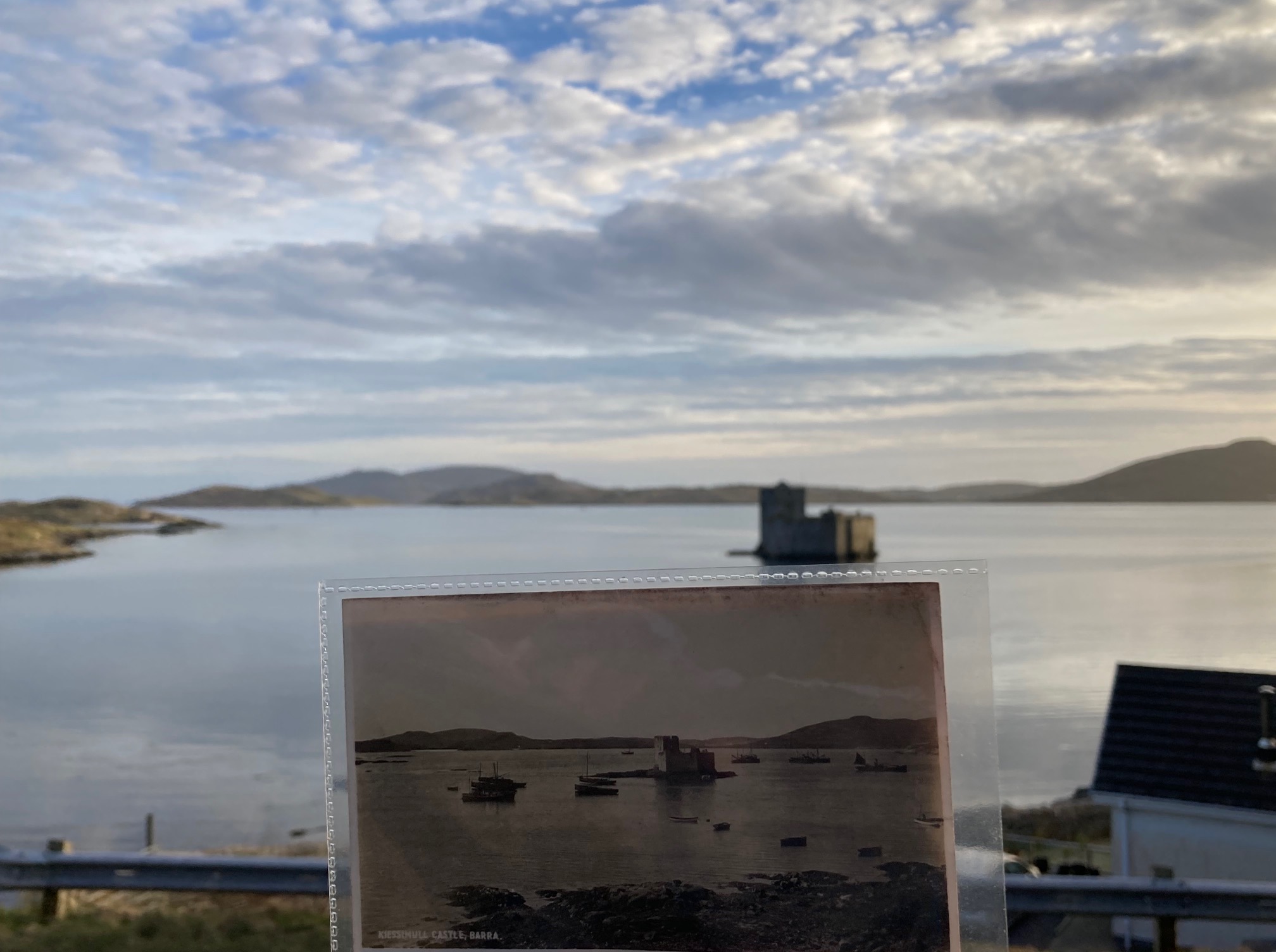
Back in Castlebay, which Banks’ captures in three photograph postcards, I could see she used what was to hand as part of her making her compositions. For example, in her photograph of Kisimul castle, perhaps she had to stand on the rocky outcrop down from Our Lady, Star of the Sea Church, in order to get the top of the castle almost level with the outline of Vatersay behind.

I am keen to find out why there are so many photograph postcards of Barra. Where were the postcards being sold from in the 1930s to 1960s? Was it from the post office or any of the hotels in Castlebay? Was Banks being commissioned to make the postcards? Where did she stay on her visits?

Where I have duplicates of the postcards, I have gifted them to Violet Banks Collection at Historic Environment Scotland. Banks’ own photography of the Highlands and Islands only came to light when discovered by John Dixon of Georgian Antiques, in a drawer in a sideboard that had been part of a furniture purchase and then gifted to Royal Commission for the Ancient and Historic Monuments of Scotland (RCAHMS) now Historic Environment Scotland (HES), to become The Violet Banks Collection.[4] Given this initial precarity, it is important that the collection and knowledge surrounding it, continues to grow.

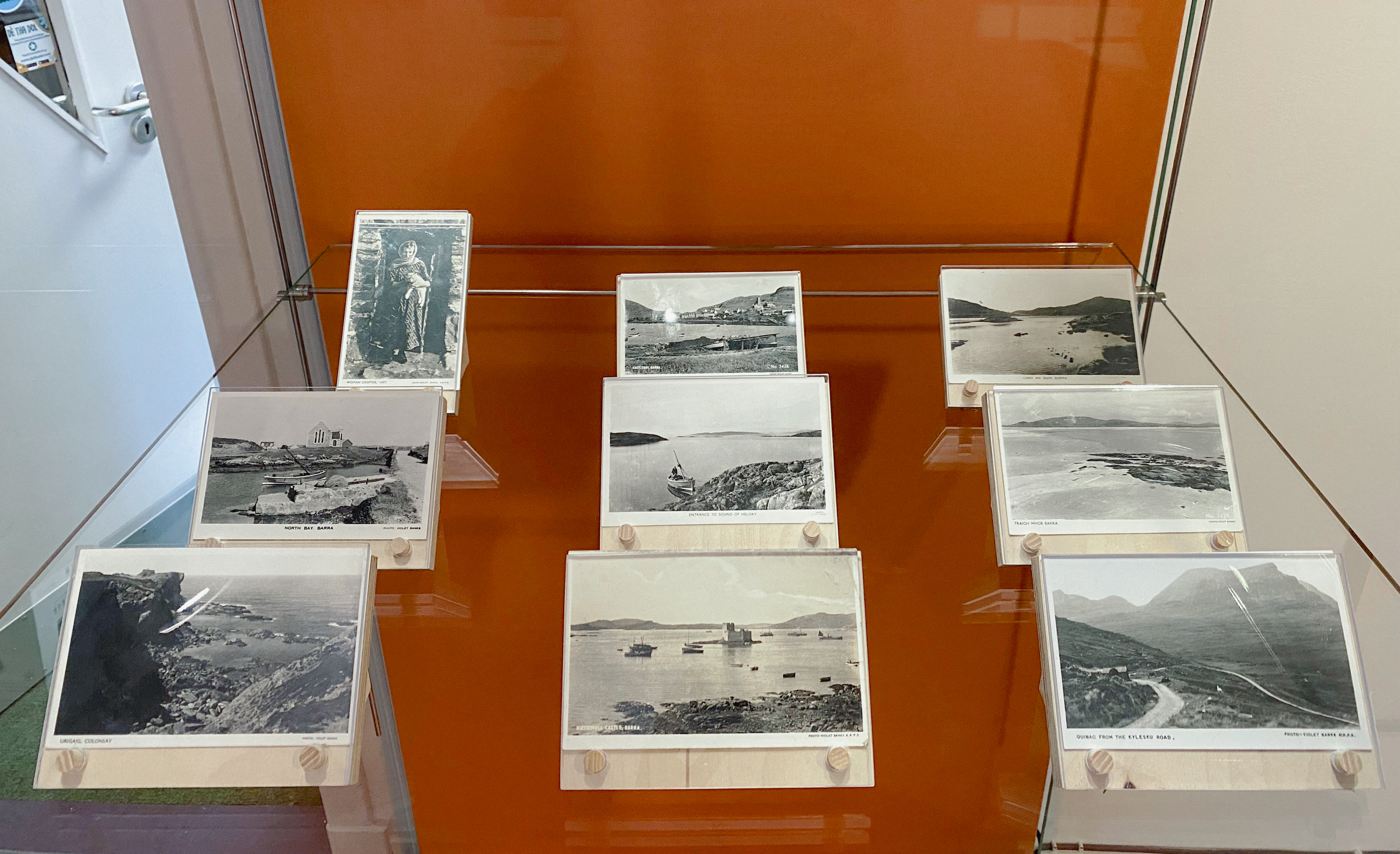
The postcards have been exhibited as part of larger exhibitions I have curated, including ‘Glean: early women filmmakers and photographers in Scotland’ (2023, City Art Centre, Edinburgh) and ‘Co-Roinn | Glean’, in partnership with Vanishing Scotland Archive (2023, Museum nan Eilean Lionacleit, Isle of Benbecula).

Violet Banks postcards collection, ‘Co-Roinn | Glean’, Museum nan Eilean (Lionacleit), Isle of Benbecula, 2023. Photo: Anne Corrance Monk

Footnotes

[1] Veronica Fraser. (2008-9). The Violet Banks Collection. In Grater, A. (ed). Vernacular Building 32. Scottish Vernacular Buildings Working Group 2008-9.

[2] From P.13, ‘St Barr’s Church Northbay Barra 1906-2006’, compiled by Mairi Ceit MacKinnon, Island Books Trust

[3] P.25, Ibid.

[4] Veronica Fraser. (2008-9). The Violet Banks Collection. In Grater, A. (ed). Vernacular Building 32. Scottish Vernacular Buildings Working Group 2008-9.

Unknown's avatar

Research Note 9: Edinburgh Central Library and Highland Folk Museum

The latest research visits (April & May 2022) have been on the trail of a particular series of photographs by Dr Isabel Frances Grant (1887-1983) that are part of the IF Grant Photographic Collection. I moved from one digital archive, am baile to two physical archives- Edinburgh Central Library which holds the photographic collection itself and Highland Folk Museum, Newtonmore, which is the embodiment and repository for IF Grant’s wider work as the founder of Am Fasgadh.

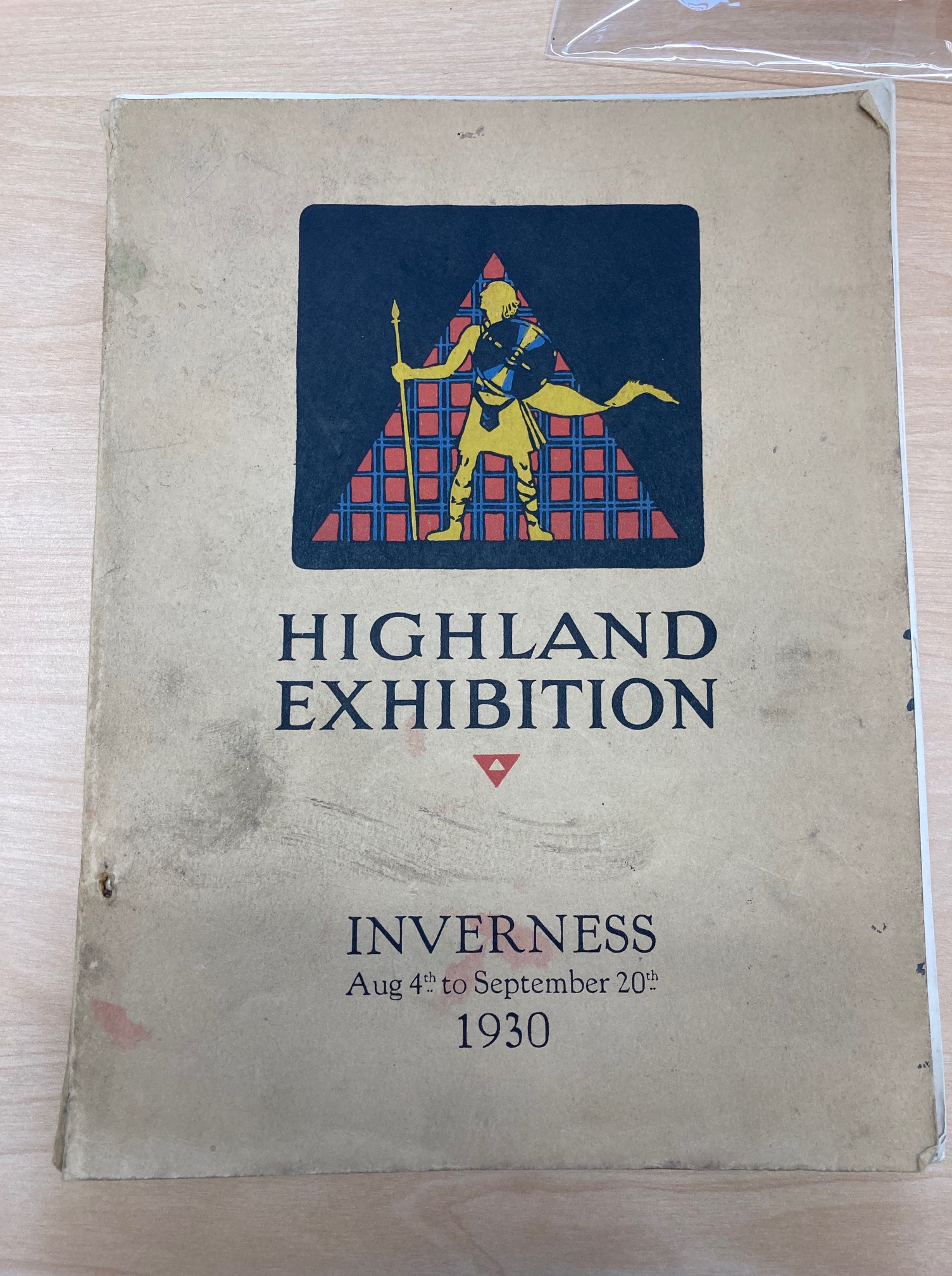
IF Grant described Am Fasgadh as ‘a pioneering attempt to create a Highland variant of the well-known folk museums of Scandinavia’. [1] She originally organised an exhibition in Inverness in 1930, in the hope that someone upon seeing the history and the material culture of different areas of the Highlands and islands, would create such a museum. Whilst the exhibition, lasting 7 weeks and receiving ‘close on 20,000 visitors’ [2] proved popular, no one came forward. IF Grant then went on to tour over Scotland to collect and buy artefacts, which she subsequently housed in three iterations of Am Fasgadh (‘The Shelter’). Grant saw Am Fasgadh as ‘providing a shelter for homely Highland things’ [3] in Iona (established 1935), Laggan and Kingussie. Following gifting her collection and museum to the four Scottish Universities [4] in 1954, Am Fasgadh was taken over by Highland Region in 1975.

The IF Grant Collection online at am baile and held at Edinburgh Central Library brings together IF Grant’s own photographs with the work of other photographers that she purchased, including Margaret Fay Shaw and Violet Banks. All the photographs depict different aspects of Highland life. Shaw’s photographs augment a gap in the collection on South Uist; whilst Banks’ works are of the ‘Last remaining inhabited thatched cottage’ in Eigg and a white thatched cottage in Sconser, Skye.

Grant’s own photographs, (attributed to her in the IF Grant Collection), depict a keen interest in different building styles and variations of thatched cottages across Scotland. Whilst there are examples from the larger islands of Lewis, Mull, Skye, and Arran, Grant also photographed buildings in Colonsay, Ulva and Lismore. She took examples across the north of Scotland in Thurso and Durness, around to north west, in Mallaig and Morar. Intriguingly, there is also a sub section of Grant’s photographs which are of ruinous cottages, which on one emotive level illustrate that this way of life was fast disappearing. Grant notes the cause in the early 1930s as ‘the Scottish Board of Agriculture was carrying a housing drive. Every steamer I travelled in appeared to be loaded with piles of window frames, sanitary equipment, etc… one began to wonder if any cottage of the traditional style would be left’. [5]

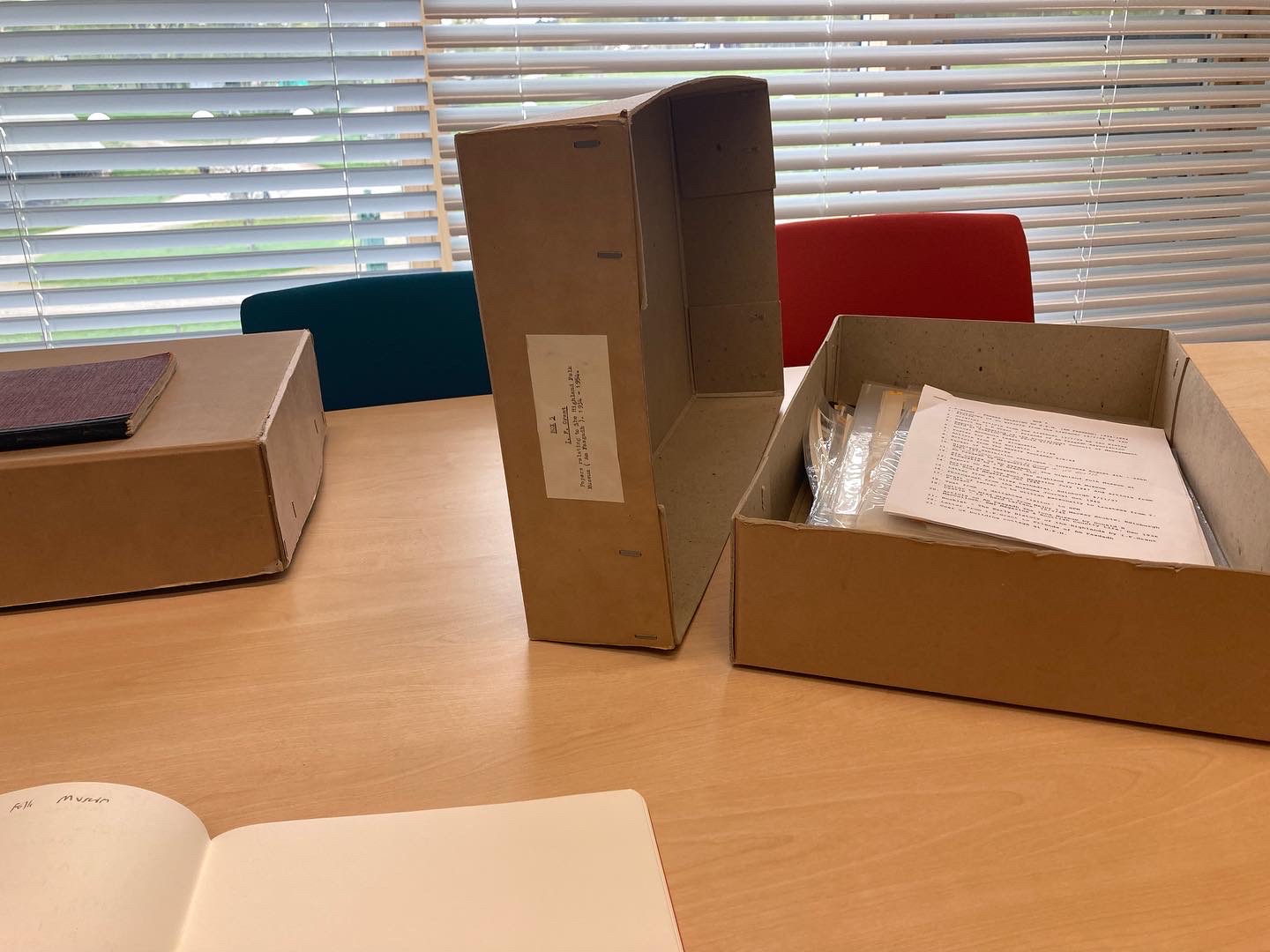
My research day at Highland Folk Museum, concentrating on IF Grant’s own photography, has proved to be three-fold – seeing the volume of photography that Grant commissioned from other photographers, mostly relating to Am Fasgadh; the subsequent usage of that photography to disseminate the existence of the museum further afield; and, some context relating to her own photography series of the cottages. Firstly, Grant worked with different photographers as well as postcard publishers Valentines and JB White, to document artefacts, interiors and exteriors of the three iterations of Am Fasgadh. She then utilised this documentation for spreading the word of the museum, in particular as saleable composite image postcards for museum visitors. A number of the photographs also illustrate articles on the museum in Scots Magazine and The Listener. Names that crop up repeatedly in her photograph album captions are Glasgow photographer John Mackay, who took photographs of the objects such as stools, chairs and farming implements, on mostly stark white backgrounds; and Donald B MacCulloch, whose address stamped on the back of one loose photograph in an album places him in Aviemore. In amongst another archival box, several visitors mailed IF Grant photographs of their day at the museum, which illustrates cameras were very much everyday objects used by the general population.

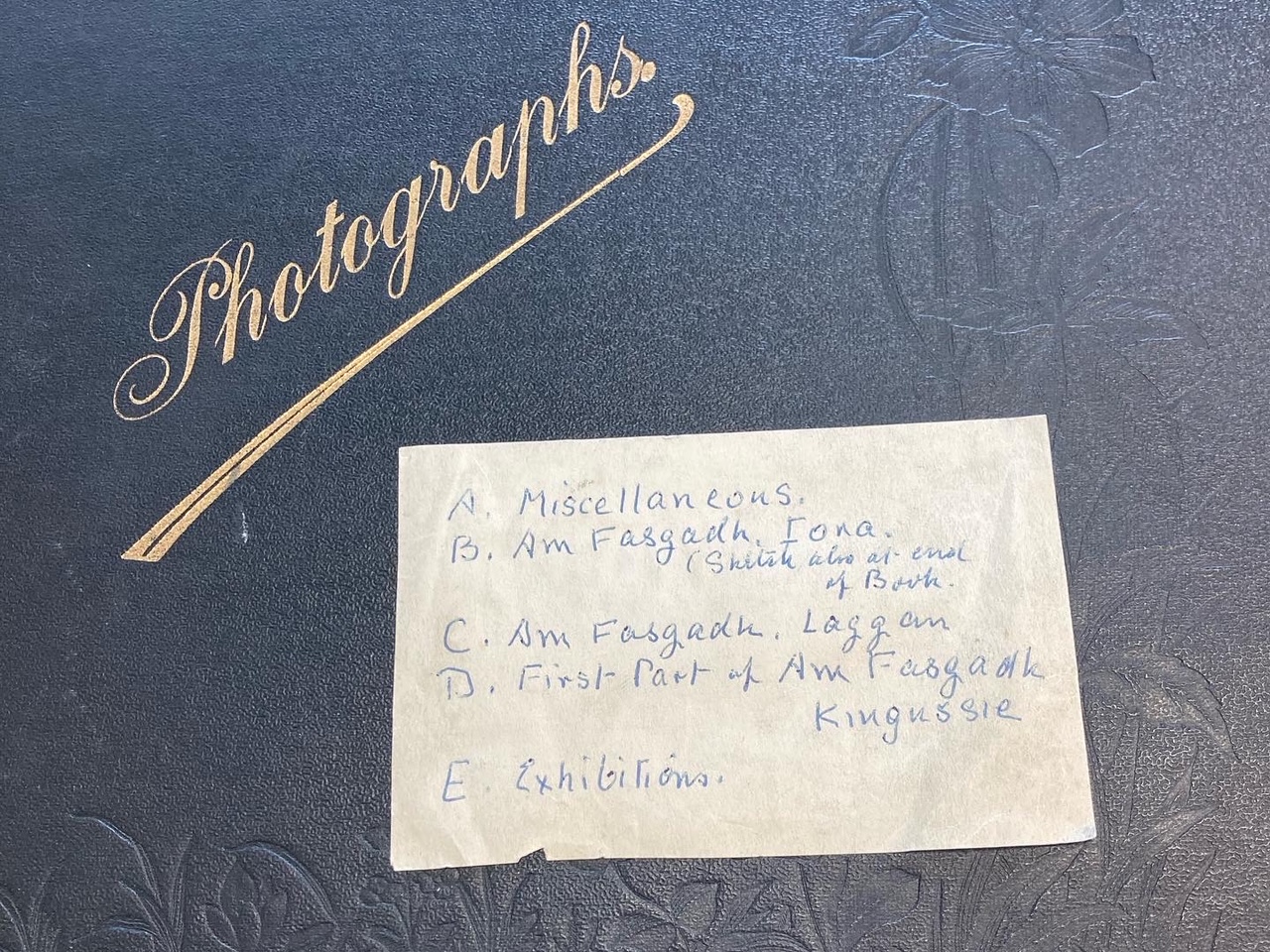
Cover of photograph album, with IF Grant’s handwritten index Photo: Jenny Brownrigg (2022)

In the photograph albums held in Am Fasgadh, Grant’s own captions provide a good level of detail relating to the authorship of photographs of the museum interiors and exteriors. An example is ‘Large photograph by D.B. MacCulloch’. However, on the pages there are also smaller, unattributed photographs of the museum. One option would be to surmise she did not note when a photograph is one of hers, but it is difficult to be sure of her authorship when she worked with numerous photographers. In Box 6, there are two foolscap sheets of paper, which are the only visual reference to the series of thatched cottages held at Edinburgh Central Library. There are 6 photographs affixed across the two sheets, with captions relating to object and place, in IF Grant’s handwriting. ‘1. A ruined cottage in Inverness-shire’ shows the pared back gable, stripped of thatch. It sits on the page next to ‘2. A very primitive cottage in Barra with hearth in the middle of the room’. The photograph captions do not state the author, however the image of the Barra interior, is definitely one of Margaret Fay Shaw’s. The Edinburgh Central Library holds larger reprints of this image, correctly attributed to Shaw. On the second foolscap page, the photograph with caption ‘5. Lewis houses’, reverts back to likely being taken by Grant. In this example, is the blurring of authorship down to IF Grant’s larger role of collector? Did she see her own photography as part of a larger collection, alongside other photographers’ work?

In Box 5, commissioned Aviemore photographer Donald B MacCulloch appears again, this time writing an article ‘Am Fasgadh: The Iona Museum’, for Scots Magazine and Scottish Country Life. MacCulloch states, ’She [IF Grant] has also formed a remarkable collection of old thatch cottages, and of various domestic activities carried on throughout the North Country and islands’ (P.48). This is the first external appraisal of the series as part of a collection.

Furthermore, the inclusion of these photographs in the exhibition catalogue for the ‘Highland Exhibition Inverness’ 1930, pre-dates this series to Grant’s subsequent establishing of Am Fasgadh’s first iteration in 1935. The introduction essay on P30 notes:

There will be a collection of portfolios [in the exhibition] for those who care to spend more time … there will be a large collection of photographs of old Highland cottages and of familiar work scenes.

The last entry in the catalogue reads: ‘Portfolio of Photography of life in the Highlands, lent by Miss IF Grant, Balnespick.’ Grant saw this particular portfolio’s purpose as one which augmented the exhibition, for those interested in the subject.

It is not unusual to traverse ground between archives to understand better the motivations and aims that each of the women photographers and filmmakers from early 20th Century in Scotland had for their work. The path between Edinburgh Central Library and Highland Folk Museum is no different. In a photocopied bibliography of Dr IF Grant’s written work, held at Am Fasgadh, it is noted ‘”Random recollections of the distribution of Local Types of Cottages”, typescript, 17pp, deposited with Edinburgh City Libraries, a companion piece to IF Grant Collection of photographs (1965)’. I shall look forward to returning to Edinburgh Central Library to learn more about this portfolio of images, and, hopefully, to shed more light on the photography she authored.

With thanks to Helen Pickles, Highland Folk Museum and Iain Duffus, Edinburgh Central Library

Am Fasgadh entrance Photo: Jenny Brownrigg (2022)

Footnotes

[1] P.11, ‘The Making of Am Fasgadh: An account of the Origins of the Highland Folk Museum by its Founder’, Isabel Frances Grant, (2007, National Museums Scotland).

[2] From Report of the Joint Honorary Secretaries to The Executive Committee of the Highland Exhibition 1930, typescript, (Accessions no: 2:1985), Am Fasgadh

[3] P.191, ‘The Making of Am Fasgadh: An account of the Origins of the Highland Folk Museum by its Founder’, Isabel Frances Grant, (2007, National Museums Scotland).

[4] P.10, Hugh Cheape, introduction, ‘The Making of Am Fasgadh: An account of the Origins of the Highland Folk Museum by its Founder’, Isabel Frances Grant, (2007, National Museums Scotland).

[5] P.30, Ibid.

Unknown's avatar

Overlaps: Island Post Office

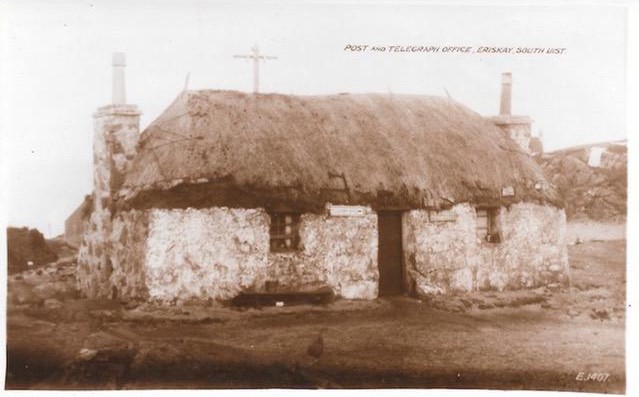
Post and Telegraph Office, Eriskay, South Uist. Photographer and year unknown

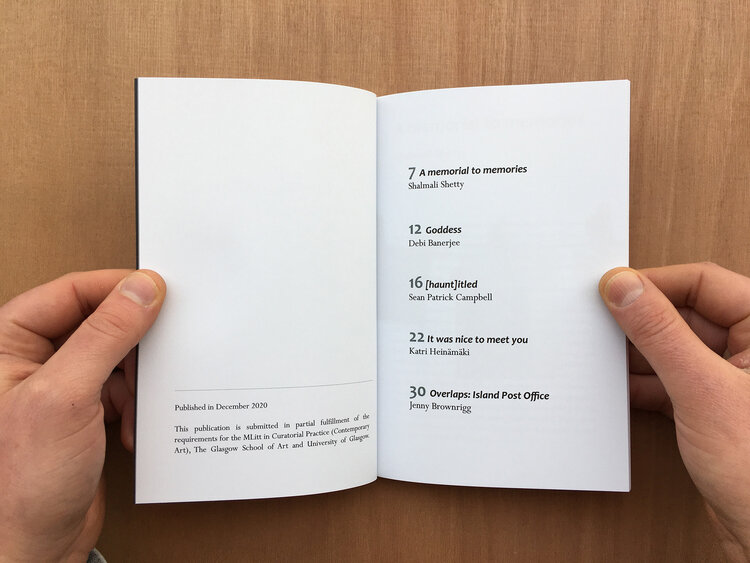
I was invited by Shalmali Shetty to write a short piece for her publication this cloud may burst (2020), which was submitted as part of her GSA MLitt in Curatorial Practice (Contemporary Art). Shetty invited four researchers and artists – Debi Banerjee, Sean Patrick Campbell, Katri Heinämäki and myself – to reflect on ideas of loss and preservation of memory around their use of archival material in their work. The publication has an overview A memorial to memories by Shetty.

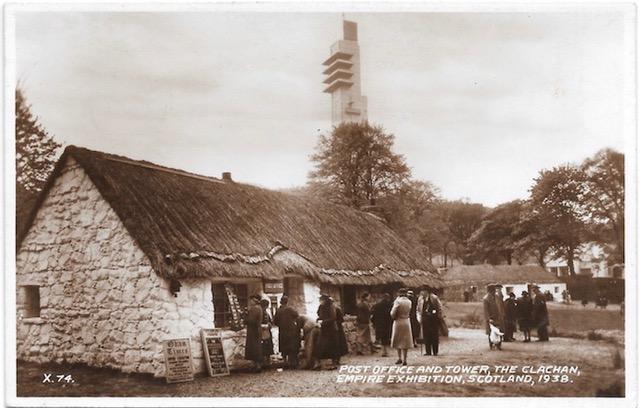
For my contribution, Overlaps: Island Post Office, I look at one post and telegraph office, on the Hebridean island of Eriskay. In the course of researching early twentieth century women photographers in Scotland, I began to notice periodic overlaps of subject matter, locations or even people in their photographs.  From trawling their archives, I saw that Edinburgh photographer Violet Banks (1896-1985) and American photographer and folklorist Margaret Fay Shaw (1903-2004) had separately photographed the same post and telegraph office. The writing begins with the photographs made by these two women, then tracks this particular example of the island post office to the 1938 Empire Exhibition in Glasgow.

Post Office and Tower, The Clachan, Empire Exhibition, Scotland 1938. Valentines and Son Limited (Dundee and London)

this cloud may burst can be purchased from Good Press retailing at £10.

With thanks to Shalmali Shetty for the invitation to contribute. Images below from Good Press listing.

Unknown's avatar

Photographs of Eigg: MEM Donaldson and Violet Banks, November 2016

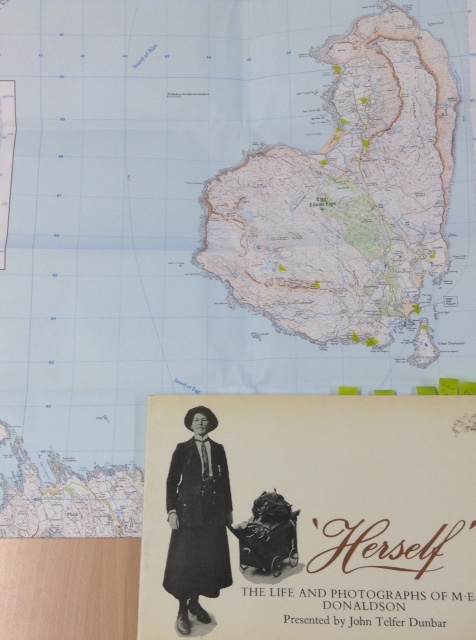
Thanks to a weeklong residency at Sweeney’s Bothy, I was able to visit the Isle of Eigg for the first time. My main aim was to seek out the places that MEM Donaldson photographed on her visits to Eigg, between 1918-1936. Her photographs illustrated her travel guide ‘Wanderings in the Western Highlands and Islands‘ (1921). The week also became a time to look at a second Scottish photographer, Violet Banks [1] and her photographs of Eigg from her tour of the Western Hebrides c. 1920s & 30s’.
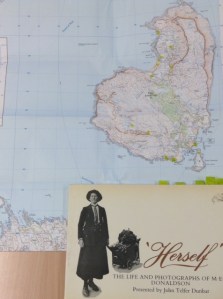
Map of Eigg, green arrows denote sited Donaldson photographed Photo: Jenny Brownrigg (2016)

Map of Eigg, green arrows denote sites Donaldson photographed Photo: Jenny Brownrigg (2016)

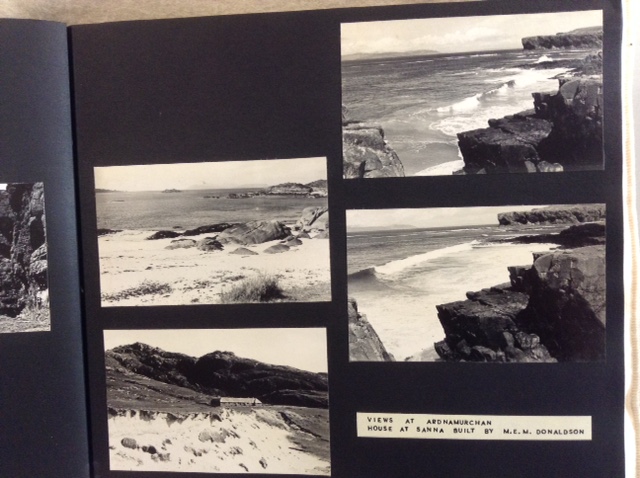
Intriguingly, Donaldson and Banks’ paths may have crossed at Donaldson’s distinctive home in Arnamurchan.  In a set of black photograph albums held at Royal Commission of Ancient & Historical Monuments of Scotland, Banks dedicates one section to Ardnamurchan, with a page of four photographs captioned ‘Views of Ardnamurchan, House at Sanna built by M.E.M. Donaldson‘. Banks frames the low buildings of MEM Donaldson’s home in the middle distance, nestled with a small hill behind and close to the edge of a low dune. The photograph with caption provides the first physical evidence that one photographer is aware of another, amongst the women who I have been researching that documented Scottish Highlands & Islands life in the inter-war years.
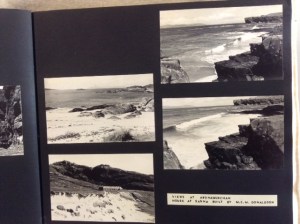
Detail from Violet Banks' photograph album, Royal Commission of Ancient & Historic Monuments Scotland Ref: PA244

Detail from Violet Banks’ photograph album, Royal Commission of Ancient & Historic Monuments Scotland Ref: PA244

Banks also visited and photographed a number of locations that Margaret Fay Shaw captured too, including the Telegraph office at Eriskay, and also a Highland Games featuring Compton Mackenzie in a line of judges at Northbay, Isle of Barra. The photographs have a similar framing, yet the seating arrangement and Mackenzie’s flamboyant dress as a chieftain is different in each photograph, so may not be taken at the same Games.

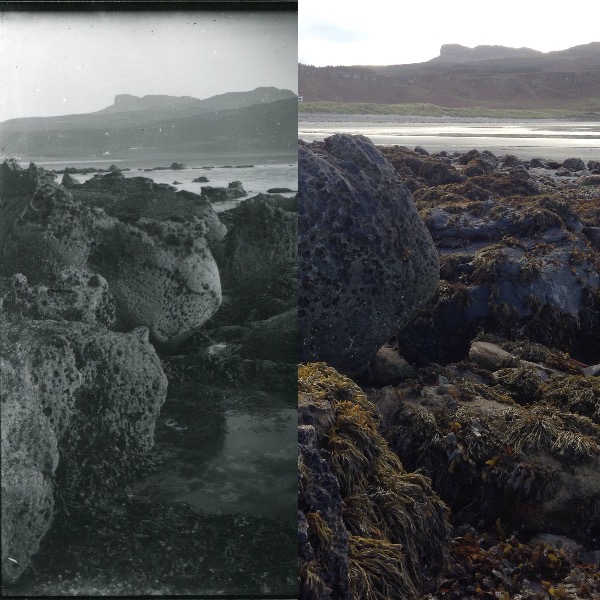
On the Saturday ferry over from Mallaig to Eigg, I showed digital images of MEM Donaldson’s series on the island to Lucy Conway (the host of Sweeney’s Bothy with her husband Eddie Scott) and another islander, Eric Weldon.  They immediately helped identify locations. A further resource has been the impressive, ten years in the writing, ‘Eigg: The Story of an Island‘, [2] by local resident Camille Dressler. This book is part of an excellent compact collection called the ‘Walking Library’ [3] at Sweeney’s Bothy. Dressler recounts that Donaldson stayed at Laig Farm, on her visits to Eigg, which in that period as well as a working farm was a Temperance Hotel. [4] Two of Donaldson’s photographs show the farm. The first shows the start of the path down to the farm, with the gateway at the side of a cliff-face. The second denotes Laig Farm’s grouping of low buildings, in a small valley with a sandstone headland rising behind [5]. Laig beach, close to the farm, is the site of third photograph, which shows a woman, likely Donaldson’s companion, the illustrator Isobel Bonus, walking along the gray sands. The distinctive silhouette of the island of Rum lies on the near horizon. Donaldson takes another photograph at this location; a detail of the strange fossilised stones found at the south end of Laig beach.
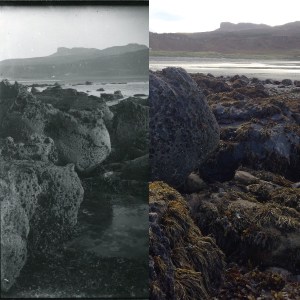
(l) Detail of 'Coast of Eigg, Sgurr in background', MEM Donaldson, Ref: 958.20.505, Inverness Museum & Art Gallery. (r) Photo: Jenny Brownrigg (2016)

(l) Detail of ‘Coast of Eigg, Sgurr in background’, MEM Donaldson, Ref: 958.20.505, Inverness Museum & Art Gallery. (r) Photo: Jenny Brownrigg (2016)

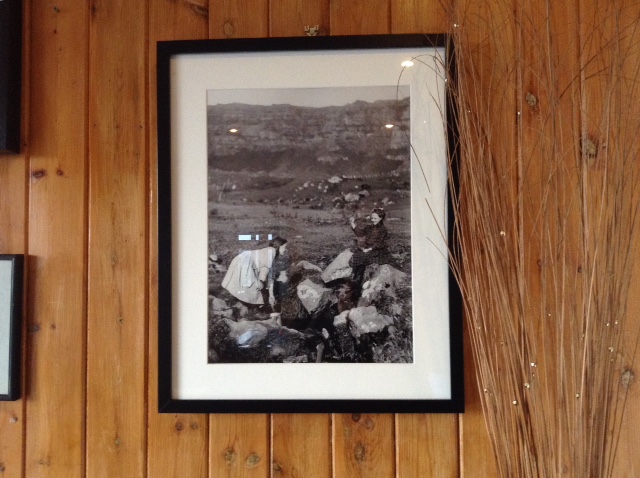
Like Laig Farm, a good number of the photographs are dotted around Cleadale itself, where Sweeney’s Bothy is located. Donaldson was drawn to ‘sites with historical associations’ [6]. She photographed two local children, Joanne MacLellan and Katie-Ann MacKay fetching water from St Columba’s Well [7] at Cleadale, where one can still take a drink of its cool, clear water, credited with healing powers, from a generously provided mug. (Lucy tells me later that this is the water for both drinking and showering with at Sweeney’s Bothy!) The well was said to be blessed by Colm Cille and believed to prophesize the fate of those children baptised in it, from the ‘number of rivulets running down’ [8].  Perhaps this story prompted Donaldson to photograph the two girls at the well. Further around the coast, in another photograph, a white bearded islander, Lachlan MacAskill points with his stick to St Donnan’s ‘pillow’ stone, lying in front of the ruins at Kildonan Church.
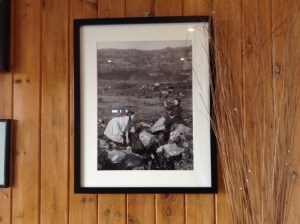
Framed MEM Donaldson photograph of children at St Columba's Well, Eigg, exhibited at Pier Café, Galmisdale, Eigg

Framed MEM Donaldson photograph of children at St Columba’s Well, Eigg, exhibited at Galmisdale Bay Café and Bar, Eigg

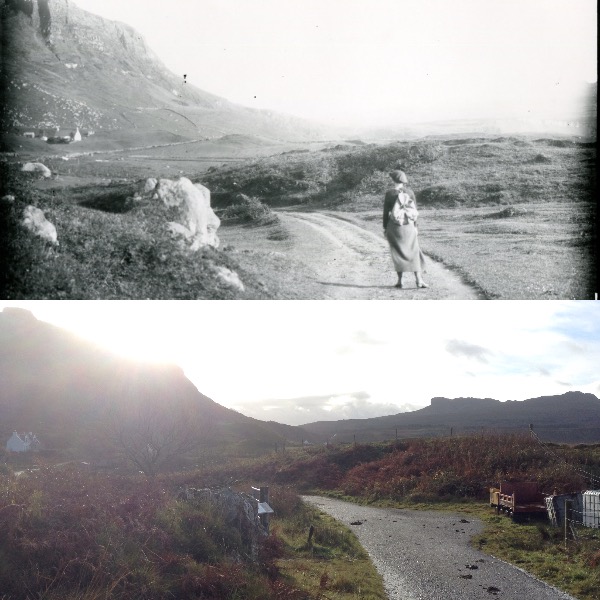
It is important to note that we read these images differently, according to our own experience. I am a similar audience, thanks to where I live, as Donaldson’s main readership was. Hugh Cheape asserts that as her photographs were to illustrate literary work, the perceived audience would have been those who were ‘probably town-based’. [9] Before my visit to Eigg, this series of photographs had their only identifiers of location as the general catalogue credits from Inverness Museum & Art Gallery Archive, which was enough to bring me to Eigg. Local knowledge shared during this residency, has brought the photographs into a new focus. The image of a woman, possibly Isabel Bonus, with knapsack on her back, walking along a track was identified as being at Cleadale, ‘round the corner by the quarry‘. A traditional cottage and byre are identified as ‘Mairi’s house and shed‘.  Dressler when looking at the same photograph pointed at the stone in the foreground and recounted that a previous owner, an old man, ‘always used to always sit on the rock’. For the island resident, the photographs are coded in a different way, moving naturally to the detail such as who currently owns the croft pictured. Sometimes the information that stands out in a local reading is an anomaly in the landscape. For example, it was remarked that it was ‘unusual to have a boat there’, in another photograph.
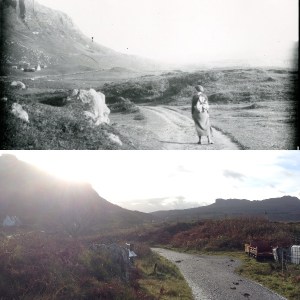
(t) Detail, 'figure, Miss D probably, on road in Eigg' Ref: 95820.182.185, Inverness Museum & Art Gallery (b) Photo: Jenny Brownrigg (2016)

(t) Detail, ‘figure, Miss D probably, on road in Eigg’ Ref: 958.20.185, Inverness Museum & Art Gallery (b) Photo: Jenny Brownrigg (2016)

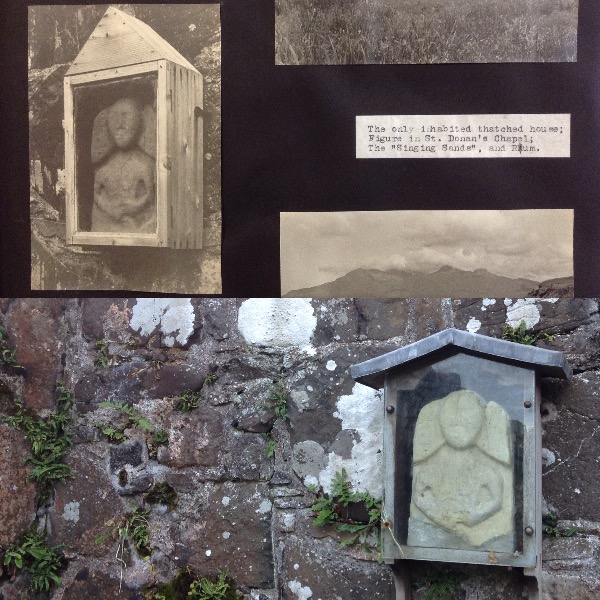
Both Donaldson and Banks photograph key landmarks on Eigg, in particular An Sgurr, the distinctive pitchstone outcrop, which the highest point of the island; also both photograph other ‘tourist sites’ at the Massacre and Cathedral Caves. Donaldson’s photographs of An Sgurr place it within the context of one of her walks, showing the approach to it from a route than can be traversed across a plateau. Banks chooses to show An Sgurr by placing a woman in scale with ‘the Nose’. Both Donaldson and Banks also separately photograph the loch to be found en route to the Sgurr, known as Loch nam Ban Mora – ‘Loch of the Big Women‘ – where the submerged causeway to the crannog in the middle could only be forged by a race of women of ‘supernatural proportions’. [10] The name refers to the Queen of Moidart’s warrior women, sent to murder St Donnan and his monks on Eigg. Lights from the dead bodies of the monks bewitched the women, leading them up to Loch nam Ban Mora, and luring the women one by one into the water, with all drowning.  Both Donaldson and Banks also photograph the Sheela-na-gig, at Kildonnan Church. Sheela-na-gigs ‘are carvings, often found in churches, which consist of a female displaying, or drawing attention to, her genitals‘. [11] Alasdair Alpin MacGregor also photographed the Sheela-na-gig  on his visit to Eigg.
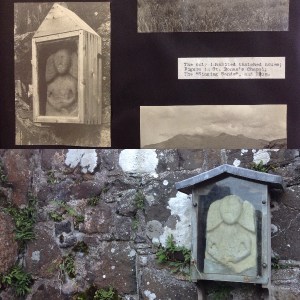
(t) detail from Violet Banks' photograph album, Royal Commission of Ancient & Historic Monuments Scotland Ref: PA244 (b) Photo: Jenny Brownrigg (2016)

(t) Detail from Violet Banks’ photograph album, Royal Commission of Ancient & Historic Monuments Scotland Ref: PA244 (b) Photo: Jenny Brownrigg (2016)

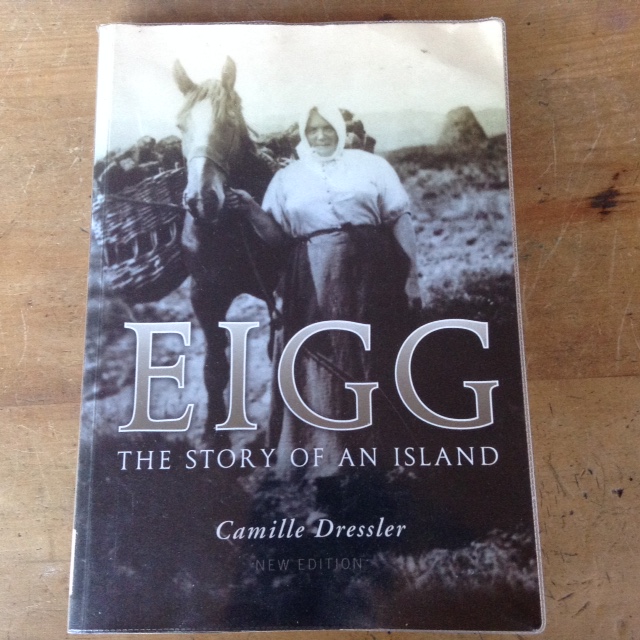
Donaldson’s work in particular has very much been given its place in Eigg, represented in (photo)copies of her work held in the photographic collection at Eigg History Society Archive and in Dressler’s writing on Eigg. Donaldson’s photographs can be found framed in the Galmisdale Café and Bar. This archive gives the unique opportunity to view Donaldson’s work alongside other vernacular historic photography collections, amassed from photographs by islanders, held over generations, in an ‘Awards for All’ project led by Eigg History Society (Comunn Eachdraidh Eige)  for the Eigg Trust, started in 1997. Taking an example, one of Donaldson’s photographs is captioned by John Telfer Dunbar in ‘Herself‘, a biography, as ‘taking the peats home’ where ‘the woman with a white kerchief tied round her head is described as ‘the embodiment of good nature, health and contentment’. This woman is named in a photocopy of this photograph held in Eigg History Society Archive as Ishbel MacQuarrie [12]. Donaldson photographs MacQuarrie at work, but also her home, which may for Donaldson signify the changing traditional architectural vernacular of the Highlands and Islands. The caption for this photograph in the archive relates to the disappearing history that the architecture represents and an anomaly which may interest the urban readership- ‘Lossit and last black house on island with hipped roof covered in thatch. Note roof of byre next door is upturned boat’. This croft house also features in the islanders’ own photographic collections, in particular the Katie Maclean Collection, with family connections to the MacQuarries, which denotes ‘Donald MacQuarrie, wife Mary, children and Ishbel MacQuarrie lived here’. Ishbel MacQuarrie is photographed here as she is a relative who is part of a family. Therefore, the photograph was taken with different reasons- to record the actual person and her significance to the related photographer. The Eigg History Society photographic archive provides a significant collection for study of local history and how islanders documented themselves and their surroundings.
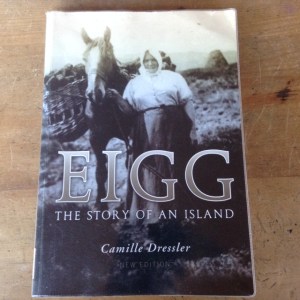
MEM Donaldson's photograph of Ishbel MacQuarrie features on the cover of Camille Dressler's book 'Eigg, The Story of an Island'

MEM Donaldson’s photograph of Ishbel MacQuarrie features on the cover of Camille Dressler’s book ‘Eigg, The Story of an Island’

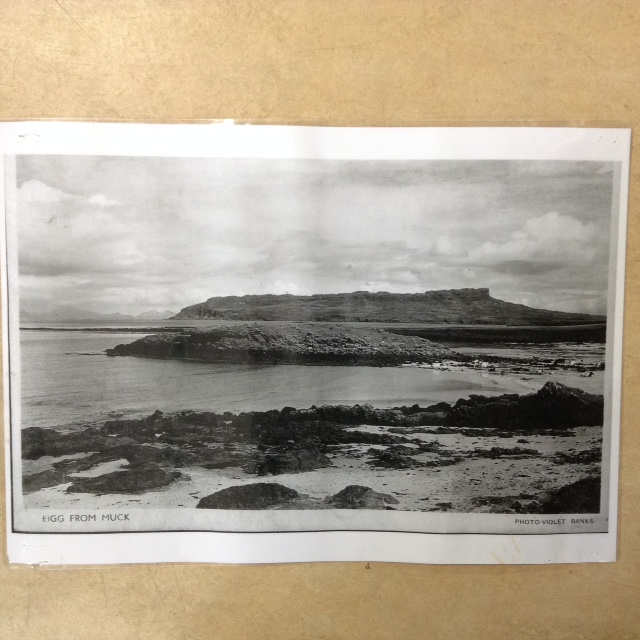
In 1935, Violet Banks established her own commercial photography studio in Edinburgh. Lucy Conway organized for me to speak about Donaldson and Banks with the Eigg History Society. At the event Camille Dressler identified that three of Banks’ photographs of Eigg, that appear in her photograph albums held by RCAHMS, are also held as facsimiles of postcards in the archive. The copies show images of Laig Bay, the Sgurr and a view of Eigg from the Isle of Muck, all bearing the credit ‘Photo: Violet Banks‘. This provides another use of Banks’ images, for commercial purposes, and another line of enquiry to follow up, in looking for the original postcards.
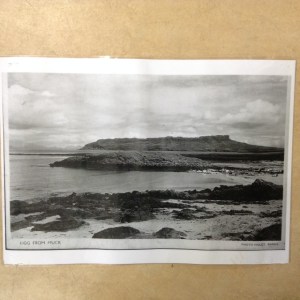
'View of Eigg from Muck, Photo: Violet Banks', photocopy of postcard, Eigg History Society

‘View of Eigg from Muck, Photo: Violet Banks’, photocopy of postcard, Eigg History Society

Footnotes

[1] Veronica Fraser, an archivist at Royal Commission on the Ancient & Historical Monuments of Scotland writes about Banks’ life in ‘Vernacular Buildings‘:

Violet Banks (1986-1985) was born near Kinghorn, Fife and educated at Craigmont, Edinburgh, and at ECA (Edinburgh College of Art). In 1927 she was senior arts mistress at St. Oran’s, a private school at Drummond Place, Edinburgh‘.Banks’ photographs of the Hebrides, Fraser recounts, were discovered by John Dixon of Georgian Antiques, in a drawer in a sideboard that had been part of a furniture purchase and then gifted to RCAHMS to become The Violet Banks Collection. P67-78, ‘Vernacular Building 32′, Scottish Vernacular Buildings Working Group 2008-2009) ISSN:0267-3088.

[2] ‘Eigg The Story of an Island‘, Camille Dressler (Birlinn Ltd 2007, 3rd edition)

[3] ‘The Walking Library’ for Bothan Shuibhne, Isle of Eigg, is a project by Dee Heddon and Misha Myers, with this particular iteration in 2013. The ‘Walking Library’s‘ aim is to bring together books on walking and its contemplation, and is a collective gathering of book recommendations from those that accompany Heddon and Myers on a walk, in this instance from Carbeth Community Huts to the Walled Garden, with Sweeney’s Bothy in mind.

[4] P.104, ‘Eigg, The Story of an Island’, Dressler, C.

[5]’The Geology of Eigg‘, John D Hudson, Angus D Miller and Ann Allwright, Isle of Eigg Heritage Trust, (2014, Second Edition) is part of the ‘Waking Library’ at Sweeney’s Bothy and accounts for the rock formations of Eigg.

[6] P.45, ‘Herself and Green Maria: the photography of M.E.M. Donaldson’, Cheape, H, ‘Studies in Photography’ (2006)

[7] P.50, ‘Eigg, The Story of an Island‘, Dressler, C, (2007, Birlinn Ltd, 3rd Edition)

[8] P.7, ‘Eigg, The Story of an Island’, Dressler, C, (2007, Birlinn Ltd, 3rd Edition)

[9] P.45, ‘Herself and Green Maria: the photography of M.E.M. Donaldson’, Cheape, H, ‘Studies in Photography’ (2006)

[10] P.4, ‘Eigg, The Story of an Island’, Dressler, C, (2007, Birlinn Ltd, 3rd Edition)

[11] P.98, ‘The Small Isles, Canna, Rum, Eigg & Muck’, Rixson, D, (2011, Birlinn Ltd, 2nd edition). Copy in Sweeney’s Bothy’s Walking Library.

[12] Donaldson’s photograph of Ishbel MacQuarrie ‘gathering the peats’ is also the cover image of Dressler’s ‘Eigg, The Story of an Island’.

With thanks to: The Bothy Project, Lucy Conway & Eddie Scott, Eigg Historic Society, Camille Dressler.
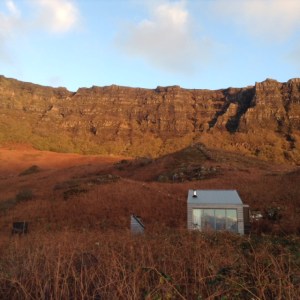
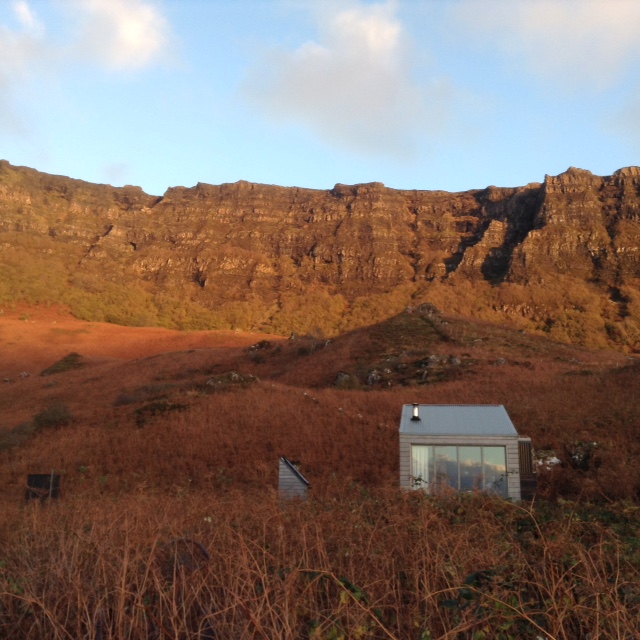
Sweeney's Bothy, Isle of Eigg, The Bothy Project Photo: Jenny Brownrigg (2016)

Sweeney’s Bothy, Isle of Eigg, The Bothy Project Photo: Jenny Brownrigg (2016)