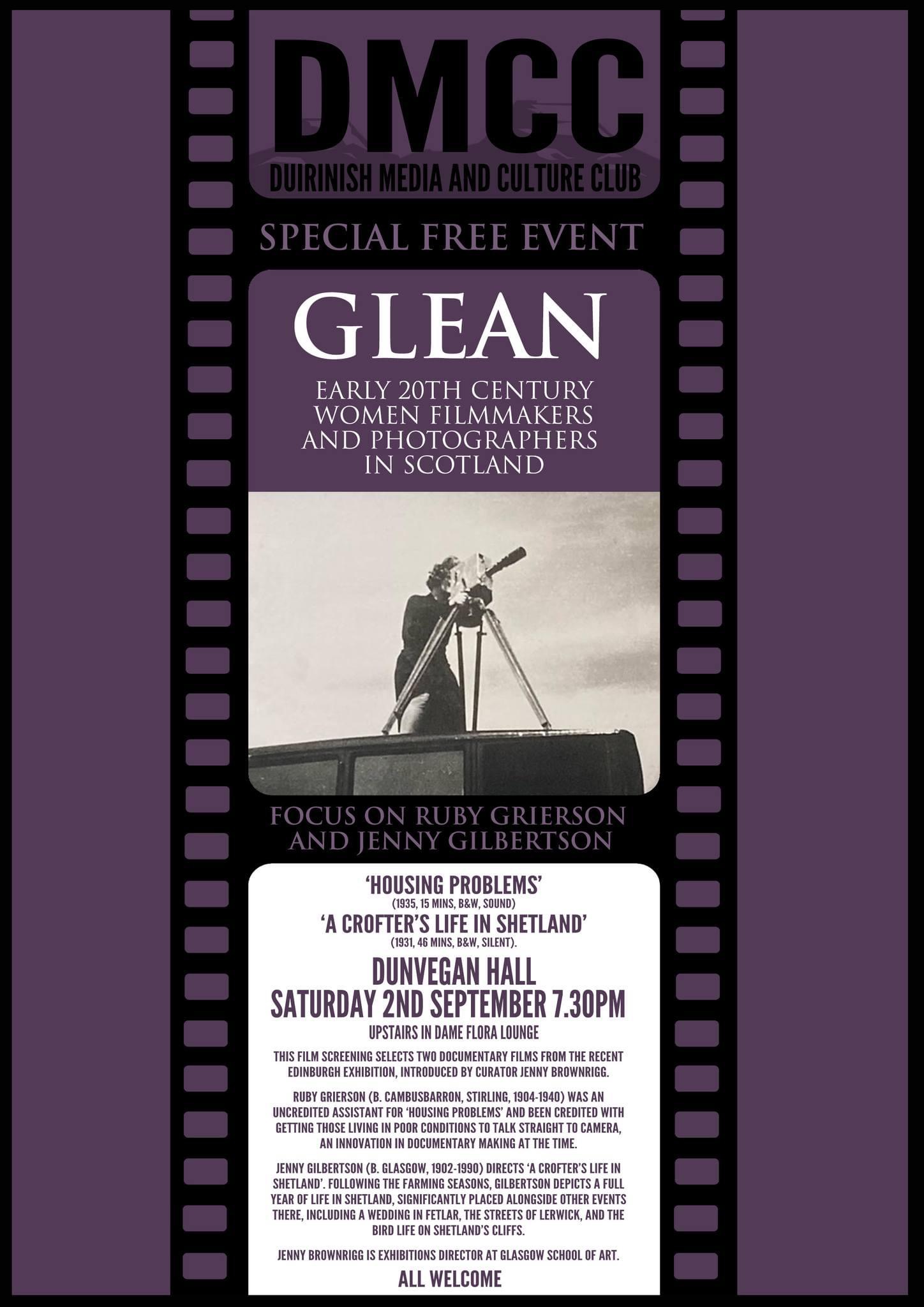
Dunvegan Hall, Saturday 2nd September, 7.30pm, free admission and all welcome.
This film screening, hosted by Duirinish Media and Culture Club, selects two documentary films from the recent City Art Centre, Edinburgh exhibition ‘Glean: early 20th century women photographers and filmmakers in Scotland’. The films are ‘Housing Problems’ (Arthur Elton, EH Anstey, directors, 1935, 15 mins, black and white, sound); and ‘A Crofter’s Life in Shetland’, Jenny Gilbertson (1931, 46 mins, black and white, silent). The films will be introduced by Glean’s curator Jenny Brownrigg.
Ruby Grierson (b. Cambusbarron, Stirling, 1904-1940) was an uncredited assistant for the documentary Housing Problems (1935) directed by Arthur Elton (1906-1973) and Edgar Anstey (1907-1987). The film shows what was done to improve living conditions in London by local authorities and planners. Grierson has posthumously been credited with getting those living in poor conditions to talk straight to camera. This was an innovation in documentary film making, which had previously relied on a narrator. Ruby Grierson was the older sister of filmmaker Marion Grierson (1907-1988) and younger sister of founder of the 1930s British Documentary Movement John Grierson (1898-1972).
Jenny Gilbertson (b. Glasgow, 1902-1990) had her career as a filmmaker in two distinct parts; the first in the 1930s’ filming Shetland life and the second, in her 70s’, recording the lives of remote Inuit communities in the Canadian Arctic. ‘A Crofter’s Life in Shetland’ follows the full year of life in Shetland. Following the farming seasons, Gilbertson significantly places this way of life alongside other events and life there, including a wedding in Fetlar and the modern main street of Lerwick, Shetland’s capital. This film also captures the bird life on Shetland’s cliffs.
Jenny Brownrigg is Exhibitions Director at The Glasgow School of Art.
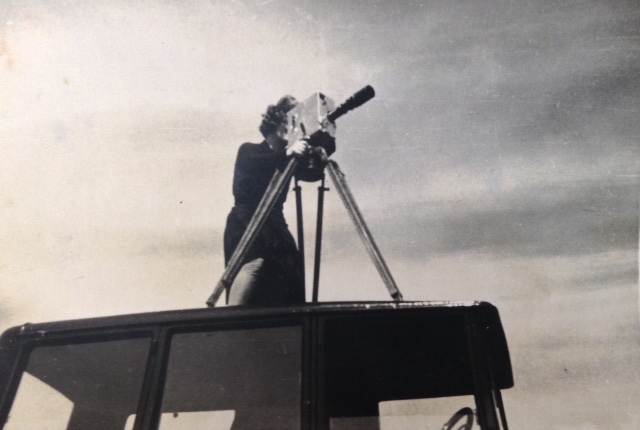
Credit: Jenny Gilbertson, (with Cuthbert Cayley), 1938/1939. Courtesy of Shetland Museum & Archives
Films: Courtesy of BFI Collections and Moving Image Archive, National Library of Scotland
Credit: Jenny Gilbertson (with Cuthbert Cayley) 1938/39, courtesy of Shetland Museum & Archive
This online event focuses on early 20th Century women filmmakers in Scotland. Chaired by Professor Melanie Bell, (Film History, School of Media and Communication, University of Leeds), whose area of expertise is in Gender and Film as well as British Cinema History, the event will discuss the film production of that period, the ethics of filming others, and caring for their work. It will also reflect on how the women filmmakers saw themselves and their motivations for making film. This discussion is with Ros Cranston (Curator of Non-Fiction Film and Television at the BFI National Archive, BFI National Archive), Shona Main (PhD researcher, University of Stirling and The Glasgow School of Art); Janet McBain (founding Curator, Scottish Screen Archive); Professor Sarah Neely (Theatre, Film & Television Studies, University of Glasgow, Dr Isabel Seguí (Film and Visual Culture Department, University of Aberdeen) and Jenny Brownrigg (The Glasgow School of Art, curator of Glean).
Biographies
Melanie Bell is Professor of Film History at the University of Leeds. She examines production histories through a gendered lens and has published widely on many aspects of women’s film history including documentary directors, costume designers, and foley artists. She uses oral histories, labour records, photographs and ephemera in her scholarship, and is especially interested in life narratives and occupational identities.
Jenny Brownrigg is Exhibitions Director at The Glasgow School of Art. Her research interests include modern and contemporary Scottish women artists. She is curator of the exhibition ‘Glean: early 2oth century women filmmakers and photographers in Scotland’, at City Art Centre, Edinburgh, Scotland (2022 / 2023).
Ros Cranston is a Curator of Non-Fiction Film and Television at the BFI National Archive. She has a special interest in women documentary filmmakers, and leads The Camera is Ours: Britain’s women documentary makers project. She also led the BFI project This Working Life, which celebrates Britain’s coalmining, shipbuilding and steelmaking heritage on film.
Shona Main has just submitted a SGSAH-supported practice-led PhD thesis at Stirling University. A filmmaker herself, she is interested in the quietly radical ethical practice of the early documentary filmmaker Jenny Gilbertson (1902-1990) who filmed Shetland crofters in the 1930s and Inuit of Coral Harbour and Grise Fiord in Arctic Canada in the 1970s – when she was in her seventies. Operating alone and outside the film industry, Gilbertson’s DIY approach to filmmaking allowed her to take the time to attend, listen and build and sustain friendships with the people she lived and filmed with.
A graduate in Scottish history, and former Survey Officer for the National Register of Archives Scotland, Janet McBain joined the Scottish Film Council in 1976 at the inception of what was to become the Scottish Screen Archive. Since then she has overseen the development of the archive into Scotland’s national collection of some 35,000 reels of film and video reflecting Scottish life and cinematic art in the film century, and has been researching and promoting the history of film production and cinema exhibition in Scotland. She is the author of ‘Pictures Past – Recollections of Scottish Cinema Going’ (pub Moorfoot 1985) and contributor of essays, articles and conference papers on many aspects of film in Scotland. In 2006 she was awarded the Outstanding Achievement in Film by BAFTA Scotland for her work in preserving and presenting Scotland’s film heritage and in 2016 was awarded the honorary degree of Doctor of Letters (DLitt) from the University of Glasgow.
Sarah Neely is Professor in Film and Visual Culture at the University of Glasgow. Her current research focuses on the areas of film history, memory and artists’ moving image. Recent publications include Between Categories: The Films of Margaret Tait – Portraits, Poetry, Sound and Place (Peter Lang, 2016) and, as editor, Personae (LUX, 2021), a non-fiction work by Margaret Tait. She is currently writing a book on memory, archives and creativity.
Isabel Seguí is a Lecturer in Film and Leverhulme Early Career Fellow at the University of Aberdeen. Her work has appeared in academic journals such as Latin American Perspectives, Feminist Media Histories, Framework, Jump Cut, and edited collections like Feminist Worldmaking and the Moving Image (Balsom & Peleg eds, the MIT Press, 2022) or Incomplete: the Feminist Possibilities of the Unfinished Film (Beeston & Solomon eds., UC California Press, 2023). She is a member of the steering committee of RAMA (Latin American Women’s Audiovisual Research Network).
This exhibition presents the work of fourteen pioneering women photographers and filmmakers working in Scotland during the early 20th century. The women are Violet Banks (1886-1985), Helen Biggar (1909-1953), Christina Broom (1862-1939), M.E.M. Donaldson (1876-1958), Dr Beatrice Garvie (1872-1959), Jenny Gilbertson (1902-1990), Isobel F Grant (1887–1983), Ruby Grierson (1904-1940), Marion Grierson (1907-1998), Isobel Wylie Hutchison (1889-1982), Johanna Kissling (1875-1961), Isabell Burton MacKenzie (1872-1958), Margaret Fay Shaw (1903-2004) and Margaret Watkins (1884-1969).
These women offer different accounts of Scotland, covering both rural and city places and communities. The exhibition shows the breadth of their photography and filmmaking, offering a critical analysis of their work. It considers their different motivations and how these informed the work they made, and the different narratives we see emerging from their work in Scotland. It is the first time their work has been seen together.
An accompanying programme of both online and in person events brings together key researchers, artists and archivists who have been looking after and creatively working with the legacies of the women in this exhibition.
With thanks to the following lenders: British Film Institute, Dumfries Museum, Edinburgh Museums and Galleries, Glasgow Women’s Library, Historic Environment Scotland, Inverness Museum and Art Gallery High Life Highland, Hidden Gallery Glasgow, Highland Folk Museum High Life Highland, The Glasgow School of Art Archives and Collections, Moving Image Archive, Museum of London, National Library of Scotland, National Trust for Scotland Canna House, Orkney Library & Archive, Shetland Museum & Archives, Vanishing Scotland Archive
Curated by Jenny Brownrigg (Exhibitions Director, The Glasgow School of Art) in partnership with City Art Centre.
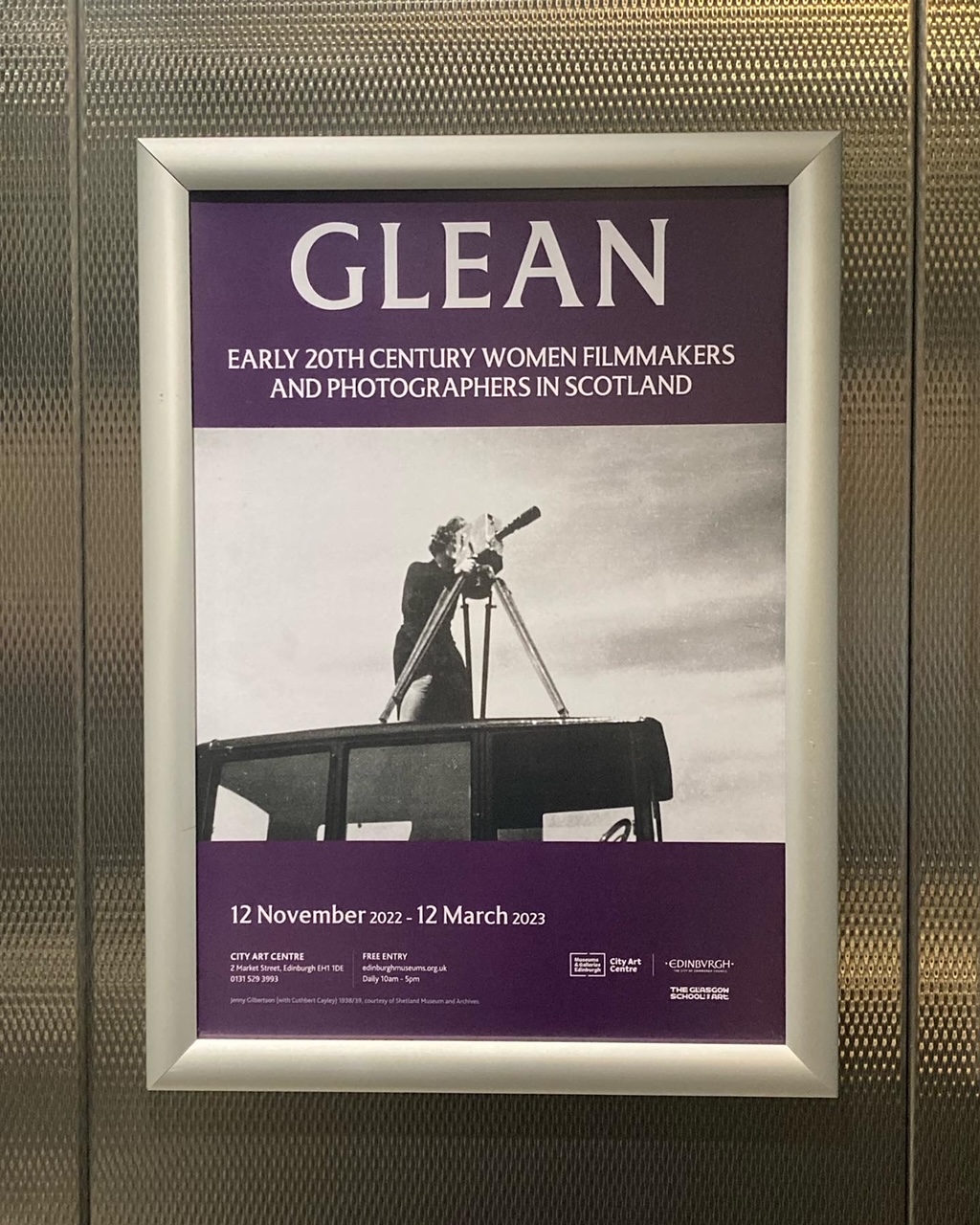
Poster image: Jenny Gilbertson (with Cuthbert Cayley) 1938 or 1939, courtesy of Shetland Museum and Archive.

 Jenny Brownrigg