Unknown's avatar

Report on Marseille contemporary art scene, for Scottish Contemporary Art Network

The Marseille  Printemps de l’Art Contemporain, British Council Scotland and Scottish Contemporary Art Network, May 2016
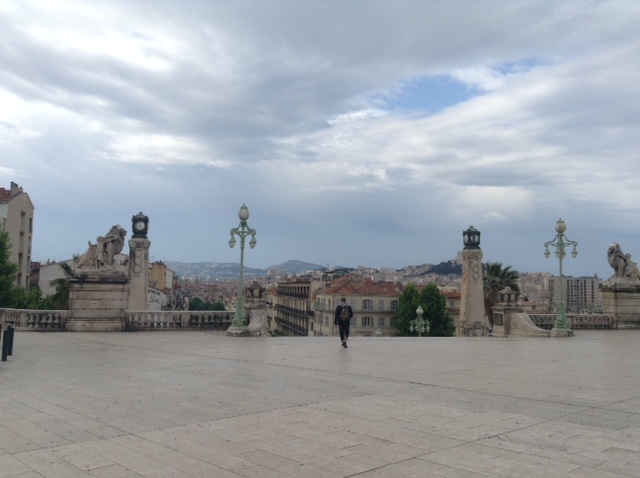
Marseille Saint-Charles Train Station. Photo: Jenny Brownrigg

Arrival at Marseille Saint-Charles Train Station. Photo: Jenny Brownrigg

In the exhibition Cartology of the Algerian Map, at MuCEM, Marseilles, one map was entitled Travels or observations relating to several parts of Barbary and the Levant (Thomas Shaw, 1738). Let this report be called Travels or observations relating to several parts of Marseille and the contemporary art scene.
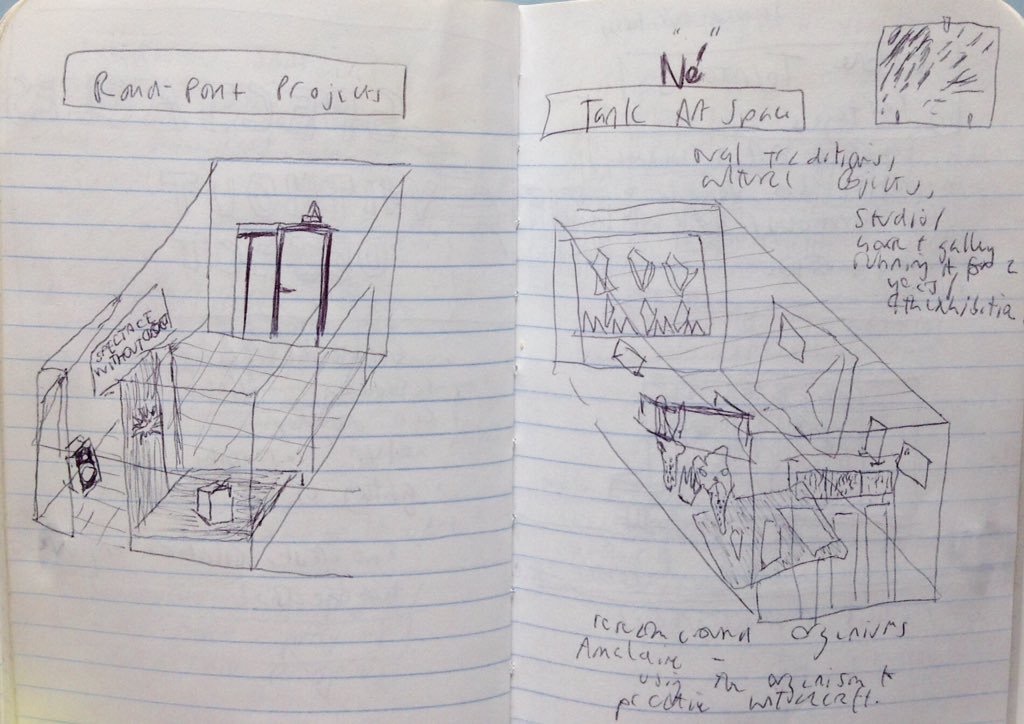
Page from my notebook Photo: jenny Brownrigg

Page from my notebook Photo: Jenny Brownrigg

Our delegation of thirteen [1], had been invited by the organising committee of Marseille Expo to attend Printemps de l’Art Contemporain (PAC) and meet a network of arts organisations who are members of Marseille Expo.  In its eighth edition, PAC is a May festival which brings together a wide range of galleries, museums, production facilities and studios. This visit for the Scottish delegation has been a scoping one, providing the opportunity to meet with galleries, artists and arts organisations with the view to developing ideas for future projects, exchanges, exhibitions or residencies with Marseille. Future links or opportunities are by no means limited to the group on this curatorial trip. This link between Scotland and Marseille builds on established links such as the Triangle France exchange, which has been running since 2012 between Glasgow Sculpture Studios and Triangle France with previous Marseille and Glasgow-based artists including, from Marseille – Amandine Guruceaga who we met at Tank Art Space a gallery space which is part of her home, and Thomas Teurlai, whose installation Bullroarer we saw at Musée Catini through Les Ateliers d’Artistes de la Ville de Marseille programme. Marseille’s Sextant Et Plus is another organisation, ( Director Veronique Collard-Bovy), which has strong links with Scotland and in particular Glasgow, most recently in 2014 working with Graham Fagen and Graham Eatough on their project ‘In Camera‘. Wasps’ project The Poundshop, selling the work of Scottish-based and Marseille-based designers, ran at Southblock, Glasgow, during Merchant City Festival 2016.

Inside Tank Art Space, Marseille Photo: Tank Art Space

Inside Tank, Marseille Photo: Tank Art Space
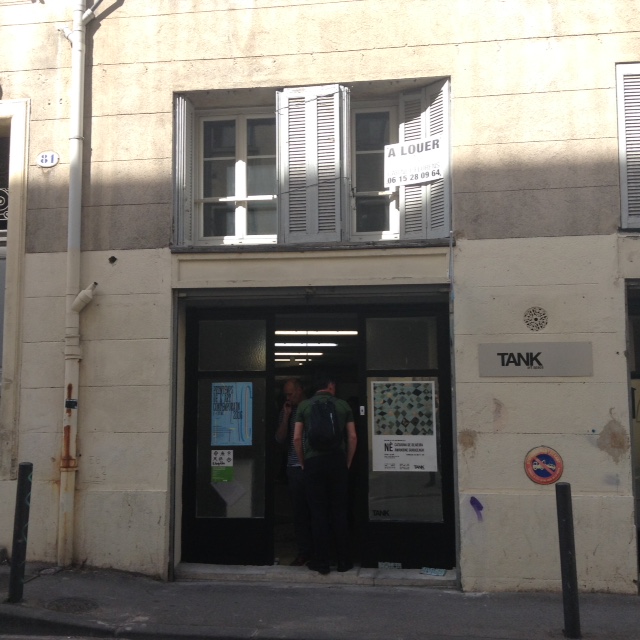
Exterior, Tank Art Space, Marseille Photo: Jenny Brownrigg

Exterior, Tank Art Space, Marseille Photo: Jenny Brownrigg

In May it was timely to visit Marseille, as announcements were just coming through that France’s second largest city will host Manifesta in 2020. For further reading, Caroline Hancock, an independent curator living in Paris, and past curator of PAC (and a key person our group met on the trip), has written the excellent piece Why Manifesta makes sense in Marseille (5.6.16, Apollo Magazine). Marseille was European City of Culture in 2013. Overlooked by the Church of the Bonne Mere, this city is surrounded by mountains and is also on the Mediterranean coast, with an ancient port and beach. The island fortress in the bay inspired Alexandre Dumas’ Man in the Iron Mask Le Corbusier’s Cite Radieuse, which in July 2016 has itself been declared a UN Heritage site, is also in Marseille. PAC, as with any good festival, allowed for the exploration of diverse parts of the city, due to the location of the galleries and museums taking part.

Le Corbusier's 'Cite Radieuse', Marseille Photo: Jenny Brownrigg

Le Corbusier’s ‘Cite Radieuse’, Marseille Photo: Jenny Brownrigg

PAC 2016 has no over-arching theme this year. However, one strand was an emphasis on cultural exchange, this year with South Korean artists. Exhibitions included The thing that you know, I do not want to know with Rohwajeong and Jihye Park, curated by Paul-Emmanuel Odin at La Compagnie,  a beautiful large gallery with massive timber beams; Cody Choi at Musee d’Art Contemporain; Jin Angdoo & Mathieu Julien with Amateurs at Straat Galerie; and  Sam (meaning three in Korean) with artists Myung-Ok Han, Oan Kim and Peter Kim at art-cade, a gallery renovated from a former Turkish bath. Art-cade is architecturally formed in a triangular layout, with a glass corridor which surrounds a garden at its heart. A staircase in the garden leads to a roof top area. Works are exhibited in the corridor and several small rooms leading from it.
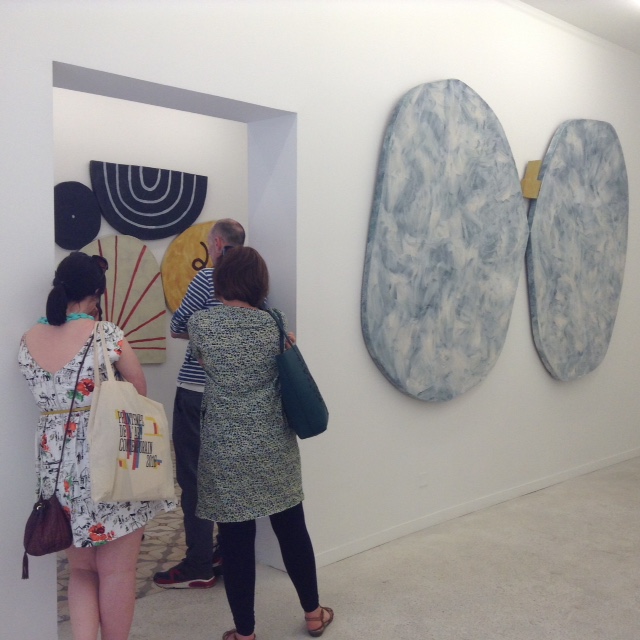
Straat Galerie

Straat Galerie, Marseille Photo Jenny Brownrigg
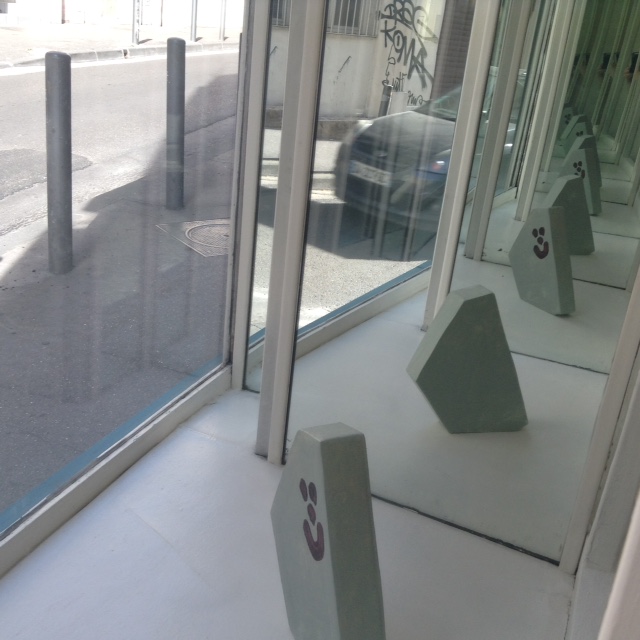
Straat Galerie, Marseille Photo: Jenny Brownrigg

Jin Angdoo & Mathieu Julien, Straat Galerie, Marseille Photo: Jenny Brownrigg

Seulgi Lee playfully created the ongoing action of Soupe at Galerie Ho, offering visitors a choice of two coloured soups, cooking in the gallery, that were the exact colours she had painted the gallery walls. Galerie Ho is open to exhibition proposals from artists, and is an unique gallery that is entered through a bookshop, with a cafe area and artist residency space in the garden.
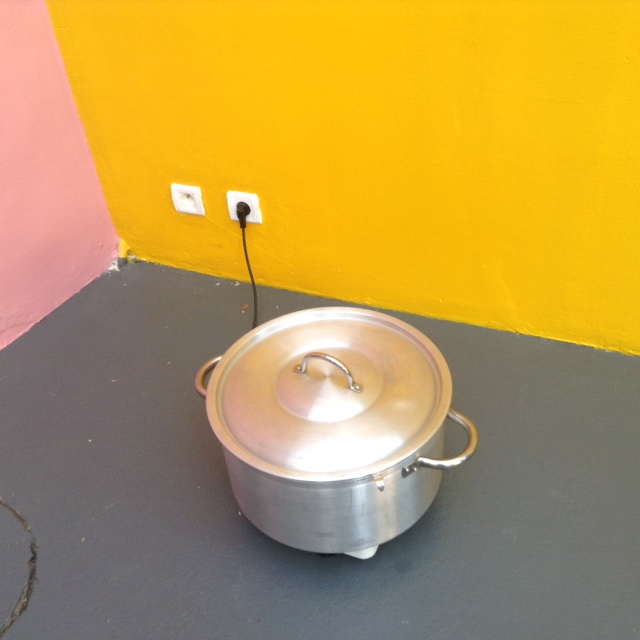
Seulgi Lee, Galerie Ho, Marseille Photo: Jenny Brownrigg

Seulgi Lee, Galerie Ho, Marseille Photo: Jenny Brownrigg

Galerie Ho, bookshop, Marseille Photo: Jenny Brownrigg

Galerie Ho, bookshop, Marseille Photo: Jenny Brownrigg

One of the stand out exhibitions of PAC in terms of ambition was by South Korean Marseille-based artist Ahram Lee, with her exhibition D’incolores idees vertes dormant furieusement at Vidéochroniques. This gallery is a former cigarette factory and tobacco warehouse. Lee brought strange measures and rules to the space with her careful assemblages built from piles of contemporary products, including IKEA boxes, bottle tops and hundreds of matchboxes, forming strange, perfectionist structures in the gallery space.  Next year, following on from South Korea, PAC will make links with Colombia.

On the arrival night we visited the preview of Ink at Studio Fotokino, an independent gallery dedicated to artists books, independent publications, print, design, photography and illustration. Ink was a concise and elegant gathering of international alternative and independent artist book and magazine editions, including Automatic Books (Italy), Corners (Seoul), FP & CF (France) and Hato Press (UK).
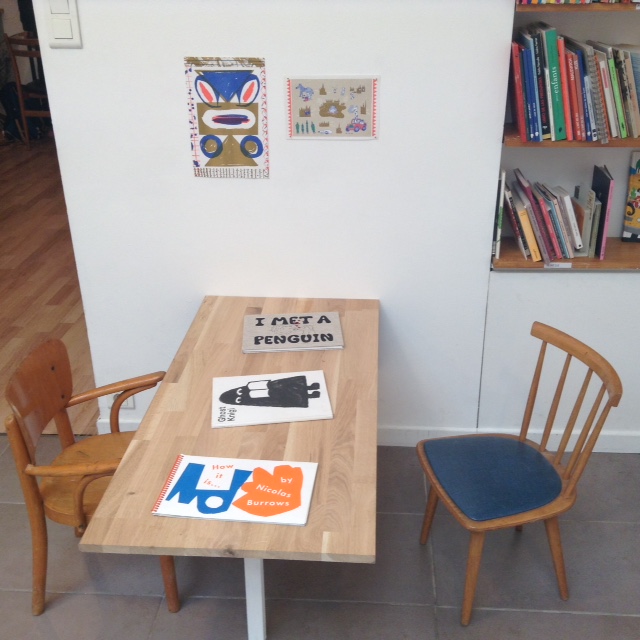
Childrens' corner, Studio Fotokino, Marseille Photo: Jenny Brownrigg
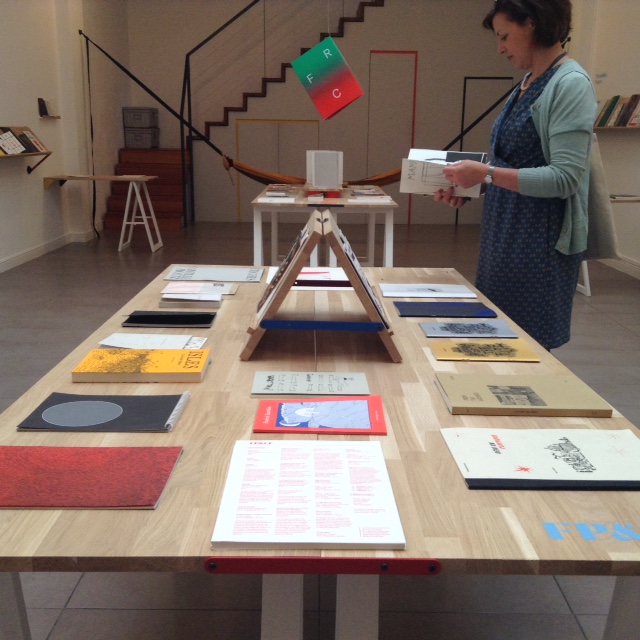
Childrens’ corner, Studio Fotokino, Marseille Photo: Jenny Brownrigg

'Ink' Installation, Studio Fotokino, Marseille Photo: Jenny Brownrigg

‘Ink’ Installation, Studio Fotokino, Marseille Photo: Jenny Brownrigg

The next day, following an impromptu drive-by of Cite Radieuse, our first visit was to the art school, L’Ecole Supérieure d’Art et de Design Marseille-Méditerranée which is located in a spectacular setting in the hills behind Marseille. The art school has approximately 400 students, with an impressive ratio of one tutor to ten students. The architecture is intriguing, with studio units and facilities built in a stepped formation up the hill. There were very good facilities, in particular for printmaking, and a new film studio called Le Plateau recently opened, with state of the art equipment for filming and sound. The art school was, through their research wing, in the process of setting up a programme of residencies for national artists to work with research staff and students.
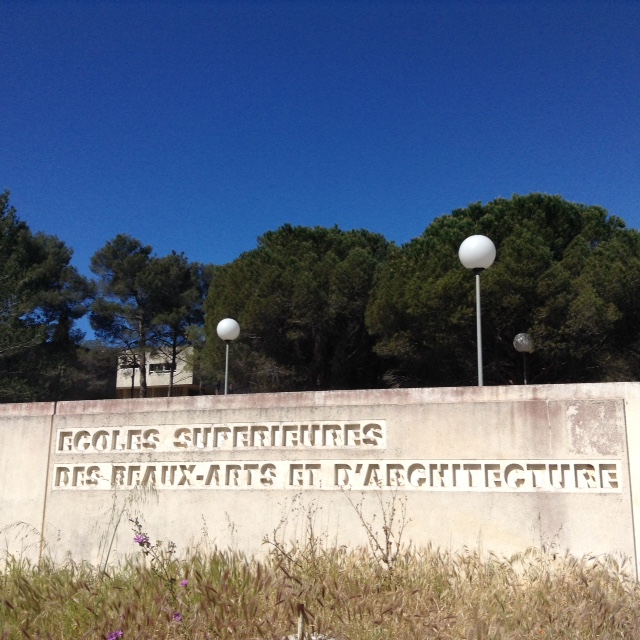
Rntrance, L'Ecole Supérieure d'Art et de Design Marseille-Méditerranée Photo: Jenny Brownrigg
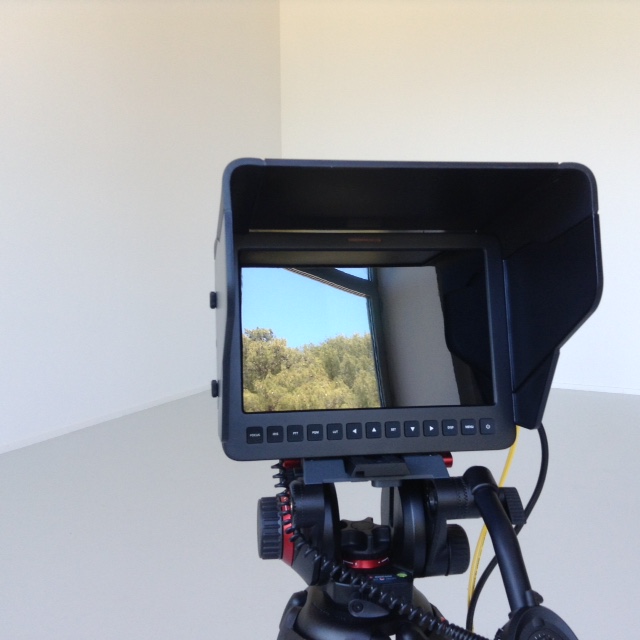
Entrance, L’Ecole Supérieure d’Art et de Design Marseille-Méditerranée Photo: Jenny Brownrigg

Le Plateau, L'Ecole Supérieure d'Art et de Design Marseille-Méditerranée Photo: Jenny Brownrigg

Le Plateau, L’Ecole Supérieure d’Art et de Design Marseille-Méditerranée Photo: Jenny Brownrigg

The art school does not have any gallery provision on site, preferring to work in partnership with organisations in the city. This included a printmaking workshop and exhibition Bois Graves XXL at La Friche Belle de Mai, where outsize prints using a steamroller were being made from large-scale woodcuts. Another of their linked projects was Biennale de Marseille Longchamp No1, curated by tutor Arnaud Deschin which, complete with map, was a tour from his live/work gallery space La GAD Marseille through different shops where students had made installations in the surrounding area. A frankly at all times confusing and often highly enjoyable tour, due to the persona of the tour leader and the fact that the art was often difficult to distinguish from its surroundings, began at La GAD with the curator wearing sunglasses at all times, keeping our group outside a closed door whilst he waited interminably for his security guards to turn up to the gallery. There was plenty of time to examine the front window, which had on it an advert for a travel agency rendering the galley frontage more like that of a quasi tanning shop. The tour took us to fridges in the local grocers, to an off-licence, Italian pasta shop and hairdressers where everyone was handed a small unique leaflet edition Aujourd’hui on va parler de ma vulve. The experience was finely balanced on the cusp of a highly ironic piss-take or is this for real, ensuring all tour participants remained polite and engaged, even when being pressed and orchestrated by Deschin at the conclusion for a group photograph amongst one of the penultimate works.
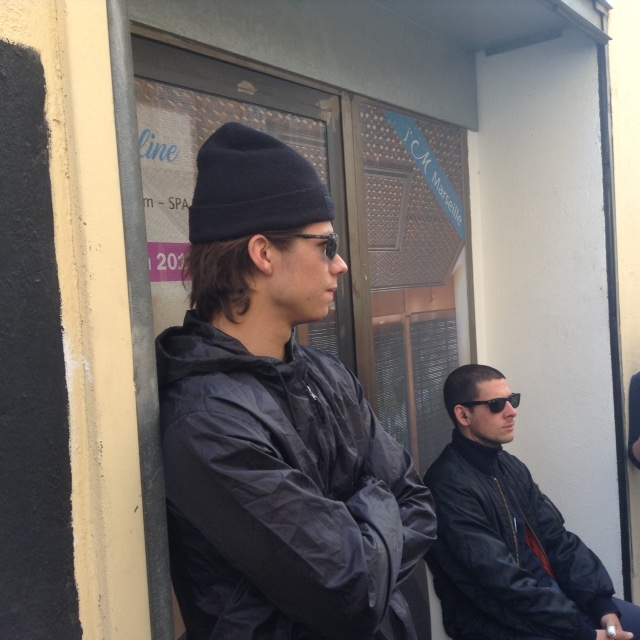
Security guards at La GAD Marseille Photo: Jenny Brownrigg

Security guards at La GAD Marseille Photo: Jenny Brownrigg

Marseille’s public institutions include MuCEM, FRAC and Musee d’art Contemporain de Marseille [MAC]. MAC was hosting two exhibitions, one by South Korean artist Cody Choi called Culture Cuts, and the second, an impressive selection from their collection, including works by Dennis Oppenheim, Denis Brun, Niki de Saint Phalle, Gordon Matta Clark, Annette Messager, Dieter Roth, Bruce Nauman and Vito Acconci. The gallery space itself is rather wonderful with vaulted ceilings. Nearby, installed long before David Shrigley’s Fourth Plinth, is the artist Cesar’s big bronze thumb, in the centre of a roundabout. FRAC Provence-Alpes Côte d’Azur held two exhibitions of London-based Koo Jeong-A and Brussels-based artist Livien De Boeck’s work. MuCEM is an impressive network of refurbished old historical garrison buildings perched on a hill overlooking the Mediterranean and is completed with signature contemporary architecture by Rudy Ricciotti, which houses their Museum of European and Mediterranean Civilisation section. Exhibitions on Jean Genet L’Echappée Belle, and on the folk influences on Picasso’s work were at MuCEM.

MuCEM Marseille Photo: Jenny Brownrigg
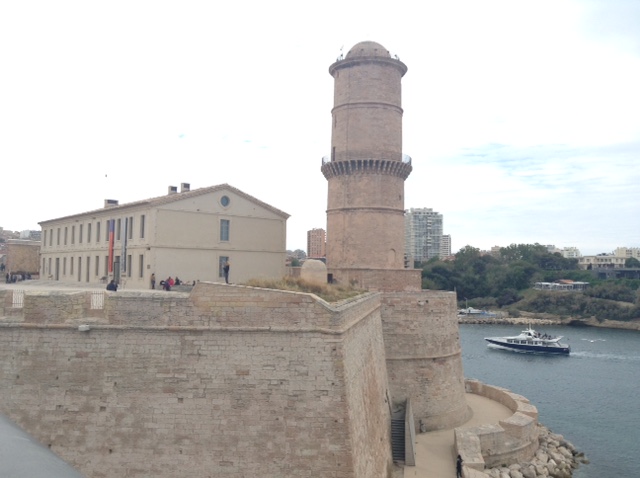
MuCEM Marseille Photo: Jenny Brownrigg

Another part of the complex of buildings, MuCEM Marseille Photo: Jenny Brownrigg

Another part of the complex of buildings, MuCEM Marseille Photo: Jenny Brownrigg

The visit contrasted an incredibly diverse range of museums, galleries and artist-run projects bringing together an intensity of scale ranging from the enormous La Friche Belle de Mai which one of its directors referred to as a flat Le Corbusier with its living spaces, play areas and galleries, to the tiny not-for-profit spaces of Galerie Territoires Partagés or OÙ Paradis. La Friche Belle de Mai has an interesting programming structure, alternating its gallery spaces between the organisations that are based there. Sextant Et Plus at the time of PAC had curated the epic Les Possédés, over two floors, with significant works borrowed from private art collections from south of France including pieces by Jimmie Durham, Saâdane Afif, Neïl Beloufa, Roman Ondák and Anri Sala.

Roof, La Friche Bel de Mai Marseille Photo: Jenny Brownrigg

Roof, La Friche Belle de Mai, Marseille Photo: Jenny Brownrigg

The city of Marseille owns La Friche Belle de Mai, with a co-operative company of organisations having it as a long term loan of 45 years. In contrast, the compact Galerie Territoires Partagés disperses its programme and ethos, focused in particular on political and social issues, through a small van that its director drives through the region, to deliver a socially engaged education programme. OÙ Paradis hosting Daphné Le Sergent’s installation Overflow in a domestic space on the top floor of flats, which the Marseille-born artist Richard Baquié (1952-1996) used as his studio.  Overflow referenced Richard Baquie’s common objects series – Baquié drew a cup of coffee repeatedly throughout his life. In the same domestic apartment building, there was also access to Baquié’s apartment on a lower floor, where his partner had continued to live after his death. The apartment formed a kind of living monument to him, communicating clearly his implicit belief in the permeability of the boundaries between life and work – his sculptural work was often made out of recycled objects.
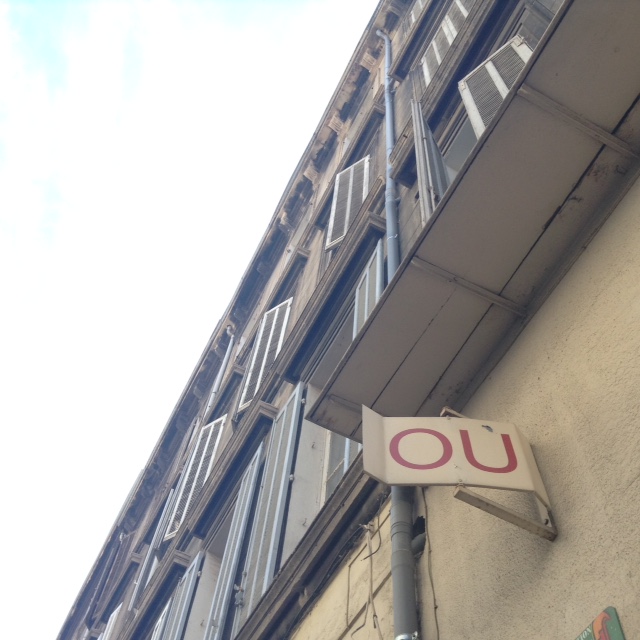
Ou, Marseille Photo: Jenny Brownrigg
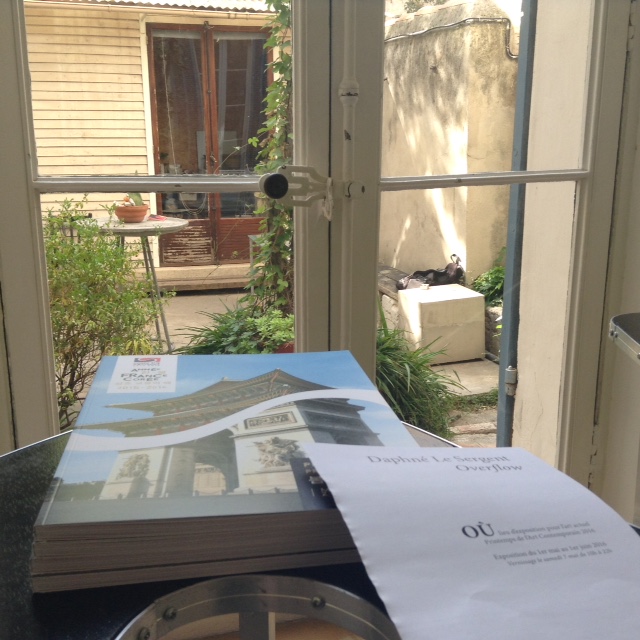
Ou, Marseille Photo: Jenny Brownrigg

Ou, Marseille, looking through to artist residence Photo: Jenny Brownrigg

Ou, Marseille, looking through to artist residence Photo: Jenny Brownrigg

is an intriguing format as it comprises three separate spaces, including the domestic spaces mentioned and the final space of a contemporary gallery, with changing programme and connected artist residency, which was hosting a two person show of Paris-based Dae Jin Choi with Daphné Le Sergent. Another exhibition forming a retrospective was of Charles Dreyfus, an artist and historian of Fluxus, at Galerie Meyer. Galerie Porte Avion‘s show of Alain Andrade’s and Pedro Lino’s work included an exhaustive list of all the walls built to enforce borders and control movement in the world now.

Commercial galleries make up a smaller part of the art scene in Marseille. Commercial galleries we visited during PAC included Béa-ba which is co-run by Beatrice Le Tirilly and Barbara Sartre and which staged a solo exhibition by Bernard Pages, En Regard, of drawings and sculptures from 1969-2015. Galerie Polysémie had an interesting take on the type of artist on the roster, with the director François Vertadier only selecting ‘outsider’ artists. The current exhibition was by art teacher Georges Bru, of dreamlike figurative work on paper. A number of the galleries were run by businesses which were different takes on the gallery model. TOGU was an architectural practice with a gallery, which had a roster of artists to propose to their architectural clients. Mécènes du Sud was working with Hotel Deux Pierres Deux Corps, hosting the last intake of a group of five young artists, through a residency in their hotel for a programme called Vacances Blues. The exhibition at the gallery included the work of Clémence Marin, with her videowork of a worker attempting the thankless task of sweeping a dance floor full of balloons to the side.

Elvia Teotski, Chateau de Servieres, Marseille Photo: Jenny Brownrigg

Elvia Teotski, Chateau de Servieres, Marseille Photo: Jenny Brownrigg

Marseille has a strong studio ethos, often linked with residency programmes, through Marseille City Studios, which is supported by the city. This initiative has been running for 20 years with a network of studios for French and visiting artists at Château de Servières, Astérides and Triangle France (director Céline Kopp),  Astérides and Triangle France are both based at La Friche Belle de Mai. Château de Servières has had an exchange programme with other European cities including Dublin, Turin and Milan. Here we met artists in residence including Elvia Teotski who had been working on the studio floor of Château de Servières in an archaeological manner to show the traces of previous artists; Charlotte Benedittini and Robin Touchard who had been working on an installation with Tony Ceppi. All artists were being supported by the city with a one year residency. Astérides were staging an exhibition at La Friche Belle de Mai of four artist-in-residence productions by Victoire Barbot, Pierre Boggio, Julie Michel and Luca Resta.

Other studio visits our group went on included to artist Rémi Bragard, who was looking to build a planetarium projector, and took us through all his prototypes and ephemera of brochures compiled by DIY planetarium builders from all over the world, including Kovac Planetarium in the north woods of North Wisconsin. Bragard had been visiting each maker or museum, and is working on producing a book of his photographs. A second artist we met was Nicolas Pincemin, where we were introduced to his paintings on hidden and collapsing architecture including abandoned military bunkers. A key resource and website flagged up during the trip to use to research French artists is the French Network of Documents d’Artistes website.

Julien Fargotten, 'real street food', Belgian waffle maker Photo: Jenny Brownrigg

Julien Fargetton, ‘real street food’, Belgian waffle maker Photo: Jenny Brownrigg

Detail of waffles made, Julien Fargotten Photo: Jenny Brownrigg

Detail of waffles made, Julien Fargetton Photo: Jenny Brownrigg

Marseille has a number of production facilities, including one for glass, which  were presenting exhibitions or projects as part of PAC. One building housed Atelier Ni, a sculpture workshop on the ground floor, and Tchikebe, a printmaking facility on the second floor. Atelier Ni hosted Selma Lepart, winner of their open call and Julien Fargetton. Atelier Ni was set up in 2010 by two artists, Arnold Degiovanni and Maxile Gianni, and is seen as a technical resource to assist artists and designers in the technical design and production of their projects. One of Lepart’s sculptures was technically highly ambitious – a breathing asteroid, where the small metal plates of its surface appeared to inhale and exhale. Atelier Ni had worked with Fargetton to help him in the construction of a Belgian waffle maker, fully operational and made from two Belgian manhole covers – real street food as the artist himself coined it.  Upstairs from Atelier Ni, was Atelier Tchikebe, an exciting printmaking studio with gallery. Tchikebe had been producing a series of new screenprints onto different surfaces including aluminium, mirror and acrylic glass, with Tania Mouraud, a multi-disciplinary artist working across performance, video and public art work. Often working in text, Mouraud declared on our visit that.. ‘one sentence will be in 7 cities’, on simultaneous billboards across Europe.

Artist's residence, The American Gallery, Marseille Photo: Jenny Brownrigg

Artist’s residence, The American Gallery, Marseille Photo: Jenny Brownrigg

To conclude this observation of the contemporary art scene in Marseille, one of the most significant factors assimilated on this curatorial trip was the emphasis each type of organisation at any size had placed on the artist residency, in particular as a means to support the production of work for exhibition. Many included as part of their architectural framework a place for an artist to live and work. This included most picturesquely, the privately owned The American Gallery, which comprises of a gallery with artist residency at the bottom of the garden of Marseille resident, psychoanalyst and gallery owner Pamela King. The American Gallery was hosting the Home Guard Manual of Camouflage by Cari Gonzalez-Casanova on the history of camouflage. Another example was Voyons Voir: art contemporain & territoire located in Aix-en-Provence.
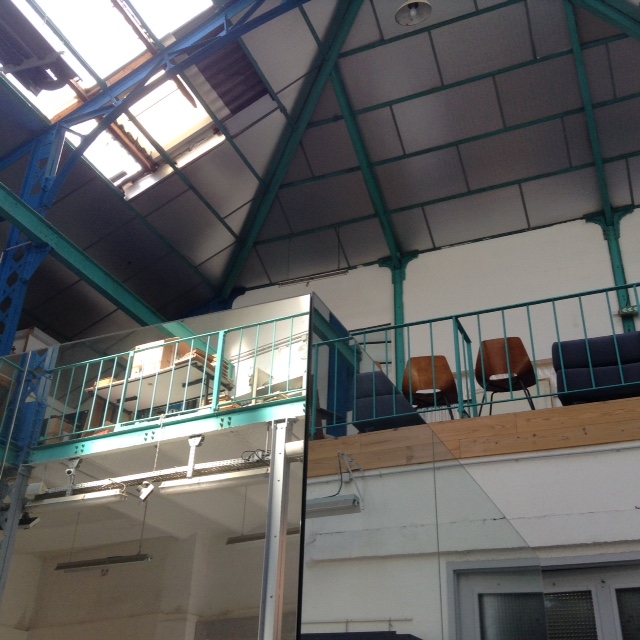
'Paradise / A Space for Screen Addiction', located at auction house in Marseille Photo: Jenny Brownrigg

‘Paradise / A Space for Screen Addiction’, located at auction house in Marseille Photo: Jenny Brownrigg

Also, the resourcefulness of artists and curators was apparent, in their ability to make projects within unusual site specific contexts, such as Paradise/A space for screen addiction which was a mirrored cube and cinema space installed within a working auction house Leclere Maisonnette de Ventres, curated by Charlotte Cosson & Emmanuelle Luciani. The film programme included films by Ilja Karilampi, GCC, Akina Cox and General Idea.  This project was linked to CODE South Way, a publication edited by Cosson & Luciani.
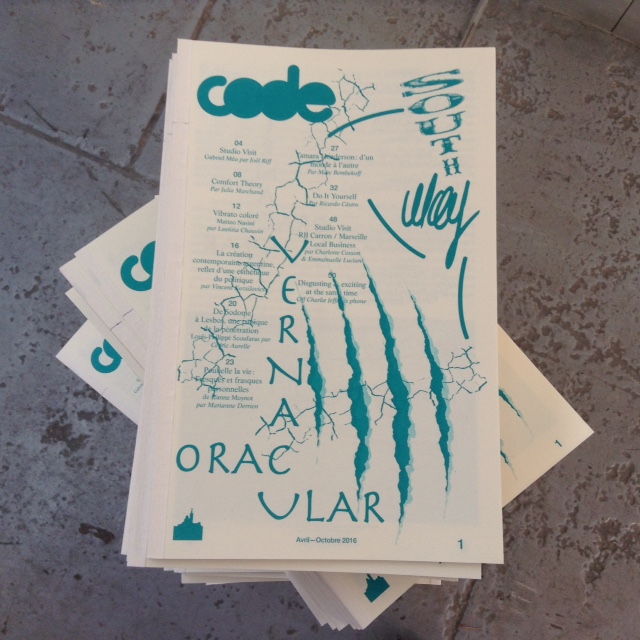
'Code' publication Photo: Jenny Brownrigg

‘Code’ publication Photo: Jenny Brownrigg

The dedication of those who worked with artists within Marseille’s contemporary art framework was also clear, in particular Rond-Point Projects with Director Camille Videcoq, who works on singular year-long residencies, for in depth dialogue and support with those she works with. Videcoq referred to the gallery as a tool for the residency, which again places the significance of the residency in the Marseille contemporary art scene.

With thanks to the trip organisers, to all our hosts and to Marseille Expo team. Jenny Brownrigg (2016) This article can also be accessed on Scottish Contemporary Art Network’s website.

Footnotes

[1] The group were Cheryl Connell (Stills, Edinburgh); Judith Liddle (Edinburgh Printmakers); Max Slaven (David Dale Gallery, Glasgow); Audrey Carling & Michelle Emery-Barker (WASPS); Sorcha Carey (Edinburgh Art Festival); Juliet Dean (British Council Scotland); Seonaid Daly (SCAN); Julie-Ann Delaney (National Galleries Scotland); Kirsteen Macdonald (GSA); Jenny Brownrigg (GSA); Dan Brown (Edinburgh Sculpture Studios); Kate Gray (Collective, Edinburgh).
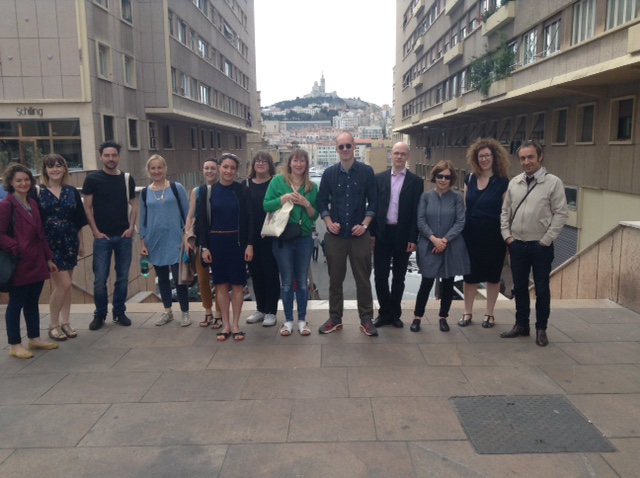
The visiting group from Scotland to Marseille

The visiting group from Scotland to Marseille

The trip was supported by British Council Scotland and Marseille Expo.

About Marseille Expo/ Printemps de l’Art Contemporain: Founded in 2007, the Marseille expos network was created to promote contemporary art in Marseille. Today it unites 36 visual art organisations, ranging from large institutions, to private galleries and numerous non-profit organisations. Since 1999, the network has organised the Printemps de l’Art Contemporain, among other activities. Each year in May, PAC presents a wide range of exhibitions (about 50) and events in the city of Marseille, mixing French and international venues, benefiting from the great diversity of spaces and curatorial practices of its members.

The network also supports the international development of its members (for example the partnership with the Ministry of Foreign aAfairs for 9 exhibitions in the context of the Year of France-Korea in 2016). In this dynamic, the network has developed some links with the Scottish visual art scene (with the help of the British Council), hoping that several collaborations will emerge between its members and art centers and artists from Scotland, in term of co-production or exchange of artists, curator and exhibitions. The expo team are keen to explore the possibilities for collaboration with Scottish counterparts for Printemps de l’Art Contemporain 2018.

Please feel free to contact Olivier Le Falher for any further information.
Email: olivier.lefalher@marseilleexpos.com

Unknown's avatar

‘Women in Art’, “Conversation Piece”, British Art Studies

“Conversation Piece” is a British Art Studies series that draws together a group of contributors to respond in 500 words to an idea, provocation or question. ‘Still Invisible?’ is a “Conversation Piece” coordinated by Patricia de Montfort (University of Glasgow) and Robyne Erica Calvert (The Glasgow School of Art) in Issue 2. It asks the question ‘Is the work of women artists on display in museums and galleries?’ The conversation in its entirety can be found here. British Art Studies is an online journal, created by Paul Mellon Centre and the Yale Center for British Art. Here is my contribution:

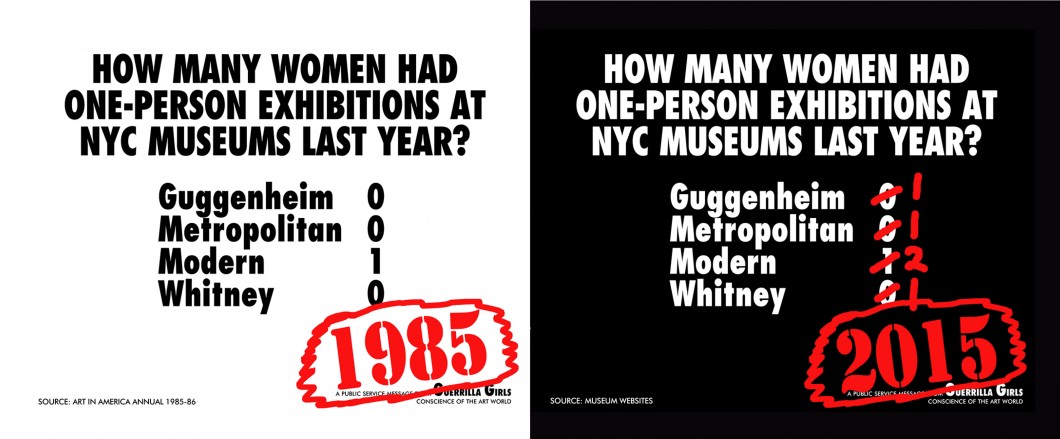
Guerrilla Girls, anniversary recount sticker showing numbers from 1985 and 2015

Guerrilla Girls, anniversary recount sticker showing numbers from 1985 and 2015

Women in Art

Tate Modern has announced two new Artist Rooms by Phyllida Barlow and Louise Bourgeois “in a bid to inspire girls”; Saatchi Galleries has its first “all women” show, Champagne Life, to celebrate the gallery’s 30th anniversary; Pussy Riot announced plans to open a women-only museum in Montenegro, the “New Balkan Women’s Museum . . . in an effort to address long-spanning issues with gender equality in the art world, in a space referred to as, ‘for women, by women, about women’”. Karen Archey writes in a January 2016 e-flux conversation, “Are all-female exhibitions problematic?” Is there something in the water? Are there too many women artists visible in contemporary art, or is this part of a reaction to there being too few?

Guerrilla Girls formed in New York in 1985 to fight the inherent gender and racial inequality in the fine arts, by producing posters, billboards, and actions containing key messages and statistics about institutions and their track records on showing female artists. Taking a straw poll, here are the statistics for men and women artists represented by a sample of UK commercial contemporary galleries (as listed in January 2016 on their websites). In Scotland, Edinburgh’s Ingleby Gallery is 15% women artists (4 out of 26 artists on roster). This figure increases if “project artists” are included, to 22%. In Glasgow, the Modern Institute has 33% women (13 out of 43), whilst smaller commercial gallery Mary Mary has the highest number at 43% (6 out of 14). Whilst more in number, this is still under half. Workplace Gallery, Gateshead, is 38% (8 out of 21 artists); in London, Hollybush Gardens was an exception with 62% of their total being women (8 out of 13); whilst White Cube (London, Hong Kong, São Paulo, Miami) was 28% (17 out of 60) and Hauser & Wirth, with galleries in London, New York, and Somerset, at 31% (20 out of 64). Why are the numbers of women represented by commercial galleries consistently much lower than the number of male artists? Is this because fewer women study fine art so there are fewer female artists? The statistics of female graduates from the Glasgow School of Art would contradict this. In the academic year 2014/15, 75 female to 33 male students graduated with a Bachelor of Arts in Fine Art with Honours, making the ratio 69% female graduates. In 2013/14, 63 women students versus 39 male students graduated from the same course. Each year back to 2010/11 the gender split is the same, with female students always the higher number of graduates from the undergraduate Fine Art course.

Sarah McCrory, Director of Glasgow International Festival of Visual Art since 2013, and previously curator of Frieze Projects, makes the point that to alter these statistics, change can only occur through gallery programmers and, in terms of commercial galleries, the buyers, who ultimately are the market. In 2010 McCrory worked with Annika Ström for Frieze Projects. The artist’s piece saw a group of “Ten Embarrassed Men” (2010) roam the tent, ashamed by the low number of women represented at the art fair. McCrory believes that rather than explicitly brand an exhibition as “all women”, these types of curatorial decision should be implicit in programming.

Guerrilla Girls aim to stop their activism when the situation of visibility of women in contemporary art is balanced. They continue, with their show at Walker Arts Center running throughout 2016. The artist Amy Bessone wrote recently: “I’ve noticed galleries whose roster may consist of 20–30% female artists, bring a 90–100% male line-up to art fairs.”[1] Clearly, we need to do more work.

Published April 2016

Footnote

  1. Amy Bessone, “Post Woman”, Kaleidoscope 23 (Winter 2015), 82.
Unknown's avatar

‘Doing Women’s Film and Television Histories III: Structures of Feeling’ Conference

Doing Women’s Film and Television Histories III: Structures of Feeling

The Third International Conference of the Women’s Film and Television History Network: UK/Ireland, 18-20 May 2016, Leicester, UK

Conference Organisers: Vicky Ball (Senior Lecturer in Cinema and Television Histories, De Montfort University), Melanie Bell (Associate Professor in Film and Media, University of Leeds), Laraine Porter (Senior Lecturer, Film Studies, De Montfort University)

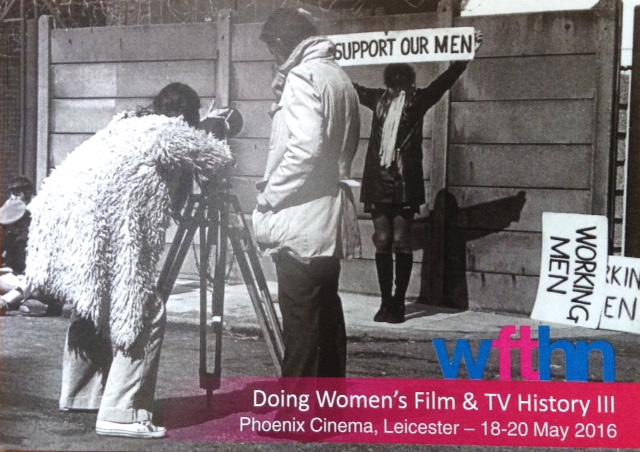
image1invite

This conference was organised by the Women’s Film and Television Network (UK and Ireland) [1]. The aims of the network are to research and disseminate women’s ‘participation in screen media’ and explore the roles of women in the industry, ensure ‘that women’s work is recognised in the writing of screen histories’, to ‘encourage new approaches to film and television that are sensitive to gender, class and race’ and to have ‘an impact on the teaching of screen media in schools and colleges.’ [2]

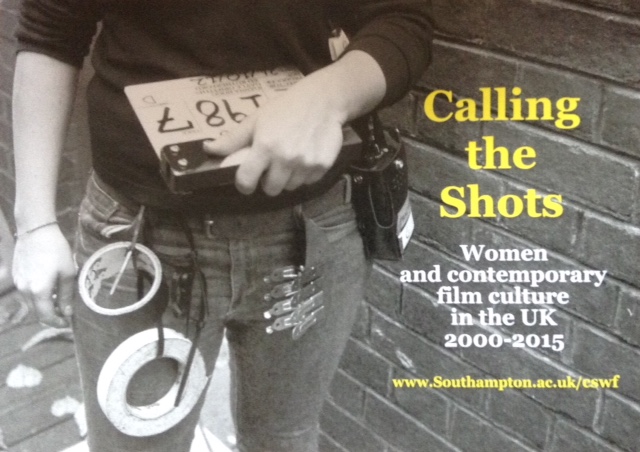
‘Structures of Feeling’, the tagline of the conference title, refers to Raymond Williams’ work [3] around the suppressed narrative; the real, lived experience which is part of culture but not recognised in the mediated history and hegemony of that culture. With presentations referring to key statistical analysis from primary research of the AHRC-funded project, ‘Calling the Shots’  [4], including the findings that ‘in 2015, women constituted just 20% of all directors, writers, producers, exec-producers, cinematographers and editors on 203 UK films in production during 2015’ ,  [5] the conference’s exploration and assessment of diverse narratives, histories and contributions by women in a male dominated industry was both timely and necessary.  Further analysis from ‘Calling the Shots’ details that ‘74% of films with a woman director also had a woman producer’, [6] highlighting that if a woman is employed in a main role, she is likely to recruit more women to other key roles in the crew. Of those women employed in key roles,  in terms of numbers of BAME women in 2015, the report found that only ‘7% of women were of Black, Asian, or Ethnic Minority identity, making BAME women less that 1.5% of all personnel’.

callingshots

If one statistical pillar of the conference was the initial findings of ‘Calling the Shots’, the other was ‘Patterns of Discrimination Against Women in the Film and Television Industries’ (1975), a report commissioned by the Association of Cinematograph, Television and Allied Technicians (ACTT) Union’s Committee of Equality. The conference chose to commemorate its 40th anniversary of publication, with presentations by Frances Galt (De Montfort University, Leicester) who gave an excellent historical context to the report and Barbara Evans (York University, Toronto), an original member from the London Women’s Film Group who was key in getting ACTT to agree to the role of a paid woman researcher to conduct the research and write the report. A screening at the conference of the film, ‘The Right Place: Women in West London Film Laboratories, 1960-2000’ (Dawson, A & Holmes, SP, 2016), intriguingly uses film footage of the researcher, Sarah Benton, in a meeting with male and female workers,  the union and shop stewards, discussing the place of a crèche in the workplace to allow women to continue to work, after having families. Benton meets with resistance to the idea, both from male and female workers that are present, who believe that the ills of society are down to mothers at work and therefore away from the home, who are not having an influence on their children growing up.

'Open Door' excerpt, Barbara Evans' presentation: ‘Breaking the Pattern, The Struggle for Equality in the Film and Television Industry’

‘Open Door’ (1965) excerpt, Barbara Evans’ presentation: ‘Breaking the Pattern, The Struggle for Equality in the Film and Television Industry’

'Open Door' (1965) excerpt, (Barbara Evans Pictured, both in film clip and in person), ‘Breaking the Pattern, The Struggle for Equality in the Film and Television Industry’

‘Open Door’ (1965) excerpt, (Barbara Evans pictured, both in film clip and in person), Barbara Evans’ presentation: ‘Breaking the Pattern, The Struggle for Equality in the Film and Television Industry’

Evans in her presentation ‘Breaking the Pattern, The Struggle for Equality in the Film and Television Industry’  outlined the situation in the workplace where women were confined to the lesser skilled roles, often secretarial, lower paid jobs, which Evans described as creating ‘sexual ghettoes’. Reasons given for women not being able to enter predominantly male domains including camera or sound work, included that the equipment was too heavy for women to carry. Evans illustrated her presentation with clips from a discussion of ACTT women activists, for BBC’s ‘Open Door’ programme in 1965, including Evans herself, to tell this story: ‘Many women were doing housework on the job… often a substitute wife or mother’ for the male bosses. The action of getting a paid female researcher was key, as many women felt intimidated to speak at union meetings or assemblies without fear of heckling. One of the ‘Open Door’ excerpts was intriguingly a satirical re-enactment of the battle between women and men around equal pay in the workplace, with women playing both gender roles. This creative approach to engaging with issues of inequality was also highlighted in Rachel Fabian’s (California) paper ‘What are We Left With?: The London Women’s Film Group and the Legacies of 1970s’ Collective Media Production’, where Fabian referred to London Women’s Film Group’s ‘The Amazing Equal Pay Show’, (1974), which was a film looking at the place of working class women in a capitalist society and worked with the Women’s Street Theatre Group,  to lampoon issues of inequality through using the language of carnival, street theatre and pantomime.

Slide from Rachel Fabian's presentation: 'What Are We Left With? The London Women's Film Group and Legacies of the 1970s Collective Media Production', featuring 'The amazing Equal Pay Show' (YEAR), London Women's Film Group

Slide from Rachel Fabian’s presentation: ‘What Are We Left With? The London Women’s Film Group and Legacies of the 1970s Collective Media Production‘, featuring ‘The Amazing Equal Pay Show’ (1974), London Women’s Film Group

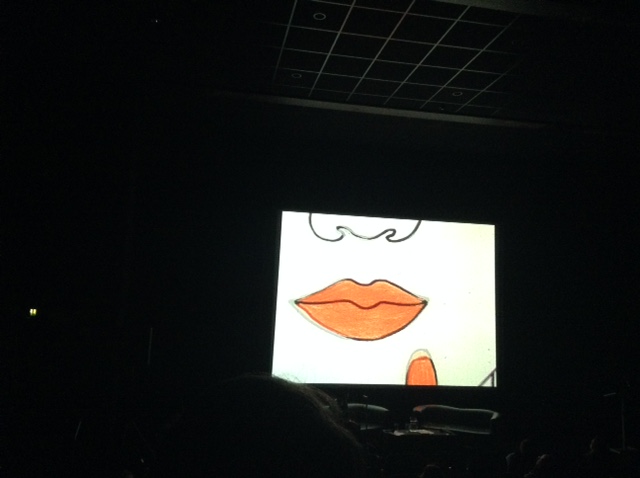
This is only one route through the conference, given its session structure of running up to four strands of panels to choose from. My own attendance had been thanks to association with Shona Main’s ‘Real Illuminators’ film programme, along with Dr Sarah Neely (University of Stirling), which presented eight short films [7] by early women film-makers in Scotland, predominantly in the field of documentary. Particularly resonant for this programme and area of research, was our meeting Barbara Evans, one of the first to research and write about Shetland filmmaker Jenny Gilbertson, in the Women Film Pioneers Project. Also of key interest, was the presentation by Sarah Hill (University of East Anglia), on the Women Amateur Filmmakers in Britain archive collection, digitised by East Anglian Film Archive, part of the University of East Anglia. Hill showed a selection of films from 1920s’-80s’ including animations by Sheila Graber and Joanna Fryer.

Slide from Sarah Hill's presentation: '(In)visible Women? Researching Amateur Women Filmmakers', image of 'Make-Up' (1978), Joanne Fryer

Slide from Sarah Hill’s presentation: ‘(In)visible Women? Researching Amateur Women Filmmakers’, image of ‘Make-Up’ (1978), Joanna Fryer

Slide from Sarah Hill's presentation: '(In)visible Women? Researching Amateur Women Filmmakers', image of 'Make-Up' (1978), Joanne Fryer

Slide from Sarah Hill’s presentation: ‘(In)visible Women? Researching Amateur Women Filmmakers’, image of ‘Make-Up’ (1978), Joanna Fryer

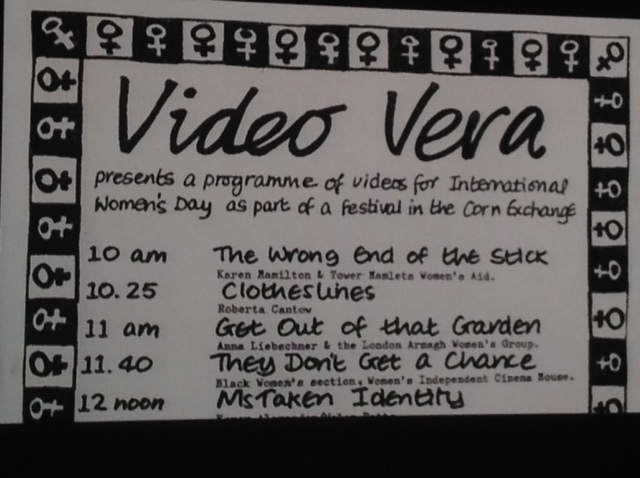
Dr Kate Dossett’s (University of Leeds) keynote, on the AHRC funded Feminist Archives, Feminist Futures’, chronicled the role of the women’s library or archive from the Fawcett Library, set up by the London Society for Women’s Service in 1926, to current day archives and libraries, including reference to Glasgow Women’s Library, and a focus on Feminist Archive North, with materials on Vera Media and Leeds Animation Workshop. June Givanni also presented on her Pan African Cinema Archive collected over her 30 years working as a curator gathering film work by women directors from Africa and the diaspora. She is currently focusing on what type of an archival space architecturally can be created for this independent archive.

Slide from Dr Kate Dossett's presentation, image 'Vera Media'

Slide from Dr Kate Dossett’s presentation, image ‘Vera Media’

Doing Women’s Film and Television Histories III: Structures of Feeling’ conference was  inspirational in its content and approach, tackling key themes from a variety of different perspectives, roles, geographies and histories. For example, the first Plenary, ‘Costume, Women, Work and History’ had a costume designer and supervisor (Lezli Everitt, Costume and Training Skills, BECTU Learning Organiser), academic (Tamar Jeffers McDonald, University of Kent) and curator (Keith Lodwick, V&A Museum) contributing, allowing the spectrum of discussion to range from the actualities of the workplace, to academic framing and then questions of exhibition. As the conference was looking at aspects of power and power holders, predominantly being ascribed in examples in favour of the male domain, a key presentation by Gina Marchetti ‘The Feminine Touch: Chinese Soft Power Politics and Hong Kong Women Filmmakers’, provided an interesting case study in the navigation of soft power by women filmmakers including Ann Hui, in securing financial backing and box office success.

The delegates and contributors were from diverse ages, points in their career and experiences which allowed for all contributions to be recognised and acknowledged as significant to the continuation of the field. And again in the sense of the ‘continuity bible’, referred to in several presentations including Lezli Everitt’s, as a trade device to track change and make note of what has occurred, the conference ephemera, notes, discussions, further reading, conversations with other delegates and presentations on key projects, will continue to have an impact on evolving lines of research investigation. It was announced that the next conference will take place at University of Southampton in 2018.

Jenny Brownrigg (May 2016)

Footnotes

[1] WFTHN is one of the results from the AHRC funded project ‘A History of Women and Work in the British Film and Television Industries 1933-1989’

[2] From delegates’ pack materials.

[3] ‘The Long Revolution’, Williams, R (1961)

[4] ‘Calling the Shots’ is led by Dr Shelley Cobb & Prof Linda Ruth Williams, University of Southamption, with partners including BFI, BECTU and Women in Film and Television UK. The project supports a Research Fellow (Dr Natalie Wreyford) with two PhD students.

[5] Ibid.

[6] Ibid.

[7] ‘Real Illuminators’ film programme, curated by Shona Main, is as follows: ‘Peat From Hillside to Home’ (1932) Jenny Gilbertson; ‘Flowers and Coffee Party at Umanak’ (1935) Isobel Wylie Hutchison; ‘Beside the Seaside’ (1935) Marion Grierson; ‘Challenge to Fascism / May Day 1938’  Helen Biggar; ‘Ceylon Calling’ (1939) Nettie McGavin; ‘They Also Serve’ (1940) Ruby Grierson; ‘A Portrait of Ga’ (1952) Margaret Tait; ‘The Aardvark or Ant Bear’ (1961) Elizabeth Balneaves.

'Real Illuminators' logo, designer Bryn Houghton, at 'Doing Women's Film and Television Histories III: Structures of Feeling' conference, Leicester, 2016

‘Real Illuminators’ logo, designer Bryn Houghton, at ‘Doing Women’s Film and Television Histories III: Structures of Feeling’ conference, Leicester, 2016

Further notes of reference from conference:

Films:

Nightcleaners, Part 1’, Berwick Street Film Collective (1975)

‘Prairie Women’, Barbara Evans (1987)

‘Women Amateur Filmmakers Trailer’, EAFA Amateur Film, www.vimeo.com/162349610

‘Daughters of the Dust’, Julie Dash (1991) (reference from June Givanni presentation)

‘A Dry White Season’, Euzhan Palcy (1989) (reference from June Givanni presentation)

Websites:

Women Film Pioneers Project http://wfpp.cdrs.columbia.edu (reference from Barbara Evans)

British Silent Cinema and the Transition to Sound 1927-1933 www.silenttosound.org.uk (reference from Sarah Neely)

The Boudica Film Fund www.boudicafilms.co.uk

Women On Boards 40:40:20 campaign www.womenonboards.net

Women 50:50 www.women5050.org campaign for at least 50% representation of women in parliament, councils and public boards

Books:

‘Gender meets genre in postwar cinemas’, Christine Gledhill, (2012)

‘Doing Women’s Film History: Reframing Cinemas Past and Future’, edited by Christine Glehill & Julia Knight (2015), University of Illinois Press.

‘Notes on Women’s Cinema’, edited by Claire Johnston (1973)

[Article], ‘The Amazing Equal Pay Show’, London Women’s Film Group 1974 / Publishers Spare Rib, Aug 1975.

‘Aftershocks of the New: Feminism and Film History’, Patrice Petro (2002), Rutgers University Press.

Publishers:

University of Illinois Press (reference from Professor Emiritus Michelle Hilmes), interested in women’s histories, in particular submission on women’s involvement in sound period.

Trade Union:

BECTU www.bectu.org.uk

Archives:

Film Archives UK

Institute of Amateur Cinematographers library, at East Anglian Film Archive, University of East Anglia

Other:

Beatriz Azurduy Palacios (1952-2003), Bolivian motion picture director (Isabel Segui, University of St Andrews presentation)

Elizabeth Haffenden (1906-1976), costume designer (reference from Tamar Jeffers McDonald presentation)

Beatrice ‘Bumble’ Dawson (1908-1976), costume designer (reference from Tamar Jeffers McDonald presentation)

Dr Heather Norris Nicholson, University of Huddersfield, archive film and changing amateur visual practice. (reference from Sarah Hill’s presentation)

‘Women and Film’ event, Edinburgh Festival, 1972

Third Eye Film Festival’ 1983 (Reference June Givanni presentation)


Unknown's avatar

Two recent articles: Helen Biggar (with Shona Main) and Michael Barr (at RSA New Contemporaries)

‘Challenge to Fascism: Glasgow’s May Day’ (1938), Helen Biggar, by Main, S. & Brownrigg, J, 1.5.16 Map Magazine online.

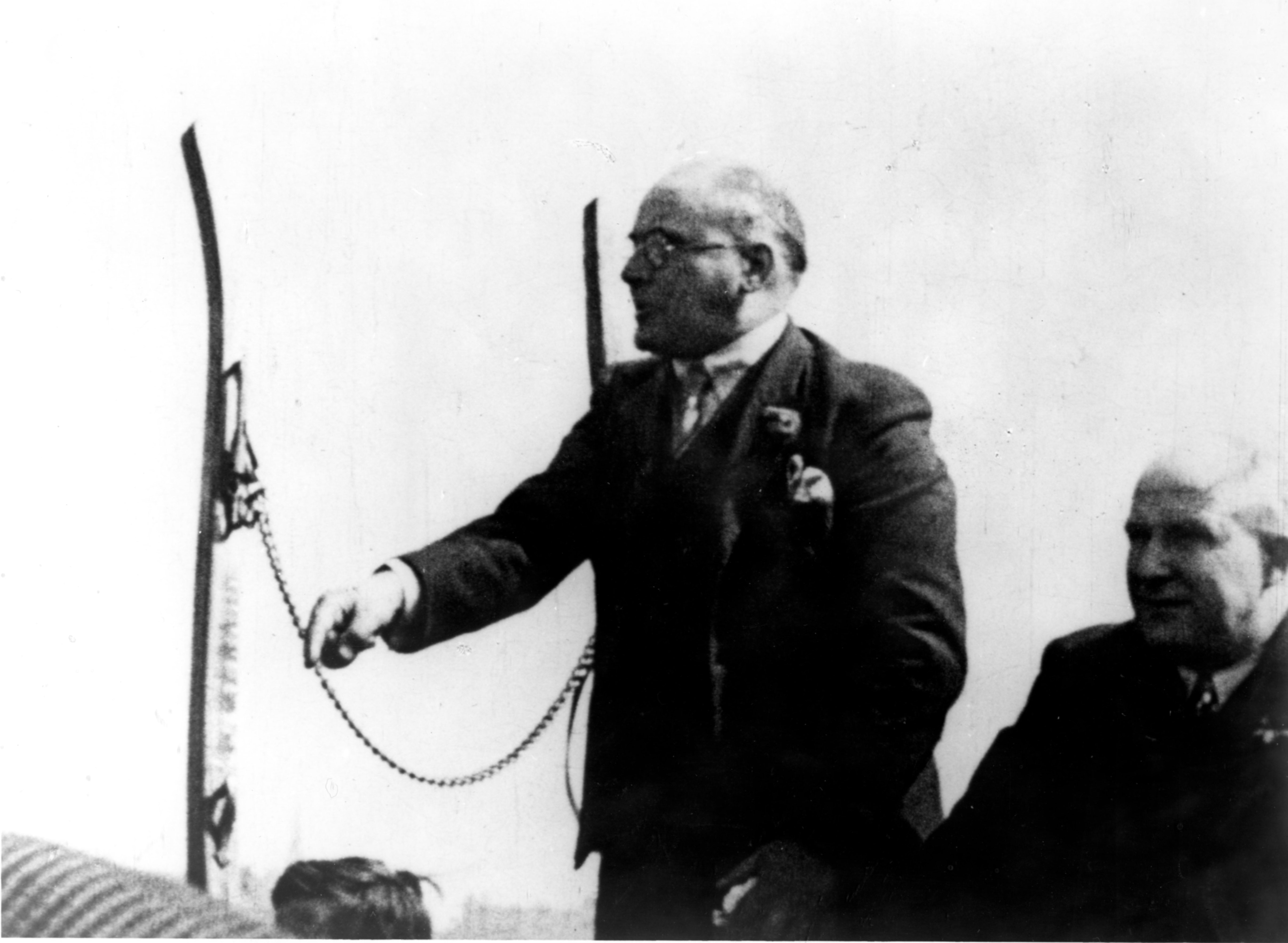
Film still, Challenge to Fascism/ Glasgow's May Day (1938) by Helen Biggar. Willy Gallacher, CPGB, MP for West Fife,speaking at Glasgow Green. Photo courtesy of Billie Love Historical Collection.

Film still, Challenge to Fascism/ Glasgow’s May Day (1938) by Helen Biggar. Willy Gallacher, CPGB, MP for West Fife,speaking at Glasgow Green. Photo courtesy of Billie Love Historical Collection.

FREE CULTURE! Review of Michael Barr’s work inspired by book on Cuban culture policy, Jenny Brownrigg, April 2016, Cuba50, online

'FREE CULTURE!', Michael Barr (2016) Photo courtesy of artist

‘FREE CULTURE!’, Michael Barr (2016) Photo courtesy of artist

Unknown's avatar

That which gives you pleasure (for ‘Bust Out’, Lillie Art Gallery, Glasgow International 2016)

Part 1: The caves (   )

Made by Sarah Kenchington, painted by Belinda Gilbert Scott

Made by Sarah Kenchington, painted by Belinda Gilbert Scott

The cave with its pleasures, dangers and obligations’

 [P.229, ‘Aku-Aku’, Thor Heyerdahl, Penguin Books, 1960]

In 1955 Thor Heyerdahl visited the Easter Islands, to find out the origins of the hundreds of giant statues which stood or lay around the island. Heyerdahl was keen to resolve their mysteries and to be the person who found the answers. How and why were they made?  How were these massive, carved slabs of rock moved or erected? One islander tells him, ‘They went of themselves’ [P.87, Ibid], walking or indeed wriggling, as the statues had only heads and bodies but no legs.  In his book ‘Aku-Aku’ (which has inspired this exhibition’s curator and artist, Belinda Gilbert Scott) Heyerdahl also describes in great detail all the caves on the island. There are secret caves, family caves, ‘taboo’ caves, treasure chambers or caves with specific purposes (Hyerdahl describes the virgin cave, where young women were kept from the sun for months on end, in order for their skin to whiten during their confinement). Pleasures and dangers co-exist – there is darkness, difficulty yet discovery.  What are the obligations Heyerdahl refers to? There are roles for those who tend to and those who visit the caves. There is the wisdom of local custom and belief. There are the gods who must be pleased and not angered. Should visitors be respectful? Some dwell with the statues and the caves for a period, bringing different languages and freedoms. Their acts leave traces hidden under the layers.

It strikes me as I spend time in the galleries- looking at the artworks themselves, drawing them in notational form, considering methods of their making, ascribing relationships between the works, attributing meaning in their arrangements- that the rooms in the Lillie Gallery have become like a series of interconnected caves, all with their own particular, and often peculiar, atmosphere.

The first smaller room [Gallery 2] houses the work of methodological yet intuitive minds, where materials and objects have been re-found, re-purposed and re-ordered in new rhythms of enticing colour, shape and association. The second [Gallery 3] is a mysterious parlour of signs and patterns where some of the objects try to speak to the visitor whilst others hide behind shades. The third, [Gallery 1] the largest, is a very physical space or lair, where objects have been dragged and hauled to their positions, manipulated, stretched, played with, enclosed or hung. This room is most reminiscent of the body in a strange landscape. There are innards spilling out and parts that protrude or sag, spent. There are spaces for contemplation, for pleasure or even for violent emotion. This space is the location for ritual. The fourth room, the shop, is a treasure chamber. There is a glittering new bank of gifts made by strange hands, of brightly coloured bean bags, token adornments and squeezed statuettes. The Lillie has numerous private spaces – stores, offices, toilets – that fold off from this public sequence of caves. A final artwork will shift restlessly through various locations in the building to be found or encountered on a one-to-one basis.

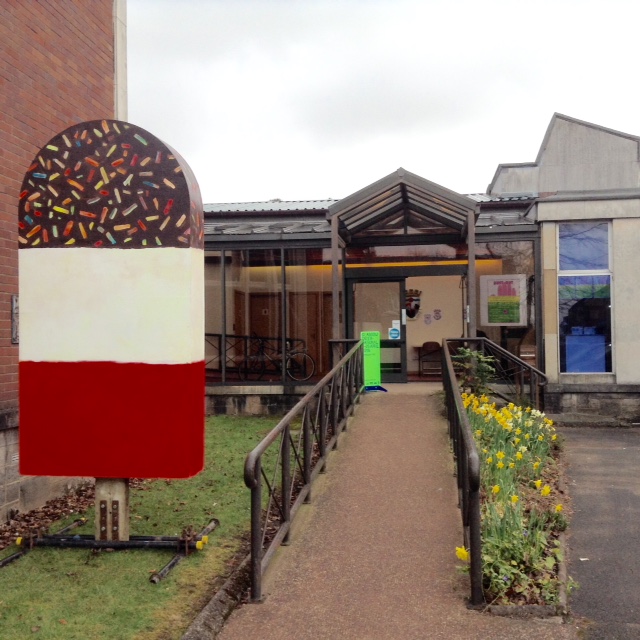
All caves have a threshold, an invitation to be considered by each visitor to enter or resist. What lies at the threshold of the Lillie? This gigantic, FAB erect ice lolly is a totem from an innocent age, an enticing treat to be licked and savoured (or if on a diet, or too serious an adult, scorned). It is a visual feast of simple ocular and oral pleasure. Where will you begin? What is your method of eating it? Which band of fruity colour will you bite into? Your synapses snap with the desire created by anticipation. A coldness of textural sensation, instantaneous joy and promised hundreds and thousands crunch follows.

Jenny Brownrigg

Part 2 : The offerings within (  )

Part 3: The performances and rituals (  )

These further parts will be issued during the exhibition life of ‘Bust Out’, a collaboration by a group of artists brought together by Belinda Gilbert Scott. Belinda Gilbert Scott, Rowan Mace, Valerie Norris, Pester and Rossi, Elin Anna Porisdottir. With Rae-Yen Song, Greer Pester and Sally Hackett.  Lilllie Art Gallery, Milngavie, Glasgow, 8-25 April 2016. Supported by Glasgow International.

Unknown's avatar

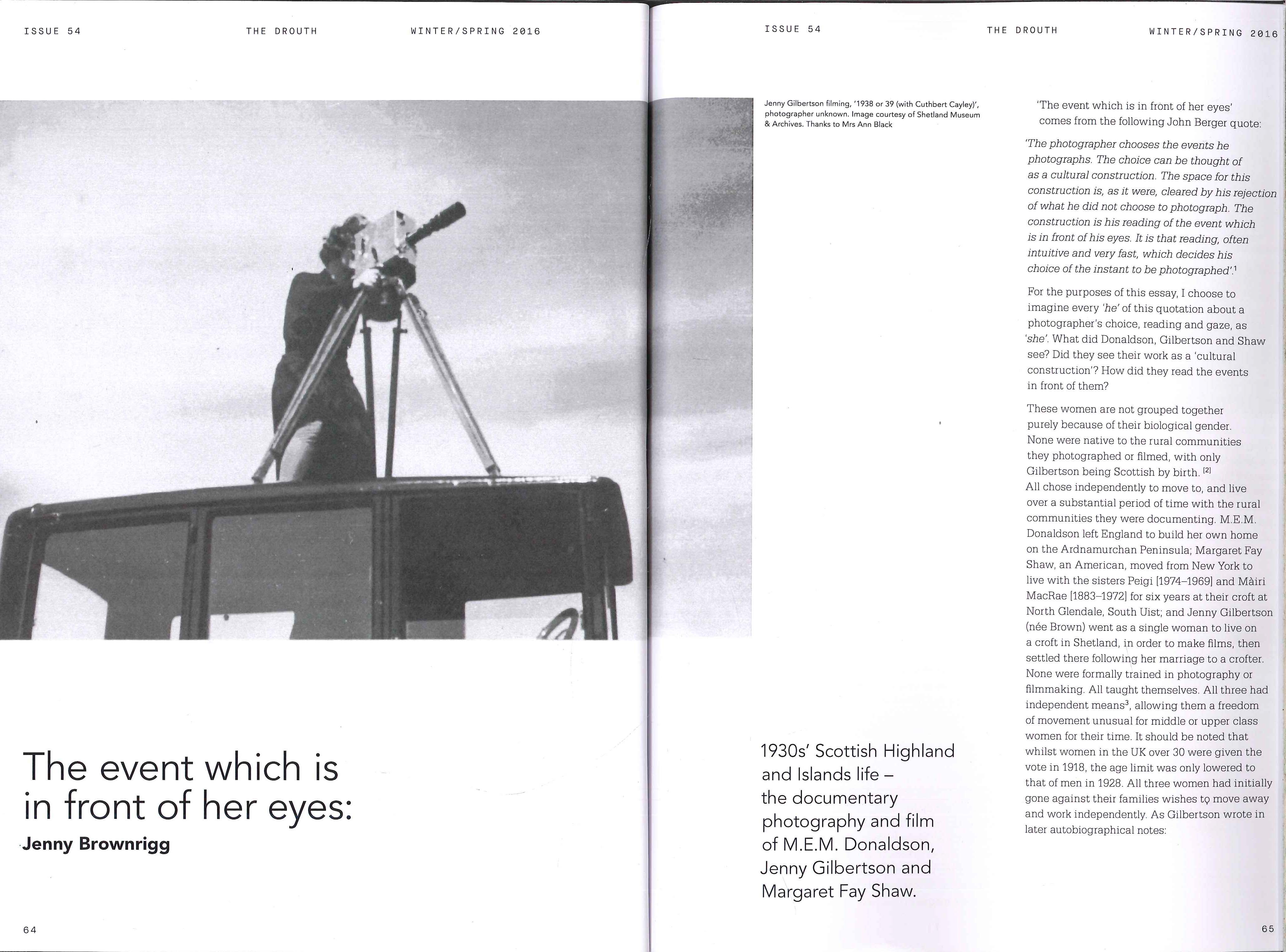
‘The event which is in front of her eyes: 1930s’ Scottish Highlands and Islands life – the documentary photography and film of M.E.M. Donaldson, Jenny Gilbertson and Margaret Fay Shaw

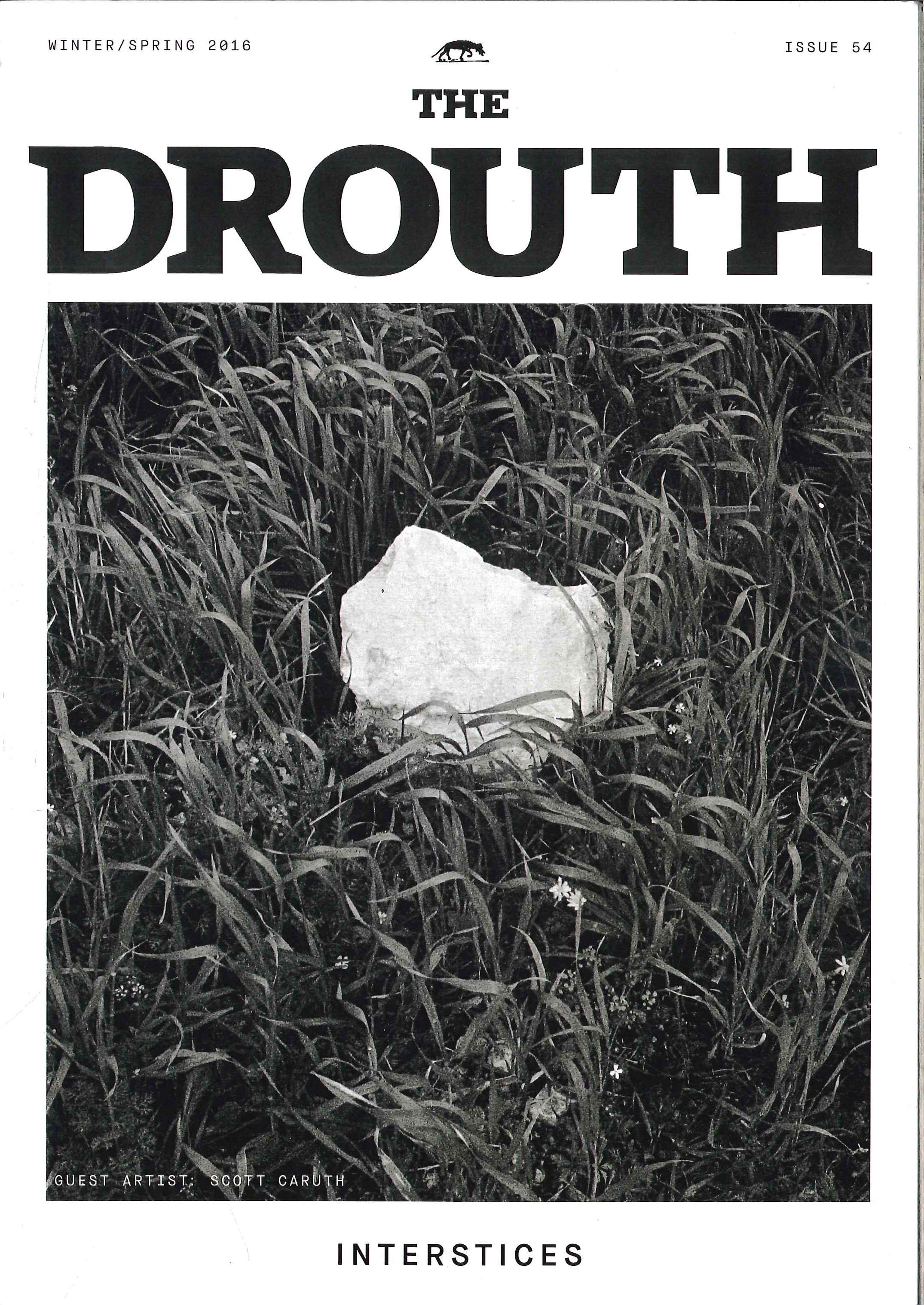
drouthcover

‘The event which is in front of her eyes: 1930s’ Scottish Highland and Islands life – the documentary photography and film of M.E.M. Donaldson, Jenny Gilbertson and Margaret Fay Shaw’, is my first essay to be published following Research Leave Oct-Dec 2015 from The Glasgow School of Art. The essay is published in The Drouth Winter / Spring 2016 Issue 54 ‘Interstices’, p64-82. ‘Interstices’ has been guest edited by Nina  Bacos and Ben Rush.  I am grateful to Shetland Museum & Archives, Mrs Ann Black, Canna House (National Trust for Scotland), Inverness Museum & Art Gallery and National Library of Scotland for permissions. Also to Shona Main, Dr Sarah Neely, Magdalena Sagarzazu,  Fiona Mackenzie and Lesley Junor for their support and knowledge.

The essay looks at the motivations of M.E.M. Donaldson, Jenny Gilbertson and Margaret Fay Shaw, for making the work they did; and how they represented the subject of Highland and Islands Scotland in front of their camera. Through comparison of their work and processes to their better known male contemporaries who were also documenting Scottish rural communities, I also frame their work in a wider national and international context of the documentary photography and film making of the inter-war years.

drouthtitlepages


Unknown's avatar

Alan Grieve: ‘Cemetery’ (2015)

Workspace, Dunfermline, 5 December 2015

Alan Grieve (2015)

Alan Grieve (2015)

Alan Grieve (2015)

Alan Grieve (2015)

The public art rolls past the bus on the way from Glasgow to Dunfermline. Yellow metal gills appear on each side of the embankment along the gateway to Cumbernauld, mirrored in mint green on departure. Roundabouts, the 1980s’ plinths for stainless steel aberrations, proliferate like daisies.

One of the passengers is deep in monologue. “She shut the door of the kitchen down and knocked that wall down. See the stairs? Take that bit of the wall down – get me, right? …Naw, naw, Sandra has got a false wall back to the stairs, so then, get what I mean? Sandra’s doors at an angle and that’s right back and she’s got her kitchen door there – and then they’ve half shut the wall – do you understand where I’m coming from…. Yer still coming up the stair. The wall’s there and she’s got her door put back at an angle.”  

The woman is beginning to get exasperated. Her friend who is sitting next to her is not following the intricacies of Sandra’s door alterations that gained her extra inches in the house layout. “Oh we’re at the seaside, girls”, she says sarcastically as the bus goes over the Kincardine bridge, with Longannet Generating Station in the foreground and the chimneys of Grangemouth Refinery on the far shore. “It would look much nicer with the sunshine out. Oh there it is! Glittering on the water!” A pause and a mindful moment for all on the bus.

The woman begins again. “I mean I cannae do it any more, I ‘m tired of it! I’ve had my ceilings all lowered and it’s plastered now. I can’t take them out like Sandra has. I’m getting older, I cannae just…” We pass a bearded man in a red top standing in a lay-by. He is videoing a field with his camera arm aloft. The field doesn’t look too extraordinary. He is in his own mindful moment.

~

Alan Grieve (2015)

Alan Grieve (2015)

Alan Grieve (2015)

Alan Grieve (2015)

I am on a trip to see Alan Grieve and find out more about his own approach to mindfulness linked with his new work about a cemetery in Dunfermline. If mindfulness is focusing on the breath in the body, there is nothing like a graveyard to help someone keep breathing and present. Alan passes through the cemetery every day when walking his dogs or on his way to work. Like the nuanced altering of angles of Sandra’s doors, much of Alan’s work is about making small yet satisfying shifts in language, drawing and object making. The subject of the graveyard is proving to be highly conducive for moving meaning from one realm into the next. He shows me his sketchbook. A page is emblazoned in felt tip with the phrase “Who put the fun in funeral?” He explains that he has been considering this as the title for the book he is working on, but other people he had tested it out on thought it too much.

Alan Grieve (2015)

Alan Grieve (2015)

Alan is an adult man who has been thinking about colouring-in of late. He is not alone, as companies have re-spun kids’ colouring-in books for ‘grown-ups’, providing nostalgia to those who grew up in the sixties and seventies’ and are now stressed in the noughties. Mindfulness, a concept not readily known to most Scottish households before the Millennium is on the increase. Using his boys’ felt tip pens, Alan has been making drawings for the last two months, in the quiet time every morning before his kids and wife gets up.

Alan Grieve (2015)

Alan Grieve (2015)

Alan Grieve (2015)

Alan Grieve (2015)

Alan Grieve (2015)

Alan Grieve (2015)

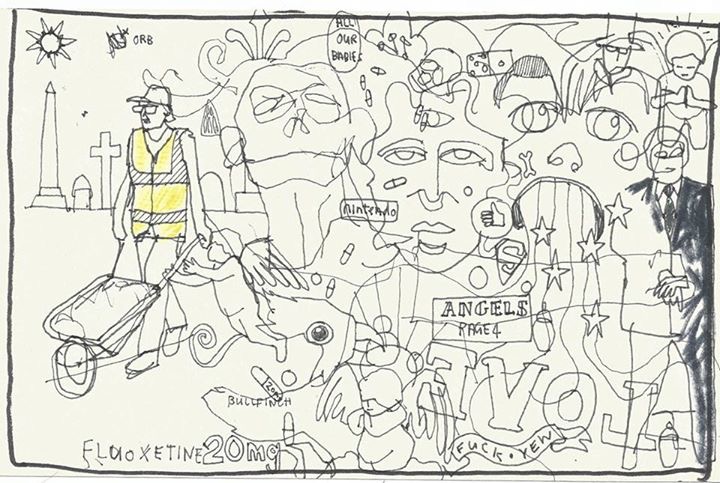
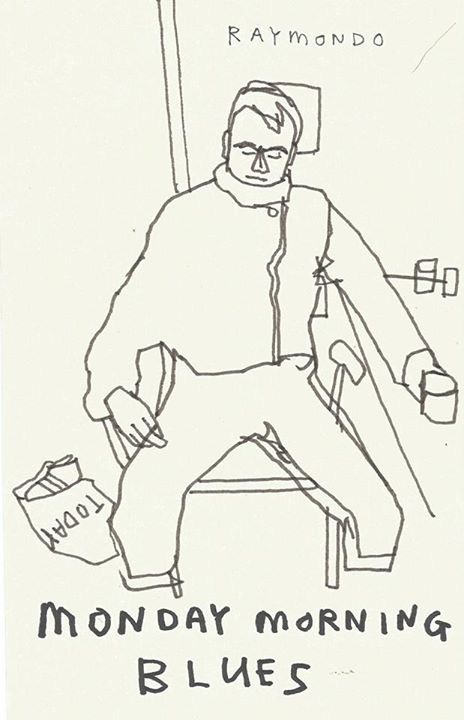
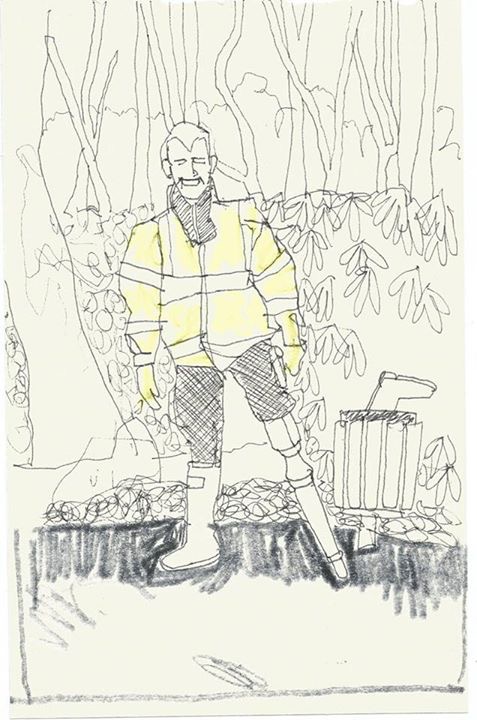
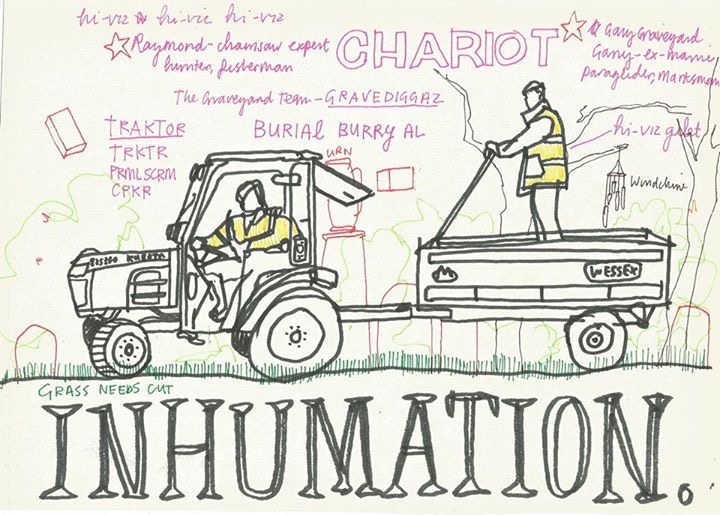
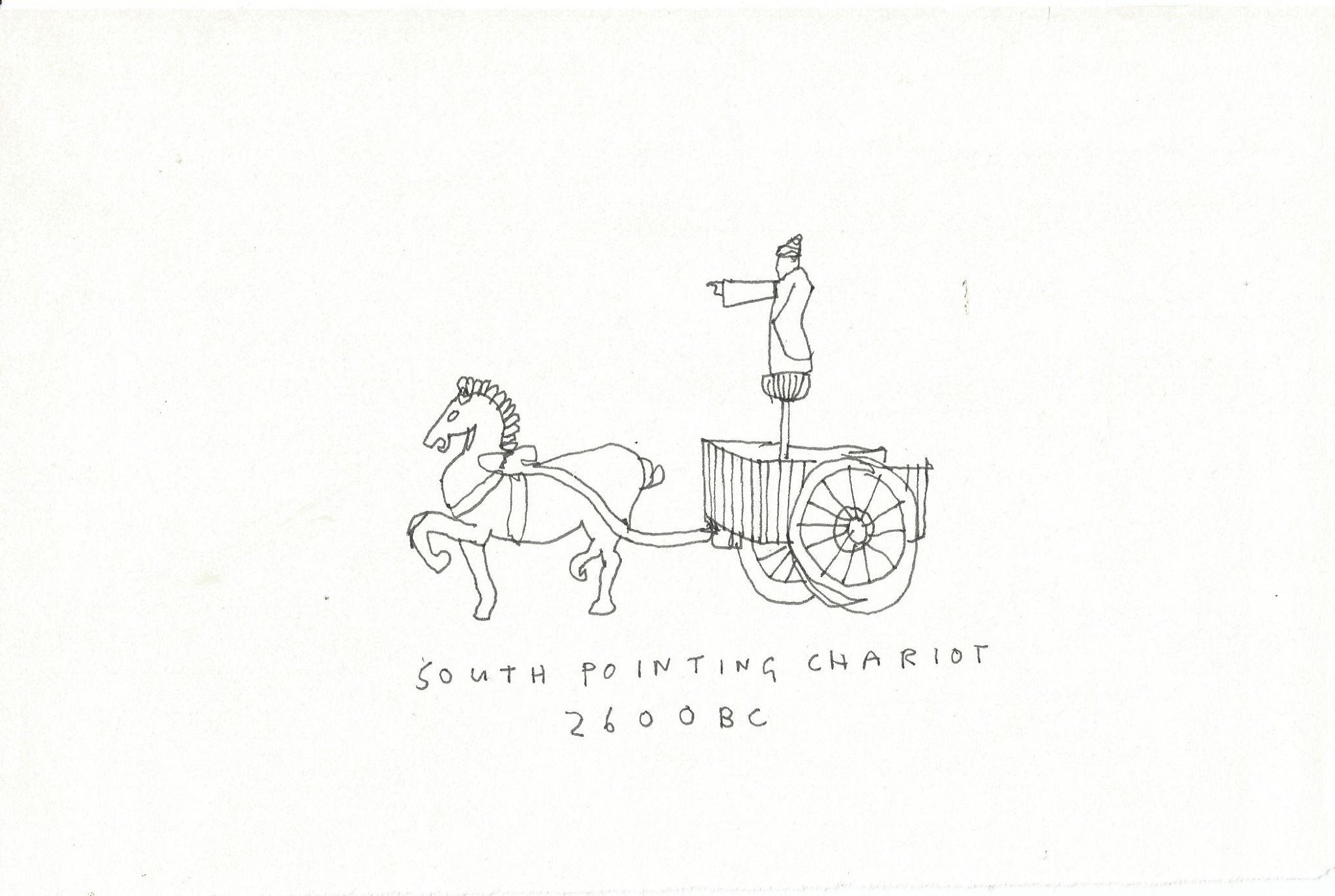
The drawings are multiplying- creating their own universe- and are a tour de force. A core of the work is dedicated to the graveyard operatives Raymond and Garry, with whom Alan speaks in passing every day. Bringing the two men centre stage is a key component, as this is a role which otherwise would normally fade into the background. In one drawing, Alan shows gravedigger as gladiator, riding the trailer around the huge graveyard as if it were a chariot. He also captures the more mundane moments such as the younger gravedigger nursing a Monday hangover. The veil between this life and the next is shown as the spirits stream behind the older grave digger who pushes a wheelbarrow in his council hi-vis vest.

Alan Grieve (2015)

Alan Grieve (2015)

Alan Grieve (2015)

Alan Grieve (2015) million

Alan Grieve (2015)

Alan Grieve (2015)

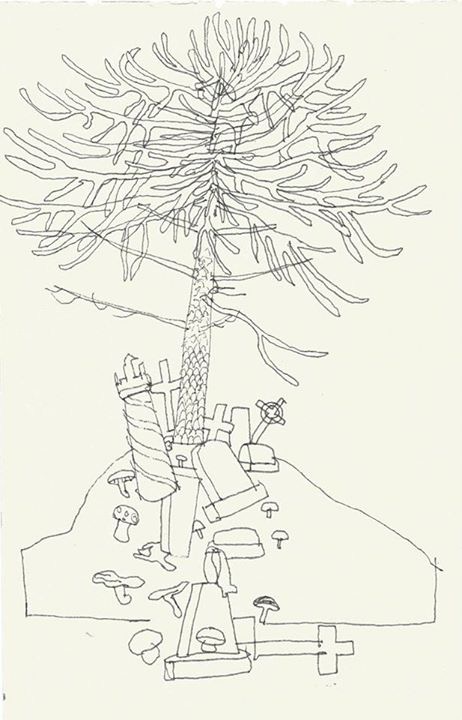
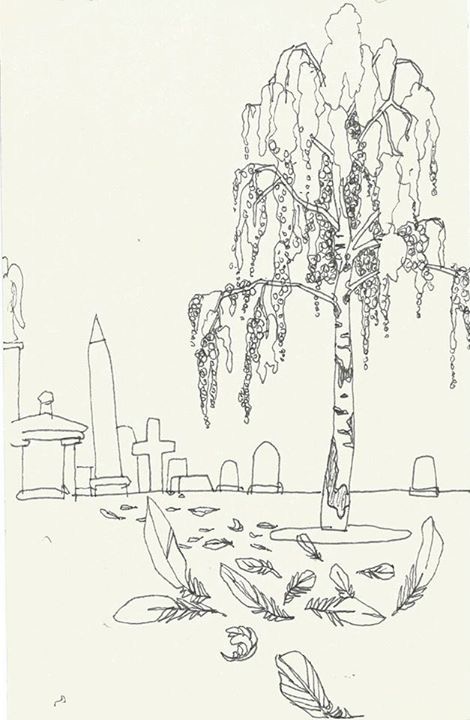
The trees, the play of light on the leaves, the animals, the stonemasonry, the unusual names and stories. It can be quite easy for the brain to slide away from the real purpose of the cemetery. Mindfulness here is mortality, so Alan ensures fresh death is never too far away in the drawings. Some feathers litter the foreground of a pastoral scene with weeping willow and gravestones. A candle is lit for all the unborn babies. Alan’s drawing skills are a joy to behold, ranging from the juvenile with an adult’s knowing (like those drawn by bad boys on the back of girls’ school jotters), to technically excellent renditions of stained glass windows in three thicknesses of pen.

Alan Grieve (2015)

Alan Grieve (2015)

Alan Grieve (2015)

Alan Grieve (2015)

Alan Grieve (2015)

Alan Grieve (2015)

Alan Grieve (2015)

Alan Grieve (2015)

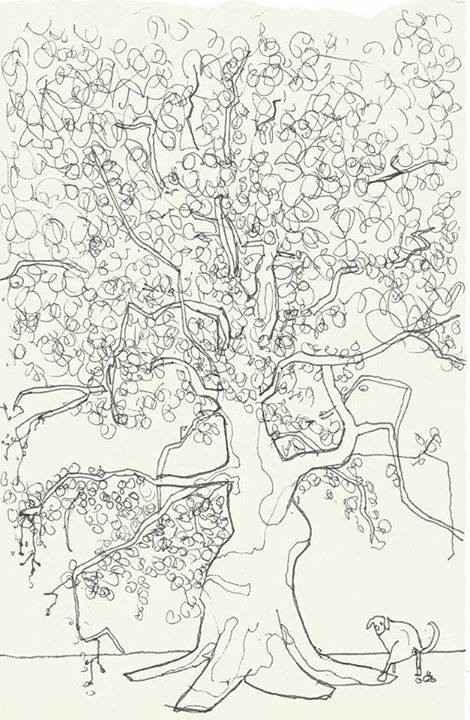
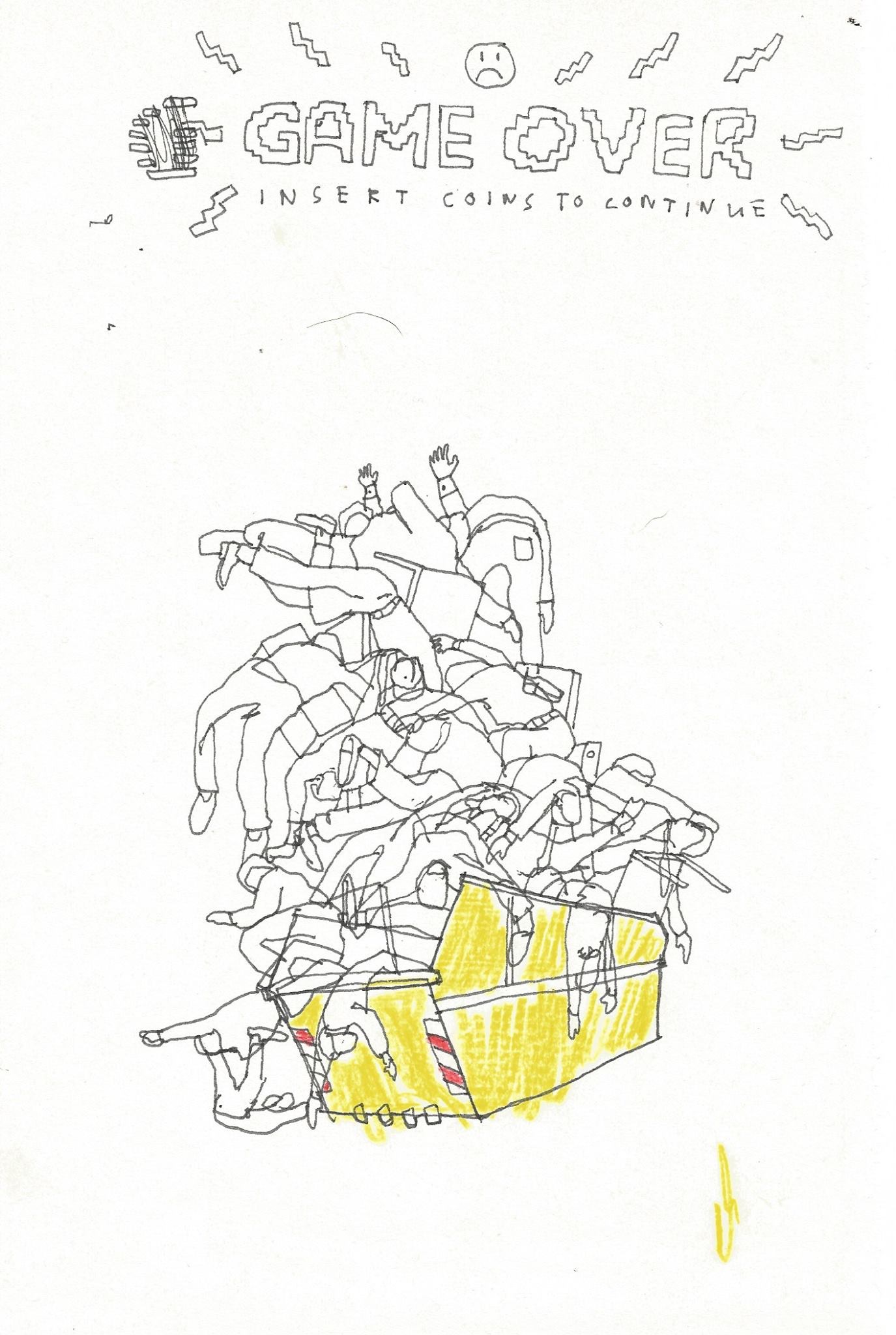
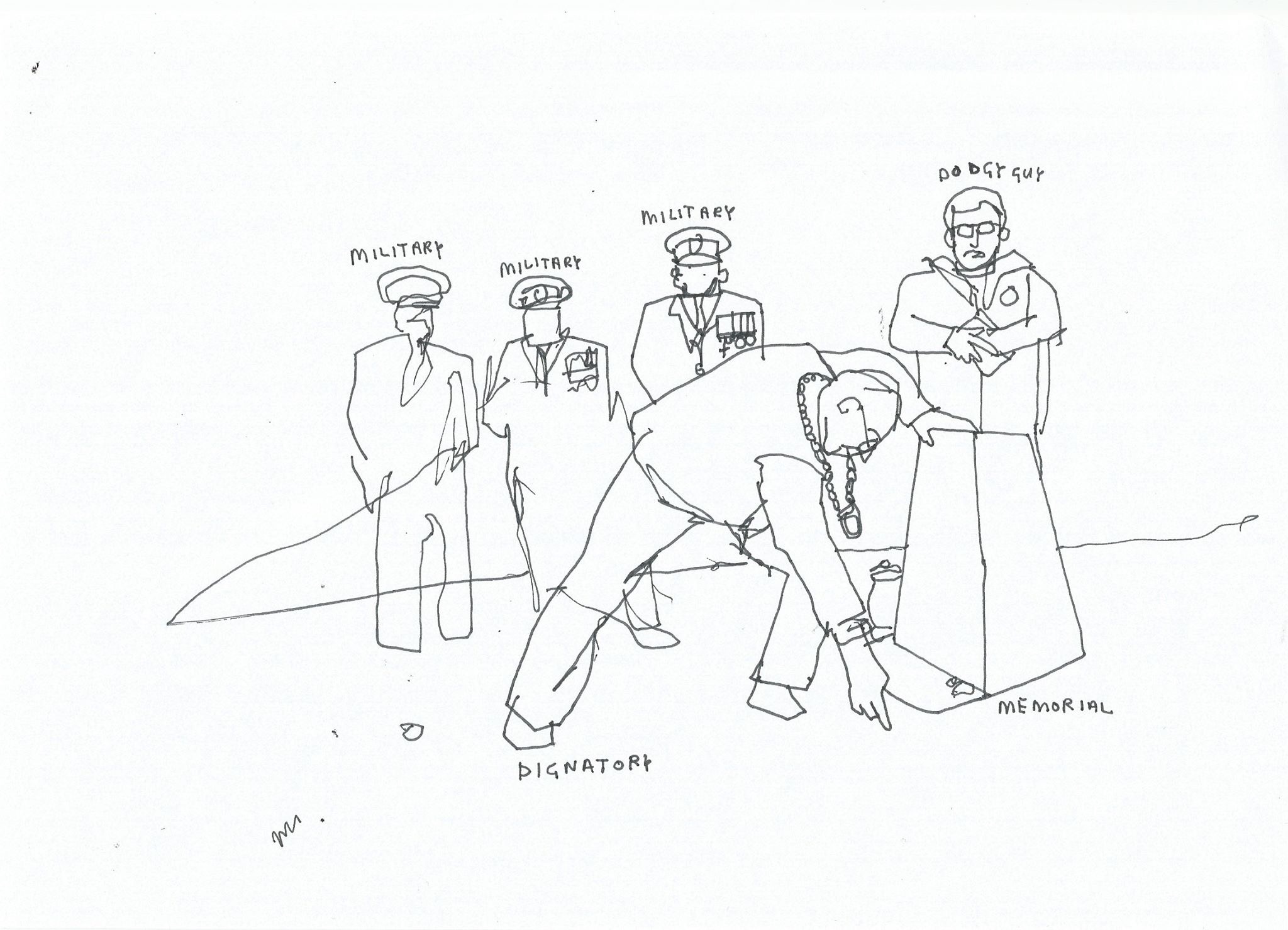
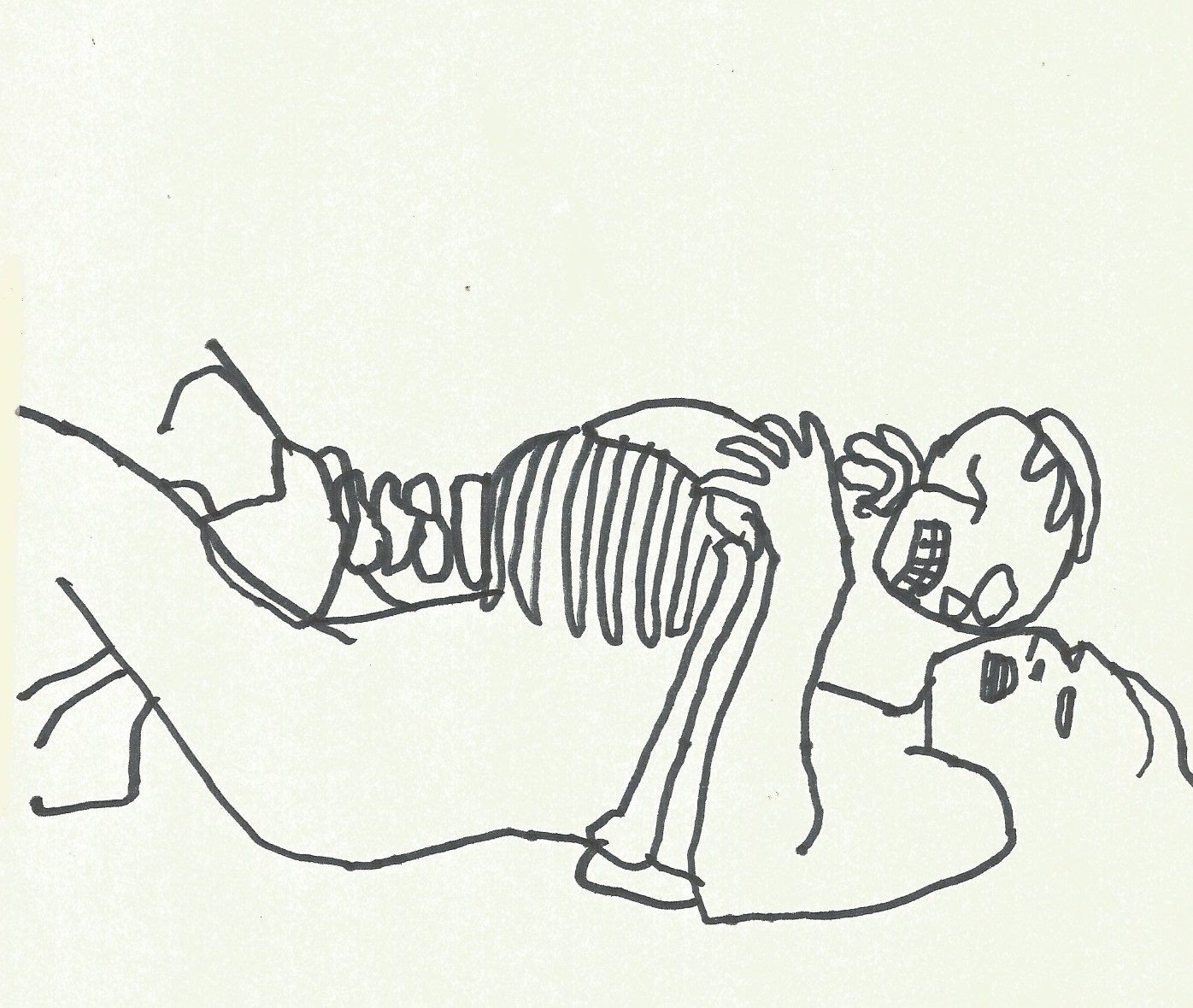
There are some I wish I could un-see such as the skeleton locked in a carnal embrace with a human. The macabre is ever-present. A council skip overflows with dead bodies under the Pac Man motif ‘GAME OVER’. Other drawings are delightfully observational; a dignitary with a bad back uses the memorial headstone to bend down and place something on the ground. A beautiful old oak tree is captured in its glory, but look down to the right of its trunk and a Labrador is defecating. The scourge of pavements and graveyards it seems, is not picking up.

Alan Grieve (2015)

Alan Grieve (2015)

Alan Grieve (2015)

Alan Grieve (2015)

Alan Grieve (2015)

Alan Grieve (2015)

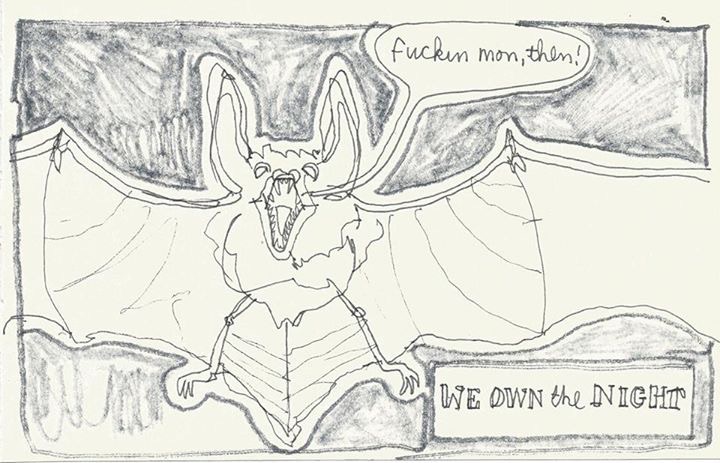
Even the animals of the graveyard are not always nice. Whilst some are sage, offering words of wisdom to the humans, others are plain ‘raj’. ’Fuckin’ mon then!’: a bat screams as it gives a full frontal to the viewer. Epitaphs are freed from celebrity gravestones. A hawk appears next to Spike Milligan’s ‘I told you I was ill’. There is a heightened sense of awareness in some of the drawings. Caught in an awkward cycle, a naked young man kneels amongst the toadstools, reaching out with an urn in his hand to catch the shite from a bird sitting above him on a branch, whilst a rabbit looks on. In another, the moon and sun explore their senses together, nestling in to kiss with no tongues. These are hallucinogenic scenes but contain their own sense of order.

Alan Grieve (2015)

Alan Grieve (2015)

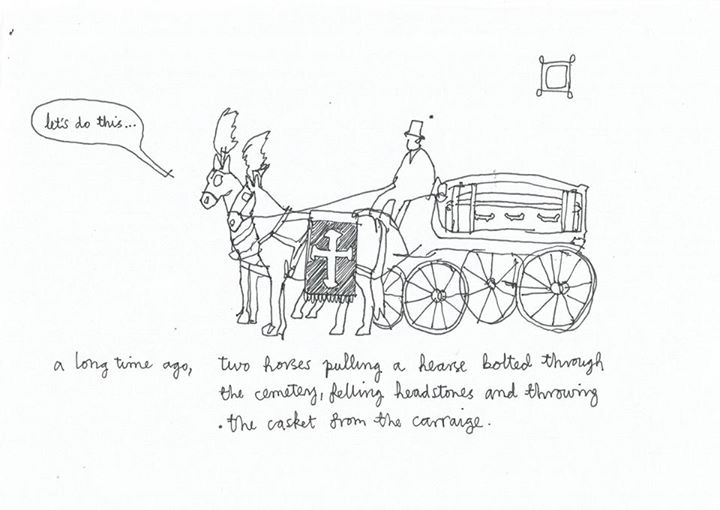
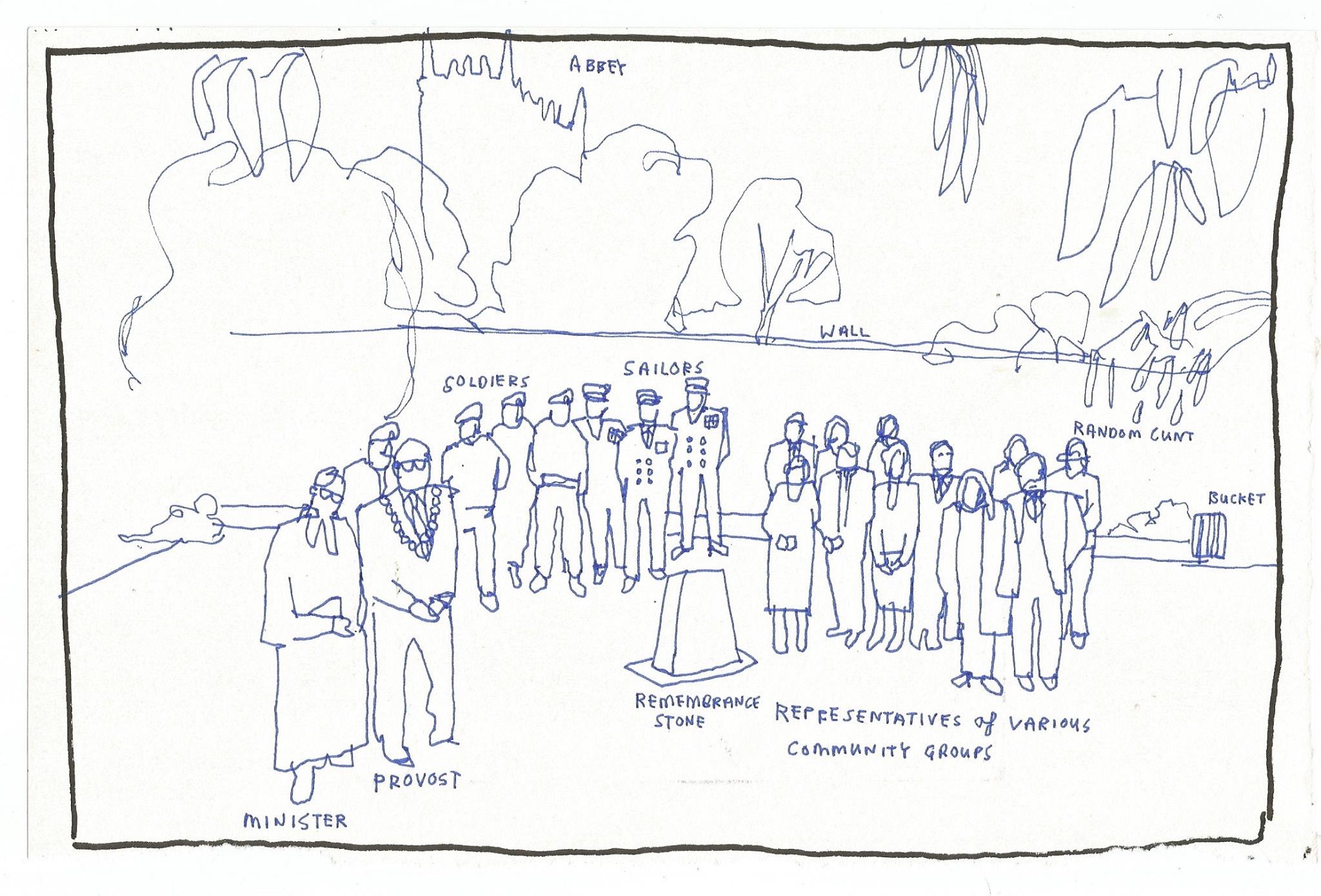
Whilst order can also be found within the graveyard- the lines of graves and neat grass edges- there is no getting away from the disorder of death even down to the detail of who turns up at your funeral or how you get there. In one drawing, a man uses a Vauxhall Chevette estate to bring his wife’s coffin in to the cemetery. This was a story Alan heard from the gravedigger. In another, the Provost, Minister, and representatives of various community groups stand dignified at a Remembrance Day service. Alan has helpfully detailed each group with their nomenclature. In the back of the crowd one man is labelled with the title ‘random cunt’. There is definitely a contemporary gallows’ humour lurking within the work.

Alan Grieve (2015)

Alan Grieve (2015)

Alan Grieve (2015)

Alan Grieve (2015)

Alan Grieve (2015)

Alan Grieve (2015)

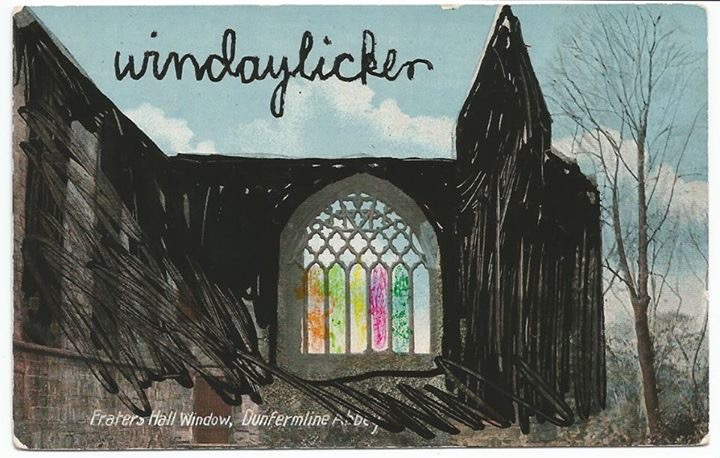
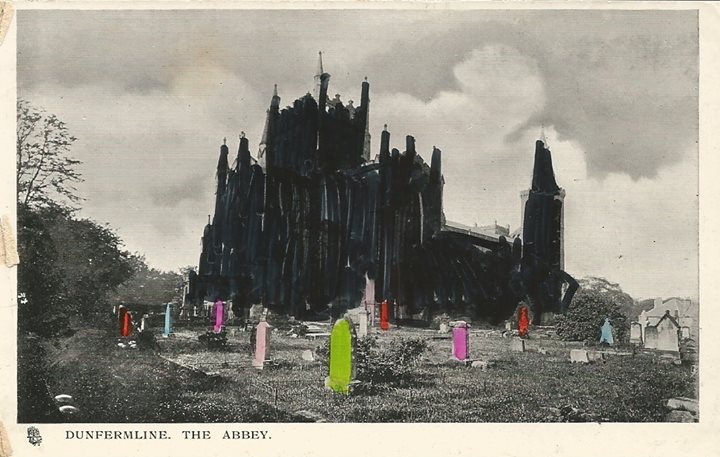
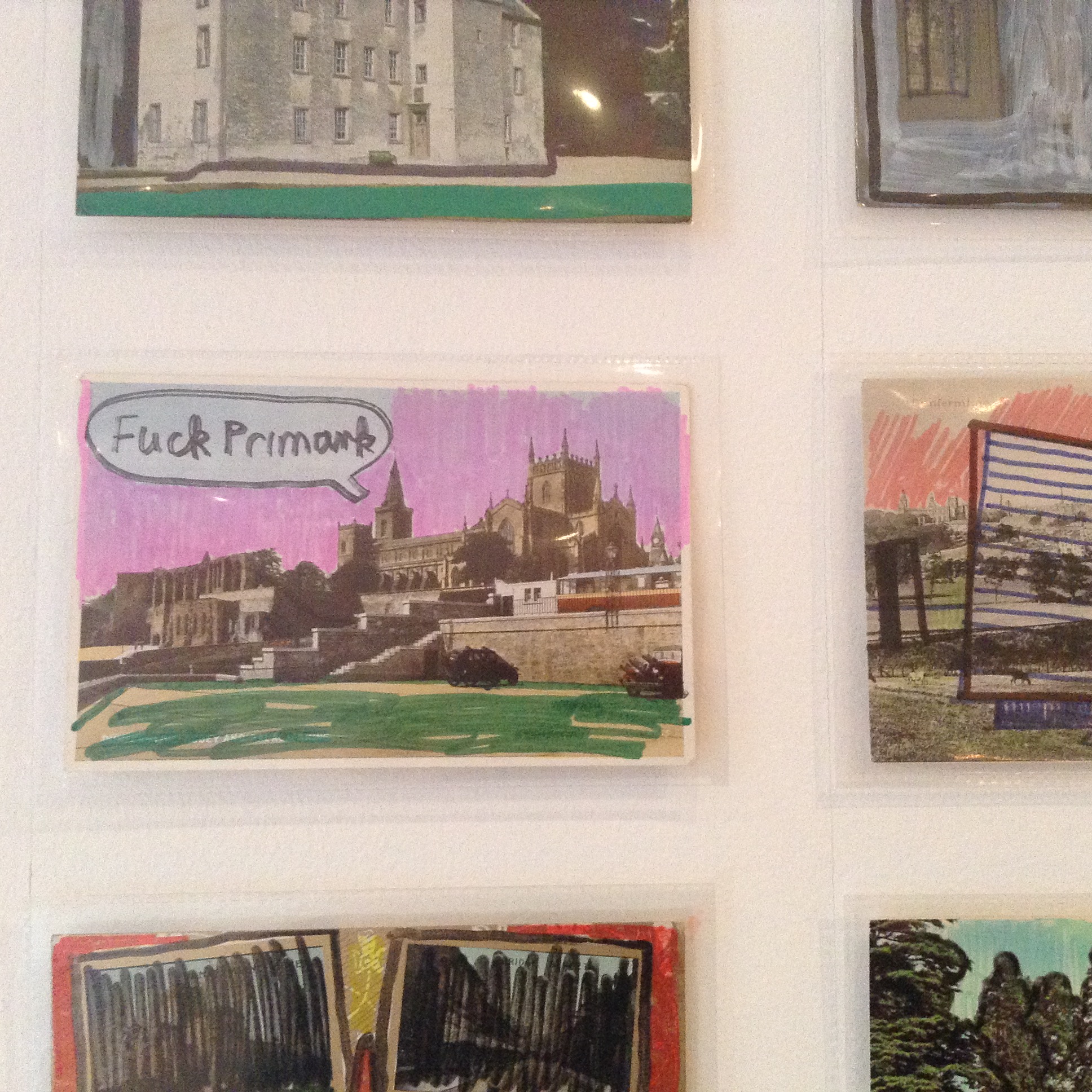
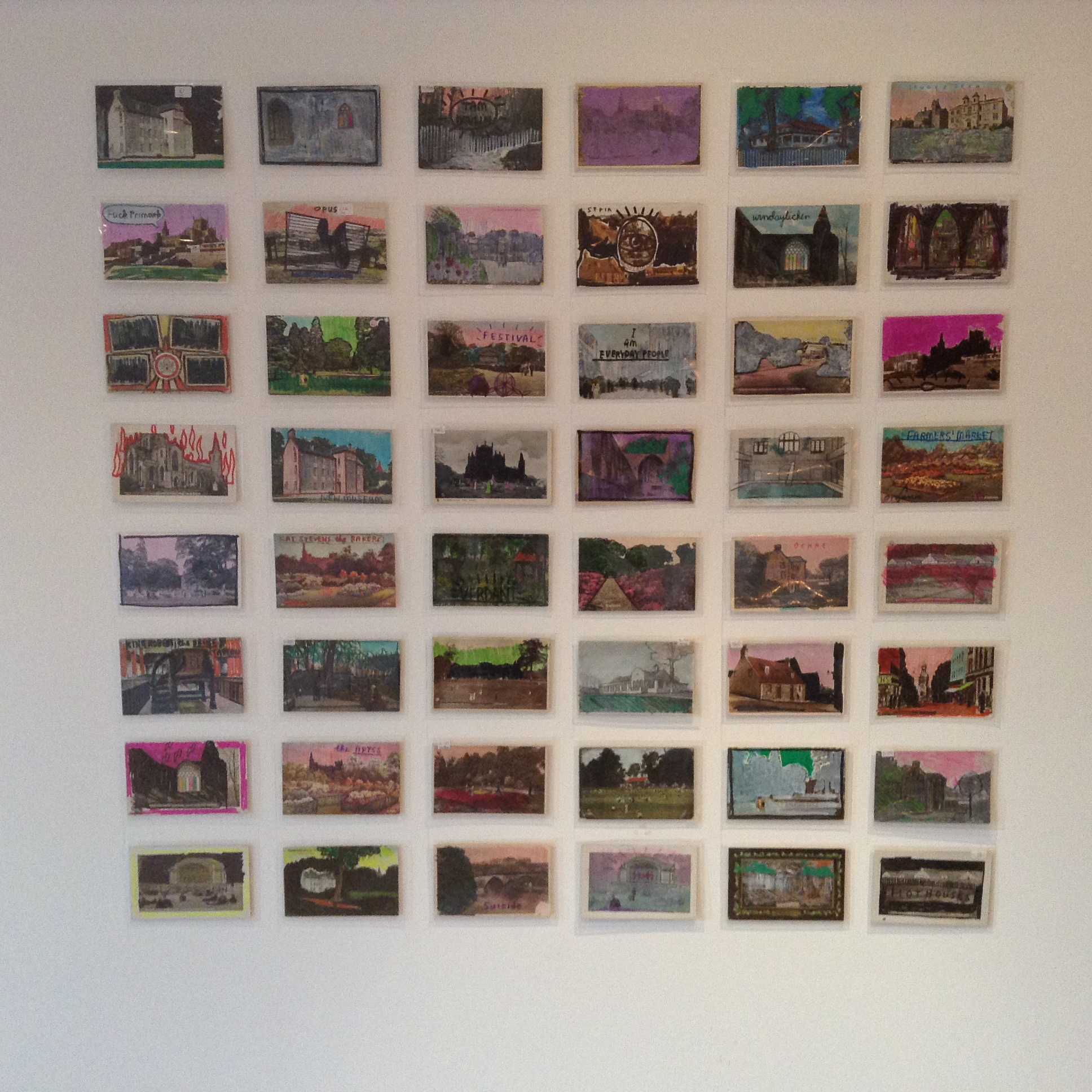
In a second strand of work, scenes of old Dunfermline depicted on old black and white postcards are helped into a trance with Alan’s bold colouring in. Frater’s Hall window panes are treated to the full range of post-it note colours of orange, green, yellow and pink. This stained glass rendering for the modern day church enthusiast is emblazoned with the colloquial epitaph of ‘windaylicker’. In another postcard, Dunfermline Abbey is cast as a version of the Emerald City with rave neon headstones.

Alan Grieve (2015)

Alan Grieve (2015)

Alan Grieve (2015)

Alan Grieve (2015)

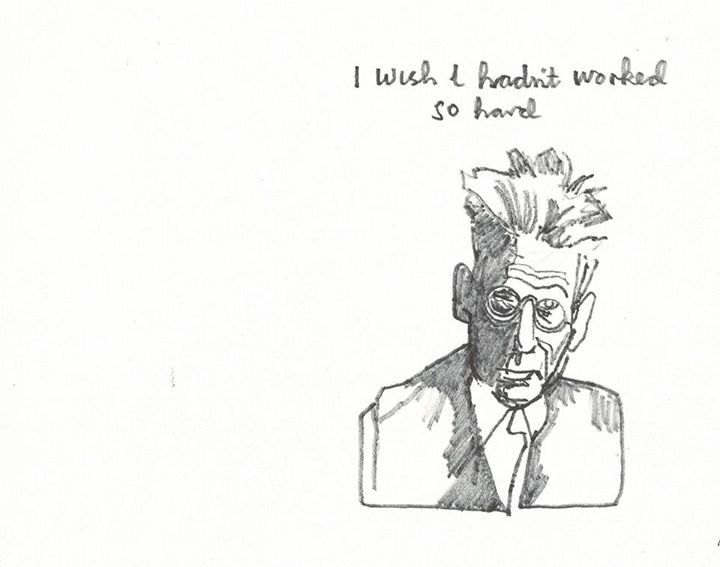
Alan gives mindfulness a reality check. The phrase, ‘I wish I had the courage to live a life true to myself, not the life others expected of me’, would perhaps be expected as an insight from the pages of Psychologies magazine, illustrated by a pensive blonde haired Nordic woman with her eyes on Nirvana. In Alan’s drawing however, it is accompanied by a cheerful man with a heightened fringe aided by hair product. He is denoted as a worker as he wears a high-vis jacket. I like this, for whilst being gently subversive it shifts the kind of person such a declaration could be associated with. It also firmly places philosophy in the domain of everyone, not just those that have the luxury of time. Death, as the old adage goes, is the greatest leveller.

Alan Grieve (2015)

Alan Grieve (2015)

Alan Grieve (2015)

Alan Grieve (2015)

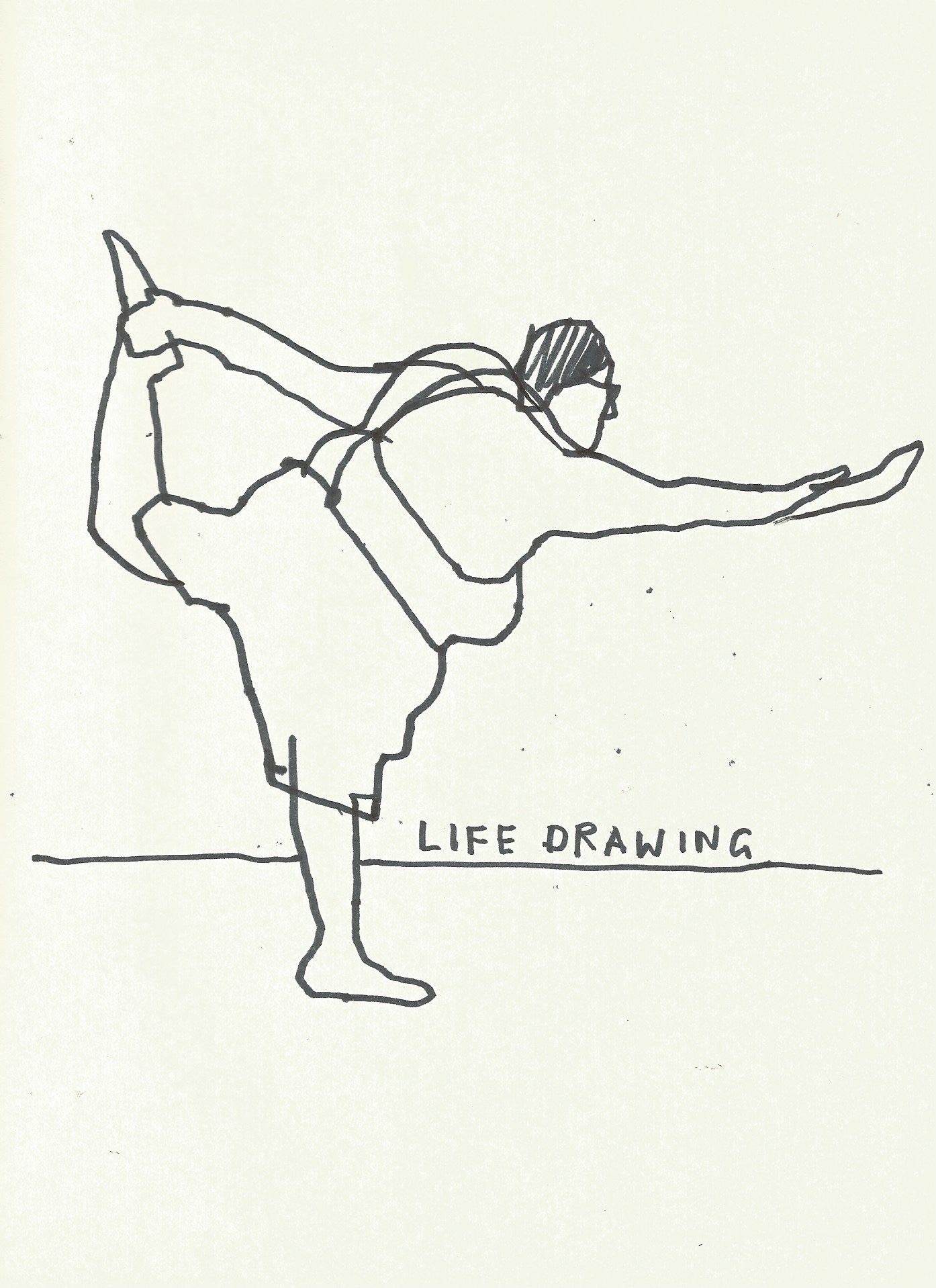
Alan’s stream of drawings are like the thoughts and feelings that occur from one moment to the next. Given the sheer exuberance and cacophony of voices that inhabit Alan’s cosmos, this mayhem could defy the calmness of mindfulness. However, to look at the drawings such as ‘Man with head in his hands’ (2015) or ‘Life Drawing’ (2015) where the pen does not come off the paper, there is the same kind of perfection of focus and concentration on the line rather than the breath. Some may quake at the foul language or perceive that some of the imagery is disrespectful in its mash-up of beliefs, but this loss of control or undermining of order cannot be ignored. It is fully present in the lives that we lead and the manner of that which awaits us. Simon Critchley’s excellent ‘The Book of Dead Philosophers’ (2008, Granta Books) details what the great philosophers wrote about death next to how they actually died. For example, Roland Barthes got run over by a laundry truck.

Alan Grieve (2015)

Alan Grieve (2015)

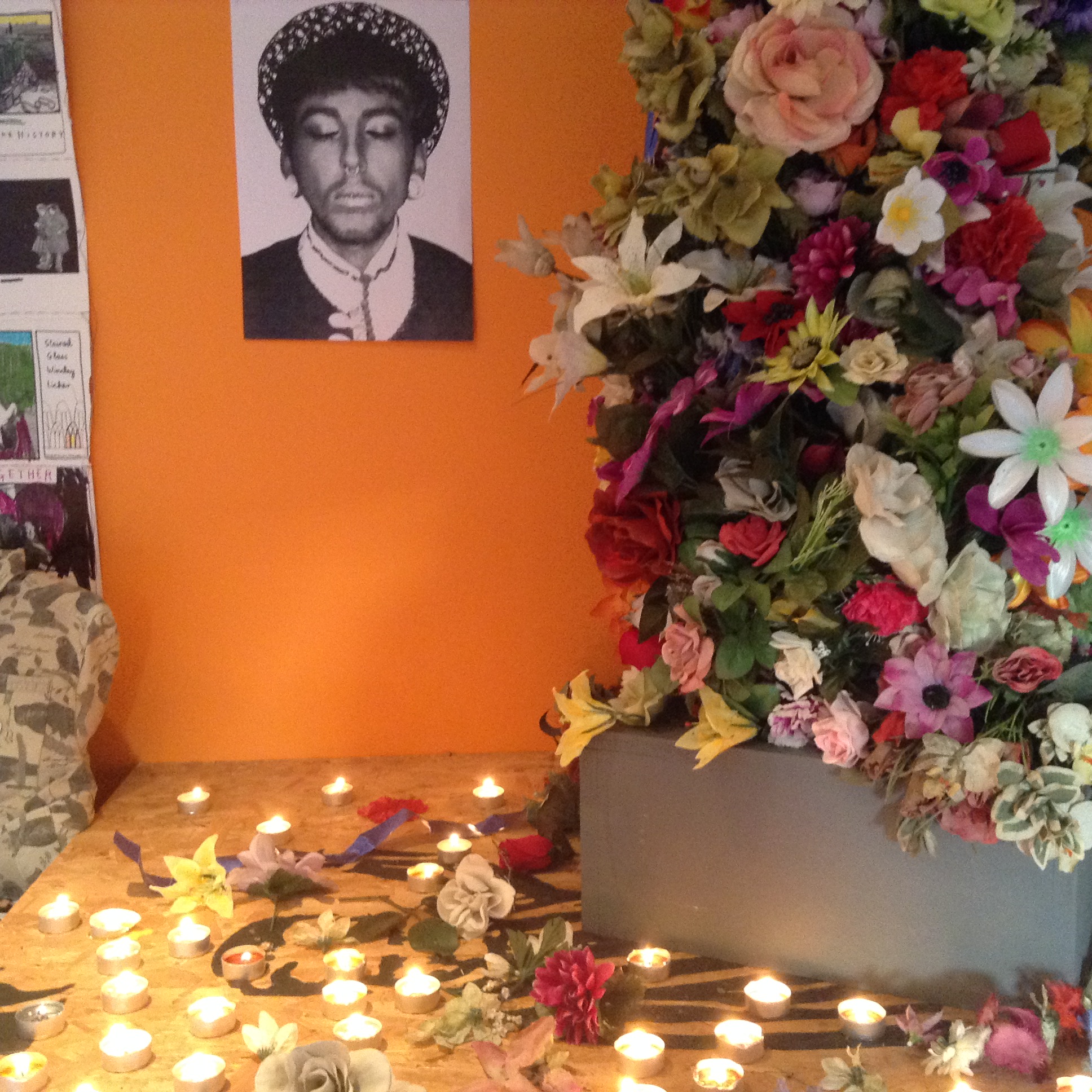
The exhibition ‘Cemetery’ and a mindful evening event were held at Workspace, a hairdressers and gallery that Alan set up with fellow hairdresser Emma McGarry in 2011, the same year as Hurricane Bawbag hit Scotland. Indeed, ‘Bawbag Memorial’ (2014-15) forms the centrepiece. It is a monument crafted from all the plastic flowers unmoored and blown amok in the Dunfermline cemetery during the winter hurricane that became an internet sensation due to its irreverent name. The plastic flowers will never die. This outsize floral tribute, reaches to the ceiling from its specially built platform. It is surrounded at its base by tea tree lights; that fragile marker of a departed soul, ubiquitous with church alters, make-shift street shrines and massage parlours. This is all set off by the saffron robe orange of the specially painted back wall and a single monochromatic collage called Deity, of Alan’s own young colleague James, who is angelic in his page boy haircut, nose ring and flesh tunnels. On the wall to the right, there is a huge mandala-like drawing completed in chunky black pen. It combines many of the images from the smaller drawings and is thoughtfully pinned up for the gallery goers to colour-in on the mindful night. Music by Dunfermline musician Dan Lyth permeates and amplifies the strange spiritual air in Workspace, encouraging the visitor to spiral into its repetitive groove.

'Cemetery', installation shot, Alan Grieve, Workspace, Dunfermline (2015)

‘Cemetery’, installation shot, Alan Grieve, Workspace, Dunfermline (2015)

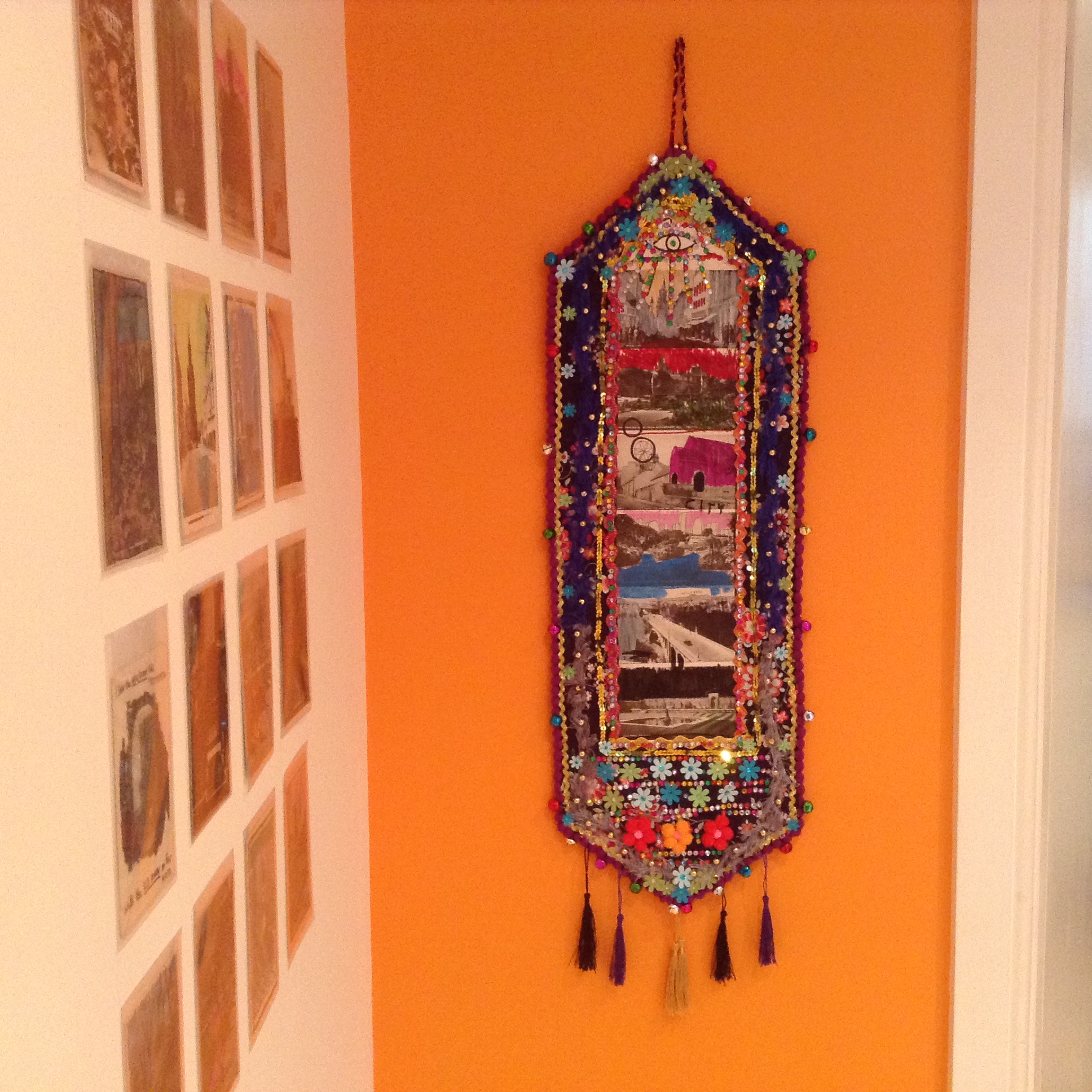
The full range of doctored Dunfermline postcards hang within a grid network. Many stand out as an alternative reading of some of the town’s better known architecture. In a futile act of resistance to modernity and consumerism a Gothic turret from the city centre shouts ‘Fuck Primark!’ En masse, Dunfermline is definitely at the centre of the universe. Alan has also worked with recent curatorial graduate Kari Adams to make a wall hanging comprising of six of the postcards. With an all seeing eye at its apex, the borders of this piece have been edged with sequins and beads, and tasselled at the bottom. Fetishizing the postcards in this way as a worshipful artefact, works in this atmosphere of the retreat. Workspace is by no means the first retreat in Dunfermline. The glen that lies at the centre of town boasts Malcolm Canmore’s tower and his wife Margaret’s cave, where she took to for prayer.

'Cemetery', installation shot, Alan Grieve (2015), Workspace, Dunfermline

‘Cemetery’, installation shot, Alan Grieve (2015), Workspace, Dunfermline

'Cemetery', installation shot, Alan Grieve (with Kari Adams), Workspace, Dunfermline (2015)

‘Cemetery’, installation shot, Alan Grieve (with Kari Adams), Workspace, Dunfermline (2015)

Detail, 'Cemetery', Alan Grieve (with Kari Adams), Workspace, Dunfermline (2015)

Detail, ‘Cemetery’, Alan Grieve (with Kari Adams), Workspace, Dunfermline (2015)

Installation Shot, 'Cemetery', Alan Grieve, Workspace, Dunfermline (2015)

Installation Shot, ‘Cemetery’, Alan Grieve, Workspace, Dunfermline (2015)

Alan Grieve (2015)

Alan Grieve (2015)

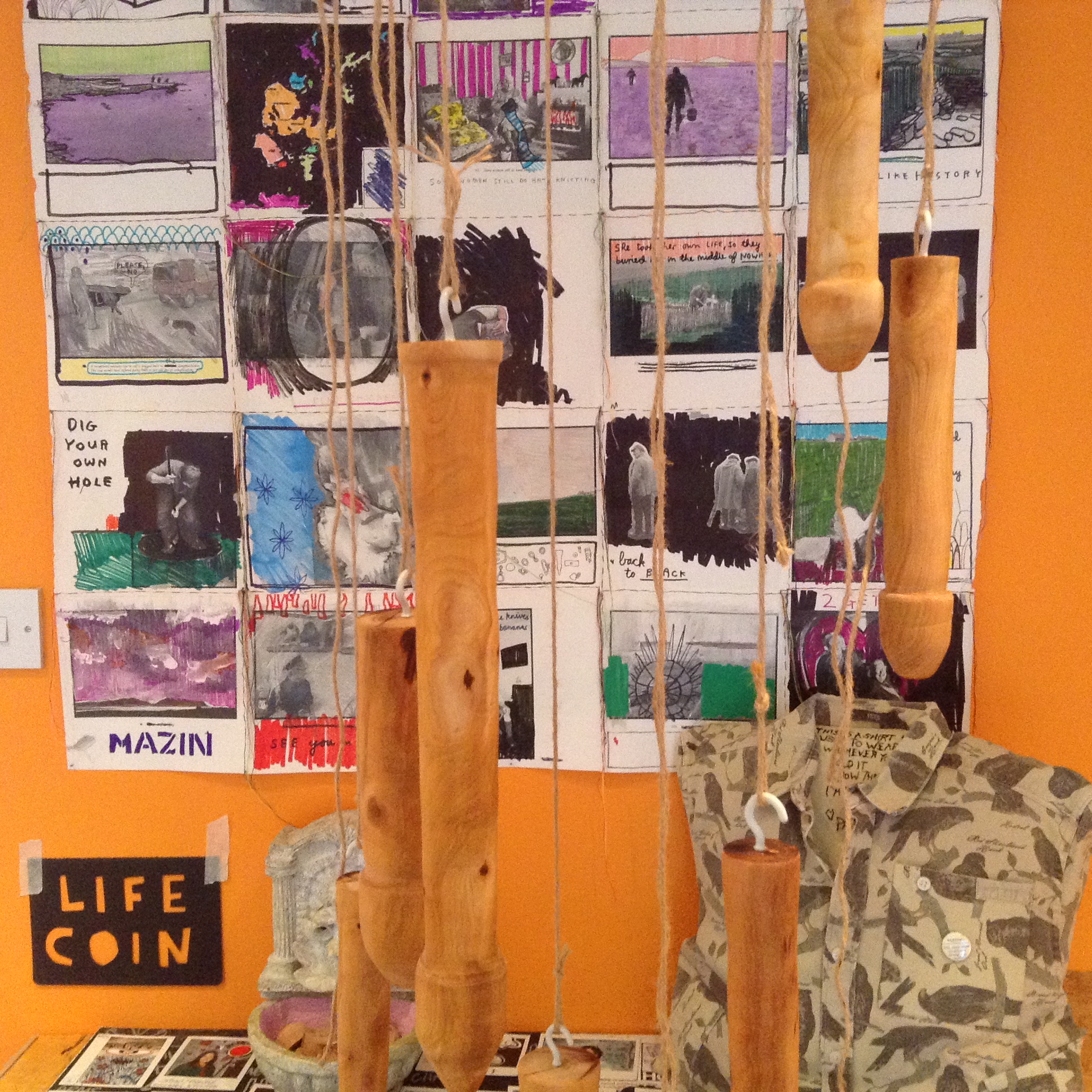
 The most unavoidable piece in this exhibition, ‘Wee Willy  Windchimes’ (2015) is satisfyingly hung bang in front of a sewn patchwork of drawings which are enticingly detailed, thus making the viewer strain forward to view them. The obstructive positioning of these phallic windchimes makes them nigh on impossible to ignore. Their adult nature has freed them from the original reference. The historic and sad gravestone of Willie Dick lies in the cemetery and tells of a child who was killed by a shotgun mistakenly going off. These windchimes have been fashioned from a felled cherry tree from the cemetery and have been turned at a local workshop. If they had been painted pink they would have been too cartoonlike but in their unadorned state the viewer cannot but help admire the craftsmanship of the polished wood. As a piece of work it symbolizes Alan’s ability to mix both the poetic and prosaic with the profane.

'Cemetery', installation shot, Alan Grieve, Workspace, Dunfermline (2015)

‘Cemetery’, installation shot, Alan Grieve, Workspace, Dunfermline (2015)

~

I’m back on the bus on this wintery day to return to Glasgow. It is pitch black outside and rush hour. The bus crawls its way back in a slow moving queue up to the Kincardine Bridge. Reflections from the car headlights from the other unclogged lane skite across the bus interior. The pristine bobbed woman in the seat front is talking at her mother down the phone, about whether a metal or plastic carrier would be better for her cat in the event of a crash (answer is metal). I require a mindful moment as this feels like it will be a long haul. As the cars in the other lane zip past they begin to sound like waves on a shore, regular and relaxing, with the trucks as the big breakers. The lights of the power station twinkle like tea tree lights through the petrified trunks of the forest.

Jenny Brownrigg, Dec 2015

Alan Grieve (2015)

Alan Grieve (2015)

Alan Grieve (2015)

Alan Grieve (2015)

Alan Grieve (2015)

Alan Grieve (2015)

Alan Grieve (2015)

Alan Grieve (2015)

Alan Grieve (2015)

Alan Grieve (2015)

Alan Grieve (2015)

Alan Grieve (2015)

Alan Grieve (2015)

Alan Grieve (2015)

Unknown's avatar

Research Note 3: M.E.M. Donaldson – Inverness research visit, November 2015

Into the landscape, M.E.M. Donaldson

M.E.M. Donaldson Collection, Inverness Museum & Art Gallery Photo: Jenny Brownrigg

M.E.M. Donaldson Collection, Inverness Museum & Art Gallery Photo: Jenny Brownrigg

Over one thousand photographs by author and photographer Mary Ethel Muir Donaldson [1876-1958] are held by Inverness Museum and Art Gallery as part of the Highland Photographic Archive . The collection was gifted by the widow of Donaldson’s biographer and custodian John Telfer Dunbar.  Inverness Museum and Art Gallery holds Donaldson’s landscape photography, whilst National Museums Scotland has the original negatives and prints of the portraits she took of the people she encountered over the Scottish Highlands and islands.[2]

For the purposes of this post, I would like to concentrate on the Inverness part of the collection. Out of the three women I am researching- M.E.M. Donaldson, Margaret Fay Shaw and Jenny Gilbertson – Donaldson covered the widest range of Scottish landscapes and locations. Donaldson wrote guides, for which her photographs often illustrated, including ‘Wandering in the Western Highlands and Islands‘ (1921) and ‘Further Wanderings-Mainly in Argyll’ (1926).  In the Inverness collection, island locations include Eigg, Skye, Oransay, Colonsay, Islay, Jura and Iona. From the Highlands there are photographs of Kintyre, Kintail, Wester Ross, Appin, Arisaig, Glen Affric, Lochaline, Loch Linnhe, Ballachuilish, Kingussie, Glen Affric, Roy Bridge, Knapdale, Morvern, down into the Trossachs. The collection also has a focus on Ardnamurchan, in particular at Sanna, where Donaldson built her house in 1927, complete with photography studio, and lived there until 1947. [3]

Whilst looking through the Inverness Collection, at landscape after landscape, I began to think of Nan Shepherd [1893-1981] who wrote about the experience of the landscape being a physical and psychological journey ‘into’ (in Shepherd’s case, the Cairngorms) rather than merely a simple passage over on the way to an endpoint. Using this reading, Donaldson’s landscapes are not composed as passive views to be looked at; they are to be journeyed into. The photographs circle lochans, dip into glens and cross plateaus. In particular ‘In Glen Carrich’ has a sequence of photographs that show the terrain unfolding. The eye traces the route in front of the camera, spotting the gap in the stones in the foreground, cutting round the corner of a rocky mound, tracking left around the hill with the three trees to the hidden landscape beyond. In others, a device such as a meandering burn, an intermittent path or rough track takes you further into the photograph. Donaldson wrote:

‘Certainly to a lover of the wild, the monotony a level stretch of high road, with its dull, even surface, doubles the distance, while the interest of a constantly varied and often ill-defined track, full of surprises and with a  marked individuality, seems actually to halve the distance.’[P.142]

The sharpness of Donaldson’s photographs also encourages this level of active looking. From her photographs in the Cuillins, the lines of the ravines on the flanks of the mountains in the background are as precise as the sheen of the wet stones of the plateau that gently coruscate in the foreground. Shepherd describes a changing the focus of the eye, and the ego, to see the landscape anew: ‘As I watch, it arches its back and each layer of landscape bristles… Details are no longer part of a grouping of a picture around which I am the focal point, the focal point is everywhere… This is how the earth must see itself.’[5]

Shepherd talks in ‘The Living Mountain’ [6] of the mountains having an ‘inside’. Throughout the Inverness collection of Donaldson’s photographs there is a series of studies of cave mouths including Cathedral Cave and St Francis’ Cave on Eigg, Fingal’s Cave in Staffa and Prince Charlie’s Cave , at Ceannacroc, Glenmoriston. Whilst Donaldson undoubtedly visited the caves for their history and associated stories for her books, the photographs themselves, freed of titles and any references again suggest the desire to go ‘into’ the landscape. Indeed, one portrait of MEM Donaldson, shows her with just head and shoulders remaining above ground. The other people who are in these photographs really inhabit the landscape too. Caught in the middle distance or far distance, any figure that appears in the Inverness collection is part of the landscape that surrounds them. A tall, thin man stands in the empty ‘o’ created by a rock formation. Two people are mysteriously held in the deep channel created by two massive boulders.
How does Donaldson’s photographic treatment of the highlander or islander differ in the Inverness part of the collection from the portraits in Edinburgh? In one Edinburgh example, there is a close up in profile view of a seaweed gatherer, bent with the weight of the load he carries in a basket on his back. In another photograph from the Inverness collection, Donaldson has zoomed out, placing this figure in the landscape. His figure can been made out on the beach, framed by rocks in the foreground, and showing the contours of the island of Rum beyond. By reducing the scale of the figure and placing him within the landscape, as the viewer we see how far he must walk, and therefore the physicality and difficulty of his labour.

Shepherd writes of an embodied knowledge, where touch, taste and experience are the agents of her understanding the environment. Donaldson also placed an emphasis on a physical sense of her body, and often mind, in the landscape. Her books ‘Wanderings of the Western Isles’ and ‘‘Further Wanderings-Mainly in Argyll’ are full of descriptions of how she traverses different terrain.  In her fictional book ‘Islesmen of Bride’ (1922, Alexander Gardner, Paisley), the unnamed narrator who is the main protagonist could be read as intriguingly genderless, with other characters never refer to the narrator as a man or woman. The narrator takes on the rowing of the boat to the island ferry for a summer, is involved in heavy labour and crosses great stretches of the islands on foot.  Donaldson’s own desire to walk and be active can be directly aligned with her own sense of freedom, which was thwarted in her childhood as she was a female. In 1929, she wrote to Marion Lochhead:

‘I have always had a hard life, for I never was one who could fall into any sort of conventional moulds… My fervent desire in those days was to be a boy who could run away and be a gypsy always living in the open.‘ [7]

Her landscape photography therefore takes on poignancy, as a place where Donaldson felt closest to her ‘founding spirits’. [8] Again in ‘Wanderings of the Western Isles’ Donaldson writes:

‘The mountain lover finds solely amongst the mountains what the sailor finds alone upon the sea – that sense of limitless freedom so essential to the well-being of the free spirit – life in its purest, simplest, physical sense.’ [9]

It should be noted that whereas Shepherd referred to a more ambiguous presence in the landscape, Donaldson attributed all to ‘the Creator’ [10]. A deeply religious person, the landscape was, for her, the place she could experience and be closer to God.

Donaldson corrects Marion Lochhead at the conclusion of a follow-up letter, dated 18 June 1929, having read a draft of an article for ‘Bulletin’ that Lochhead had wrote on her:

“I who have never left these shores, have never thought of myself as a ‘traveler’, but having looked it up in the dictionary and see one definition to be ‘a wayfarer’, in that sense the description is correct“.

Shepherd’s journeying was to return to the mountain’s foot hills time and time again, rather than to aim only for the summit, in order to continue her deep reading and connection with her surroundings. Through Donaldson’s wayfaring, her landscape photography communicates the physicality of the walk, of carrying her camera out and above all, her sense of freedom.

Footnotes

[1] ‘Herself’, DUNBAR, J.T. (1980) 2nd Ed, Ticknor & Fields, New Haven and New York.

[2] National Library of Scotland also holds copies of the portraits as part of the John Telfer Dunbar Collection.

[3] Donaldson lived at Sanna Bheag until 1947, when a fire destroyed her home.

[4] P. 142, ‘Wanderings of the Western Isles’, DONALDSON, M.E.M. (1921), Alexander Gardner, Paisley.

[5] P.10-11, ‘The Living Mountain’, SHEPHERD, N. (2011) 3rd Edition Canongate Books

[6] Ibid. Shepherd wrote ‘The Living Mountain’ in 1945, but it was not published until 1977 by Aberdeen University Press.

[7] Letter from M.E.M. Donaldson, to Marion Lochhead, dated ‘St Columba’s Day, 1929’. Letter held by National Library of Scotland.

[8] Ibid.

[9] P. 141, ‘Wanderings of the Western Isles’, DONALDSON, M.E.M. (1921), Alexander Gardner, Paisley.

[10] P.141, Ibid.

Unknown's avatar

Research Note 2: Margaret Fay Shaw – Canna House research visit, November 2015

Salutations, Margaret Fay Shaw

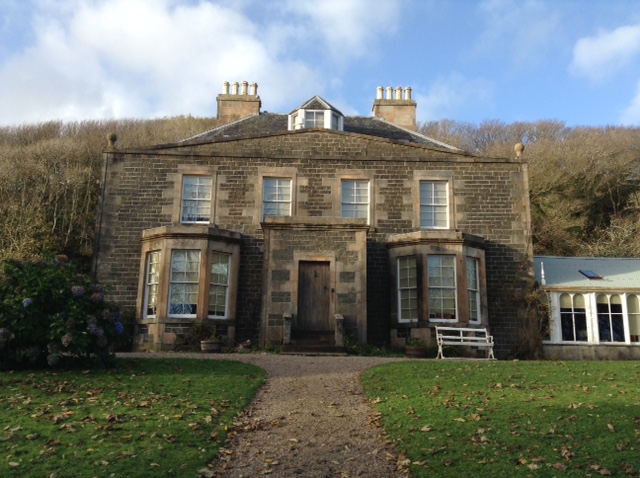
Front door, Canna House Photo: Jenny Brownrigg

Front door, Canna House Photo: Jenny Brownrigg

Mrs Shaw Campbell, Mrs John Campbell, Dear Mrs Campbell, Dear Mrs Lorne, Dear Margaret, Dear Margarita, Dearest Maggie, Maggie love, Dear Meg, My dear Meg, My dear dear Meg, Dearly beloved Meg, Dearest Marge, Dearest Marcat.

These salutations are on letters addressed to Margaret Fay Shaw (1903-2004) ranging from the formal to the diminutive. These letters, both business and personal, were sent from all over the world and are part of a significant archive at Canna House, on the Isle of Canna, where Margaret Fay Shaw lived with her husband John Lorne Campbell. Both sought to record the everyday life of people living in the Hebrides.  Whilst John Lorne Campbell specialised in capturing the spoken word, in order to understand everyday Gaelic and its dialects, Margaret Fay Shaw focused on transcribing Gaelic songs and recording Hebridean island life predominantly through her photography.

Shaw, as a single woman, spent six years from 1929-35 living with the sisters Peigi [1874 -1969] and Màiri MacRae [1883 -1972] at their croft at North Glendale, South Uist. Màiri MacRae was forty-six and Peigi, fifty-five, when a twenty-six year old Margaret Fay Shaw arrived. Indeed, as Shaw’s own ‘amanvensis’ Magdalena Sagarzazu [1] narrates in her introduction to the book ‘The Voices’ by Alex MacRae [2], this time was so significant for Shaw, (leading to a continued friendship with the sisters), that she chose to be buried next to them: ‘Margaret Fay Shaw was buried beside her two friends and among the people of South Uist she loved so well at Cladh Halainn cemetry’. [3] Shaw recounted during the programme ‘Tir A’ Mhurain’ that Peigi and Màiri MacRae, ‘… taught me more than university, they were the most interesting and knowledgeable women’.  [4]

A trained musician, Shaw’s primary motivation to move from New York to South Uist was to transcribe Gaelic songs at their source. In her own words, she ‘… chose South Uist, as the island least visited by strangers and where there would be an opportunity to live amongst a friendly and unprejudiced people not self conscious of their unique heritage.’ [5]

 After hearing Màiri MacRae sing at Boisdale House on her arrival in 1929, she was invited by Màiri to learn the song by visiting her at home in Glendale. On making the journey to their croft, which was two miles from any road and easier accessed by boat, Shaw asked if she could lodge there. Over the next six years Shaw transcribed the MacRae’s songs and those of their neighbours, further learning Gaelic over this period too. Michael Russell in his book ‘A Different Country: The Photographs of Werner Kissling’ attributes Shaw’s knowledge of Gaelic- ‘almost unique[ly] amongst photographers who worked in the Hebrides’ – as a way ‘to penetrate Hebridean culture more thoroughly and to get closer to the rhythms of place’. [6]

With her Graflex camera (the first on loan for two years from her brother-in-law Boone Groves until she was able to buy her own) and 16mm Kodak movie camera, Shaw photographed and filmed the Glendale community at work and at leisure. She did not own a light meter or tripod at that point: ‘I used piled up rocks for support or got someone to crouch on all fours while I balanced the camera on their back’. [7] Whilst a photographer such as Paul Strand, who over three months of the summer of 1954,  made single monumental portraits of South Uist islanders, [8] Shaw focussed on a single community and recorded it in its detail.  The time shared with the MacRae’s and their neighbours allowed Shaw to take numerous photographs, in particular of Màiri MacRae. Shaw records her digging the field with her son Donald; sything the oats with her sister Peigi; and shearing the sheep.

Like Shetland film maker Jenny Gilbertson [8], through the prolonged period of time spent living on a croft, Shaw was highly aware of its seasons and cycle. She records both in her diary, her transcript ‘The Outer Hebrides’ and subsequently in her life work ‘Folksongs and Folklore of South Uist’(1977):

The spring work of the croft began in February, when seaweed, used as fertilizer, was cut with a saw-toothed sickle called a corran on the tidal islands of the loch at low water of a spring tide’. [9]

The year closes with: ‘All the harvest work done, the women wash and card the wool and start the spinning wheels. It is the season for the fireside and the ceilidh, the rough weather and the short days.’ [10]

Beyond the archetypal image of crofters at labour, also denoted by other photographers and film makers of the era such as Werner Kissling (1895-1988) or Alasdair Alpin MacGregor (1899-1970) [11], Shaw’s photography goes further, recording everyday domesticity as well as the special occasion on the croft. In one photograph, Màiri MacRae stands in her doorway and holds a gifted salt cod up by its gills. The fish is viewed avariciously by the cats at her feet, with one reaching up to snatch at the fish’s tail. In another, Angus John Campbell sits with Màiri MacRae by the fireplace in an interior shot. The second of this short sequence shows him still seated next to MacRae and playing an accordion.

The sisters and their neighbours are often photographed in social situations and gatherings outdoors, one of these scenes being a tea party with Màiri MacRae, her son Donald and Peigi MacRae who all kneel on a white sheet that has been laid out on the grass. This gathering looks ceremonial; Màiri MacRae holds a china teacup with her left hand, raising it to camera, whilst her right hand keeps a hold of a sleeping cat who looks in danger of slipping off her knee. Peigi MacRae holds the teapot in her right hand and bannock in her left. Donald, the most surprising of the trio to contemporary eyes, sits in the middle with their dog Queenie. Whilst the man of the house, he looks barely in his teens in this photograph, but has a pipe in his mouth. A white piece of laundry can be discerned in the background. Like the snowcap of a mountain, it is laid out on the stone wall to dry in the sun.

The sound of the everyday is also wonderfully evoked by a typed document from Canna House Archives entitled ‘South Uist in Sound’ [12] where Shaw lists ‘characteristic sounds’ under headings including ‘Birds on the shore’, ‘The beasts of the croft’, ‘Conversations’ ‘Transport’, ‘The shop’, ‘Dancing’, ‘Songs and stories’ and ‘Agriculture’:

‘Inside the cottage.

Milking, churning, mending shoes, noises above the stoves, lids rattling, kettles boiling, setting dishes, spinning heel, carding (with appropriate songs), the loom and wool winders, the bucket to the well and back, washing clothes and ironing, noise of children, primus stoves and tilly lamps; clocks ticking, rats scuffling in the walls, cats growling under the dresser, dogs being cursed and told to lie down (in Gaelic), scratching fleas.

Magdalena Sagarzazu believes that the photographs cannot be viewed alone without relating them to music and culture; they sit holistically within a wider context. This is borne out through Shaw’s pencil notations on the songs’ original music sheets, held as part of the Canna House archive, as well as the printed transcriptions in Shaw’s ‘Folksongs and Folklore of South Uist’ where tune, words and sometimes composition are attributed to those who appear in her photographs from the Glendale community. For example, ‘Óran Fogarraich – An Exile’s Song’: ‘The tune, chorus and first verse from Miss Peigi MacRae, the second and third verses from Angus John Campbell.’ [13] Shaw records for most songs how the singer learnt the song: ‘Miss Macrae learnt the song from Miss Catriona MacIntosh while employed at Boisdale House when a young girl’. [14] The excellent online resource Tobar an Dualchais’ contains original recordings of songs sung by Màiri MacRae and Peigi MacRae, that were recorded at a later date by Campbell and Shaw when recording equipment was available. It also contains an extract of a song ‘Oran a’ Chutaidh’, sung by Donald MacRae, about a dog.

Canna House, The National Trust for Scotland Photo: Jenny Brownrigg

Canna House, The National Trust for Scotland Photo: Jenny Brownrigg

The word ‘source’ crops up often in researching and thinking about Margaret Fay Shaw and John Lorne Campbell’s collection and archive at Canna House. The ‘source’ is the singer, the landscape, language, stories and lives. Martin Padget in his book ‘Photographers of the Western Isles’ [15] notes Shaw’s quest for authenticity, referencing the first occasion Shaw heard a Gaelic song, sung by Marjory Kennedy-Fraser (1857-1930) [16] and wishing that she could hear the song in its raw state sung by the original island singers.  The idea of authenticity and source also follows through to Shaw’s photography and her films, the latter which remained as unedited film rushes, purely made for her and the community’s enjoyment, until later television programmes on Margaret Fay Shaw used this footage. [17]

Furthermore, the very fact the archive is held at Shaw and Campbell’s home at Canna House means it is also kept at ‘source’, rather than in another repository on the mainland. This was not the Campbell’s holiday home but their only home, each room a collection in itself. All has been left as if the couple have just stepped out for a few moments. This condition, gives the opportunity when researching the archives at Canna House to feel closer to the life’s work of Margaret Fay Shaw, John Lorne Campbell and the lives of those that they recorded.

With thanks to Fiona Mackenzie, archivist at Canna House and Magda Sagarzazu, retired archivist, Canna House.

Footnotes

[1] Magdalena Sagarzazu, retired archivist, Canna House, The National Trust for Scotland. Margaret Fay Shaw called Sagarzazu her ‘amanvensis’: a person employed to write or type what another dictates, or to copy. From an interview with Sagarzazu, 2014.

[2] ‘The Voices’, MAC RAE, A. (2010) Elk Classic Publishing. Alex Mac Rae is the son of Andrew Mac Rae and compiled the book ‘The Voices’: ‘Through a chance meeting with Margaret [Shaw], Peigi and Mairi’s nephew Andrew Bei Mac Rae was encouraged to record the ways of life of his family through images and sound. So he did and captured life in the 60s and 70s.’

[3] Ibid, P3.

[4] ‘Tir A’ Mhurain: Margaret Fay Shaw’, (9.3.89), TV programme.

[5] P10, ‘The Outer Hebrides: Margaret Fay Shaw’, SHAW, M.F. Undated. Typescript held at The National Trust for Scotland, Canna House.

[6] P32, ‘A Different Country: The Photographs of Werner Kissling’, RUSSELL, M. (2002), Berlinn Ltd.

[7] P4, Typescript of the Aran Islands, SHAW, M.F.  12 July 2002. Typescript held at The National Trust for Scotland, Canna House.

[8] ‘Tir A’ Mhurain: The Outer Hebrides of Scotland’, STRAND, P. (2002) 2nd Ed. Aperture Foundation.

[9] Jenny Gilbertson (1902-1990) was a filmmaker who in the 1930s’ began living on a Shetland croft, making documentary films about life in Shetland. She took up her film-making again in the 1970s’, where she went to live in the Canadian Arctic.

[10] P 96, ‘Folksongs and Folklore of South Uist’, SHAW, M.F. (2005) 2nd Ed. Birlinn Ltd.

[11] P21, ‘The Outer Hebrides: Margaret Fay Shaw’, SHAW, M.F. Undated. Typescript by Margaret Fay Shaw, held at The National Trust for Scotland, Canna House

[12] Alasdair Alpin MacGregor had an ongoing spat with Shaw, her husband John Lorne Campbell and Compton MacKenzie over their differing perspectives on how Hebridean islanders were depicted. This came to a head following the publishing of MacGregor’s book ‘The Western Isles’ (1949, Robert Hale Publishers) where MacGregor ‘endeavoured to give a contemporary account of the Islanders and their ways, free from any “nebulous twentieth-century impressionism”’ (preface, ‘The Western Isles’). MacGregor called the islanders lazy: ‘The characteristics of the people which the stranger to the Western Isles is swift to observe, certainly so far as the male population is concerned, are laziness and drunkeness. Many of the islanders are now so indolent and so spoilt by easy money that they no longer deign to cut peat, even though it is to be had on their own crofts.’ P234, ‘The Western Isles’. A letter from Shaw to MacGregor, held at Canna House, reads: ‘You ask me for an assurance not to express my opinion either by word of mouth or by writing. My letter to your publisher will be my writing. Of my speech I will condemn your book and your action in writing as long as I live’. (Jan 1950).

[13] P5, ‘South Uist in Sound’, SHAW, M.F. Undated. Typescript held at The National Trust for Scotland, Canna House.

[14] P96, ‘Folksongs and Folklore of South Uist’, SHAW, M.F. (2005) 2nd Ed. Birlinn Ltd.

[15] Ibid.

[16] P126, ‘Photographers of the Western Isles’, PADGET, M. (2010) John Donald, an imprint of Birlinn Ltd.

[17] Marjorie Kennedy-Fraser was a professional Scottish singer, composer and arranger. Including songs she transcribed from Eriskay, Kennedy-Fraser made three volumes of ‘Songs from the Hebrides’ published between 1909-1921.

[18] ‘Among Friends: Margaret Fay Shaw’, (2003) made by Mòr Media for BBC Scotland, and directed by Les Wilson. This programme was made to celebrate Shaw’s centenary.

This Research Note is part of my Glasgow School of Art Research Leave project ‘Documenting 1930s’ Scottish Highland and Islands Life: M.E.M. Donaldson, Jenny Gilbertson and Margaret Fay Shaw’.

Looking out to the bay from Canna House garden Photo: Jenny Brownrigg

Looking out to the bay from Canna House garden Photo: Jenny Brownrigg

Unknown's avatar

Documenting 1930s’ Scottish Highland and Islands life- M.E.M. Donaldson, Jenny Gilbertson and Margaret Fay Shaw

Research note 1: Jenny Gilbertson- Shetland research visit, October 2015.

Heylor, Shetland.

Heylor, Shetland- one of the locations for ‘Rugged Island’ (1932) Jenny Gilbertson.

Thanks to research leave from The Glasgow School of Art, I have three months away from my role as GSA Exhibitions Director, to work in depth on one piece of written research. I will be looking at Margaret Fay Shaw (1904-2004), Jenny Gilbertson (1902-1990) and M.E.M. Donaldson (1876-1958), in particular their photography or filmmaking from the 1930s’, a period where all three women were independently documenting different aspects of Scottish Highlands and Islands life, having moved to live with the communities they were witnessing.  My aim is for these posts to serve as an introduction or notebook to my research and as an aid to help record, excavate and edge closer to the key points to write about.

As an early career researcher, this is the first experience I have had of working alongside other researchers on the same subject. I am incredibly lucky to be part of a motivated group of women all inspired by Shetland film maker Jenny Gilbertson– Shona Main, a writer and film-maker currently working on a biography of Gilbertson; Dr Sarah Neely, University of Stirling, who has written in particular about Gilbertson’s later work in the Arctic; and Joanne Jamieson from Shetland Moving Image Archive who is writing about Gilbertson and working to gather all Gilbertson’s films in the archive. I have been impressed by and grateful for their openness in sharing their knowledge and field work.

My first research visit has been to Shetland and the Shetland Museum and Archives in Lerwick (thanks to Brian Smith, Blair Bruce and Angus Johnson), to look through their material on Jenny Gilbertson. This resource has mostly been gifted by her two daughters Helen Thomson and Ann Black who live on Shetland.

'Rugged Island' photograph holder, Shetland Museum and Archives.

‘Rugged Island’ photograph holder, Shetland Museum and Archives.

These important holdings include Gilbertson’s correspondence over her lifetime, both personal and professional;  the interpretation material she wrote about her work including autobiographical notes and film synopsis; press cuttings, in particular relating to her later filming in the Canadian Arctic with the Inuit; reflections and references from others about her work including a recommendation from her peer, filmmaker Elizabeth Balneaves (1911-2006), a letter and review of her early work by John Grierson (1898-1972) and feedback from the teachers and pupils of the schools she personally toured her films to; ephemera from film screenings and lecture tours that she undertook including some posthumous material; photographs from both her family and professional life, the latter including photographs from her early lecture tour to Canada in 1934-5 as well as from the period in her seventies and eighties living at Coral Harbour and Grise Fiord filming the Inuit; reference material she had compiled relating to subjects that interested her, both historical and contemporary; some of her film outlines and drafts, including a radio play ‘Busta House’ (1955) and essays she sent to magazines; and raw material including 35mm negatives from ‘Rugged Island’(1932) and ‘Prairie Winter’ (1934) as well as sound reels of recordings made in Coral Harbour and Grise Fiord. Shetland Museum and Archives have begun the process of cataloguing this collection.

The importance of the archives has been threefold – to see how Gilbertson saw herself and her work, through her own words and through others; to gain insight into her motivations for filming; and to understand the conditions she had to navigate as an independent filmmaker throughout her career, including those with the film and TV industry.
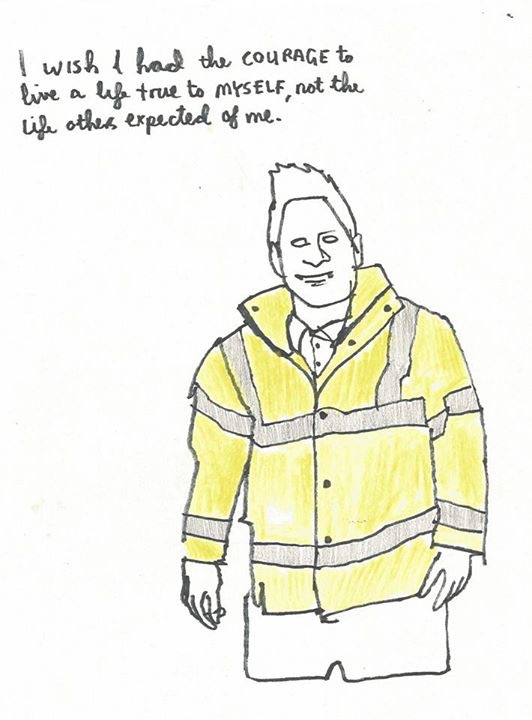
Screening of 'Rugged Island' (1932) at Shetland Museum and Archive. Photo: Joanne Jamieson

Screening of ‘Rugged Island’ (1932) at Shetland Museum and Archive. Photo: Joanne Jamieson

During the time I was in Shetland, Shona Main along with Shetland Moving Image Archive’s Joanne Jamieson, staged two screenings of Gilbertson’s 1930’s films (11 & 15 Oct 2015). The first in Lerwick at Shetland Museum was a screening of ‘Rugged Island’ (1932), the sound version with original score by Kenneth Leslie Smith. The second, to a packed village hall in Hillswick, where Gilbertson and her family had lived, showed her first film ‘A Crofter’s Life in Shetland’ (1931) alongside a number Gilbertson went on to make and sell to Grierson and the G.P.O. Library: ‘Cattle Sale’ (1932), ‘Da Makkin o’ a Keshie’ (1932), ‘Peat From Hillside to Home’ (1932) and ‘In Sheep’s Clothing’ (1932).

Site visit with David Anderson to Hillswick. Heylor and Eshaness

Site visit with David Anderson to Hillswick, Heylor and Eshaness.

As well as showing these films, the aim of the screenings was for Main and Jamieson to find out and record from the audience if they knew the locations and people within the films. They did this following the screenings by going through the films again and using them as an ‘aide memoire’ to prompt discussions on who it was and where it was in different scenes. This proved to be a successful method, in particular leading to a subsequent site visit with David Anderson (Davie a’ Hammar), a member of the audience from the Lerwick screening who had been taught by Gilbertson at Urafirth Primary School. He drove Shona, Joanne and myself around Hillswick and Eshaness areas before the second screening, to locate the croft and ruined cottage that Gilbertson’s husband Johnny Gilbertson had worked on, at Heylor, for part of the ‘Rugged Island’ (1932) set.

Joanne Jamieson and Shona Main at Heylor, with the croft in background from 'Rugged Island' (1932)

Joanne Jamieson and Shona Main at Heylor, with the croft in background from ‘Rugged Island’ (1932)

The experience of this research visit to Shetland has been immersive – from the darkness of the film screenings where people and places came to light, to the richness of material in the archives. I had not contended for the feeling of exhilaration that results from the first connections to occur through research, source material, conversation and of being out in the landscape on the trail of Jenny Gilbertson.