Unknown's avatar

Alasdair Gray Season: ‘Spheres of Influence II’

Reid Gallery, Reid Building, The Glasgow School of Art, 164 Renfrew Street, Glasgow G3 6RF

22 Nov 2014-25 Jan 2015

Aubrey Beardsley, Oliver Braid, Eric Gill, Alasdair Gray, Peter Howson, Dorothy Iannone, David Kindersley and Lida Lopes Cardozo, Stuart Murray, My Bookcase, Denis Tegetmeier, Hanna Tuulikki

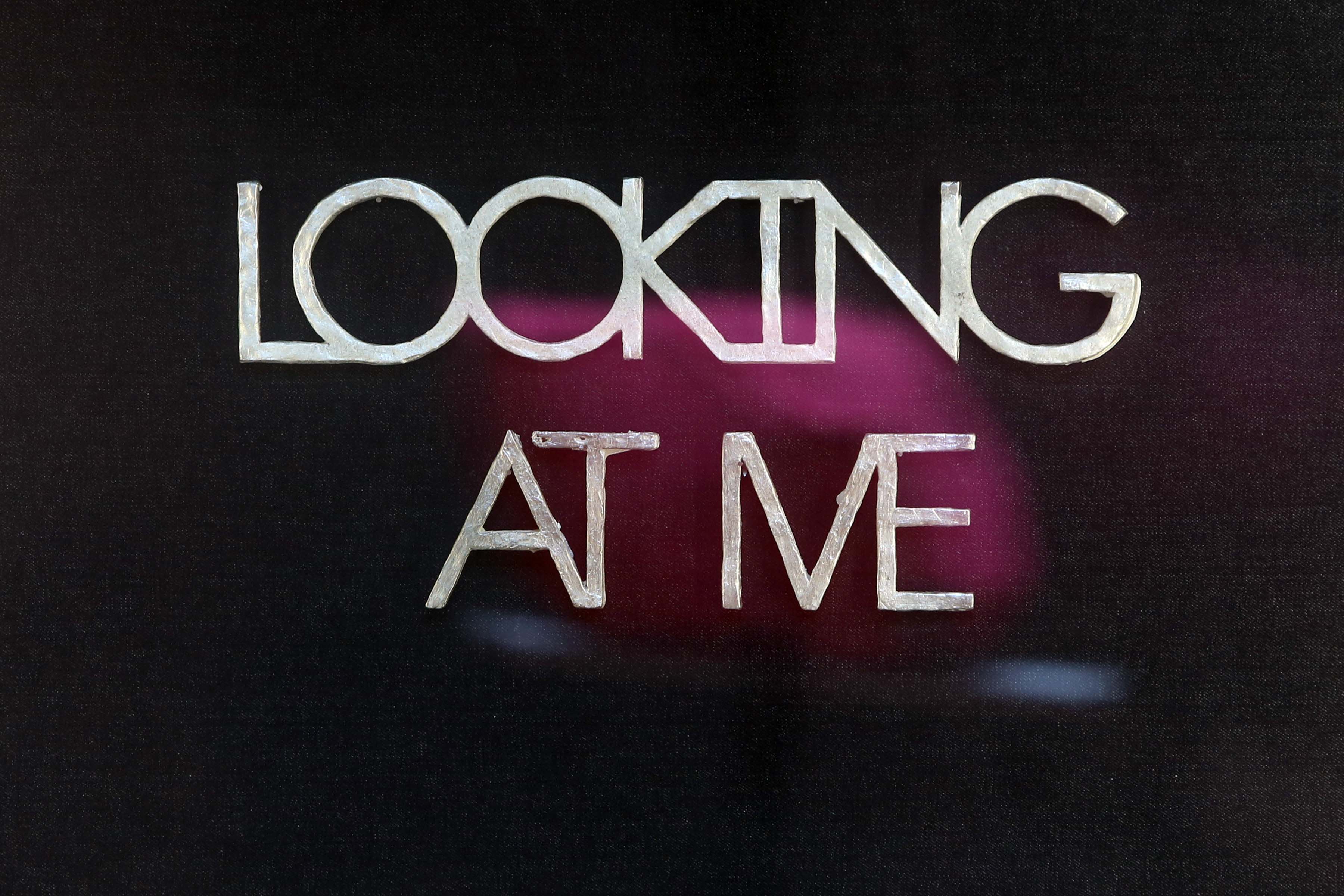
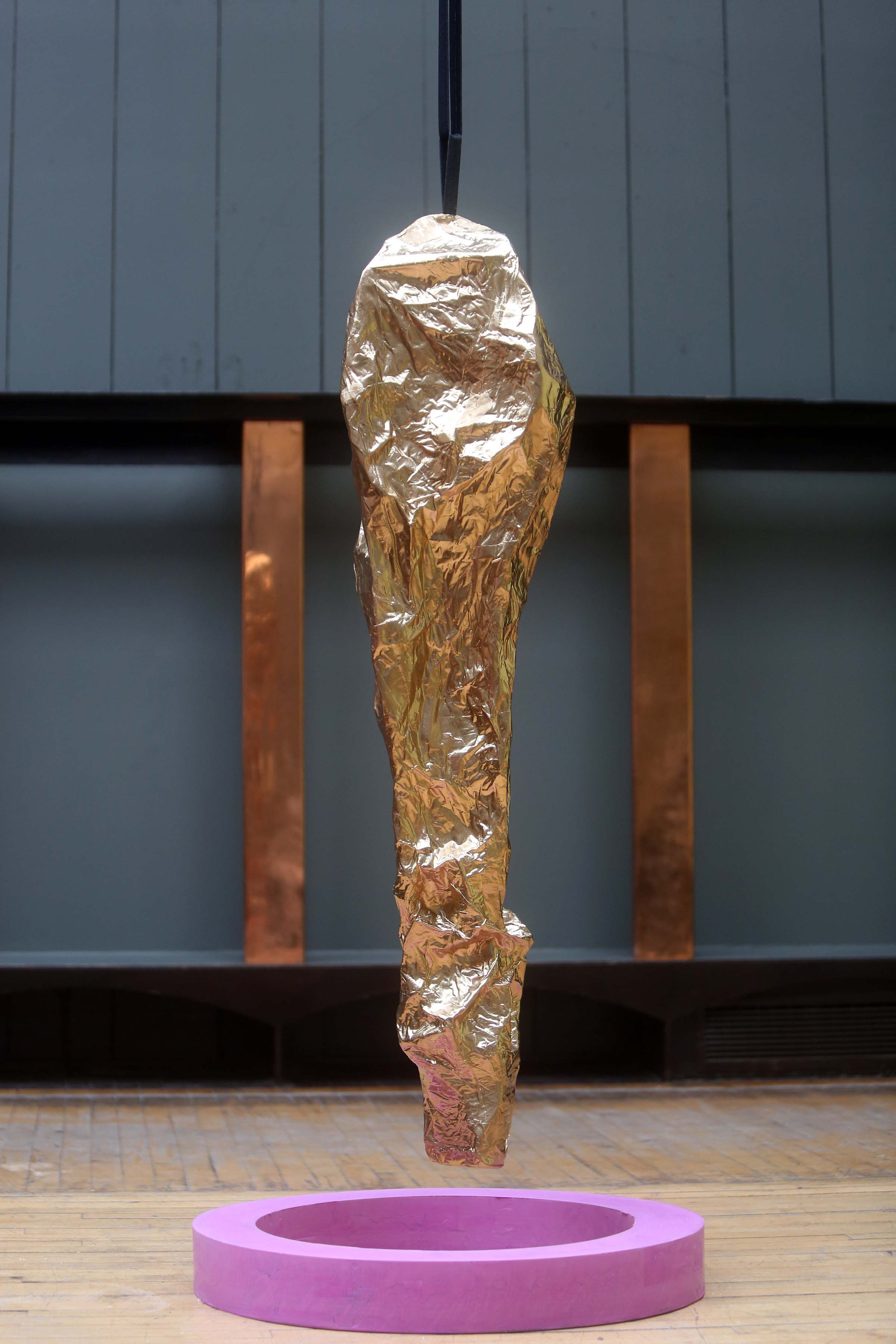
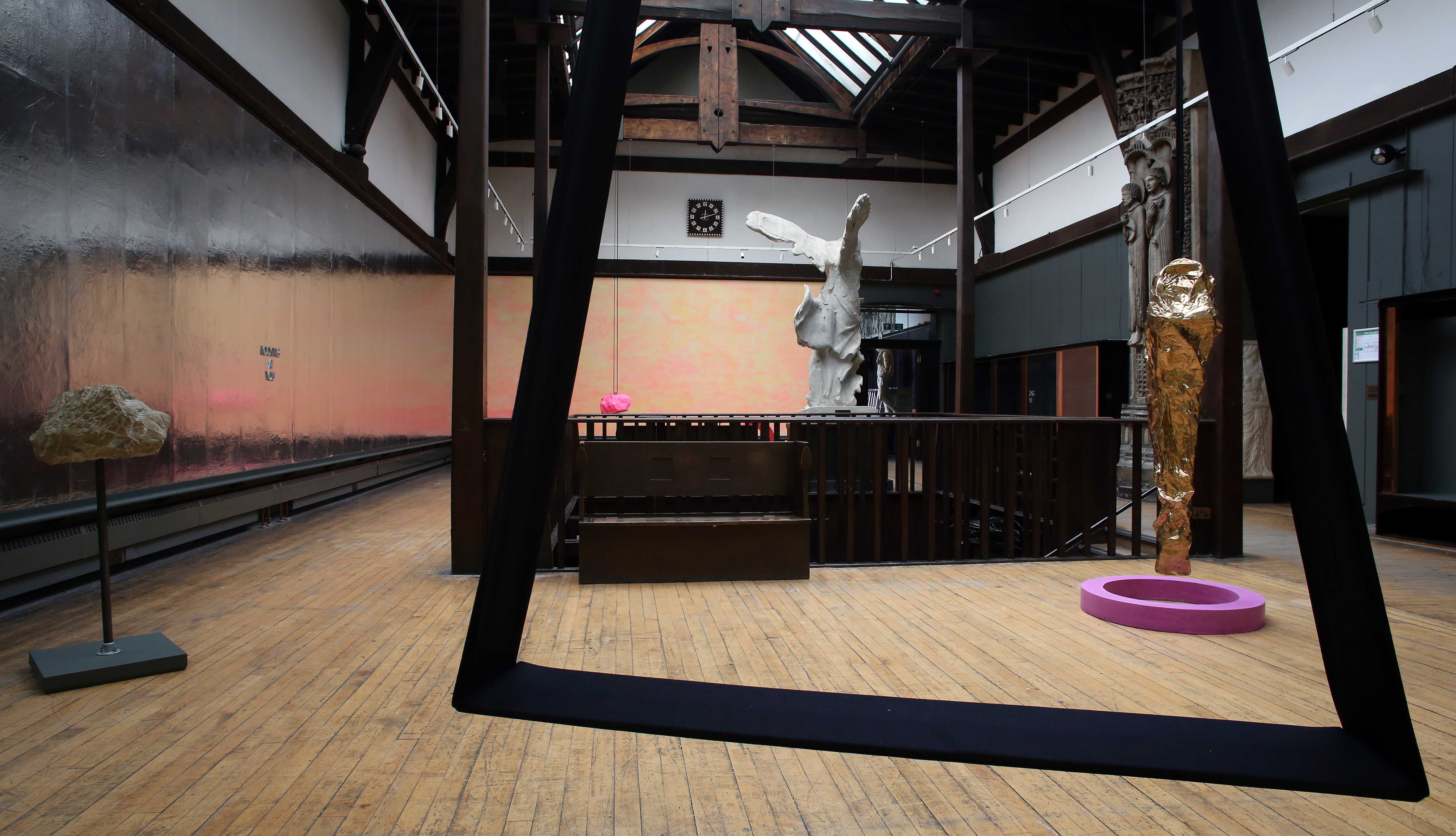
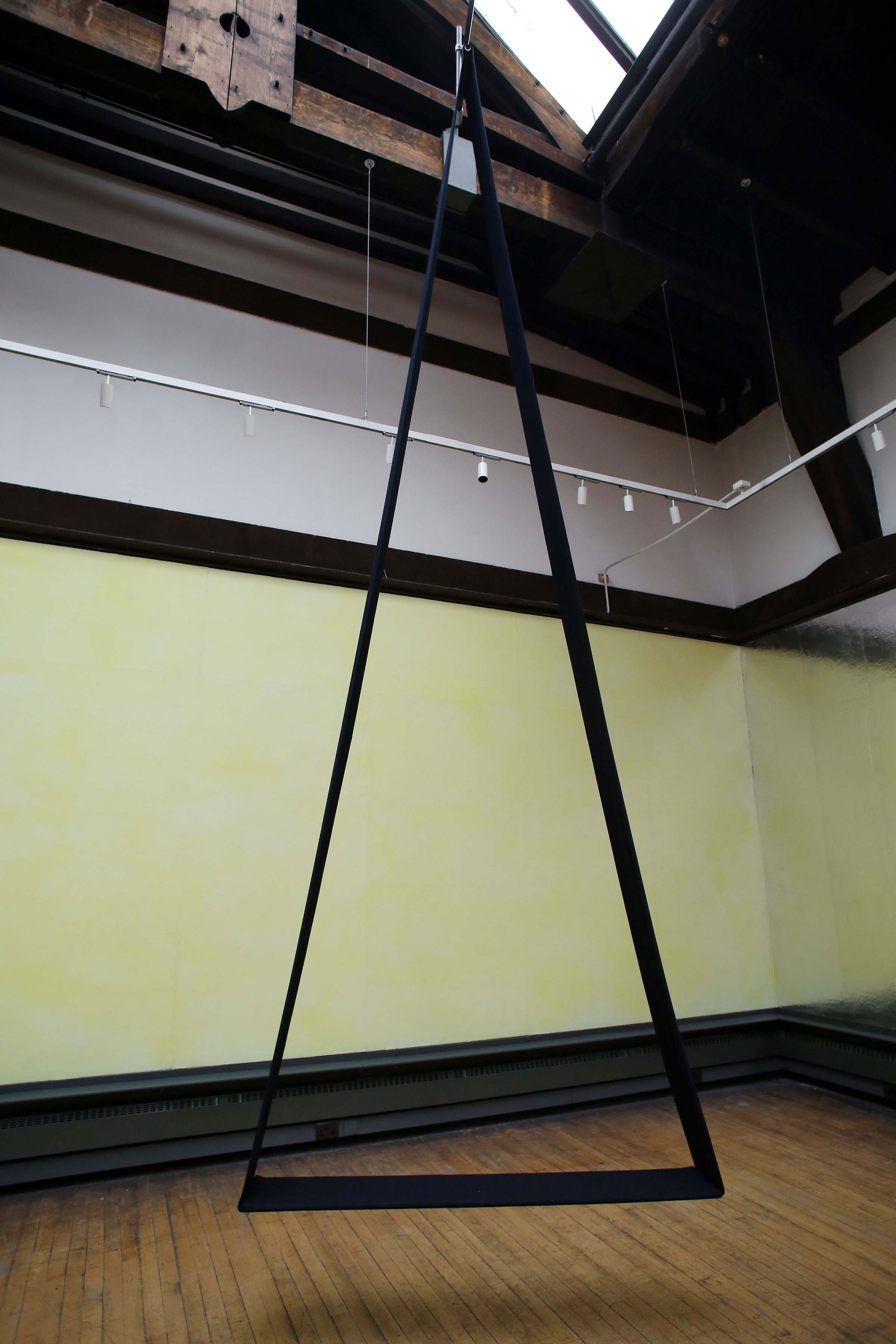
This exhibition provides alternative readings of Alasdair Gray’s visual practice, through the prism of others’. Spheres of Influence II includes both historical and contemporary pieces from the realms of visual art, design and illustration. Gray’s work forms the central point around which the other works orbit. The broad themes drawn from Gray’s oeuvre include graphic style; symbolism; text and image; lettering and the alphabet; portraiture and identity; labour; religion; war; love and sexuality. The exhibition includes four new commissions by Oliver Braid, Stuart Murray, My Bookcase and Hanna Tuulikki. The new commissions and event programme are funded by Outset Scotland in association with YPO.
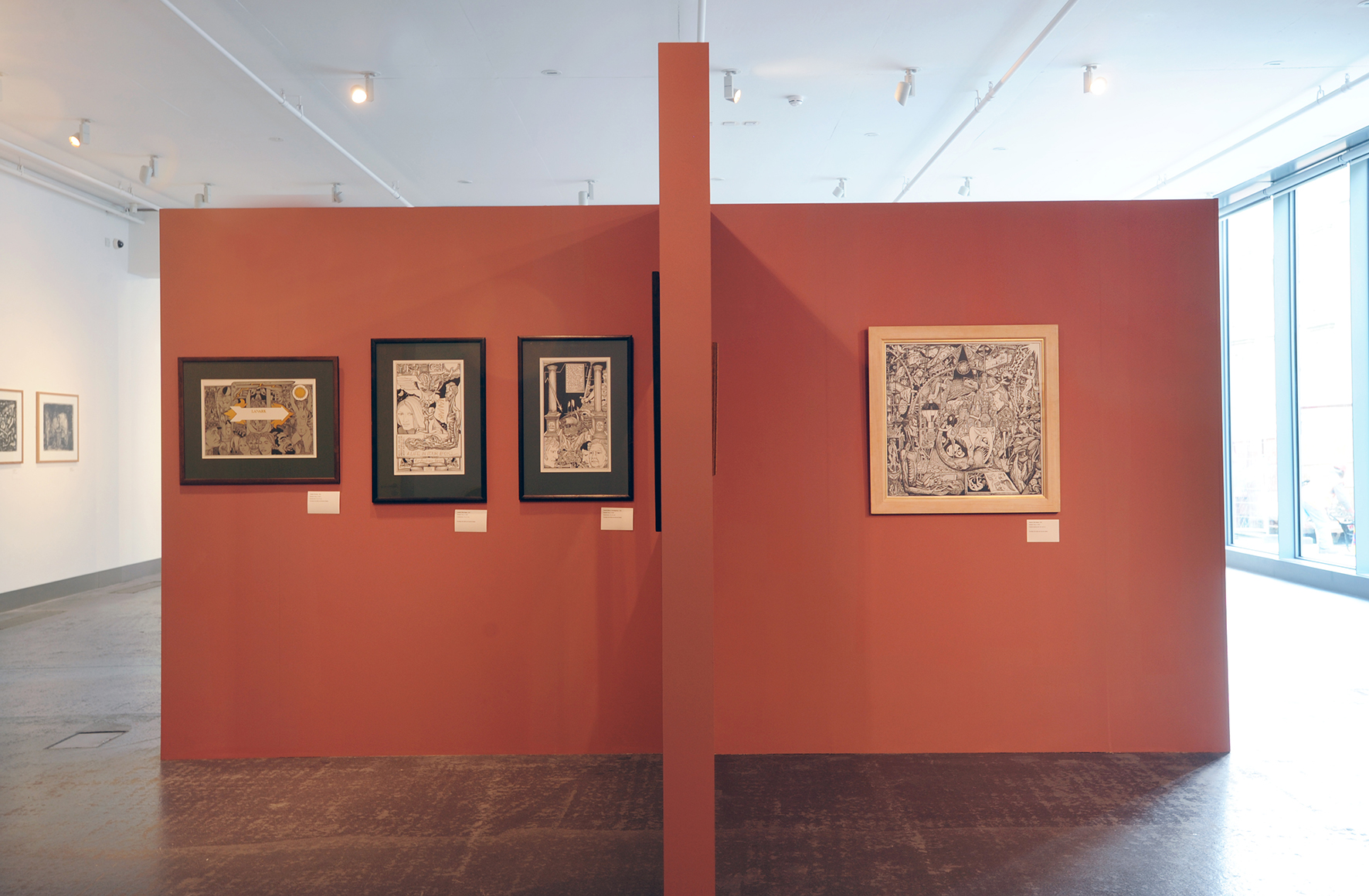
'Spheres of Influence II', Reid Gallery, The Glasgow School of Art (2014). Photo: Alan Dimmick

‘Spheres of Influence II’, Reid Gallery, The Glasgow School of Art (2014). Photo: Alan Dimmick

Alasdair Gray‘s (b. 1934) visual work is the central inspiration for ‘Spheres of Influence II’, which is part of The Alasdair Gray Season. This season is devised by Sorcha Dallas, to celebrate Gray at eighty years old. Gray studied in Mural Design at The Glasgow School of Art 1952-57. His fifteen works selected for ‘Spheres of Influence II‘ include working drawings for book covers, poster designs and screenprints made between 1954 and 2010. Gray’s retrospective ‘From the Personal to the Universal’ is at Kelvingrove Art Gallery and Museum, running until 22 Feb 2015. ‘Spheres of Influence I’ is at Gallery of Modern Art, Glasgow (GoMA) until 25 May 2015, and draws on works from Glasgow Museums’ collection, to look at Gray’s practice, influences and work.
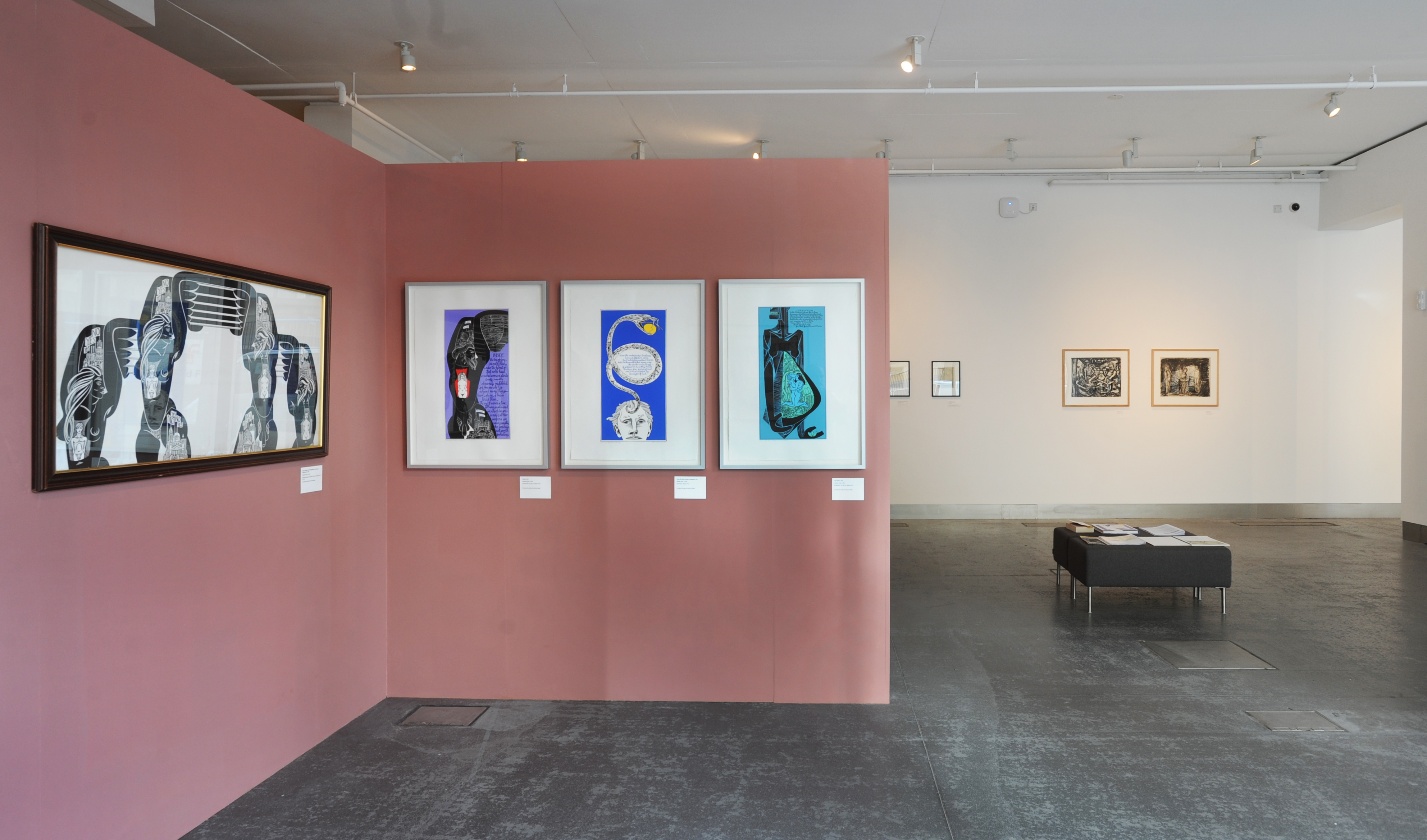
Installation view, 'Spheres of Influence II', Reid Gallery, The Glasgow School of Art (2014). Photo: Alan Dimmick

Installation view, ‘Spheres of Influence II’, Reid Gallery, The Glasgow School of Art (2014). Photo: Alan Dimmick

Aubrey Beardsley (1872-1898) believed that ‘The grotesque is the only alternative to the insipid commonplace‘. An artist of the Art Nouveau era, his black ink drawings, inspired by Japanese Shunga woodblock prints, emphasised the erotic and decadent. This exhibition shows two illustrations made for Edgar Allan Poe stories including ‘The Murders in the Rue Morgue’ (1895). Alasdair Gray remembers,

When fifteen or sixteen I discovered Aubrey Beardsley and loved the way he made innocent fun of mild perversity. He drew naked bodies beautifully, but also enjoyed inventing fantastic costumes for them to dress and undress in‘. 1

A further series of Beardsley’s illustrations can be seen at GoMA.

Eric Gill (1882-1940) has been cited by Alasdair Gray as a visual influence. Gray’s work ‘Corruption‘ (2008) borrows a Gill image of an entwined couple, to rest in the belly of a skeletal woman (this image of the couple also appears in Greenhead Church mural in 1963 and in the oil painting ‘Eden and After’ (1966)). Gill was an artist, letter cutter, sculptor, designer, writer and wood engraver, ‘with a passionate urge to achieve an integration of life and art and work and worship, his own sense of mission -often thwarted- ‘to make a cell of good living in the chaos of our world’.” 2 Influenced by John Ruskin and William Morris, he founded a Roman Catholic craft guild, The Guild of St Joseph & St Dominic, and built workshops, homes and a chapel on Ditchling Common in East Sussex. His three main households were at Ditchling (1907 – 1924), Capel-y-ffin, Wales (1924-8) and Piggots (1928-40).

'Our Lady of Lourdes', (1920); 'Epiphany' (1917), Eric Gill (1882-1940). Photo: Alan Dimmick

‘Our Lady of Lourdes’, (1920); ‘Epiphany’ (1917),
Eric Gill (1882-1940). Photo: Alan Dimmick

Commissioned by Monotype, Gill created the type of Gill Sans and Perpetua. ‘Spheres of Influence ll‘ shows a series of Gill’s illustrations and bookworks. In the former, a number of his striking religious illustrations are shown, including ‘Our Lady of Lourdes‘ (1920), ‘Epiphany‘ (1917) and ‘The Madonna and Child: Madonna Knitting‘ (1916). Illustrations of his lettering for ‘Autumn Midnight‘ (1923) show figures animating each letter. Through St Dominic’s Press, his printing venture with Hilary Pepler, a series of ‘Welfare Handbooks‘ were printed covering all their favourite topics of the time, including Welfare Handbook No.10 on ‘Birth Control’, and the two Welfare Handbooks on display, No. 4 ‘Riches‘ (1919) and No.7 ‘Dress: Being an essay in masculine vanity and an exposure of the Un-Christian apparel favoured by females’ (1921).
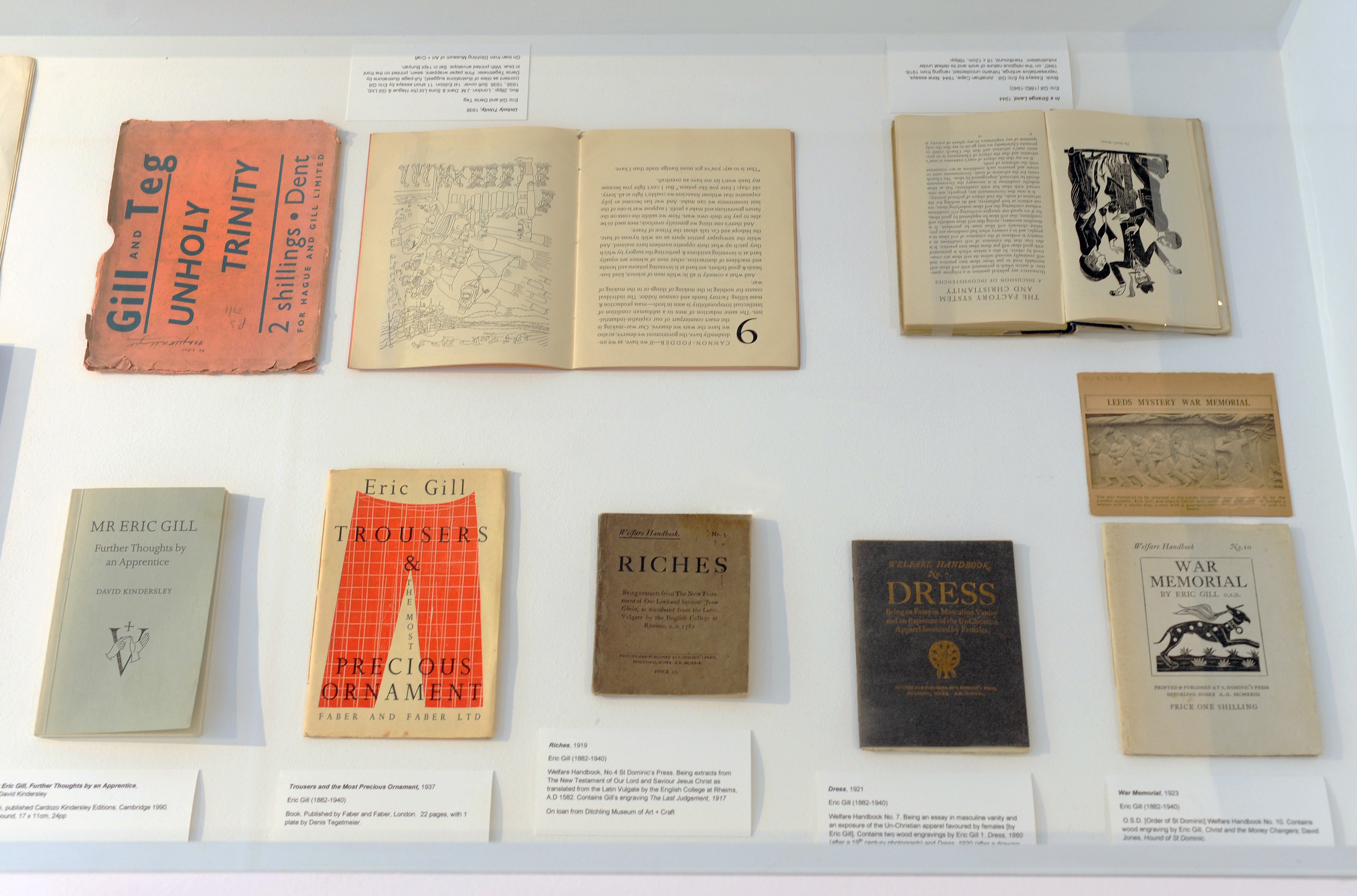
Display case, 'Spheres of Influence II', GSA (2014). Photo: Alan Dimmick

Display case, ‘Spheres of Influence II’, GSA (2014). Photo: Alan Dimmick

Eric Gill was a controversial figure in his life and choices. Fiona MacCarthy’s 1987 biography ‘Eric Gill’ charts the contradictions between his life and practice.

Peter Howson (b. 1958) studied Painting at GSA 1975-7, then 1979-81. In between these periods, he signed up for the army spending nine months in the Fuseliers in Midlothian. In an interview with the actor Steven Berkoff he says of this time,

I was about 18, 19, I think. I was in the Infantry and then because they thought I would go onto different things they put me in the Scottish Divisional Squad. All sorts of mad things in that, but I couldn’t handle it. I was too young, so that’s why I left... I spent about a year doing other jobs before I went back to Art School. When I returned I still continued being unhappy until one day a new tutor came called Sandy Moffat... He was going through all my drawings and the drawings were mostly crap; until the last few at the bottom, the ones that I had hidden away. They were the Army drawings. And they were all these things about regimental baths, all the stuff that happens in the Army. He went crazy for these drawings – so that was the start of me getting, I suppose, more confident.’ 3

Spheres of Influence II’ shows these early drawings, alongside two portraits from ‘Saracen Heads‘ series that Howson made of people he encountered around his studio of that time in the Gallowgate, Glasgow. Howson’s army images echo the gaunt lines of Gray’s ‘Preliminary Sketch for the Horrors of War (for Scotland USSR Friendship Society)‘ (1954), an artwork Gray made whilst still at GSA. This piece is the design for a mural which Gray describes as denoting his ‘dread of how nuclear war would distort humanity.’ 4

Peter Howson’s portraits ‘Jimmy‘ and ‘Rupert‘ from Saracen Heads (1987) link with Stuart Murray’s six drawings from his blog ‘The Folk Ye Bump Intae‘, http://thefolkyebumpintae.wordpress.com/ where the artist remembers the people he encounters in East End of Glasgow pubs and streets, and draws them from memory, along with their conversations.

'Jimmy' and 'Rupert' from Saracen Heads (1987), Peter Howson. Courtesy of Flowers Gallery. Photo: Alan Dimmick

‘Jimmy’ and ‘Rupert’ from Saracen Heads (1987), Peter Howson. Courtesy of Flowers Gallery. Photo: Alan Dimmick

Dorothy Iannone (b.1933) is an American self- taught artist, now living in Berlin, who is a year older than Alasdair Gray. As Gray’s works have more often contextualised with his own peer group, or with a younger generation of artists, ‘Spheres of Influence II’ offers the opportunity to see his work alongside an international artist who is also drawn to using a graphic style of confident line and flat colour, to record the autobiographical in text and image. Whilst Gray’s work speaks from a masculine perspective, Iannone offers the female viewpoint, of a woman in search of ecstatic love. Iannone’s work, such as ‘The Next Great Moment is Ours‘, (1976), is in the style of a hand drawn comic strip and records “a journey of ever-increasing sexual, political and spiritual awareness and a life perpetually in search of union – with the beloved, the viewer, listeners and the world.” 5
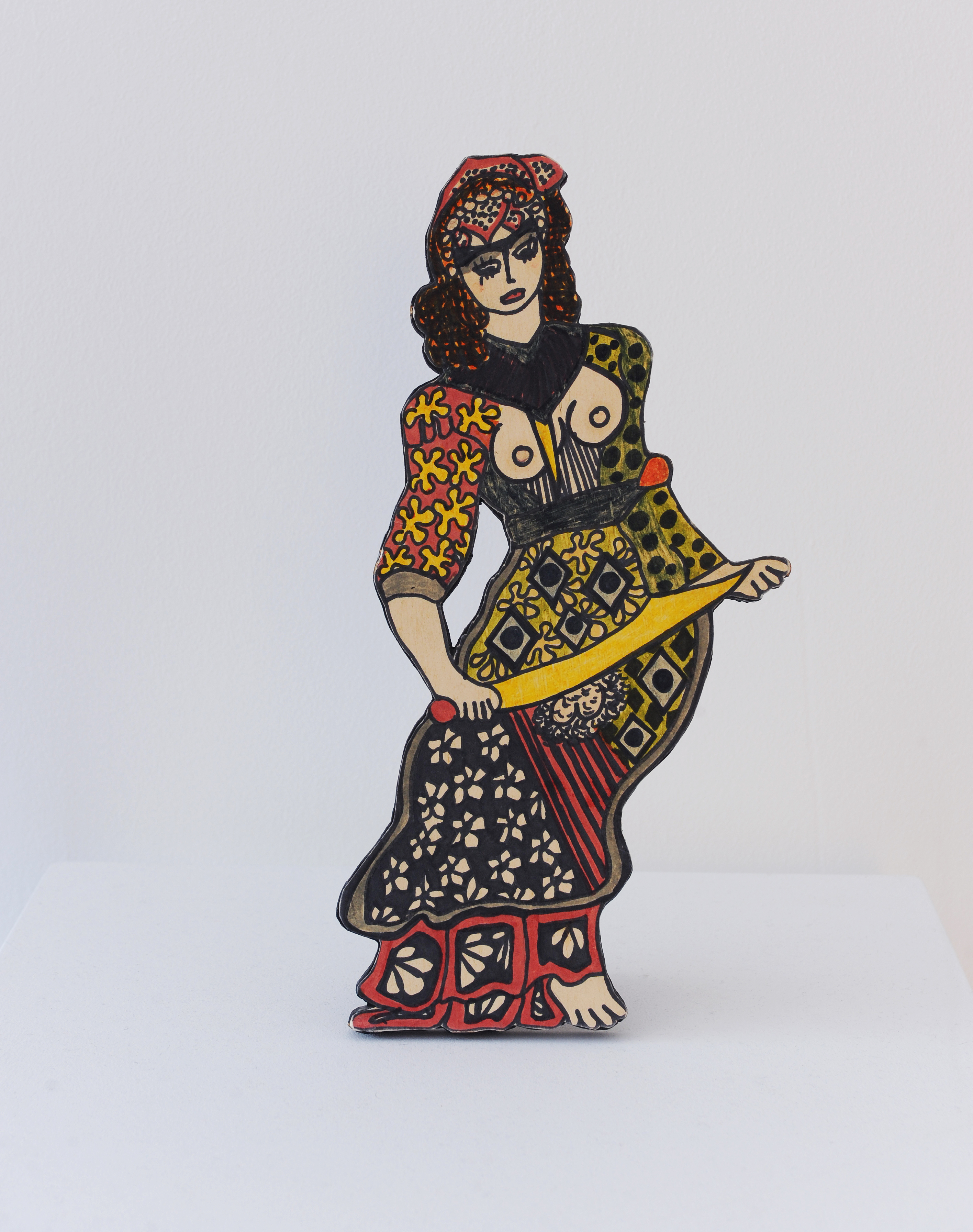
'Unknown', (1967) Dorothy Iannone. On loan from Living Art Museum. Photo: Alan Dimmick

‘Unknown’, (1967)
Dorothy Iannone. On loan from Living Art Museum. Photo: Alan Dimmick

David Kindersley (1915-1995) and Lida Lopes Cardozo, formed the Cardozo Kindersley Workshop in Cambridge in 1976. Designers of the main gates at the British Library in London, the Workshop also undertook the letter cutting of the gold signage of The Gallery of Modern Art in Glasgow on the front facade of the building. Kindersley had been an apprentice of Eric Gill’s at Piggots in the 1934, drawn to the workshop as a model of integrated art and life, following reading Gill’s book of essays ‘Art-Nonsense and other essays‘ (1929) which derided the mystery and elitism of the artworld. The small slate work by Kindersley and Cardozo in ‘Spheres of Influence II’, ‘The Promises of Lovers‘, cut in 1988, bears the inscription ‘The promises of lovers are as light as the leaves which the winds carry away’.

'The Promises of Lovers', cut in 1988, David Kindersley and Lida Lopes Cardozo  Slate, h. 311mm, w. 311 mm, d. 19mm On loan from Glasgow Life (Glasgow Museums) on behalf of Glasgow City Council. Photo: Alan Dimmick

‘The Promises of Lovers’, cut in 1988,
David Kindersley and Lida Lopes Cardozo
Slate, h. 311mm, w. 311 mm, d. 19mm
On loan from Glasgow Life (Glasgow Museums) on behalf of Glasgow City Council. Photo: Alan Dimmick

Denis Tegetmeier (1895-1987) was an illustrator, engraver, carver, letterer, designer and painter. He, (like Kindersley), was an apprentice of Eric Gill, marrying Gill’s daughter Petra in 1930. Tegetmeier was also a political cartoonist, gathering cuttings of all the news of the day, then going onto use them as the source for his illustrations for Catholic Herald and GK Weekly. The six etchings on show are illustrations from a collaborative bookwork with Eric Gill called ‘Unholy Trinity’ (1938). This book opening sentence is, ‘In the beginning was power; that is to say, the police and the military‘. Tegetmeier fought in WW1, spending three years fighting in France in the Royal Field Artillery. Following this experience, he believed his path to be religious and stayed for a period with monks. When they tried to persuade him to become a priest, which would not have allowed him a solitary existence to draw, he went on to attend the Central School of Arts and Crafts. His tutors put him forward to assist Eric Gill in the lettering for the War Memorial Gill had been commissioned to make in Oxford.

'Europe and the Bull', (1932); 'An obese reclining man carrying whip', (1932), Denis Tegetmeier (1895-1987). On loan from Ditchling Museum of Art + Craft. Photo: Alan Dimmick

‘Europe and the Bull’, (1932); ‘An obese reclining man carrying whip’, (1932), Denis Tegetmeier (1895-1987). On loan from Ditchling Museum of Art + Craft. Photo: Alan Dimmick

Oliver Braid (b.1984) studied MFA at GSA from 2008-10. One group of three drawings are a series from his event ‘Communal Dolphin Snouting’ at Transmission Gallery, Glasgow (2013). The second group are commissioned for ‘Spheres of Influence ll‘. Braid always works on A3 sketchbook paper for his intricate pen drawings, which in their level of detail are reminiscent of Gray’s ‘Faust in His Study‘(1958) or illustrations for ‘Lanark‘ (1982). Braid conceals symbols and messages within his drawings, endeavouring, ‘to get away from our pre-occupation as the audience with the meaning of an artwork being the full stop and us working it backwards to understand it.’ He is keen that, ‘the artwork moves forward, relying on the idea of belief or leap of faith.’ 6
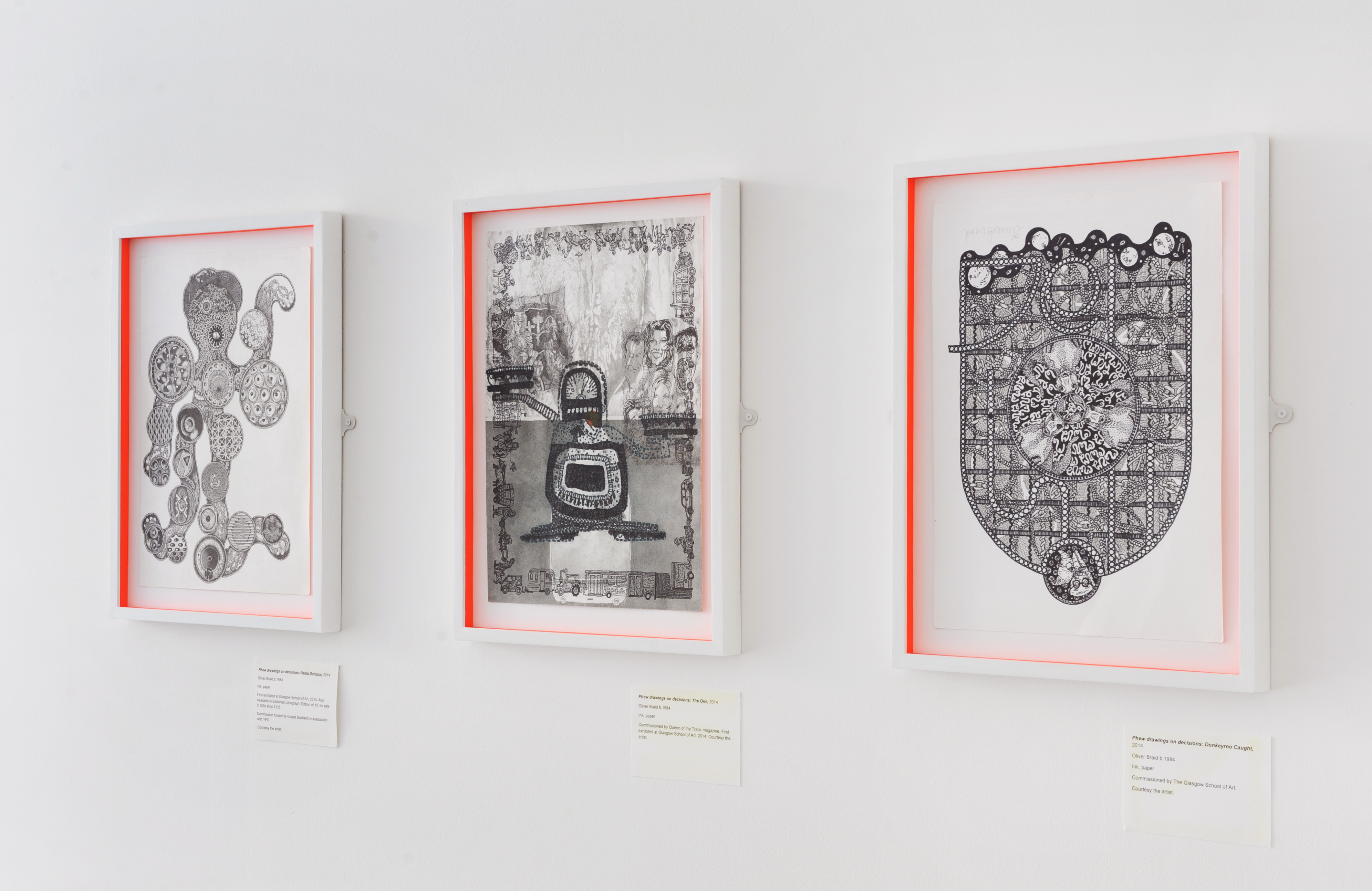
'Phew drawings on decisions: Radio Octopus', (2014); 'Phew drawings on decisions: The One', (2014); 'Phew drawings on decisions: Donkeyroo Caught', (2014); Oliver Braid. Photo: Alan Dimmick

‘Phew drawings on decisions: Radio Octopus’, (2014); ‘Phew drawings on decisions: The One’, (2014); ‘Phew drawings on decisions: Donkeyroo Caught’, (2014); Oliver Braid. Photo: Alan Dimmick

Stuart Murray (b.1978) has made a new book, ‘Gateway to Work’, which brings together sixty new drawings made from his experience in the early 2000s attending  ‘Gateway to Work ‘ training through the ‘New Deal’, a workfare programme instigated in the late 1990s by Blair’s Labour Government to reduce unemployment. In Gray’s City Recorder series, showing at Kelvingrove, Gray notes that ‘The man wearing a blue jacket with a folder under his arm, ‘ in ‘Graham Square Cotton Mill and Entrance to the Meat Market’ (1977) ‘was a modern inspector employed by the Jobs Creation Scheme, who had come to find if I was usefully employed’. 7
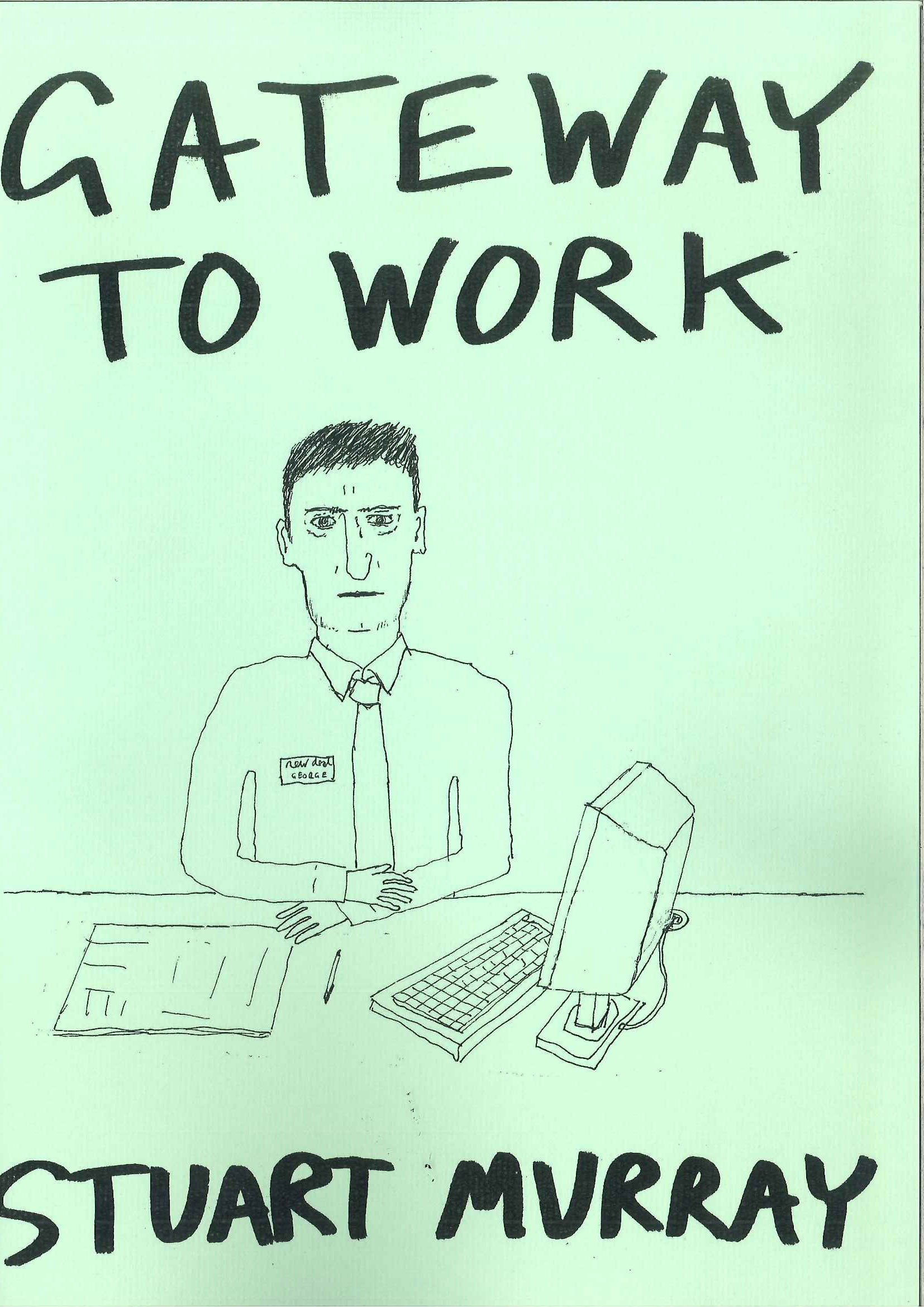
'Gateway to work', publication (edition 300), Stuart Murray (2014)

‘Gateway to work’, publication (edition 300), Stuart Murray (2014)

Stuart Murray studied Printmaking at GSA from 1997-2001. ‘Gateway to Work’ is shown alongside Eric Gill’s book ‘Servile Labour and Contemplation’, published posthumously by The Aylesford Press (1987). Gill believed in ‘the idea of the sacredness of workmanship: the perception that ‘happy intense absorption’ in any work, brought as near to perfection as possible, is a state of being with God’. 8

My Bookcase’ (b. 1986) From a dialogue between artist and writer Alasdair Gray and Cristina Garriga, founder of My Bookcase, a book resource has been created in occasion of Alasdair Gray Season: Spheres of Influence II. The book collection on display has been specially picked by the artist from his personal bookshelves. It acts as a reading resource for the visitor, as well as an alternate reading of the artist through his personal library. www.mybookcase.org is a non-profit organization dedicated to the dissemination, understanding and appreciation of books. My Bookcase won a Deutsche Bank Award for Creative Enterprise in 2014. Cristina Garriga graduated from GSA’s MLitt in 2014.

'Alasdair Gray & My Bookcase' (2014), My Bookcase. Photo: alan Dimmick

‘Alasdair Gray & My Bookcase’ (2014), My Bookcase. Photo: alan Dimmick

Hanna Tuulikki (b.1982) is an artist and composer. She studied 2003-2006 GSA Sculpture and Environmental Art. For this exhibition Tuulikki has brought together illustrations for two ‘Alphabets’, where the letters are formed by naked figures. These two pictorial alphabets were made for the artwork of albums by Tuulikki’s band Two Wings. Alphabet 1’ was devised as the artwork for the album ‘Love’s Spring’ (Tin Angel Records, 2012), and inspired by medieval figurative alphabets. ’Alphabet 2’ was devised as the artwork for the album ‘A Wake’ (Tin Angel Records, 2014). Again, devised from naked figures, on this occasion carrying tools, celebrating the ordinary everyday objects with which we make and remake the world. The objects carry practical and symbolic meanings. For each Alphabet, a possible ‘meaning’ is expressed in a phrase realised from the letterforms: ‘A Rose in the Dawn’ and ‘A Wake to the Dream’.
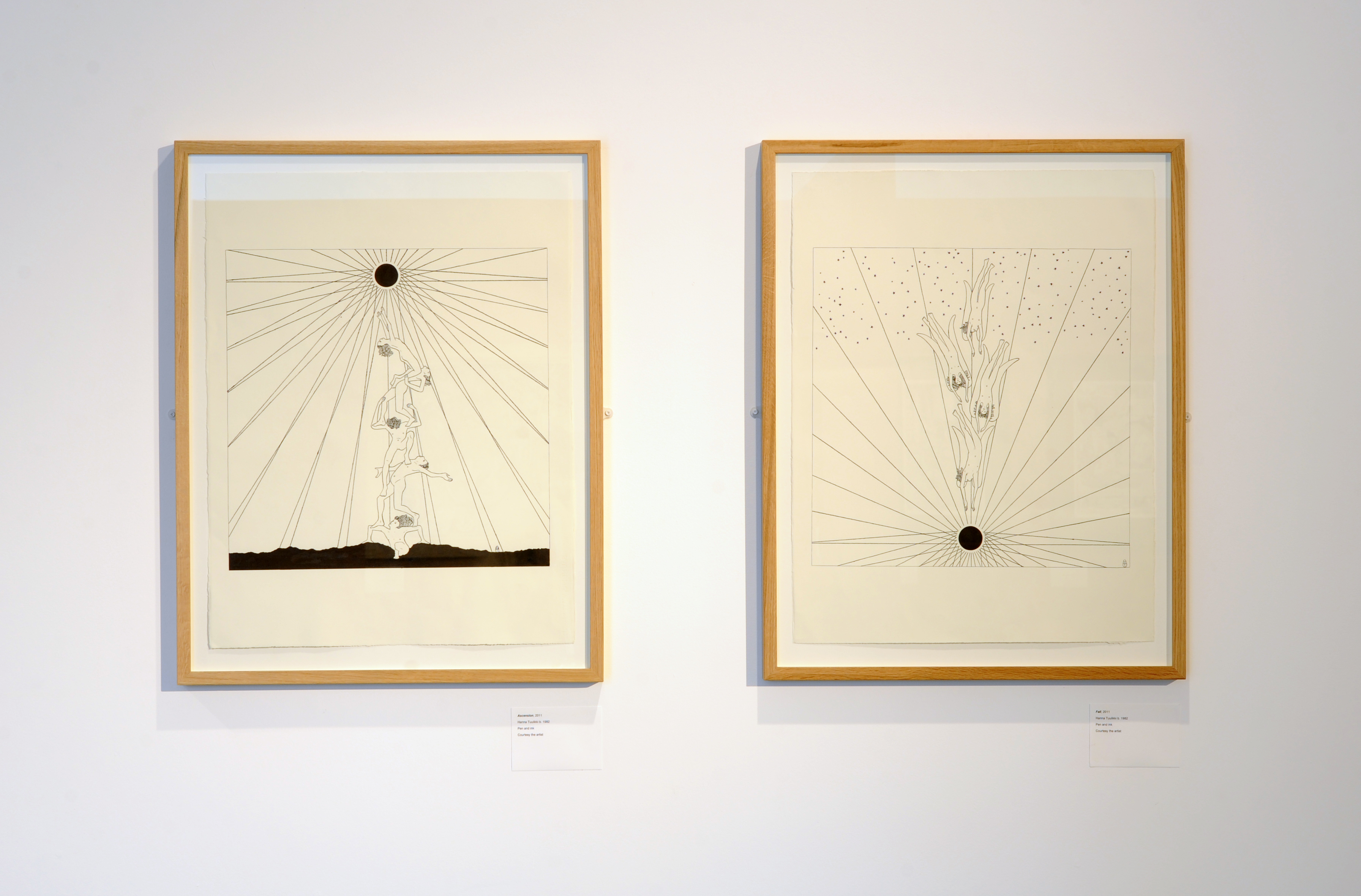
'Ascension', (2011); 'Fall', 2011 Hanna Tuulikki. Photo: Alan Dimmick

‘Ascension’, (2011); ‘Fall’, 2011
Hanna Tuulikki. Photo: Alan Dimmick

Linking to Alasdair Gray’s ‘The Fall of Kelvin Walker’(1990) and Eric Gill’s ‘Ascension‘ (1918), the exhibition also shows Tuulikki’s two original pen and ink illustrations ‘Fall‘ (2011) and ‘Ascension‘ (2011). Tuulikki says of the works:

These drawings reflect on the familiar themes of fall and ascension, setting aside the traditional Christian axis, which places the earth in the centre (Hell-Earth-Heaven), for one that places the sun in the centre (Earth-Sun-Sky).  In Ascension genderless naked bodies transcend their human form. Emerging from the dark earth they clamber on top of one another and learn to co-operate, creating a human ladder, in order to reach to their common goal ­– the sun, source of light and life. The same genderless naked bodies, this time pictured with wings, dive out of from the constellations of the night sky and reach towards the sun, in Fall.”

The commissions and event programme are funded by Outset Scotland in association with YPO. Works on loan are from Sorcha Dallas, Ditchling Museum of Art + Craft, Glasgow Museums, The Living Art Museum (Iceland), Flowers Gallery, the collection of Sandy Moffat and the artists.

The exhibition is curated by Jenny Brownrigg.

Footnotes

1 P.15, ‘A Life In Pictures’, Alasdair Gray, Canongate (2010)

2 P22, ‘Eric Gill’, Fiona MacCarthy (1989), Faber and Faber Limited

3 ‘Profile: Peter Howson: The Best of Times, The Worst of Times,’ in conversation with Steven Berkoff http://discreet-uk.com/state-of-art/ISSUE%20THREE/howson.html

4 P.60, ‘A Life In Pictures’, Alasdair Gray, Canongate (2010)

5 Camden Arts Centre interpretation, ‘Innocence and Aware’, Dorothy Iannone, solo show 2013

6 Conversation with artist on studio visit

7 p.179, ‘A Life In Pictures’, Alasdair Gray, Canongate (2010)

8 P257, ‘Eric Gill’, Fiona MacCarthy (1989), Faber and Faber Limited
Unknown's avatar

Inquiry into the nature and causes [1]: on Alan Grieve

'Real Bothy', (2014), Alan Grieve

‘Real Bothy’, (2014), Alan Grieve

Having attended the opening of a large retrospective recently, where the CEO of that City’s Services stated, ‘Everyone knows that art is really made in the cities’, (even when one of the rooms was dedicated to landscape studies), I would like to continue to write and accumulate a section of reviews and essays that witness art that is made and presented outside of the city.

Kirkcaldy’s civic centre represents the historical nexus of philosophy, economy, life, death, labour, learning and art appreciation. Industrialist John Nairn, a linoleum manufacturer, bequeathed the building of a war memorial with museum and galleries to the town of Kirkcaldy, in memory of his son who was killed in the Great War. Built in the Classical style, the building, designed by Perth architects Helton and McKay, along with the gardens, opened in 1925 and established the area as the civic square. The Adam Smith Theatre, named after the social philosopher, economist and writer of ‘The Wealth of Nations’ (1776), is directly across the road. Kirkcaldy Art Gallery and Museum contains a series of rooms for the John Waldegrove Blyth Collection. Blyth (1873-62) was a local manufacturer who collected the works of Scottish painters, including William McTaggart and Samuel Peploe as well as, more surprisingly, the Camden Town Group [2] who were Walter Sickert, Spencer Gore and Harold Gilman. Blyth was chair of Kirkcaldy Museum’s Trustees and honorary Curator for 36 years. The wall panel about the collection states that he visited the paintings weekly on a Monday morning, to spend time with them.
This essay will look at the work of artist Alan Grieve, collector of stories and objects, entering via the latest project he has led on, Real Bothy’, at Kirkcaldy Art Gallery and Museum (11 Oct 2014- 18 Jan 2015). Adam Smith wrote in ‘The Wealth of Nations‘, that ‘What everything costs to the man who wants to acquire it, is the toil and trouble of acquiring it’. A key factor in Grieve’s practice is that he works to gather the stories that would usually be left locked in a person’s mind. The turns of phrase or surreal fortunes of objects and people, under Grieve’s custodianship take on a new significance. Categories for Grieve have included those relating to his own personal history, such as the boxing history of his effervescently stylish father Jock or his own existence as a hairdresser and artist [3]; to the wider social history of Dunfermline, where he, as the parlance of art cv writing would state, ‘lives and works’, with projects on The Kronk Disco or Jim Leishman’s stewardship of Dunfermline Athletic; to this latest series on the collective experience of landscape.

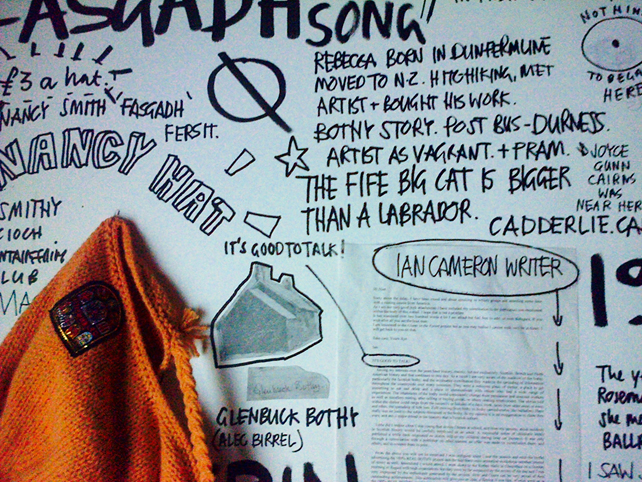
The Real Bothy, an OSB plywood assemblage, which has been flat packed then reconstructed at a series of locations over the Kingdom of Fife for the last 18 months, rests easily in the middle of one of Kirkcaldy Museum’s classical rooms. Designed to the simple layout of the bothy hut, a shelter to be found in a wilderness situation for anyone to use, its threshold encourages visitors to have to turn in around a corner;  a passage way so designed, as Grieve illuminates, because ‘Scottish folk are as wary as fuck‘. The bothy contains a row of coat pegs, a shelf for books, a bench and an animation of a crackling fire by Claire Lamond. In the midst of these physical nods to bonhomie, Grieve met with bothy visitors and charted their recollections across the bothy’s interior, alongside fragments of bothy history. Comments range from ‘My gran met Vivienne Westwood in public toilets in Galasheils‘, to someone who had to meet the call of nature on Portobello beach; to a photocopy of a letter from the Palace secretary, thanking the Mountain Bothy Association on their letter of condolence following Lady Diana’s death, concluding that they were pleased that Gelder Valley Bothy on Balmoral Estate was being enjoyed by so many walkers. The cacophony of comments on the walls form a map that criss-crosses from the personal to universal experience; a hallucination of place, with points of recognition for the viewer, through humour, names and situations.
'Real Bothy' (2014), Alan Grieve

‘Real Bothy’ (2014), Alan Grieve

How do you meet a contemporary artist out in the landscape? One inscription reads:

Rebecca born in Dunfermline, moved to New Zealand, hitch-hiking met artist and bought his work. Bothy Story. Post Bus- Durness. Artist as vagrant + pram.’

I surmise from these clues that the artist that Rebecca met must have been Pete Horobin [4], on his personal pilgrimage ‘Year of the Tent’, when he lived outside from 01.01.1989 to 31.12.1989, tramping the length and breadth of Scotland. The pram contained all objects that Horobin needed, including tent and plastic yellow chicken. Rebecca bought one of his artist books.

Alan Grieve has been an aficionado of bothies since his hair was big in his twenties to the present day, where he takes his own family or his ‘bothy partners‘, who include his mates Fred and Gary. The Real Bothy in situ in Kirkcaldy, is surrounded by a panorama of framed cut-outs from family albums, showing bothy gatherings from different times. One includes a picnic which looks likely to have followed a heavy night before, with muted males languishing around sandwiches re-captured in the bread bags they came out of. Another is more of a classic Casper David Friedrich lone figure on a peak. Giving an example where Grieve combines additional facts and fictions to assemble a new work, many of the figures in the photographs have been coloured out by a blue or black felt tip pen. This follows the artist seeing someone else’s album where a divorced ex-partner had been double excommunicated from the family book through their being systematically coloured out of each photograph of each album.

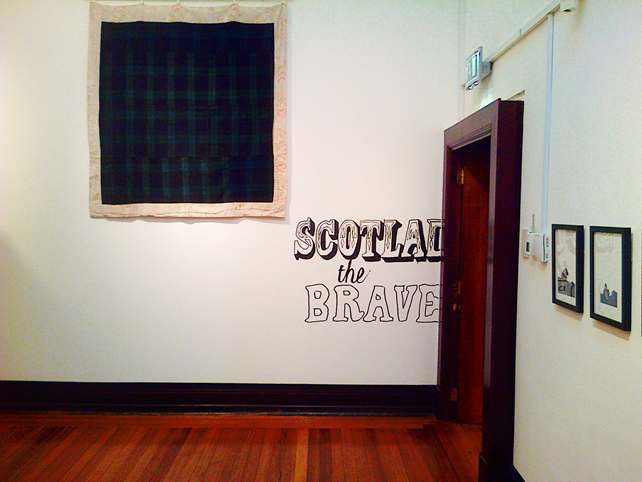
Grieve’s love of the quirk of language and action is also illustrated by his on-going painted text series, here shown in the wall painting ‘Scotlad the Brave’, which edges into the margin of the dark wooden door surround of the gallery. The phrase is one that Grieve heard about, the result of an amateur tattoo done far too late at night, challenged by spelling and a lack of space on the available arm.

'Real Bothy' (2014), Alan Grieve

‘Real Bothy’ (2014), Alan Grieve

Grieve has also worked to have on loan a number of the objects that were mentioned in the stories he gathered during ‘Real Bothy‘. The objects give a validity to the credence of a potentially tall story. Presented as museum objects, they also bring another layer to the creativity of people and their social history. Norma Ferguson’s picnic blanket, has been mounted on the wall like a banner on a rampart. In an object which resonates with the founding cause of Kirkcaldy Museum and Gallery and its memorial gardens, the tartan of this blanket comes from the kilt of Norma Ferguson’s father John, who survived active service in WW1. After his death in 1972 and the subsequent house clearing, Norma ironed out the pleats of the kilt, and tacking it in squares with an edging of a white material with a simple yellow and pink pattern, she made the blanket which is still used by the family to this day.  Other objects include Roger Hayward’s Pigeon Rings, a necklace denoting another kind of battle, made up from brightly coloured identification rings replete with the odd stray pigeon bone gathered by Hayward, during his study of Peregrine Falcons and their nesting sites for Scottish Raptor Study Group. Roger Hayward has sadly since passed away.

The surface syntax of Grieve’s work could be said to share allegiances with the REAL LIFE tattoo, social history and fake scenery of Ross Sinclair’s ‘Real Life Rocky Mountain‘ performance and installation, most recently to be viewed at National Galleries in Edinburgh as part of GENERATION, 25 years of contemporary art in Scotland; or the separate artist-led ‘The Bothy Project’, which has continued to build a formidably bespoke rival to Premier Inn network of bothies as sites for artist residencies across Scotland. With the former, Grieve shares the desire to show the disparity between “the reality of my landscape” over a romantic vision of Scottish landscape, beloved of the Tourist Board. With the latter, ‘Real Bothy’ shares links the intimacy of architecture and investigation of surroundings. However, Grieve’s work, through its collective nature, recalls the landscape of the locale as more of a fight between language, experience, people and place. This kind of an approach is illustrated by Norman Maclean in his autobiography ‘The Leper’s Bell’ (2010)  on the weekly village hall dances of South Uist [5]:

For the duration of the dance- anything between four and five hours- there would be a kind of tag boxing match taking place outside the hall…..Accordingly, if you got tired watching couples performing Quadrilles and Lancers, you could go outside and watch a couple of lads knocking lumps out of each other’.

Grieve’s work always records this flavour of the cut and thrust of social history. Like a latter day bard, he explores through his work a surreal landscape which acknowledges the arcane alongside the poetic. The Real Bothy bears a hand-painted  ‘flammable sign’, which  accepts the fine line in its own construction that a contemporary art object to one person is something to be set alight by another. Yet, whilst the male identity is present within the work, this is no Irvine Welsh approach to Scottish bravura. The presence of women feature equally in Grieve’s work, from Norma Ferguson’s blanket, to The Nancy Hat, as knitted by Nancy Smith, proprietress of the Fersit Bunkhouse in Lochaber, whose Nepal-esque inspired hats graced many the head of a departing visitor. The books on Scotland of Kelty teacher Frances Barclay have also been loaned to the exhibition, by her daughter Ros; a fitting display given that the local library is also part of the same building as Kirkcaldy Gallery and Museum.

Grieve’s observations of others, never oversteps romanticising his role as the artist recording those around him. In one of his drawings ‘Rock Rock Rockit’ (2014)  from a separate series, a collage shows an earnest bespectacled young academic in bashed jacket and jeans, proffering a microphone to an old man in a flat cap. The handwriting above the academic says, ” I’m really interested in recording your stories of this once thriving community”. The writing above the old man simply says, “Fuck off”.

Jenny Brownrigg October 2014

 Real Bothy’, Alan Grieve, Claire Lamond, Andrew Lennie, Kirkcaldy Art Gallery and Museum, 11 Oct 2014 -18 Jan 2015. The exhibition has been supported by Creative Scotland and Fife Cultural Trust.

Footnotes

[1] Title derived from the full title of Adam Smith’s ‘The Wealth of Nations’: ‘An Enquiry into the Nature and Causes of the Wealth of Nations’ (1776)

[2] The Camden Town Group only held three exhibitions and aimed to reflect the realities of urban life. One of their works in the Kirkcaldy collection, by Sickert (1860-1942), is entitled ‘What Shall We Do For the Rent?‘ (1909). Sickert, who chose to have his studios in the working class areas of London, had been focussing on pursuing a different narrative to the paintings of nudes, through the suggestion that the women were prostitutes. The gender shifts in ‘What Shall We Do for the Rent?’; a study of a male nude on the bed, with a clothed man sitting on the edge, leaning over him. A pair of discarded shoes can be made out, lying under the bed.

[3] Grieve was one of nine artists involved in the Duncan of Jordanstone College of Art and Design’s Nine Trades of Dundeeproject (2009-10).  Artists from Dundee and across the UK were invited to take up residency in the second non-art trade they practiced in order to support their art practice. Grieve’s residency was in Nori’s Salon in Dundee. Working with the other hairdressers and clients, the magazine ‘Masters at Work‘, was produced, and distributed across salons Dundee-wide. Grieve has also worked with National Theatre of Scotland on the production ’99…100′, (2011) where the stories Grieve gathered on a tour of a temporary hair cutting booth across the country, led to a script and production. Grieve’s own hairdressers salon Workspace Dunfermline, doubles up as a gallery and event space.

[4] ae phor aitch (2010-) has changed his identity and focus of work every ten years. Firstly Pete Horobin (1980-89), he was also Marshall Anderson (1990-1999) and Peter Haining (2000-2009). See  Moving Images From the Attic Archive’, for the excellent 2010 Cooper Gallery solo exhibition of this artist’s work, curated by Laura Simpson. Peter Haining and Alan Grieve were also part of ‘Fifeman‘ (2009) exhibition along with Jason Nelson and Kevin Reid at the Cupar Arts Festival. Horobin’s ‘Year of the Tent’ was archived by the artist, and this project’s archives are now held at the Scottish National Gallery of Modern Art in Edinburgh.

[5] P49, ‘The Leper’s Bell‘, (2010), Norman Maclean, published by Birlinn Ltd.

Unknown's avatar

‘Skin & Bones’: 1 Royal Terrace, Glasgow

Skin and bones can be an architectural term, with ‘skin’ referring to the material used for the building’s exterior, and ‘bones’, the basic structure within. Early design sketches of the new Reid building for The Glasgow School of Art (GSA), by architect Steven Holl, compare the skin and bones of the Mackintosh building with that of its new neighbour.  In the design process, the two buildings were denoted as binary; a thick skin of brick for the Mackintosh versus a thin skin of recycled glass for the Reid; then thin wooden bones of the former versus thick concrete bones of the latter.

skinbonesposter

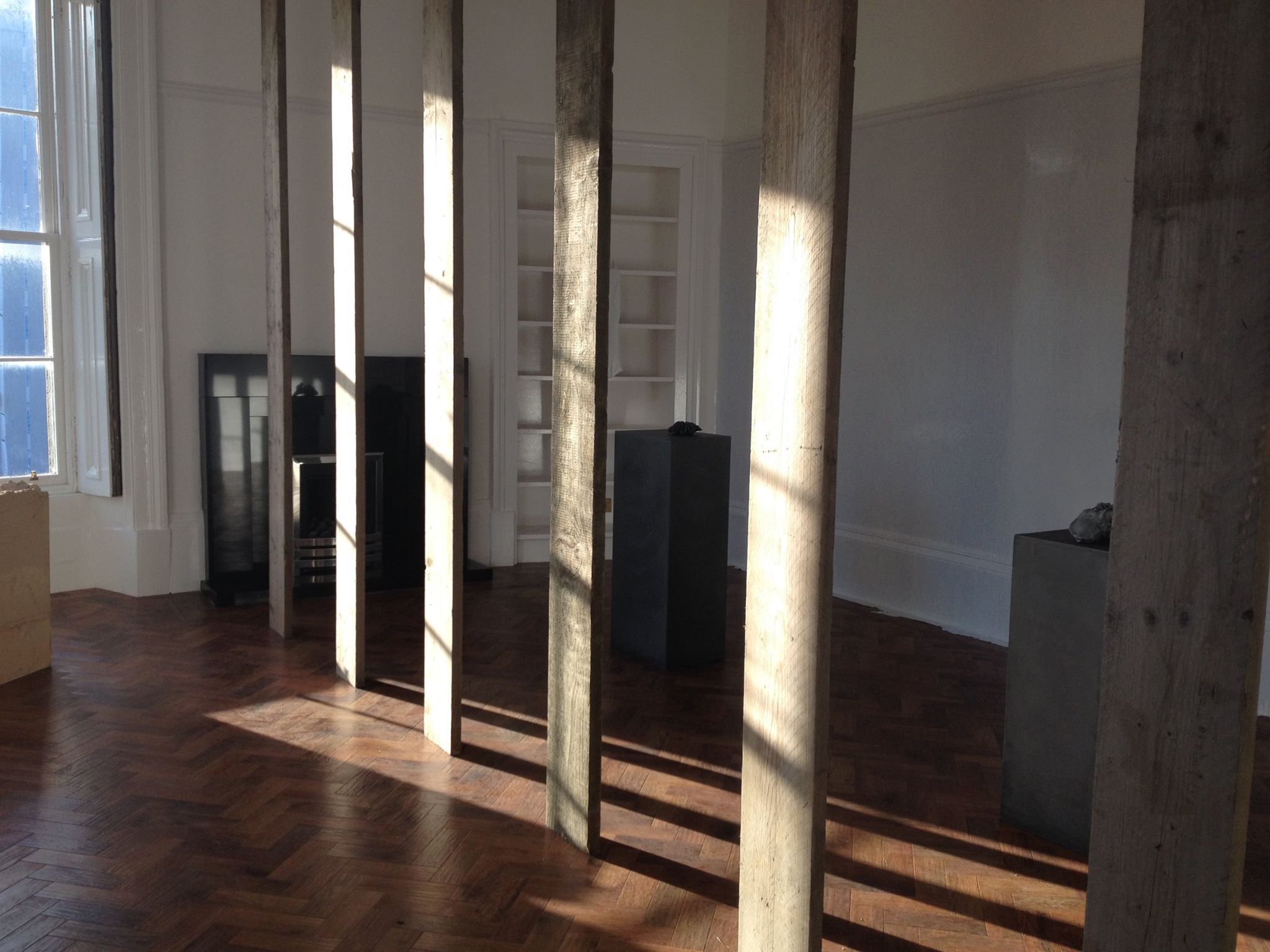
The exhibition ‘Skin & Bones‘ (8.6.14-22.6.14) is a ten minute walk from the GSA. It takes place in the airy and generously proportioned front room of a domestic tenement built in 1777 which has been repurposed as a gallery for a six-month long exhibitions programme. 1 Royal Terrace is located at the beginning of the West End. The gallery windows overlook Kelvingrove Park, which was established by the City between 1852 and 1854 to be one of a series of parks to combat the ‘skin and bones’ condition of the masses, following the Industrial Revolution. 1 Royal Terrace‘s closest contemporary gallery neighbour, is The Common Guild [1], the latter to be found on the higher ground of Park Circus, built for the upper classes to reside up wind of the factories, in the cleaner air. 1 Royal Terrace resides in the middle ground.

1 Royal Terrace is, historically speaking, not the only gallery to have sprung up from a domestic space or to reference the domestic realm as a more natural place for experiencing art.  ‘At Homes‘ was a series of performance and musical events that The Glasgow School of Art Club organized in the late 19th Century and early 20th Century, allowing for informal collaboration and gatherings within institutional exhibitions. Events included ‘Conversazione‘ in 1901 at The Royal Glasgow Institute of Fine Arts, on Sauchiehall Street, created a more informal space for group gatherings, in the gallery setting.

A second example, The Gallery of Modern Art Glasgow, was originally a townhouse built for £10,000 by ‘Tobacco Lord’ William Cunninghame (1731-1799), the year after 1 Royal Terrace was built, in 1778. He renamed the street outside to match the tenor of his new residence- Cow Loan became Queen Street- after George III’s wife. Cunninghame then sold his townhouse to the Royal Bank of Scotland; when the bank moved the building became a business centre and exchange, which was when the Corinthian pillars were added; then a library established by Glasgow Merchant Walter Stirling; then in 1996, finally, a gallery for the City’s collections. The changing functions of the one building breathed different lives into it.

1 Royal Terrace is also a building that has experienced changes of use over its time, primarily the oscillation between private and public domain- from middle class domestic dwelling, to insurance offices, returning to a home. Andrea Zittel refers to this layering and change of a building’s purpose as,

“… incremental building… where there are layers of decisions that happen over time for different reasons by different authorities, where the building is a rich combination of all those different decisions”. [2]

The six month long exhibitions programme at 1 Royal Terrace, should be viewed in its entirety on the same terms as ‘incremental building’. This exhibition ‘Skin & Bones‘, by the gallery co-founders and curators Ruth Switalski and Petter Yxell, is the concluding iteration of six exhibitions. Rather than jar as an example of curators curating themselves, it is the fitting conclusion that mirrors the close conversations between firstly Switalski and Yxell, then with each of the five solo practitioners they selected [3]. Instead of treating the gallery space as a tabula rasa for each show, the programming of 1 Royal Terrace has purposefully allowed a flow between the shows of artists that didn’t necessarily know each other well; from Helen Shaddock’s bright low-rise ‘Gathering‘ of parquet tile sized colour casts to the slowly discernible objects from the darkness of Augustus Veinoglou’s ‘Below the Spillway‘. The curators placed an emphasis on the solo show format, as one they perceived to be missing for emergent practitioners. The majority of the practitioners also utilise the casting process in their work, with each show exploring materials. A key objective cited by the curators of 1 Royal Terrace has been to foster a group of artists who were predominantly ‘outside’ the Glasgow ‘scene’ and to provide a professional platform complete with website and print, all undertaken by Switalski and Yxell so not outsourced. Perhaps a distant echo of the ‘At Homes‘ series of last century Glasgow School of Art Club, a series of open conversations with the 1 Royal Terrace artists has also punctuated the duration of each exhibition; its regularity allowing for overlaps between each of the involved practitioners to find out and consider how each has responded to the opportunity.

1 Royal Terrace architecturally echoes aspects of the ‘white cube’. Brian O’Doherty in ‘Inside the White Cube; The Ideology of the Gallery Space’ (1976) [4] explores the genesis of the gallery into a white cube- “The ideal gallery subtracts from the artwork all cues that interfere with the fact that it is ‘art’.” [5] White walls, uniform floor, no windows- these elements become part of the equation for this room to become ‘’a placeless gallery”. [6] However, the gallery in a flat operates within a ‘place’, the domestic realm, which lies beyond.  As a room it can be formalized, through emptying it of recognizable objects. It may also take on a number of the accepted givens of a gallery, in the case of 1 Royal Terrace, which places itself through address, the gallery adopts the clear language of white walls, gallery lighting, parquet flooring. However, this type of gallery is on the terms of the occupation of the owner and collaborators. It also places itself in a network; as a mode of activity this model has credence and is accepted in the wider art scene of the city. The ideology of the gallery in a flat lies in its immediacy and possible economy. The artist need not wait to attain visibility by being picked up or invited by an institution. The individual can become owner occupier of their own production, and that of invited others who cross its threshold. As a model, it makes artwork visible in a vital way. For the audience, there is an intimacy with the work and the host.

'Skin & Bones', Ruth Switalski, Petter Yxell, 1 Royal Terrace, Glasgow (2014)

‘Skin & Bones’, Ruth Switalski, Petter Yxell, 1 Royal Terrace, Glasgow (2014)

Whilst ‘Skin and Bones’ exists in a domestic interior, with works referring to materials that relate to buildings and the body, this exhibition retains an edited formality which suits the nature of the gallery space created at 1 Royal Terrace. The precision and editing of the works, follow the tradition of a Modernist hang; allowing the objects to breathe with plenty of white space around.  Switalski and Yxell talk of having had to negotiate the space of the room as the first two person show to inhabit it, following five solo presentations. This is quite literally seen in the division of space that Yxell’s work I know where my bones are buried creates, with the placement of six scaffolding planks, standing elegantly between floor and ceiling, to take on the volume of the space. In visual detail, reminiscent of Roger Ackling’s (1947-2014) simple wooden works where sunlight was angled onto surfaces through a hand held magnifying glass to burn the surface, Yxell instead uses a blow torch to char simple areas on the top of each piece of pine board.

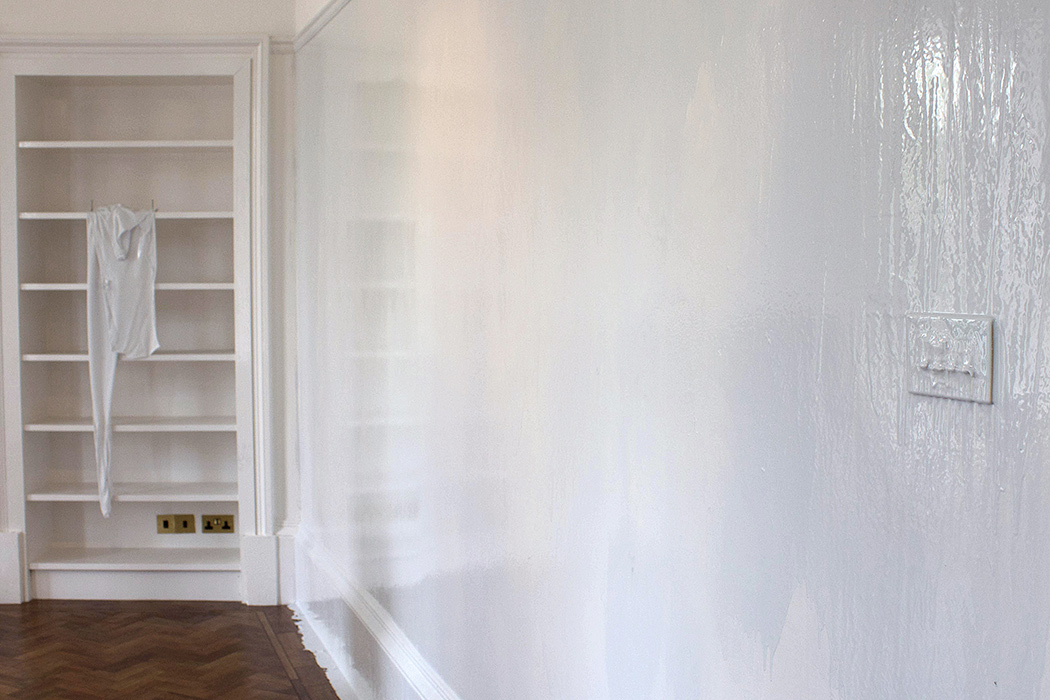
 One of the stand-out works in the exhibition is ‘Stratum Coneum (horny layer)‘ (2014) by Switalski. A grey silicone ‘skin’ coats an entire length of wall, covering even the light switch. ‘Le Moi-peau‘, translating as ‘The Skin-ego‘ (1974) by Alain Didier, details his psychoanalytical theory on the skin as interface for the individual, a container of ideas and boundary marker between inside and outside. Didier quotes Sylvia Plath, who at a formative level, experiences a severing of connection with her mother when as a two year old she is superseded by another baby: “I felt the wall of my skin. That I am I. That a stone is a stone. My beautiful fusion with the things of this world was over.” [7]

'Stratum Coneum (horny layer)' (2014) Ruth Switalski. Image courtesy 1 Royal Terrace

‘Stratum Coneum (horny layer)‘ (2014) Ruth Switalski. Image courtesy 1 Royal Terrace

There is no space between the gallery wall and the ‘skin’ of Switalski’s work. Its surface holds the painterly marks of its application. ‘Stratum Coneum‘ covers the surface of the dividing wall between the gallery and the domestic  apartment that lies beyond, providing an interface between the hidden ‘id’ of life in the apartment, and the presentable ‘ego’ of the gallery as a rational and controlled container of objects for audience perusal. This ‘ego’ is very much the opposite to Erica Eyres and Sigga Bjorg Sigurdardottir’s 2014 Glasgow International presentation Sniffer, where the ‘Id’ of the protagonist, detailed as having been ‘abandoned by his parents at an early age’ (a more physical type of abandonment than Plath experienced), roams uncontrollably through a filmic and object installation in a Victorian tenement apartment on Alexandra Parade, in the east end. Sniffer’s Freudian ‘drive’ sees him stalk an unseen prey and also, through a separate film, the viewer able to see the grotesque ‘skin’ of his hand, leaf delicately through a jewelry catalogue.

The reference to skin, skeleton or container continues in Switalski and Yxell’s other works within the gallery at 1 Royal Terrace. Switalski’s piece ‘St Bartholomew‘ (2014), hangs a ‘flayed’ silicone skin on the wall beyond ‘Stratum Coneum’, meeting Didier’s medical observation that ‘a piece of skin detached from the body shrinks greatly‘ [5]. The body, in this case, is defined as the gallery itself. A further two works by Switalski continue to reference the body through the skeleton.  ‘Scleractinia‘ in both its title and form, refers to a type of stony coral which generates its own skeleton. ‘Inverted Acetabulum‘ (2014) presents part of a pelvis, made from graphite. It is interesting to note that Yxell orders the space in his work ‘I know where my bones are buried’, whilst Switalski’s work often references the body or skin. Mark Wrigley argues in his chapter ‘Untitled: The Housing of Gender’, in ‘Sexuality and Space’, that the skin and bone of architecture are gendered: ‘The feminine materiality of the building is given a masculine order and then masked off by a white skin.’ [8]

'Inverted Acetabulum' (2014) Ruth Switalski. Image courtesy 1 Royal Terrace

‘Inverted Acetabulum’ (2014) Ruth Switalski. Image courtesy 1 Royal Terrace

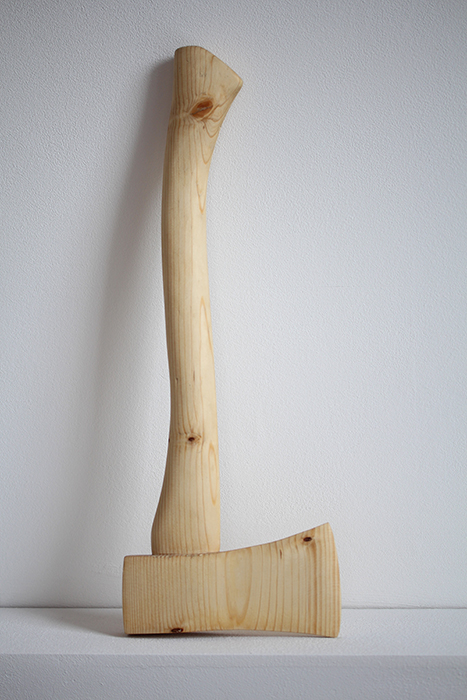
Yxell’s ‘In advance of a broken line‘ (2014) creates an axe made from wood, fusing this elemental manmade tool with the material it has been invented to deal with. Using this work’s title as a metaphor, where and how does 1 Royal Terrace sit in the lineage of other examples of recent and past manifestations of galleries occupying domestic spaces? A defining feature of grassroots activity in the contemporary visual arts scene in Glasgow has been the proliferation of galleries within domestic flats. It should be noted that within Scotland this is not purely a Glasgow phenomenon, with examples such as ‘Annuale’ in Edinburgh (2009-) often taking place in flats, or Magnifitat (2002-2007) set up by Kim Coleman and Jenny Hogarth in a flat in Bruntsfield, Edinburgh. The home as a site for artist work and studio is also well documented. A concise, detailed narrative of US and European examples is recorded in the excellent Sternberg Press publication, ‘The Artist’s House: from workplace to artwork‘ by Kirsty Bell (2013).

'In advance of a broken line' (2014) Petter Yxell. Image courtesy 1 Royal Terrace.

‘In advance of a broken line’ (2014) Petter Yxell. Image courtesy 1 Royal Terrace.

Back in Glasgow, over the last twenty years, key examples have included Cathy Wilkes’ Wilkes Gallery (1995-7) in a spare room in her ‘flat in the Dalriada tower-block in Anderston’ [9], to the origins of Mary Mary, established by Hannah Robinson in her corner flat with views on Alexandra Parade in Dennistoun. Switchspace, ran by Sorcha Dallas and Marianne Greated (1999-2004) began in Dallas’s west end flat then, through partnerships with the city and an interested property developer, created opportunities for artists in a series of newly renovated empty flats. This format of a gallery in a domestic interior has been an immediate, flexible and independent means to create a space for making work and showing it. As co-founders, Switalski and Yxell were very aware of the lineage of such spaces in Glasgow, and have seen 1 Royal Terrace as “adding to the historical heritage of an [art] scene so rather than ignore or find a gap, we have updated the model” [10]. In choosing in 2014 to make a gallery within a private dwelling, Switalski joked that they wanted it, “… not to feel like it has an outdated 90s’ house party vibe“.

As a model of self-sufficiency and signifier of independent activity, the gallery in a domestic dwelling has continued to endure, in particular, in its appeal for students and recent graduates. Examples from the recent present include ‘Friends’ (2013-), at 42 Charlton Place, by the river Clyde, run by GSA MFA graduate Lauren Hall. rez-de-chaussée [11] on Woodlands Drive, led by five GSA MFA students, existed for a year in 2011, in a front room of a flat on Woodlands Road in the west end of Glasgow.

To compare 1 Royal Terrace to an enterprise which has ran separately yet concurrently in Glasgow, Friends, some formal differences arise in approaches. For  Lauren Hall, ‘Friends are pals’, which has led to an organic series of solo presentations and collaborations with immediate peers in the domestic flat she rents. For 1 Royal Terrace, a main premise of selecting the artists for the six monthly shows, was that they would not necessarily know each other and were predominantly chosen as they are outside the perceived Glasgow art scene. Formally, the front room of 1 Royal Terrace has been transformed into a room that reads successfully as a high spec gallery space, with its specially installed lighting and synonymous white walls. For ‘Comfortably Warm’, Hall’s 2014 collaborative Glasgow International project with Jay Mosher, the domestic life and nature of the flat, even when reduced through the process of emptying out all furniture and belongings, could not be eradicated.

The life of an independent gallery in a flat is often a finite one. Such initiatives have lived, breathed, altered shape, and had different lengths of life span. The evolving nature of technology and social media since the 1990s’ may help to serve these recent enterprises better with a more visible afterlife of documentation on the web. [12] The form of the projects they house and the duration of the entity are closely intertwined with the paths and individual trajectories of the artists who have ran them. The gallery may flex into another kind of enterprise, for example, when awarded funding, or more likely be closely tied to the tenure of the location; if rented property, or a conclusion in education, the person moves on. Individuals also may chose to focus solely on their own practice again. In 2014, as Switalski has concluded her Masters of Letters at The Glasgow School of Art, and Yxell moves to London to do an MFA at Goldsmiths, the activities of 1 Royal Terrace, following a conclusive and finite six month run, the initiative is in abeyance to see what naturally arises from the protagonists’ own trajectories.

Footnotes

[1] The Common Guild was established in 2006, and is a charitable, not-for-profit organisation, originating from the development of The Modern Institute as the latter evolved fully into a commercial enterprise. The Common Guild is sited in Douglas Gordon’s Glasgow house.

[2] P.119, Andrea Zittell’s interview with Kirsty Bell, ‘The artist’s house, from workplace to artwork’, Sternberg Press (2013)

[3] The exhibitions at 1 Royal Terrace have been Helen Shaddock (‘Brimming’), Nick Thomas (‘Quote Spam’), Rachel Levine (‘Here, Create distance, Tension It… Feel It Flex’), Augustus Veinoglou (‘Below the Spillway’), Caroline Inkle (‘Re:Production’) and Ruth Switalski / Peter Yxell (‘Skin & Bones’).

[4] ‘Inside the White Cube; The Ideology of the Gallery Space’, Brian O’Doherty (1976), originally in Artforum in 1976, then first book edition 1986, The Lapis Press, San Francisco

[5] Ibid

[6] Ibid

[7] Sylvia Plath, ‘Ocean 1212-w‘, p.120, ‘The Skin-ego’, Alain Didier (1974)

[8] Mark Wrigley, ‘Untitled: The Housing of Gender’, ‘Sexuality and Space’, edited Beatriz Colomina, Princeton Papers on Architecture (1992)

[9] P.200, ‘Social Sculpture’, Sarah Lowndes, published by Stopstop Publications (2003). This book details the programme and aesthetic of Wilkes Gallery and exhibitors

[10] Conversation with Ruth Switalski, 8.7.14

[11] rez-de-chaussée was run by five GSA MFA students in 2011 – Justin Stephens, Suzanne Dery, Zoe Williams, Marie-Michelle Dechamps and Geneva Sills, ‘aim(ing) to provide an experimental yet critical environment from which to work with a diverse range of emerging artists, from Glasgow, rest of UK and further afield. Shows included Nicolas Party, Kate V Robertson, Lawrence Leaman and Sheena Hoszko http://www.rezdchaussee.blogspot.co.uk

[12] Whilst 1Royal Terrace have had a cohesive website knowingly reminiscent of an organizational website with archive section and new section, ‘Friends‘ has moved out from a website as starting point, to individual Tumblr platforms for each project, which operate as a holding page of abstract images to represent ideas and processes.

Jenny Brownrigg, August 2014

Unknown's avatar

Hanna Tuulikki: Away with the Birds

You stand water-loud

From the poem Ben Eubhal, Mary Maclean, (1952) [1]

'Away with the Birds', Canna (2014) Image: Daniel Warren

‘Away with the Birds’, Canna (2014) Image: Stewart Connor

These words by the North Uist poet Mary Maclean (1921-2004) are addressed to her island’s mountain, where she describes the speed of its streams as moving fast from the summit then, ‘Gentle voiced to the quiet bevelled edge of the shore‘ [2].

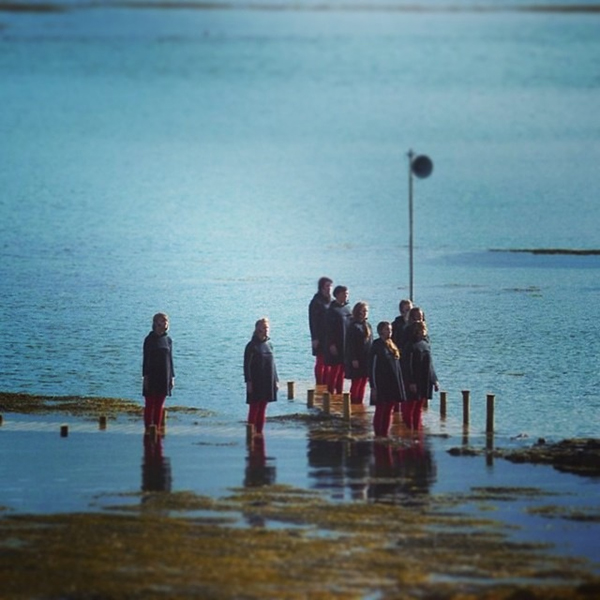
The phrase ‘You stand water-loud’ is highly apt to describe Away with the Birds/Air falbh leis na h-eòin’ , a performance (29/30 August 2014) addressed to the surrounding sea, sky and land of Canna. Staged on the foreshore of Canna’s harbour, this location was noted by Martin Martin in 1695 as having ‘good anchorage‘[3]. Ten women dressed in costumes based on shore birds, such as the oystercatcher and redshank, performed a score composed by Hanna Tuulikki. The composition was drawn from fragments of traditional Gaelic songs where different birdsong is mimicked.

The foreshore defined as the area of land between low tide and high tide is a strange zone of land. Historically owned by the Crown, this land is always in a dance with the sea. The choreography of the piece, by Nic Green, deftly picked up on this. Over the duration of this one hour performance [4], the ten singers [5] moved over manmade and natural elements of terrain which included the old pier, new purpose-built jetties designed in the v-formation of a skein, and the seaweed coated rocks. The weather altered from overcast to a light rain, then sun. In the fourth movement entitled ‘flock and skein’, the tide had sufficiently drawn in over the wooden jetties for the crabs to run over the singers’ red neoprene feet. Further out in the bay, a curve of six horn speakers- each standing at four meters high- transmitted the calls of the women. During interludes, as the singers silently dispersed to re-congregate in another position, a series of field recordings by birdsong expert and wildlife sound recordist Geoff Sample, of birdsong from the Western Isles, was played. This clever shift in sound created a transitory space, suggestive of the women moving between human and avian form.

Tuulikki carefully evolved ‘Away with the Birds’ over a period of four years, with the score beginning with one person, moving to three, nine, then finally ten singers for Canna. As Margaret Fay Shaw (1903-2004) noted in her book Folksong and Folklore of South Uist, ‘To sing a complete waulking song alone without anyone to take up the chorus imposes a considerable strain on any reciter’. [6] The score is drawn from fragments of Gaelic lullabies, children’s songs, keening, dance and work songs from the Highlands and Islands (all women’s songs or sung from a woman’s perspective), from Barra to St Kilda, that include bird song within the narrative. Tuulikki, with Gaelic expert Mary Smith and Geoff Sample, analyzed the transcriptions of birds ranging from seabirds on cliffs, to redshank, oystercatcher, whooper swan, raven, Manx shearwater, geese and ravens. In the subsequent performance of ‘Away with the Birds’, through repetition and vocal techniques such as ululation, the score truly created ‘syllables that carry the air’ [7]. The vocalists who joined Tuulikki, all brought with them their own reasons for creating sound that makes a connection with nature, ranging from a belief in ‘wildness’ [8], a connection to Canna, (Nerea Bello is the niece of the Canna House Archivist Magdalena Sagarzazu), to a background in Gaelic singing. In the seven week rehearsal period that led up to the Canna performance, the group went ‘deep into the material’ [9] in a series of sessions around improvisation and play, in order for Tuulikki to organically develop the skeleton of the composition.

Tuulikki sourced a number of the songs from the Canna House Archive and John Lorne Campbell’s recordings. Magdalena Sagarzazu, whose life’s work has been dedicated to working with Canna House, describes this house and its remarkable contents perfectly:  “I often think of Canna House as an island within an island” [10]. This archive was created by the island’s previous owners, the photographer and folklorist Margaret Fay Shaw (1903-2004) and Gaelic scholar, environmentalist, farmer and folklorist John Lorne Campbell (1906-1966) who gifted the island and archive to the National Trust for Scotland in the 1980s. Canna House, their collective archive and preserved home, contains their lifelong work of recording Gaelic songs from the islands and chronicling Gaelic culture through its language and traditions. Also, contained in the House’s archipelago are Shaw’s photographs, Campbell’s butterfly collections and possessions including an engaging cornucopia of ephemera relating to cats. Pattern cascades across wallpaper and curtain material, with bird curtains in the bedroom (now archival room) and fish swimming across the walls of the bathroom.

The couple would have no doubt have greatly appreciated both the high spec technology embodied by the speaker horns and the sounds of women singing in ‘Away with the Birds’. A trawl through the Canna House archives shows that methods of recording and writing alter each time technology superseded itself, from recordings on wire, to reel to reel, to VHS. In Campbell’s own voracious correspondence and research, his notebooks and papers show that he utilized a typewriter, then carbon paper, followed by the earliest photocopies to the first computer printouts on voluminous concertinas of green lined paper with perforated edges.

Hanna Tuulikki

Hanna Tuulikki

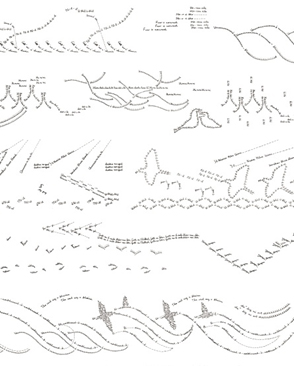
Tracing the lines that Campbell’s correspondence took from the island as he compiled a Gaelic dictionary is like following the flight path of birds. The correspondence shuttled back and forth between Canna House and destinations from all over Scotland and the world, in the days before the internet. There were letters from Sister Veronica in Nova Scotia; Father Allan Macdonald on Eriskay; Annie Johnston from Barra (Tuulikki drew from Campbell’s recordings of Annie Johnston and her husband Calum); and correspondences with academics from the universities of Edinburgh, Glasgow and Aberdeen amongst others. They worked with Campbell to try and pin down Gaelic for phrases like ‘a crop of pimples or to describe specific types of seaweed or on phrases relating to ‘Strange Things’.[11] These lines of words in flight are very much present in the beautiful notations of Tuulikki’s scores for the performance, where the lyrics can form the chord [12] of a wing or denote the lift and fall of a bird in flight.

Both ornithologists and folklorists have established methodology to recognize particular song. With many versions of the same songs existing, due to locality, dialect and additions of verses, according to length of activity, Margaret Fay Shaw in ‘Folksongs and Folklore of South Uist’, identified it was often ‘the chorus called the fonn or ‘ground’ and is the means by which the songs are popularly identified’ [13]. For the bird-watcher, where the sound is often in advance of the sighting, the mnemonic is a human aide-memoir for identification. Tuulikki’s score gathers the Gaelic mnemonic along with the narrative. The techniques that Tuulikki and the nine singers developed, ensure mimicry through concentration on pitch, volume, complexity of sound. The numbers of voices in the acoustic structure cross over on notes. Some species of birds can split a note, to sing both at the same time. At times, the sound created by the singers is often spectral in its mimesis, which is no small feat given that the avian vocal organ, the syrinx, is at the bottom of the trachea unlike the human larynx which is at the top. In order to explore the voice as an instrument itself, Tuulikki has long used the ‘extended vocal technique’ and improvisation to “find ways to define self through similarity with the more than human world“. [14]

The costumes, designed by Deirdre Nelson, cleverly combine symbolism and pragmatism. The colouring and detail of the costumes reference the distinct visual appearance of waders, whilst also drawing upon their Celtic meaning. The name of the Oystercatcher, or gille-brìghde , translates as servant of St Bride. The book The Peat Fire Flame, Folk Tales and Traditions of the Highlands and Island, tells the following tale about this bird:

When Christ was being pursued from one Hebridean isle to another, he was hidden at low tide by two oystercatchers, who covered Him with seaweed, and kept watch over Him until His enemies had passed. [15]

The costumes are a key element of production linking ancient belief in nature to the spiritual. The colour red in Celtic culture is associated with the otherworld. The redshank is the bird who sings to the soul on its departure to the next. Nelson references red in the singers’ legs and the pleated insert on the back of the tunics. The designer cleverly combines contemporary with historical fabric in the singers’ costumes. Local Canna wool made by islander Julie McCabe is used in the tunics, whilst hi-tech red neoprene creates the legs of the garment which allows the singers to move in the water. The hoods of the woolen shrugs, somewhat monastic in nature, are based on 1930s’ patterns of fishermen hoods, providing a protection against the elements. The hood is a key part of the outfit. When drawn up over the singer’s head it aids the visual transition of human turning into bird. The detail of the reveal is key too, with knitted white inserts in the sleeves under the arms, detailed with a ‘v’ pattern, mimicking a skein of birds in flight. Tuulikki mentions in a studio visit that she enjoys the wordplay of ‘skein’, meaning a skein of wool or birds. At the back of the charcoal grey tunics, an inserted red pleat accentuates choreographed movement. The transformation of the human form into the unknown is reminiscent of Margaret Fay Shaw’s photograph of islanders dressing up in sheep skins for Halloween.

One of Tuulikki’s source material songs ‘An Eala air Loch Chaluim Chille’ -‘ The swan on St Columba’s loch’- suggests the bird’s association with this Saint. The sonic properties of Sounds are recorded in the ‘Life of St Columba’, by Abbot Adomnán, where visitors frequently stand on the far shore of Mull, to call over the Sound to Iona, asking to be picked up by boat. Indeed, Canna’s original chapel was dedicated to Colm Cille, with Campbell stating in his book ‘Canna: The Story of a Hebridean Island’ that the Saint ‘certainly must have visited [Canna] on his missionary travels during his exile in Scotland, AD 563-97‘ [16]. ‘Away with the Birds’ fills the Sound of Canna with a new sound. Sailors coming in to moor in the bay during the rehearsals later remark on hearing mysterious, magical song.

A collective feeling is created by ‘Away with the Birds’  through the experience of meeting fellow spectators travelling to and from the island, from time camping together, a camp fire and chance encounters in the social spaces of the island at the community shop and café . By the time the audience gathers on the shore road to watch the performance, they form a migratory ‘skein’ from the mainland and Skye. Following the first performance of ‘Away with the Birds’, an illustrator, Kieran Austin, goes camping to Garrisdale Point, over on the west of the island. When he returns several days later to Canna Harbour, he finds it uncanny that two hundred visitors have flown and that the island has returned to normal. This humanity is also very much present too in the Canna House Archive where, as well as the scholarly interplay on Gaelic phrases, throughout this correspondence a warmth flows between the writers. Academic secretaries thank Campbell for Christmas gifts; anecdotes describing local situations are swapped; greetings are passed onto spouses and people promise to come to Canna again soon. Indeed, the table in Campbell’s office is a billiard table, which he used a respectable office ‘table’ during the week thanks to a sheet of wood placed over it, and as the site of an on-going billiards competition with islanders at weekends.

For the final movement ‘night flight to the burrow‘, the ‘birds’ move up to positions behind the audience to sing. Woven from fragments of a St Kilda lullaby, this movement is dedicated to the Manx shearwater,  a bird once prevalent on Canna (indeed Campbell commissioned a special stamp bearing its image).  Tuulikki sees this movement as an incantation for their return. The dramatic backdrop to the performance, Rum, which lies five miles away, is now centre stage. Geoff Sample observes this island beautifully in his field notes:

‘I find the architecture of Rum’s western mountains constantly satisfying. They aren’t quite as ruggedly spectacular as the Cuillin proper. But their serrated vertical ridges, swooping down to the sea, hemmed in lush green ribs, mark the course of the day like a sun dial, as the light changes.” [17]

At its conclusion, with any human physical presence removed from the scene, the sound more than ever filled the land and seascape. Whilst the people and their voice are the source of oral tradition, with Tuulikki taking her place with this rich interpretation, it is the land and the sea that will endure.

Return to the sea

                                    Breathe           [18]

Footnotes

[1] P.56, The Voice of the Bard: Living Poets and Ancient Tradition in the Highlands and Islands of Scotland, Timothy Neat with John MacInnes, Canongate, (1999).

[2] P.56, Ibid.

[3] P.167, A Description of the Western Islands of Scotland Circa 1695, Martin Martin. Birlinn Ltd (1999).

[4] Attended 29.8.14 performance.

[5] Vocalists: Hanna Tuulikki, Lucy Duncombe, Nerea Bello, Anna Sheard, Judith Williams, Nicola Scrutton, Mischa MacPherson, Kim Carnie, Megan Henderson, Kirsty Law.

[6] P.73, ‘Folksong and Folklore of South Uist’, Margaret Fay Shaw, second edition Birlinn Ltd (1999). First published Oxford University Press (1977).

[7] P.73, Ibid.

[8] ‘My practice is wildness and not knowing’, Judith Williams. Vocalists biographies, ‘Away with the birds’ brochure (2014).

[9] From conversation in Tuulikki’s studio, 12.9.14.

[10] In conversation with Magda Sagarzazu.

[11] Any of the Gaelic words that Campbell could not categorise or that related to myths, second sight and ghosts, he entered into his ‘Book of Strange Things‘.

[12] In terms of birds and aeronautics, the ‘chord’ describes the imaginary line drawn between the leading edge and trailing edge of a bird’s wing.

[13] P.73, Folksong and Folklore of South Uist, Margaret Fay Shaw, second edition Birlinn Ltd (1999). First published Oxford University Press 1977.

[14] From conversation in Tuulikki’s studio, 12.9.14.

[15] P122, The Peat Fire Flame, Folk Tales and Traditions of the Highlands and Islands, Alasdair Alpin MacGregor, The Moray Press, (1937).

[16] P.1,Canna: The Story of a Hebridean Island, John Lorne Campbell, Fourth Edition, edited by Hugh Cheape, Birlinn Ltd, (2004).

[17] Geoff Sample, from his notes taken on Canna, Aug 2014.

[18] From verse (v), 5. Night-flight to the burrow. Away with the Birds score, Hanna Tuulikki.


‘Away with the birds’ is part of the Culture 2014 programme.

 Jenny Brownrigg, September 2014

Unknown's avatar

A Story to be Read Inside a Tower

The one thing I am afraid of is moths.”

 The moths are in the tall turret, wrapped up in the green leafy carpet that climbs up the stairs. By torch light, we see them flit, contained in their own vertical cosmos, well beyond the stately rooms. We climb up to the highest point, gingerly stepping up and out onto the flat, flexing zinc, to look over the balustrade, past the concertina of tiled roofs to the horizon line beyond. A ship tanker lined in white fairy lights, glides from left to right, as the more adventurous of us rattle doors, on our quest to learn the layout of the house’s many passageways or to scare the ghosts. In one of the books lifted from the Library shelf, the writing on the page is so tiny, that the black ink coalesces to nearly cover the white.

The common clothes moth tineola bisselliella when caught between fingers turns to a gold dust, causing the sheerest cast of light over the ridges of fingerprints. The chine-collé printmaking technique sees an image transferred to a thin surface which has been bonded to a heavier support. The lighter paper pulls the finer detail from the metal plate. A print, now unwrapped and placed carefully on the studio table, has travelled from Dundee to Brazil and back. A subtle golden sheen embedded within the weight of the pressed black panes, causes a shimmering light to dance through the scratched inky darkness. The print now travels to Glasgow as a gift.

Uma Ray, Work in Progress, Hospitalfield Arts Residency, Aug 2014

Uma Ray, Work in Progress, Hospitalfield Arts Residency, Aug 2014

‘Of all that was there/ and of what there was none’. This house is a strange compression in time. In the Cedar Room, a man from another period holds a clay bowl, which has been simply made from coils and decorated with circles. On a shelf next to this portrait, this exact clay bowl sits in amongst the detail of the room. The bowl exists as both a painted artefact and a real object. Over in the artists’ studio, another bowl sits, perched on the head of a hovering blue body. What kind of spell is this?

A bump, the bus lurches and stops, reminding two of us of their journeys through India. A body moves involuntarily from back to front seat. Bang! A goat is held. Wheels dangle over the cliff edge. A man is hit. Don’t worry, we are the mountaineers! Now see this yellow transparent cloth suspended from the ceiling, in the studio. It is the cloth she picked up in India. The recent shared stories have served as a marker for her to return to this once visited place, through her work. Look through the material’s lined pattern and see the happy detritus of this space of making, from the man with his love of art who began it, to the present occupant. His plaster busts line the mantle. She makes her own discreet whittled objects as an everyday exercise. Half torsos here, a sewing needle there. All are in constant motion and rearranged, until they too come to a pause, resting on the curve of a pregnant belly, hidden in a unisex white office shirt.

A conversation begins on cadavers. A pencil presses too hard, then too light on the paper. It is hard to commit to the tracing of death. Another of us conducts a digital examination of Deleuze’s corpus. It is not about ‘being’ but ‘becoming’ (devenir). The action lies in the flow and the space in between, until it stops.

A row of static caravans, so neat and so ordered. Surely these oblongs are shaped to hug the landscape and horizon. A different kind of static, to the ones she has known, so it must be recorded onto reed paper. This image awaits its turn with others, ready to be suspended in the white curved track, to become a painted length of film.

Look up and see the golden light and the turned soil of the field through the window. Flatness becomes animated. Hands are helped in order to gesture silent words. They make for a strange yet moving couple, the child-like puppet who sits in the woman’s lap, out in the field. Indoors, the watercolours of their words and actions lie under the studio table. Again, a further step back in time into the bedrooms of young German Princes. The portrait of another couple, divided by age, hangs on the wall, warning youth of the outcome of hurried choices. Another of us dreams about this ill-matched couple.

Now in the courtyard, a small wire-haired dog dances in the concrete trough, his movements as exact as a puppet, disturbing the black water and green weeds through the regular rhythm of its paws. One door swings shut, locking out the dweller. A man climbs a ladder and moves through the window gap. His legs can be seen by the audience below, with toes slowly pointing, as they slide gracefully from view. Meanwhile a whippet opens other doors, without a care, nor good reason, but to dance on steel surfaces. A woman, with great care, places fresh flowers from the garden, onto tables throughout the house and forgets a pile of runner beans.

The Latin beat of Nosce te Ipsum is carved into the fireplace of the Picture Gallery, originally Plato’s maxim inscribed on the Temple of Apollo in Delphi. There are many translations here in our house, from Norwegian into Croatian, whispered through the grand halls. The translator follows the paths by day that her words take at night. She stops to admire blue wallpaper as seen in mirrors, or meet the outstretched hands of the figures in the tapestries. Another figure, another night, this time in white silk, moves through the house and up the stairs. An out of tune pianola plays.The leaves wind around the house’s ornate stone pillars. A stone tortoise takes refuge in the column’s base.

Another, whose name means Flax in Sanskrit or Bright in Hindi, methodically turns garden wire, then lengths of white paper, in her hands, and the gentle shapes of leaves begin to cascade. Raw material falls into the shapes they cannot refuse.

The house’s dwellers and visitors act as an encyclopaedia for each other as connections and new views are cultivated in a spirit of generosity. A film, ‘Solar Breath’ (2002) by Michael Snow, is recommended. For the film’s duration, as the cabin inhales and exhales, the curtains at the window rise and fall, to reveal the solar panel outside that fuels the camera and the enterprise.  A continuing circulation of ideas, conversation and actions fuels this particular house. The people within make an almighty collaborative generator which continually transfers energy from the original owners to the those who care for and guide this place and its inhabitants; to those that are invited to share a fragment of time within its walls. Several rivers flow through. One leads to Venice; another winds from India to Scotland and back. A smaller, regular tributary carries the willing recipients’ stomachs and mouths from work to dining table and back.

The last mystery: “Do all Canadians know each other?”


‘A Story to be Read in a Tower’ was written following a week spent with Hospitalfield Arts Interdisciplinary Residency practitioners in Arbroath, Scotland (Aug 2014): Mireille Bourgeois (CA), Yael Brotman (CA), Christine Goodman (UK), Libby Hague (CA), Birthe Jorgensen (UK), Anja Majnaric (HR) and Uma Ray (IN). The story picks up on what each person was working on at Hospitalfield Arts, along with fragments of conversations and experiences of the week spent together.

Jenny Brownrigg, August 2014


Unknown's avatar

The Economy of the Embrace

Forsoth it is an vnmete maryage

And disagreynge and moche agaynst the lawe

Bytwene fresshe youth, and lame vnlusty age

The loue bytwene them is scantly worth a strawe

So doth the one styll on the other gnawe[1]

The Ship of Fools‘, published firstly in 1494, with illustrations by Albrecht Dürer, covers all human follies and vices, including lust, pride, greed, vice, negligence, impatience, addiction, lewdness, impudence, gossiping and selfishness. Humanity is folly-prone to a grand scale. Over the course of one hundred and twelve chapters, each failing is presented as an allegory, spoken through the voice of the fool, as in this guise, the author could freely express his own opinions. A devout Christian, Brant wished to chart the fallen behaviour of mankind, thus morally highlighting the redemptive path.

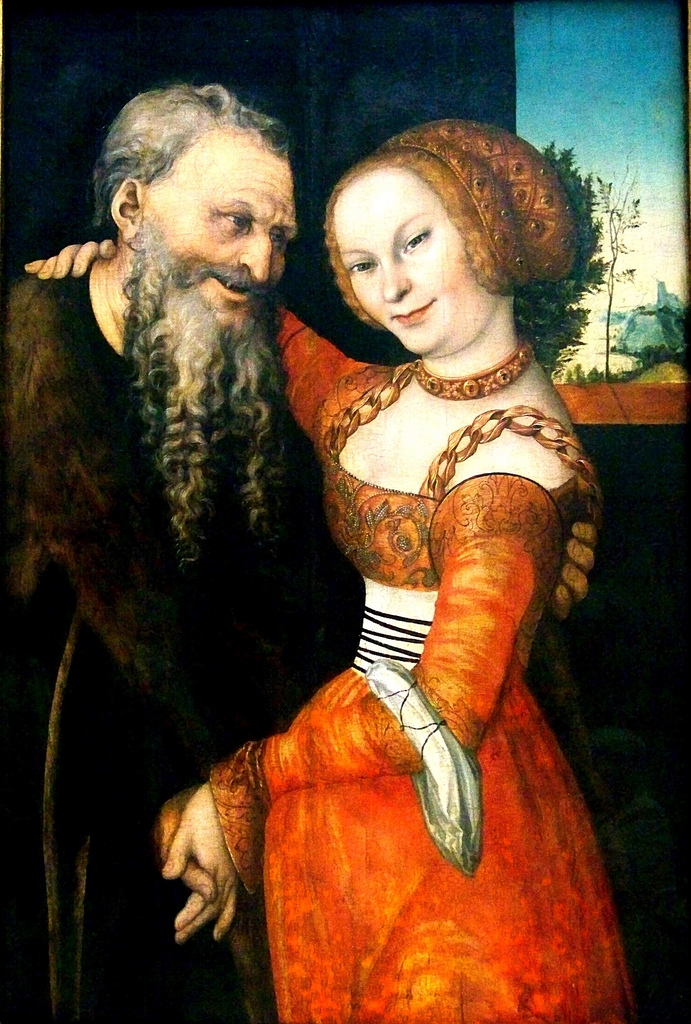
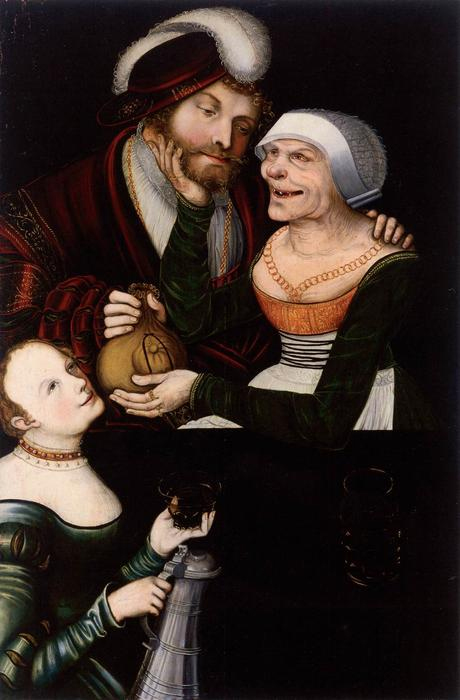
One of the allegories presented is that of the ill-matched couple, unequal in age, which became a popular theme in painting, particularly in the sixteen century, with artists including Dürer (1471-1528), Lucas Cranach the Elder (1472-1553) and Quentin Matsys (1466-1529) making such portraits. This essay will focus on six such paintings by Lucas Cranach the Elder [2] (the sixth by Cranach Workshop), charting the shift of the embrace depicted in each painting, by viewing them in sequence.

‘The Unequal Couple’, Lucas Cranach the Elder, (c. 1530). 86.7 x 58.5 cm. Germanisches Nationalmuseum, Nuremberg

‘The Unequal Couple’, Lucas Cranach the Elder, (c. 1530). 86.7 x 58.5 cm. Germanisches Nationalmuseum, Nuremberg

The first painting, ‘The Unequal Couple’ (painted circa 1530), currently hangs in the National Museum in Nuremberg, where I encountered it as an anomaly in a salon full of religious scenes. Nuremberg is an apt geographical location and moral loci for the work, in a city once described by Martin Luther as ‘Germany’s eye and ear‘ [3] due to its printing presses and distribution of information.

The ‘happy’ couple stand in a dark room. The black wall behind them is divided in plane.  It is complete darkness behind the old man, perhaps suggestive of the grave and longest sleep that awaits him. However, to the right of the young woman’s head, a window opens onto a sun-lit vista.  Thanks to her youth, and the positioning of the window in her balance, this escape from the room hints at her possible, freer future.

The woman glows out from the canvas. Her skin is luminescent. Her hair, cap and dress are an iridescent copper. In contrast, the old, toothless man wears darker colours. His skull is all too visible through his thin hair whilst his grey beard curls downwards in a mournful fashion. The furs that the man wears and the intricately decorated dress and jewellery of the woman symbolise what has brought this ‘ill-matched’ couple together. In marriage, the value of the man lies in his wealth, whilst for the woman, her currency is in her looks and reproductive ability. See how her corset is nipped in at the waist, yet there is a swell to her belly.

Whilst this young woman, who returns his embrace and mirrors his smile, may be seen to overlook the obvious cosmetic detriments of her elderly companion, the painter most definitely has not. In his visceral detailing of the thinness of pate and yawning chasm of mouth, there is a grotesque aspect alluded to, with the painter inviting us to imagine this formal embrace progressing. By detailing these only too human failings brought about by age, Cranach the Elder has created a form of Memento Mori. If this picture were translated as a still life, this couple represent the maggot settling on the bloom of the apple.

This woman’s hand rests lightly on the shoulder of her partner, with her other, loosely entwined in his. His left hand gently holds her around her back. Her body is orientated as the object of desire to the viewer, whilst he gazes on adoringly. Let us now sequentially view the other paintings from this theme of ‘The Ill-Matched Couple’, and follow the shift in embrace.

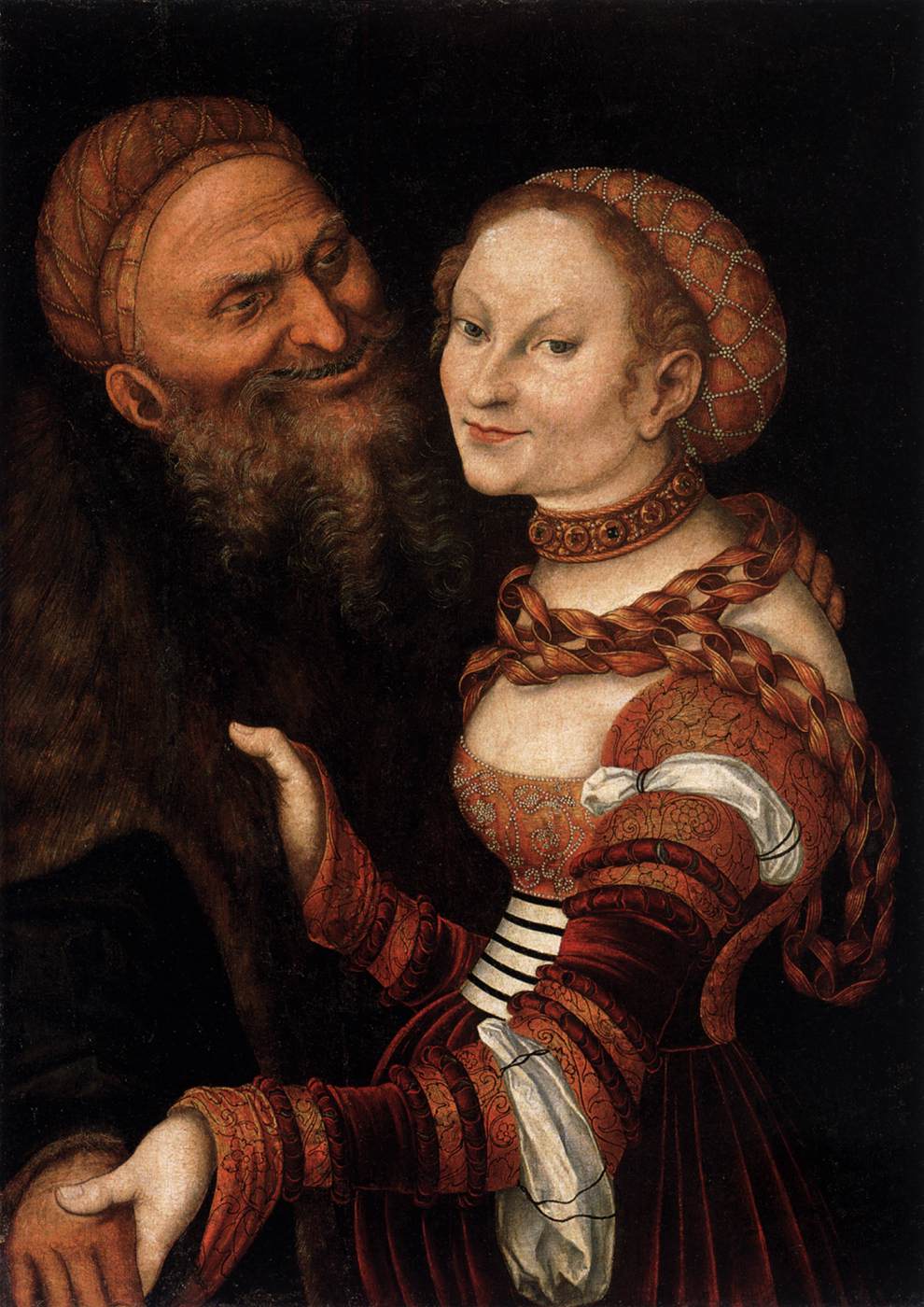
‘Ill-matched Couple: Young Widow and Old Man’, Lucas Cranach the Elder, (1525-30). Oil and tempera on wood, 79 x 58 cm. Musée des Beaux-Arts et d'Archéologie, Besançon http://www.wga.hu/html_m/c/cranach/lucas_e/14/index.html

‘Ill-matched Couple: Young Widow and Old Man’, Lucas Cranach the Elder, (1525-30). Oil and tempera on wood, 79 x 58 cm. Musée des Beaux-Arts et d’Archéologie, Besancon

The second painting is ‘Ill-Matched Couple: Young Widow and Old Man’, (1525-30). Although their unity is suggested in their matching caps, there is now no escape from this second dark interior; unlike the first painting, there is no window. The elderly male companion recedes into the shadow. Whilst he still gazes with certain ardour at his young partner, her grip has noticeably shifted. She still holds his hand, left in right, but her other is placed on the material object – his luxuriant fur collar. The copper of her finery has dulled, in comparison to the first painting. As she looks, more knowingly, her eyebrow arches, out of the plane of the painting towards us, her necklace has tightened and the braided detail of dress has slipped, to resemble the chains of a prisoner. The black stitching on the white ruffles on the arm of her dress appears like wire. The painting’s title gives us more biographical detail. As a ‘young widow’, this is her second marriage, more likely entered into for security, not love.

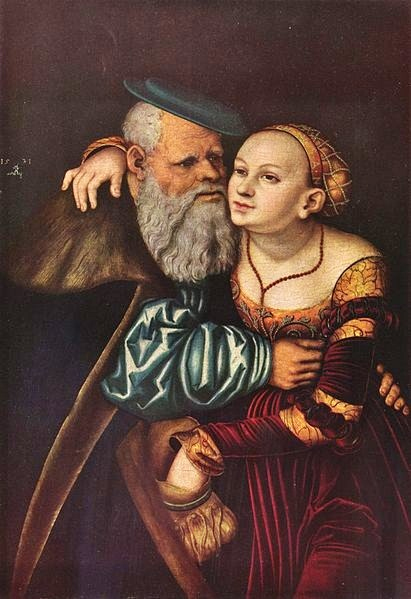
‘The Ill-matched Lovers’, Lucas Cranach the Elder, (1531) Tempera on wood. Akademie der bildenden Künste, Vienna http://www.wga.hu/html_m/c/cranach/lucas_e/14/index.html

‘The Ill-matched Lovers’, Lucas Cranach the Elder, (1531) Tempera on wood. Akademie der bildenden Künste, Vienna

In the third paintingThe Ill-matched Lovers(1531) and variation, the young woman no longer looks towards us to meet our gaze. She is elsewhere, staring wistfully into the distance, whilst her male companion, hands clamped around her waist, devoid of the smile worn in the first two paintings, expresses more of an urgency, as he paws her. Her left hand is placed on the fur of his cloak, a detail that whilst referring to wealth also could signify that the man is more animalistic, given the nature of their embrace. The economic necessity of their exchange is stressed. As the woman returns the half embrace with her right hand, her left is slipped into the man’s open purse, positioned over his groin. With the sexual connotation of the hand in the purse, we are left in no doubt of the type of labour involved. With the complicity of the woman in this arrangement and the introduction of currency through the inclusion of the purse, the folly of greed also enters the frame.

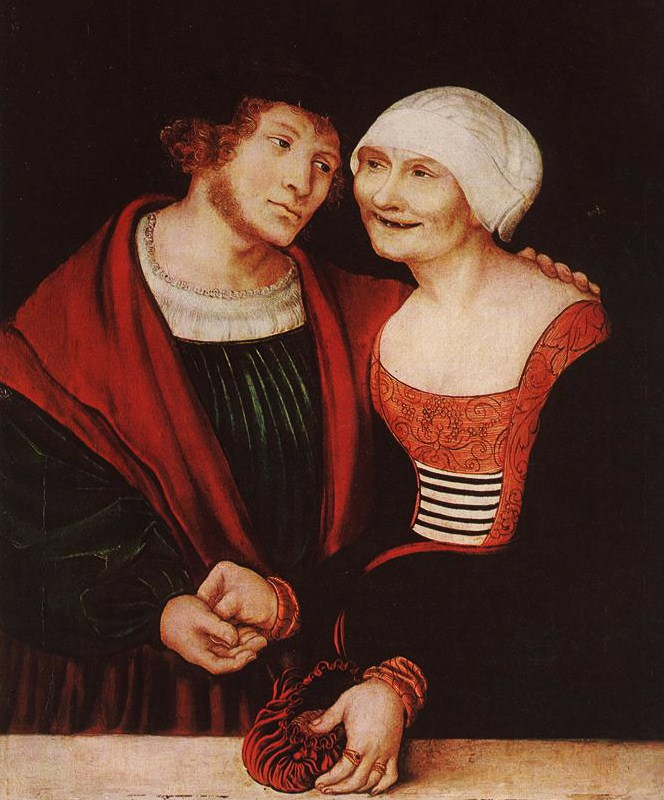
‘Ill-matched Couple- Peasant and Prostitute’, Lucas Cranach the Elder (1525-30) Oil and tempera on red beechwood, 32 x 23 cm. Hessisches Landesmuseum, Darmstadt

‘Ill-matched Couple- Peasant and Prostitute’, Lucas Cranach the Elder (1525-30) Oil and tempera on red beechwood, 32 x 23 cm. Hessisches Landesmuseum, Darmstadt

The fourth painting in this selected series makes this exchange explicit in its title and labelling of the characters: Ill-matched couple- peasant and prostitute (1525-30). The male hold has shifted from the proprietary hand around his partner’s waist and shoulder, to both clasping around her neck. As he looks through rather than at his companion, the woman is freed to have both hands handling the purse. In all four of these paintings, reading in the western tradition from left to right, the man is always on the left, the woman on the right, making the male primary and the female secondary, in its order. In an intriguing variation of the theme, the next two in the series swap the ages of the partnership.

‘Ill-matched Couple: Young Man and Old Woman’ Lucas Cranach the Elder (1520-22) Oil and tempera on red beechwood, 37 x 31 cm. Szépmûvészeti Múzeum, Budapest

‘Ill-matched Couple: Young Man and Old Woman’ Lucas Cranach the Elder (1520-22) Oil and tempera on red beechwood, 37 x 31 cm. Szépmûvészeti Múzeum, Budapest

The fifth painting is Lucas Cranach the Elder’s Ill-matched Couple: Young Man and Old Woman(1520-22). The man now is clean shaven with lustrous curls, whilst the woman wears a white cap, denoting age. It is now the woman who has the toothless grin. She holds the money bag and places coins directly into his cupped palm. This inversion of order, of young husband and old wife, also appears in ‘The Ship of Fools‘, with the adage that with ‘no hope of children nor lynage‘ there can only be pain and strife:

Suche ar they that for treasour and ryches

Whyle they ar yonge in theyr chefe lustynes

An agyd woman taketh to theyr wyfe

Lesynge theyr youth, and shortynge so theyr lyfe [4]

‘Ill-matched Couple: Young Man and Old Woman with a Maid’, Cranach Workshop, Lucas Cranach the Younger (c. 1540s) Oil and tempera on pine, 91 x 61cm. Kunstsammlungen der Veste Coburg, Coburg

‘Ill-matched Couple: Young Man and Old Woman with a Maid’, Cranach Workshop, Lucas Cranach the Younger (c. 1540s) Oil and tempera on pine, 91 x 61cm. Kunstsammlungen der Veste Coburg, Coburg

In the sixth painting, Ill-matched Couple: Young Man and Old Woman with a Maid, painted in 1540s by Cranach Workshop, (possibly Lucas the Younger, the painter’s son), a  third person is introduced into the scenario. The old woman is more grotesque in this version, with wrinkles on her neck cascading towards her immodest cleavage. Her eyes and nose are pink and the few teeth she has left are sharp and wolf-like. As she cups the young man’s beard with one hand, her other is outstretched to receive a full bag of money. The maid kneels in the bottom left of the frame, proffering a glass, an open vessel, to the couple above. In this scene, the old woman becomes a procuress for the young maid or prostitute.

For this essay, I have gathered these six paintings together, in their own fictitious singular space, in order to show each in respect of its neighbour and establish a pattern. In this way, the decline of connection between the protagonists, can be charted incrementally, through the shifting nature of the embrace. In reality, each of these works is dispersed, residing in different museums across Western Europe. However, this was not the original architectural context for the paintings. With Cranach the Elder employed as Saxony’s Court Painter, such works would have been hung intimately in the chambers of German Princes, as a moral tale, instructing against hurried choices. In contrast, the paintings to be found in women’s rooms would have promoted chastity and virtue.

The other staple subjects that Cranach the Elder painted were religious iconography in support of Martin Luther’s Protestant Reformation, a movement which was establishing itself in Germany at that time, and also the commissioned portraits of important people, in particular, of his employers, in his role as court painter to the Electors of Saxony. The ‘ill-matched or unequal couple’ does not hint at either glory or the good. Instead, through its parable of age and youth, and through representing the economy of such an embrace, it focuses on the foibles of the fallen, the human condition and how we can fool ourselves, often by circumstances, financial necessity or by society’s dictates.

Jenny Brownrigg, August 2014

Footnotes

[1] From the chapter ‘Of younge folks that take olde wymen to theyr wyues nat for loue but for ryches‘, p.347, ‘Ship of Fools, Volume 1‘, Sebastian Brandt, iBooks

[2] Lucas Cranach the Elder was a venerated German Renaissance painter and printmaker

[3] Cited in Albert Werminghoff’s ‘Conrad Celtis und Sein Buch uber Nurnberg (Freiburg i. B., 1921)

[4] From the chapter ‘Of younge folks that take olde wymen to theyr wyues nat for loue but for ryches‘, p.344, ‘Ship of Fools, Volume 1‘, Sebastian Brandt, iBooks

Unknown's avatar

Introduction, ‘Cabbages in an Orchard: Graham Fagen’ publication

A new publication, designed by Owned and Operated accompanies Graham Fagen’s exhibition ‘Cabbages in an Orchard’, Reid Gallery, The Glasgow School of Art. Download my introduction here. The publication is full colour, and contains commissioned essays by Graham Fagen and Johnny Rodger. The exhibition and publication are part of GENERATION, a programme across venues in Scotland led by National Galleries and Glasgow Life, looking at 25 years of contemporary art in Scotland. The publication is £10 and can be ordered from GSA Shop.

I invited Graham Fagen to look at Charles Rennie Mackintosh works held in The Glasgow School of Art Archives & Collections, in order to find the common ground between his work and Mackintosh’s. The resulting new body of work, plus three early original Mackintosh watercolours, from The Magazine, a DIY publication Mackintosh worked on with his student peers, runs in the Reid Gallery until 29 August 2014.

Cover_front

Unknown's avatar

Five Art Curators Consider Transforming an Interior

‘Five Art Curators Consider Transforming an Interior’ by Jenny Brownrigg has been published as part of ‘The Burning Sand Volume III’, edited by Sarah Lowndes and designed by Sophie Dyer & Maeve Redmond.  Download full text: Five Art Curators Consider Transforming An Interior

burningsandcover

[Excerpt]

…”The owners, they don’t ask for money, and God knows we don’t have money, but I can transform it all”. Romano is the leader of the group for no other reason than this is the way he sees it.

Irme tries to overlook Romano’s use of ‘I’. Surely he should remember that they have been brought together from different countries by the Festival organisers to work as a symbolic group for this project…”

The Burning Sand  Volume III also includes work by Nerea Bello, Wolf, Luke Fowler, Kathryn Elkin, Tony Swain, Sarah Lowndes and Lauren Gault. It retails for £4 from Aye-Aye Books and is distributed by  Good Press and Motto . Volume III was launched on 18 April 2014 as part of Glasgow International with support from Outset. ISSN 2052-5699 

Unknown's avatar

‘This Song Belongs to Those who Sing It’: Michael Stumpf, The Glasgow School of Art, Glasgow International 2014

Alphabet Chat Letter ‘O’ [1]

“Here is a secret about the letter O”, says Big Bird. “Whoops!” The camera frame turns him, and the ‘O’ he is holding, upside down. “It looks the same upside down, but I don’t.” [2]

'Ring', Michael Stumpf (2014). Cast acrylic resin. Mackintosh Building, Director's Balcony, GSA. Photo: Janet Wilson.

‘Ring’, Michael Stumpf (2014). Cast acrylic resin. Mackintosh Building, Director’s Balcony, GSA. Photo: Janet Wilson.

'Ring', cast acrylic resin, 2014. Michael Stumpf. Mackintosh building Director's Balcony.

‘Ring’, cast acrylic resin, 2014. Michael Stumpf. Mackintosh building Director’s Balcony.

‘O’ can be seeing something in the round. Where is the object positioned in relation to you? Can you move round it? Can you see inside it? What information do you need to understand what it is you are looking at?

Included in the ‘O’ of this essay are references to Michael Stumpf’s past work, descriptions of his present work for Glasgow International at The Glasgow School of Art (GSA), some Sesame Street philosophy  and other thoughts for you to include or exclude, as you encounter ‘This Song Belongs to Those who Sing It’.

'Ring', Michael Stumpf (2014). 'This song Belongs to Those who Sing It', The Glasgow school of Art. Photo: Janet Wilson

‘Ring’, Michael Stumpf (2014). ‘This Song Belongs to Those who Sing It’, The Glasgow School of Art. Photo: Janet Wilson

We first travel back to Michael’s exhibition ‘In My Eyeat the Pipe Factory, Glasgow in January 2014 [3]. A projection screen was placed in the middle of the gallery. In this action by the artist, the viewer was able to encounter the screen as a three-dimensional object as it could be walked around. The film playing on the screen presented a sequence of objects which slowly revolve: a small brown vase spins against a black backdrop; the camera circles an abandoned men’s black tap shoe. We are shown the surface of these two objects with the sheen of the glaze and the soft black leather and metal toe tap. We are then reminded that these objects have an interior as both begin to quietly emit smoke. The act of filming explores the object in a different way.

I am reminded of ‘In My Eye’, as we make choose the image for the GSA poster and invite for ‘This Song Belongs to Those Who Sing It’. Rather than repeat the same digital image across both, Michael decides to use the two flat surfaces to show front and back view of the same sculpture ‘The Sound of Silver‘ (2010).

'Sound of Silver', Michael Stumpf (2010). Recyled fabric, acrylic resin, denim, tap-shoes, powder coated steel. Front view.

‘Sound of Silver’, Michael Stumpf (2010). Recyled fabric, acrylic resin, denim, tap-shoes, powder coated steel. Front view.

'Sound of Silver', Michael Stumpf (2010). Recyled fabric, acrylic resin, denim, tap-shoes, powder coated steel. Back view.

‘Sound of Silver’, Michael Stumpf (2010). Recyled fabric, acrylic resin, denim, tap-shoes, powder coated steel. Back view.

Michael likes us to see things from different angles and to be aware of looking, “to see things in the round”. This can often be reflected in his choice of title. For the Pipe Factory exhibition it is ‘In My Eye’. In the Mackintosh Museum there are two pewter word sculptures separated by the void at the heart of the space, itself an inverted architectural ‘O’One says’Looking at me’. The second says ‘Looking at you‘.

Above the nose I’m sure you’ll agree / there are two things that help you see/ they help when Elmo looks at you / and you use yours to see Elmo too” [4]

'Looking at You', Michael Stumpf, detail 'This Song Belongs to Those who Sing It', GSA Photo: Janet Wilson

‘Looking at You’, Michael Stumpf, detail ‘This Song Belongs to Those who Sing It’ (2014) GSA Photo: Janet Wilson

GSA_StumpfLYouwidelores

What are we looking at in the Mackintosh Museum? Does it look back? The silver foil creates a smooth new skin on the longest wall. It offers up a new depth in the room. To the left, the reflection of the yellow-washed side wall folds back through the silver into infinite space. The painted right hand-side wall is reminiscent of a dawn or sunset, with the Mackintosh Museum’s resident headless Nike ‘facing’ towards this landscape composition. Both colour walls create a glow upon the burnished copper of the two Museum display cabinets which have been revealed for this exhibition and treated like sculptural objects. The polished glass on the case to the left of the director’s doorway becomes a mirror. The dark denim panel inside it provides a clear back drop and depth. Looking at me. There are no glass panels on the display case on the right. It is the same but different.

'Looking at me', Michael Stumpf (2014), detail. 'This Song Belongs to Those who Sing It', GSA Photo: Janet Wilson.

‘Looking at me’, Michael Stumpf (2014), detail. ‘This Song Belongs to Those who Sing It’, GSA Photo: Janet Wilson.

'Perplexed', Michael Stumpf (2014), 'This Song Belongs to Those who Sing It', GSA. Photo: Janet Wilson. Paper, calico, aerosol paint, denim, acrylic-resin, steel, tube clamps.

‘Perplexed’, Michael Stumpf (2014), ‘This Song Belongs to Those who Sing It’, GSA. Photo: Janet Wilson. Paper, calico, aerosol paint, denim, acrylic-resin, steel, tube clamps.

The three suspended works from the beams hang low to the floor, allowing us to circle them. Each of the works in the Museum has a different relationship to our body, as we look and relate to it. Is it recognisable?  What size are we in comparison to it? Does it change relating to where we are positioned? A gigantic denim triangle draws the eye up to take in the volume of this space.

'This Song Belongs to Those who Sing It', Michael Stumpf, Mackintosh Museum, GSA. Photo: Janet Wilson

‘This Song Belongs to Those who Sing It’, Michael Stumpf, Mackintosh Museum, GSA. Photo: Janet Wilson

'Endless long bowed phrases', Michael Stumpf (2014). Denim, plywood, steel, tube clamp. 'This Song Belongs to Those who Sing It', GSA. Photo: Janet Wilson.

‘Endless long bowed phrases’, Michael Stumpf (2014). Denim, plywood, steel, tube clamp. ‘This Song Belongs to Those who Sing It’, GSA. Photo: Janet Wilson.

“When I imagine a triangle, even though such a figure may exist nowhere in the world except in my thought – indeed it may never have existed, there is none the less a certain nature or form, or particular essence of this figure that is immutable and eternal which I did not invent, and which in no way depends on my mind”. [5]

Both the Mackintosh building and Michael take a non-linear approach to time. There is a strange circular timeframe in the Mackintosh building where past, present and future co-exist all at once. Michael talks about trying to move differently within an artistic practice – “not to get sucked into following the one line”. He both revisits past works and ideas whilst moving forward in his practice, viewing materials and methods as an alphabet which can be drawn from. Small forms can potentially be big. A chain which appears graphically on the front of a past work called ‘Sweats‘ (2012), becomes a three dimensional work for this project.

'SWEATS Lovesong; Song (ring, chain, rope, nail, rock)' (2012), Michael Stumpf. Ongoing series of screenprinted sweatshirts.

‘SWEATS Lovesong; Song (ring, chain, rope, nail, rock)’ (2012), Michael Stumpf. Ongoing series of screenprinted sweatshirts.

'Ring', cast acrylic resin, 2014. Michael Stumpf. Mackintosh building Director's Balcony.

‘Ring’, cast acrylic resin, 2014. Michael Stumpf. Mackintosh building Director’s Balcony.

'Link (flame red/red)', 'Link (red)', 'Link (violet, red)', cast acrylic resin (2014), Michael Stumpf, GSA

‘Link (flame red/red)’, ‘Link (red)’, ‘Link (violet, red)’, cast acrylic resin (2014), Michael Stumpf, GSA

The links from the chain move from exterior to interior – as a single ‘O’ outside on the Mackintosh Building’s Director’s Balcony and as a communal gathering inside the Mackintosh Museum on its floor. Denim, the ‘everyman’ material and stone often appear in different forms throughout Michael’s work. Stone occurs as an ordered section of wall in 2005, on which two polo shirts rest [6] then in 2012/13 as the archaeological strata from which different objects protrude [7]. Here in the Mackintosh Museum in 2014, we see the ‘mother’ stone, sandstone which has been chiselled, and also a pink cast from the stone which is suspended from the beam. [8] Michael also includes a small vase he made in the 1980s which his mother has sent over for the exhibition.

'Song (Ring, Twig, Rock), sandstone, cast bronze, glass, steel, tube clamp (2014), Michael Stumpf. 'This Song Belongs to Those who Sing It', GSA. Photo: Janet Wilson.

‘Song (Ring, Twig, Rock), sandstone, cast bronze, glass, steel, tube clamp (2014), Michael Stumpf. ‘This Song Belongs to Those who Sing It’, GSA. Photo: Janet Wilson.

'Called Upon', Michael Stumpf (2014). Paper, denim, acrylic resin, aluminium, glazed ceramic steel, tube clamps, wood. 'This Song Belongs to Those who Sing It', GSA. Photo: Janet Wilson.

‘Called Upon’, Michael Stumpf (2014). Paper, denim, acrylic resin, aluminium, glazed ceramic steel, tube clamps, wood. ‘This Song Belongs to Those who Sing It’, GSA. Photo: Janet Wilson.

“O-O-O-O-O-O-O-Oooo…/Grow and Go / Roll over the road” [9]

For ‘The Balconies Commission’ here at The Glasgow School of Art, Michael was invited to work with the new pairing of the Mackintosh Building and the Reid Building. The resulting text sculpture NOW SING sits on the Reid Building balcony and can be viewed as a street scene with its corresponding neighbour, the ‘O’ on the Mackintosh Balcony.

'NOW SING', Michael Stumpf (2014), Reid Building Balcony, GSA Photo: Sarah Lowndes

‘NOW SING’, Michael Stumpf (2014), Reid Building Balcony, GSA Photo: Sarah Lowndes

Architect Steven Holl, designer of GSA’s Reid building, wrote ‘The Alphabetical City’ in 1980.  It examines how city buildings in USA conformed to different letter types depending on the shape of the site. There are ‘T’, ‘I’, ‘U’, ‘O’, ‘H’, ‘E’, ‘B’, ‘L’ and ‘X’ types of housing. ‘O’ Type Housing has an enclosed communal space at its centre.

If we view the ‘O’ architecturally as having the space inside, the outer walls and the space beyond it, Michael’s work for this exhibition is situated at three points- inside the Mackintosh Museum, on the exterior of the Mackintosh Building, then over the road on the Reid Building balcony.This Song Belongs to Those who Sing It should be considered as an exhibition across an expanded field.

The words ‘NOW SING’ have been handmade by the artist – a truly monumental endeavour. The orange of NOW and the pink of SING echo the beginning and end of one day [10]. To say NOW is strange, because as soon as it is said, it is in the past. The viewer will walk past NOW SING on the way in, and see NOW SING, later on the way out. NOW SING could be directly asking something of us or be a declaration of intent for the new building.

'NOW SING' detail (2014), Michael Stumpf. Cast acrylic resin, steel, wood.Installed on Reid Building balcony, GSA, 'This Song Belongs to Those who Sing It', GSA. Photo: Jenny Brownrigg

‘NOW SING’ detail (2014), Michael Stumpf. Cast acrylic resin, steel, wood.Installed on Reid Building balcony, GSA, ‘This Song Belongs to Those who Sing It’, GSA. Photo: Jenny Brownrigg

“O’s on the wall / O’s on the King and Queen’s costume / This is the Kingdom of ‘O’/ See all the O’s” [11]

Looking across to the Director’s Balcony on the Mackintosh Building, the ‘O’ placed on the railing is an open mouth on the façade [12]. After all, ‘façade’ is derived from the French for ‘face’.  The ‘O’ also mimics the circular shapes of Mackintosh on the building’s iron work or even the glass globes on the Mackintosh weathervane. Look up. It is also like the ‘O’ of the ‘driven voids’ which are three architectural features to be found in the Reid Building.

“One of these things is not like the other / One of these things doesn’t belong / Can you tell which thing is not like the other?/ By the time I finish this song?” [13]

Early on, Michael visited our Exhibitions office and showed us a Vimeo excerpt of Gregory Hines and his brother Maurice presenting ‘Near and Far’ for Sesame Street. Maurice says, “Now this is near“. Gregory then tap dances in a circle around him, and continues to tap across to the back of the set. He then says “Now this is far“. They swap positions, in order to emphasise that in these pairings, they only make sense if one is in relation and oppositional to the other.  Each time they trace a circle round each other before one moves off.

'NOW SING', Michael Stumpf (2014). View from Sauchiehall Street, Glasgow Photo: James Dean

‘NOW SING’, Michael Stumpf (2014). View from Sauchiehall Street, Glasgow Photo: James Dean

Dr Sarah Lowndes has said of Michael’s work, “It is the essential thing-ness of his objects that is the most striking aspect of his practice”. I like the word ‘thing-ness’, which could be seen as serious and playful at the same time. On one hand, in grammatical terms, ‘thing-ness’ is a derivational suffix of ‘thing’. A derivational suffix takes a word as a source or origin and then adds to it. Sing – Singer – Song. Michael chooses a material from his alphabet then adds to it. On the other hand, ‘thing-ness’ sounds like a Big Bird word.   ‘This Song Belongs to Those who Sing It’ is a communal offering for the architecture, its passers-by, The Glasgow School of Art community and its visitors.

Jenny Brownrigg, Exhibitions Director, The Glasgow School of Art. April 2014.

Text for: ‘This Song Belongs to Those who Sing It’, Michael Stumpf 4 April – 4 May 2014.

Footnotes

[1] Sesame Street – ‘Alphabet Chat Letter O’.

[2] Sesame Street -‘Big Bird and the Letter O’.

[3] ‘In My Eye’, Michael Stumpf 30/1 – 1/2/14, Pipe Factory, Glasgow.

[4] Sesame Street Lyrics – ‘Elmo Sings “Right in the Middle of the Face”’.

[5] René Descartes, ‘Discourse on the Method’, 1637.

[6] Collective Gallery, as part of New Work Programme, 2005.

[7] ‘This rhyme is 4 dimensional’, Michael Stumpf (2004-2012), shown in ‘Last Chance’, SWG3 Gallery, Glasgow. 8/12/12-19/1/13.

[8] Michael was classically trained as a stone mason before art school, so stone was a trade material for him before a creative material.

[9] Sesame Street Lyrics – ‘The O Song’.

[10] Text sculptures which declare, as an object, their own purpose or state have been a recurrent theme in Michael’s work. ‘Massive Angry Sculpture’ at Glucksmann Gallery in 2011 and ‘Fade to Black’, made at Scottish Sculpture Workshop in 2009 and shown in Leith Hall Gardens in Kennethmont, Aberdeenshire, are two examples of this strand in his practice.

[11] Sesame Street – ‘The Kingdom of ‘O’.

[12] Observation by Talitha Kotzé, The Glasgow School of Art Exhibitions co-ordinator.

[13] Sesame Street Lyrics – ‘One of These Things’.

'This Song Belongs to Those Who Sing It', Michael Stumpf (2014). Leaflet, cover.

‘This Song Belongs to Those Who Sing It’, Michael Stumpf (2014). Leaflet, cover.