
Lydia Shackleton (1828 –1914) was one of the early artists-in-residence in Europe. For twenty three years, from 1884 onwards, she painted at the Royal Botanic Gardens in Dublin. She produced over 1500 botanical studies, each time taping a pressed leaf or flower next to her study on paper, allowing for a comparison between the real thing and her copy.
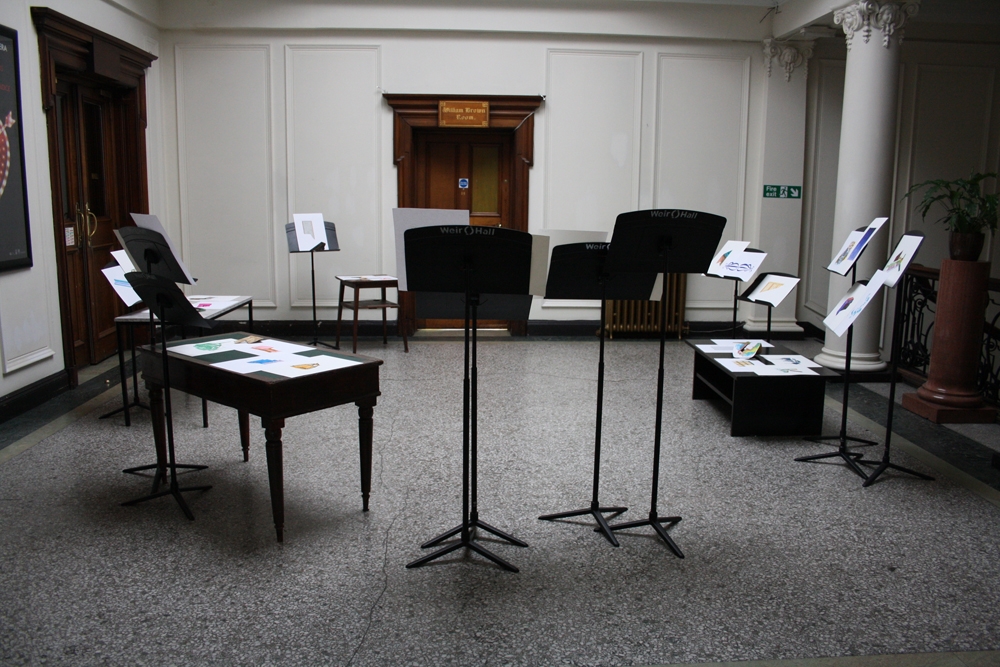
Scottish Opera, Ally Wallace (2012) Photo: Ally Wallace
Ally Wallace has since 2011, undertaken a series of self-initiated artist residencies in different kinds of buildings, ranging from offices to museums [1]. Each time, at the conclusion, he uses the space he has been working in, whether its walls or objects found within, as his ‘page’. From large paper works and structures to small watercolour studies, all hold details from the surroundings and are presented back to the building, its inhabitants and visitors. The elements he chooses to focus on, whether a section of marble balustrade or a detail from a museum collection, float as fragments on the white page. Whilst still recognisable, the images are always translated into a different colour ways than their real nature. A green piano is placed on the green baize of a writing desk. The pink fold of a marble staircase is given a brown shadow. The act of showing the ‘copy’ within the original space where it was created, affords the viewer a new reading.
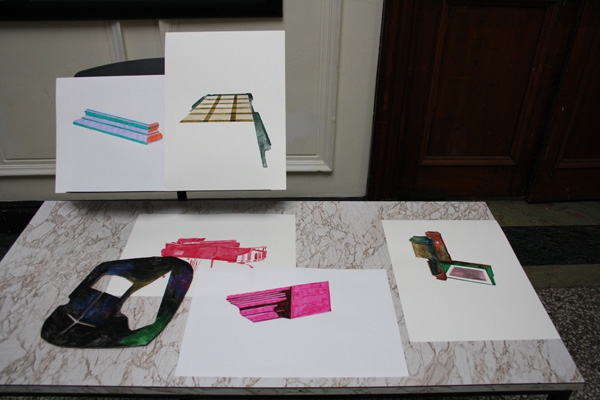
Scottish Opera, Ally Wallace (2012). Photo: Ally Wallace
Plotting out the points where Wallace’s residencies have taken place in Glasgow, many of the buildings are hidden, as the city has adapted and shifted over time around them. In particular, The Martyr’s Public School in Townhead, Glasgow, is a case where motorway meets Mackintosh, with this early work by Charles Rennie Mackintosh only three minutes from The Royal Infirmary and the east end flyover. In subtle ways Wallace’s work observes and reveals these shifts of use and change by casting a democratic and levelling eye over past and present situation in the details he chooses to record. During his residency at Martyrs School, now part museum, part offices, the longer Wallace spent observing, he saw modern office furniture of Glasgow Museums administration set against the Mackintosh tiles.
In 2012, Wallace negotiated with the host organisation, Scottish Opera, to allow access for individuals to see the conclusion of his residency at their private administrative offices at 39 Elmbank Street, Glasgow. I slipped out of a busy group residency where the Mackintosh Museum at The Glasgow School of Art had been transformed into an open studio [2], to visit a building that I had not realised existed, only ten minutes away from my place of work. Once an engineer’s office, the building has a sense of grandeur, with a sweeping staircase that leads up to the landing. Wallace described to me the time shift he felt within the building: “You can look through the windows and where the masts of the ships once were, now the lines of the multi-storey balconies float in front of your eyes.” Here on the first floor landing, I found an ‘orchestra’ of his works, placed in a semi circle on music stands, all lit by natural light from the cupola above. I remember feeling privileged at having been invited for this one-to-one encounter. It is strangely unusual to feel like the work has just been placed there for you to see it.
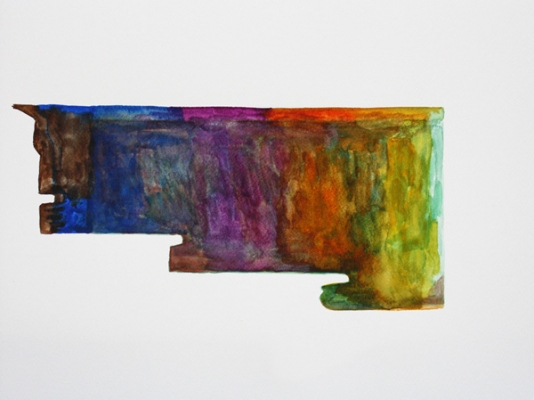
‘Stair Trace’, Ally Wallace (2012) watercolour Photo: Ally Wallace
Wallace’s work always moves away from being just a surface reading of a space. The time of the residency allows him to move from a visual response to feeling like he is an element within the building; a ‘member of staff‘ rather than a visitor. During Wallace’s latest residency at the Lillie Art Gallery in Milngavie [3], he used the gallery as an open studio for a few days a week, chatting with any visitors who came through. This has resulted in the exhibition ‘Connected Parts’ (until 20 March 2014). By placing himself so publicly on show as ‘the artist’, he was reminded of the artist figure of Tony Hancock in ‘The Rebel’ (1961, Associated British Picture Corporation). In the film, Hancock gives up his office job and bowler hat to move to Paris to become a beret wearing artist. With such exchanges between Hancock and his disbelieving art landlady (the wonderful Irene Handel) who is less than charitable about contemporary art – “I’ m not one of the realist school of art, I’m an impressionist. / Well, it don’t impress me.” – the film is satirical in its treatment of the artist having a certain kind of persona and pretentious ideas which he believes no-one, critics or audience, has the right to question. The time spent in the Lillie Gallery allowed Wallace to question his own notions of what a traditional art audience may be and expect from visiting a gallery.

‘Connected Parts’, Ally Wallace (2012) Lillie Art Gallery. Photo: Alan Dimmick
In the first gallery, Gallery 2, Wallace produced a freestanding structure, which displays large paper works [4] with simplified details from bronze sculptures held in the Lillie Gallery’s Collection. The structure creates a new threshold within the gallery, shielding the visitor from the gallery entrance. The physicality of the materials Wallace uses, very much play with the traditional elements within the gallery. The untreated wooden struts of the framework, found in a nearby skip, are the same width as the painted strips of wood forming the double picture rail that circumnavigated all the gallery spaces. Moreover, the screen’s construction allows for the front and back of the paper works to be presented to the viewer, in a venue that perhaps may predominantly choose a classic museum hang. The paper Wallace uses is roughly cut rather than a standard size. This means the viewer is drawn to the paper’s physicality, as more than just a surface, for example in the detail of the way that the paint has dried, wrinkling the paper slightly. The circular cut out within one of the paper works allows for new views through to a red work on the far away wall. The circle, looking up through it, echoes the circular steel spotlight fitting in the lowered rectangular ceiling. Wallace’s way of working utilises the architecture and detail of the gallery and is not afraid to draw attention to the choices made in the space which make it what it is. The largest painted work makes use of this gallery’s floating ceiling, hung from its edge, creating a paper wall. Another paper work uses the picture rail, but is hung so it follows the contour of the corner of the room, rather like a piece of fabric in its gentle fold and change of direction.
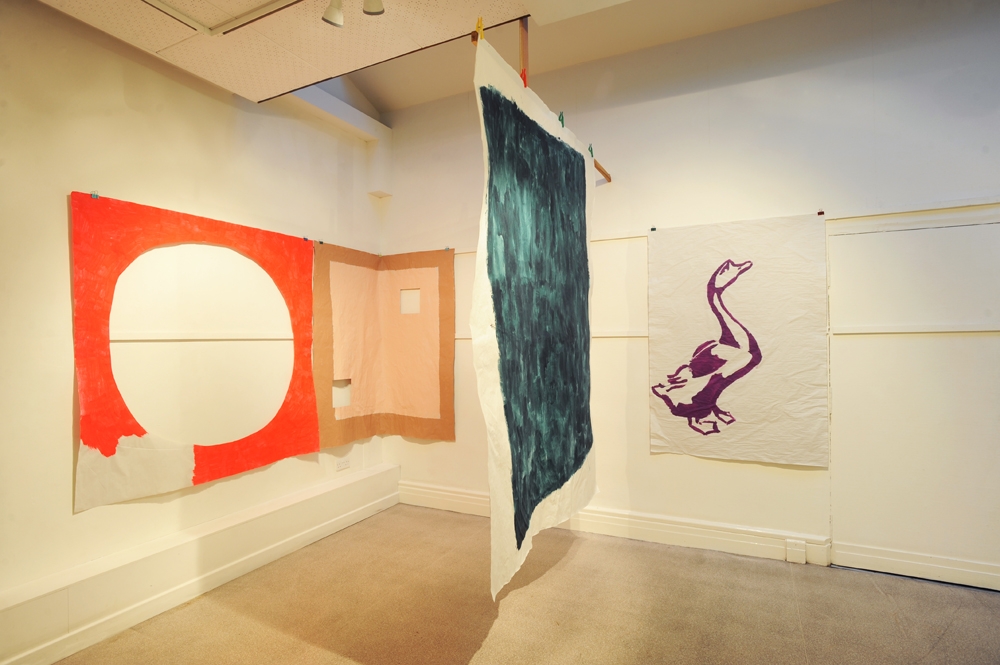
‘Connected Parts’, Ally Wallace (2014) The Lillie Art Gallery Photo: Alan Dimmick
In the opposite corner, there is a little collection of smaller works, formally gathered together, around a cardboard structure. Each of works holds a detail from still-life paintings that Wallace chose from the collection. By citing the artists’ names in this part of the installation- ‘After Anne Redpath’, ‘After Leon Morocco’, ‘After Cynthia Wall’– Wallace is very mindful that the collection is part of the DNA of this particular building and that he is, as he puts it, “making art about art“. The roughness of the cardboard totem works well within this arrangement. As the brown of the cardboard still shows through the paint that has been applied to it, it’s surface echoes the tactile nature of the hessian walls, where the grid of the fabric is still archaeologically discernible through the layers of white paint that have covered it over the years.
Moving through into the next gallery, Gallery 3, with its blood red interior, this particular space acts like an expanded notebook for Gallery 2 and the residency, including studies of elements of the Lillie Gallery as well as 2d and 3d design ideas for Wallace’s resulting work. Watercolour studies of the linoleum floor pattern in the lobby, as well as observations of the shapes of specific door handles in the venue, show how the artist has made his in depth inventory. Recording the life of the building in such a way, fine tunes how I, as the viewer, spend my time in the space, as well as altering my attention to take in the elements beyond the work. As I move around the space on my second visit, I enjoy the glitter of the gallery floor’s silver surface and eavesdropping on the life of the building, in particular a conversation between the gallery staff and a visitor who is passing time. Subjects for discussion include how to cook pork, the making of shoes for strange shaped feet and a discussion about World War One: “Why do people go to war for no reason, because of one man who upset the caboodle? What a character. He was a real menace“.
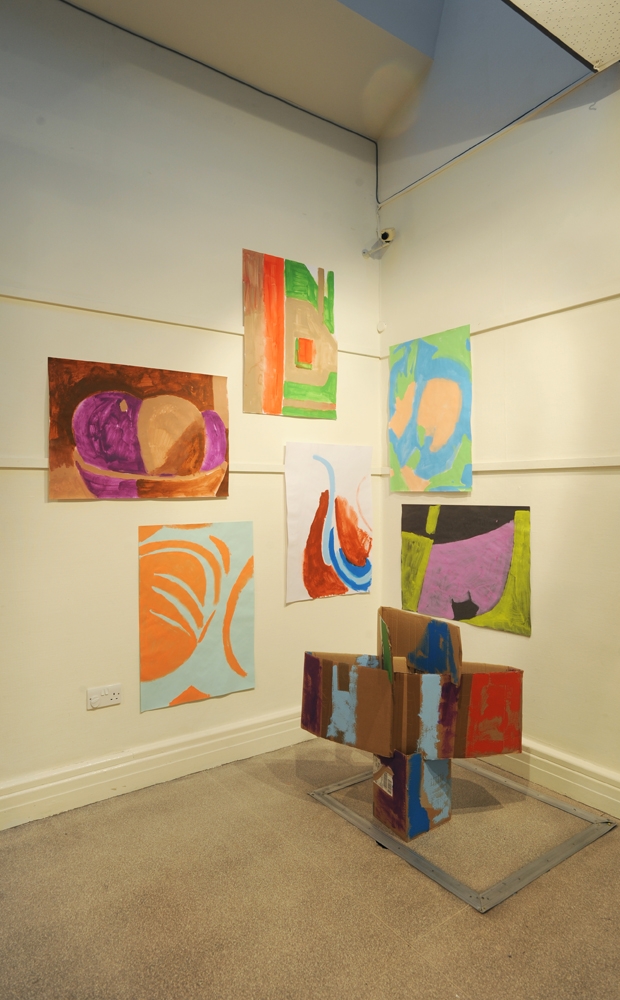
‘Connected Parts’, Ally Wallace, The Lillie Art Gallery (2014) Photo: Alan Dimmick
In coming away from The Lillie Art Gallery, I carry with me an expanded portrait of the building, its inhabitants and the collection it takes care of. In particular, The Lillie Art Gallery should be commended for placing importance on creating a space within its programme for artists to take the next step in their practice, whether it is Ally Wallace or The Glasgow Group, who exhibited concurrently with ‘Connected Parts’. In particular, I have enjoyed Wallace’s painterly handling of colour, with bold acid yellows and pinks placed next to metallic silver and retiring beige. With the colours resonating in my mind, it seems fitting to conclude with another quote from ‘The Rebel’, which came out the year before the Lillie Gallery was established. Hancock has come up with an art movement and theory when put on the spot by another painter and calls it ‘The Shape-ists’.
“The colours shouldn’t end where the shapes end. They should send out a glow in the air. Why? Why? We’ll take this room for instance. At the moment I feel this room to be indigo. Can’t you feel it? No. Oh dear. An article will always suggest its own colour. Irrespective of the colour it’s transmitting. To me at the moment I feel this room to be transmitting indigo, with a feeling of the octagonal. Yes that’s it. Indigo octagon. This is incredible. An entirely new conception of art.”
Jenny Brownrigg. March 2014
Footnotes
1.Residencies at Scottish Opera’s office in 39 Elmbank Rd; RMJM Architects Hope Street office; and Summerlee, the Museum of Scottish Industrial Life.
2.Three Points of Contact Residency, The Glasgow School of Art leg 2012: http://issuu.com/threepointsofcontact/docs/threepointsofcontact
3.Milngavie is at the beginning of the West Highland Way, which leads onto 95 miles northwards to Fort William. The Lillie Art Gallery is a municipal gallery which opened in 1962 and has a collection of around 450 works of Scottish art dating from the 1880s to present day. It was built due to a bequest by banker and artist Robert Lillie (1867-1949).
4.In the 19th Century, Milingavie was a minor industrial centre with paper mills and bleach works on the Allander River. It seems fitting that Ally Wallace’s large paper works are here at the Lillie Art Gallery.
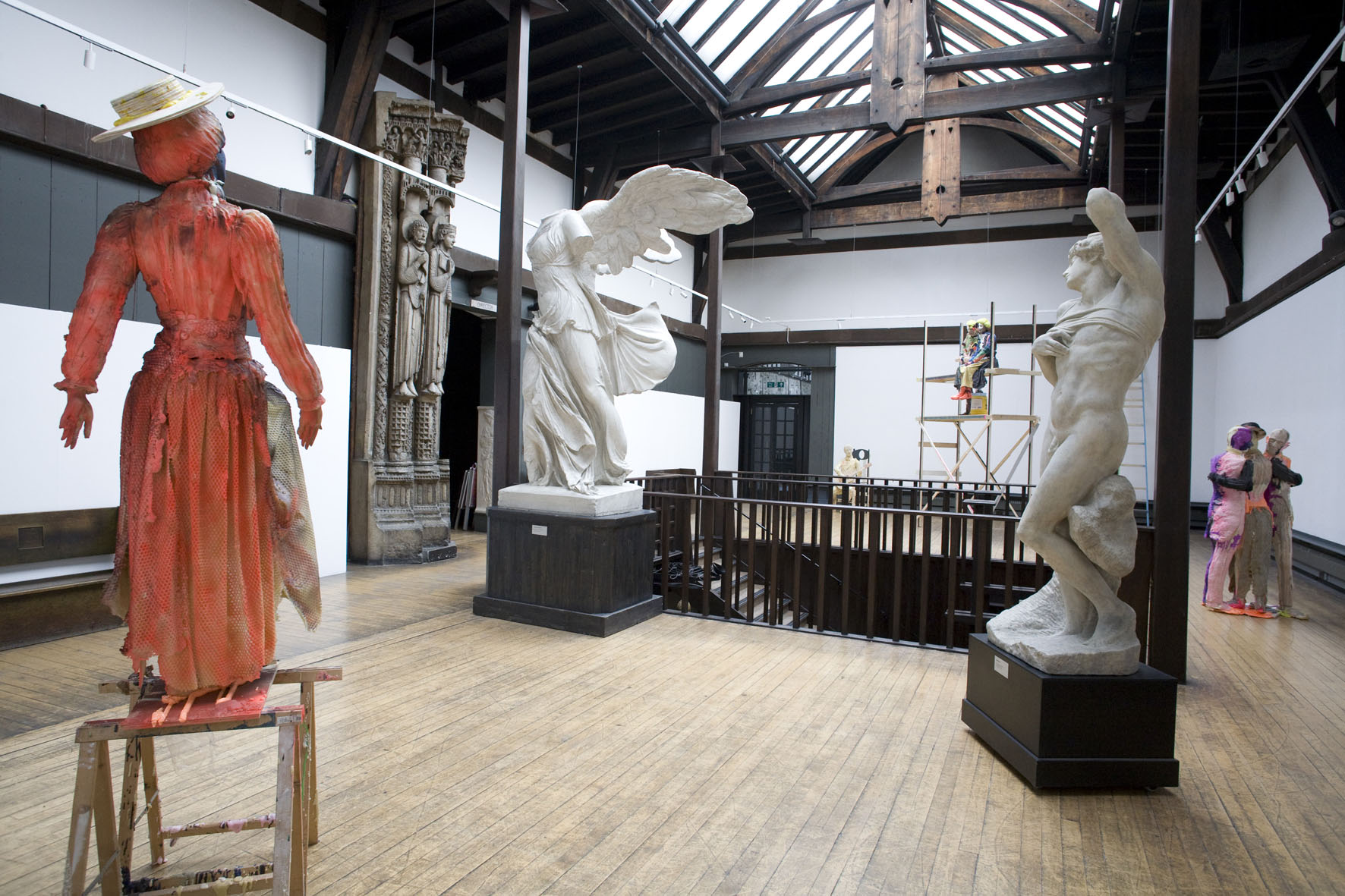
The article below was published in ‘The Past in the Present’, Engage: the international journal of visual art and gallery education, issue 31, P.79-88, Autumn 2012. Editor: Karen Raney
Download: ENGAGE_journal31_brownrigg
[excerpt]
“The Mackintosh Museum, built in 1909, is at the heart of Charles Rennie Mackintosh’s masterwork, The Glasgow School of Art’s Mackintosh Building. With its high level of architectural detail inside and outside, the museum is the antithesis of the ‘white cube’. This essay will explore the ways in which the contemporary exhibitions programme for the gallery space within this iconic building can create a critical exchange between present, past and future”.
Many megaliths were destroyed or defaced by the early Christians.
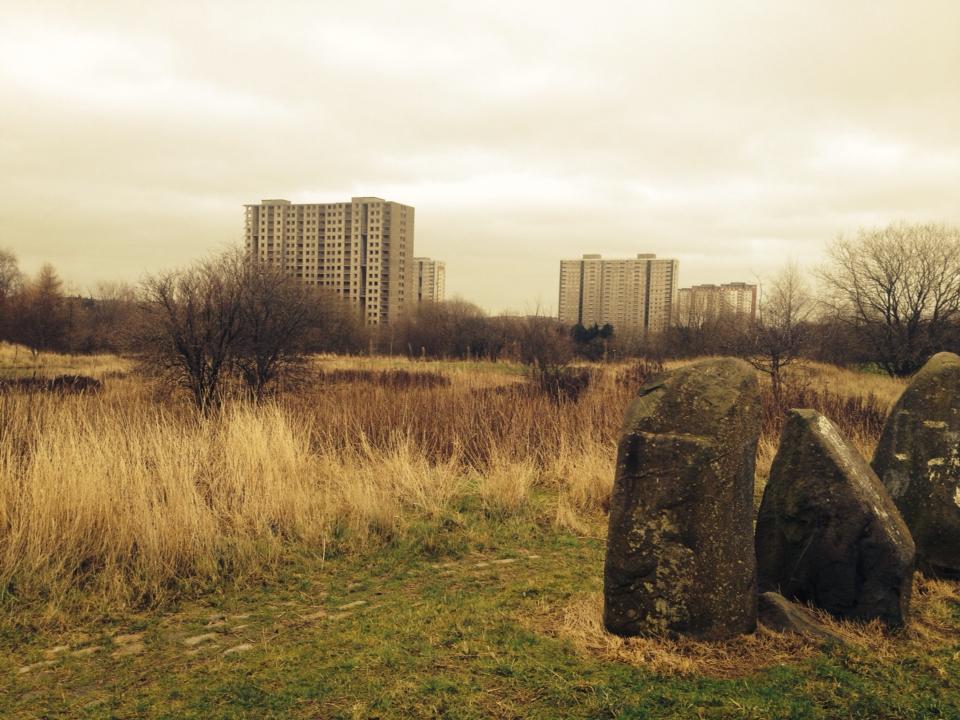
Sighthill Standing Stones, Glasgow. Photo: Julie Ramage
The Monkland Canal, to the north of the Sighthill Standing Stones, was constructed in sections between 1794 to 1797 in order to bring coal from Monkland to Glasgow. In 1952 the canal was closed to navigation. Due to the construction of the M8 motorway, sections of the canal were infilled.
St Rollox Chemical Works, for the production of bleaching liquor and powder for the textile industry existed here from 1797 to 1964.
The Sighthill Housing Scheme was built by Glasgow City Corporation from 1964 to 1969.
The M8 motorway, which runs alongside the site and bisects the city, was built between 1968 and 1972 under Glasgow City Corporation.
The Callaghan government created the Job Creation Scheme in 1978.
The Thatcher government abolished the Job Creation Scheme in 1979.
Through the Job Creation Scheme, Glasgow Parks’ Astronomy Scheme built the Sighthill Stone Circle in 1979. The project was designed and led by Duncan Lunan.
The stones were from Auchinstarry Quarry, Kilsyth. The quarry closed in the 1980s’ and is now used for fishing and climbing activities. The stones were brought to the site by a Royal Navy helicopter.
The Sighthill Stones are placed at points of sunset and sunset at the Equinox. This system follows later beliefs relating to why megaliths were originally built.
The demolition of five of the Sighthill high rises took place 2008-2009.
This site is currently marked for regeneration, linked to a Youth Games in Glasgow bid for 2018. Plans are to relocate the stones and demolish the remaining monoliths that surround them, to make way for an athletes village and park. This bid is by Glasgow City Council, The Scottish Government and the British Olympic Association.
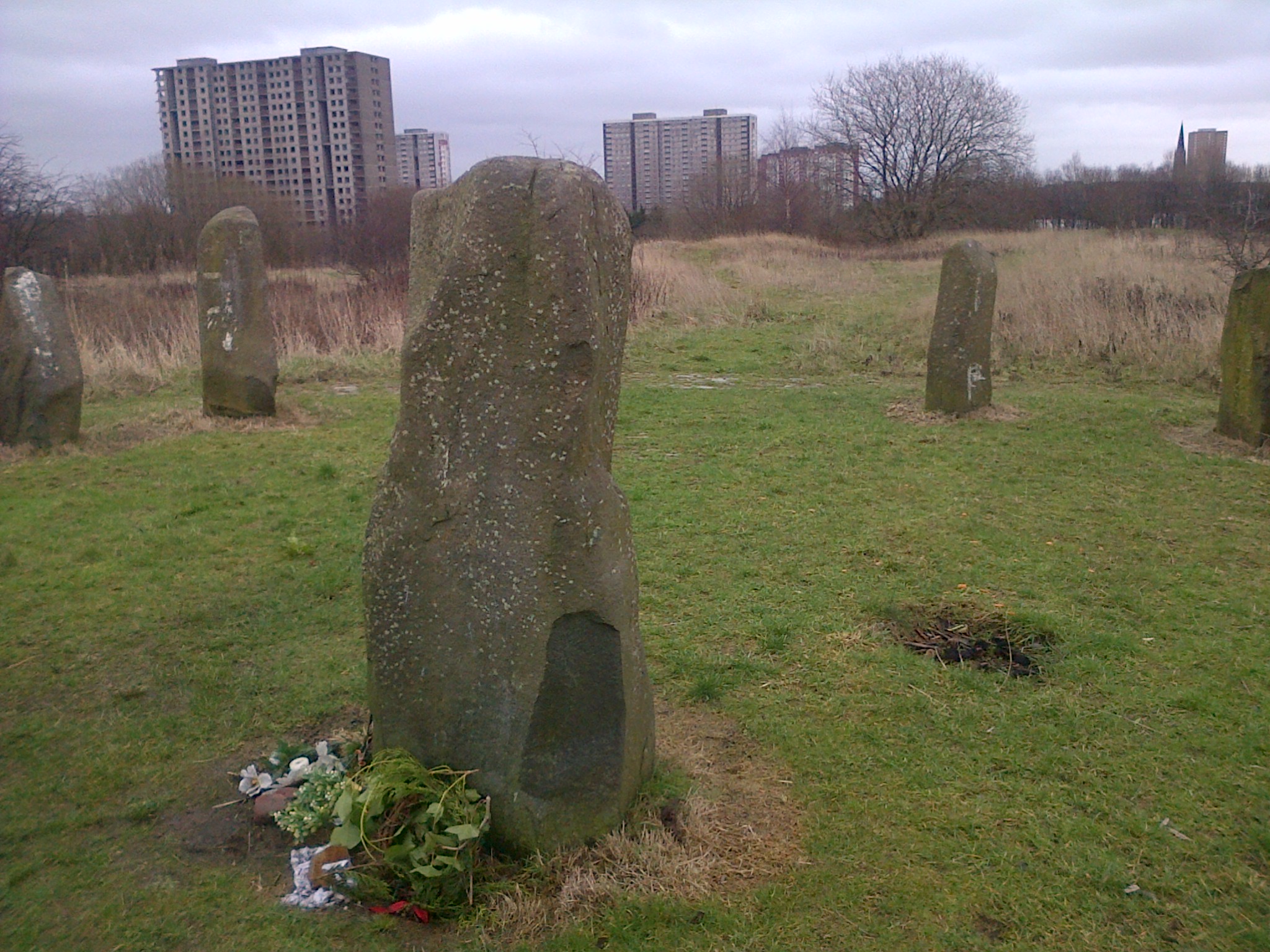
Sighthill Standing Stones, Glasgow. Photo: Jenny Brownrigg
Exchange, Hospitalfield House, Arbroath~ Tomorrow, South Kensington flat, Victoria and Albert Museum, London ~ HOUSE 3, 2 Lonsdale Rd, Notting Hill, London
Over the last three months I have visited three houses in which contemporary art projects have existed; an historic house, a fictional apartment built in a national museum and a domestic flat.
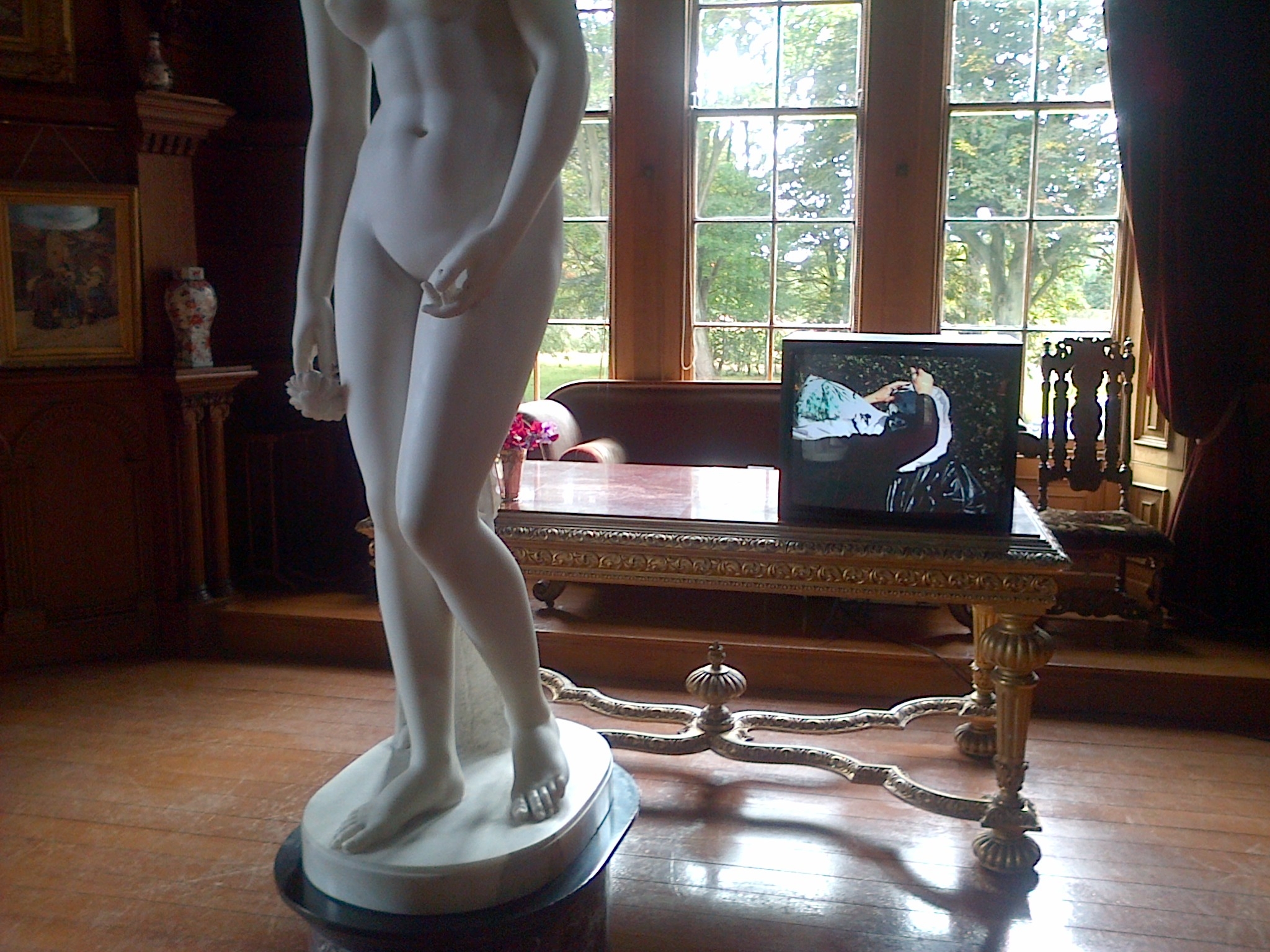
‘Mercantile Portraits’, Siniša Labrović (2005) Performance on video. Hospitalfield. Photo: Jenny Brownrigg
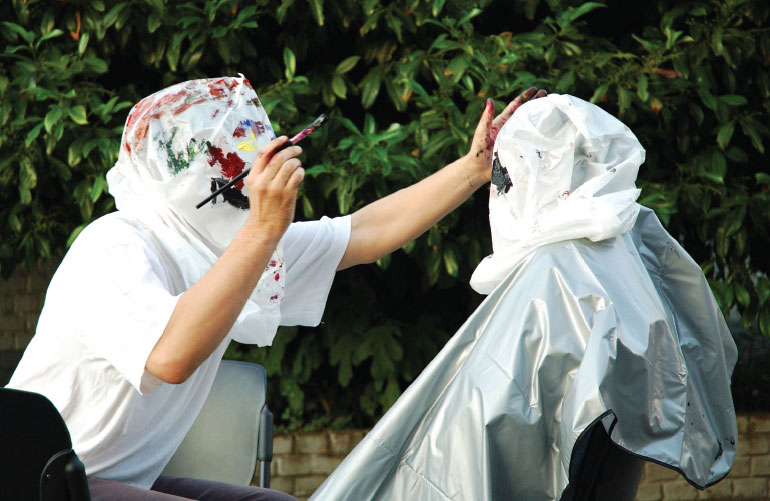
‘Mercantile Portraits’, Siniša Labrović (2005) Performance on video. Courtesy the artist.
Hospitalfield House was originally founded in the 1200s by monks from Arbroath Abbey as a leprosy and plague hospice. It was purchased and extended by James Fraser in 1665, then further expanded in mid nineteenth century by Patrick Allan-Fraser, who married into the family. He and his wife Elizabeth were patrons of the arts, and with no heir, they left Hospitalfield in trust to support young artists. Hospitalfield House continues as a place for artist residencies. It boasts a fine interior replete with 19th Century collection including tapestries that the Allan-Frasers’ bought, in order to echo a passage from Sir Walter Scott’s[1] novel ‘The Antiquary’. In August 2013, the House and its grounds were opened to the public for ‘Exchange’, an Open Weekend. As part of ‘Exchange’, four video works by William Cobbing, Anne-Marie Copestake, Siniša Labrović and Smith/ Stewart, all referencing themes around dialogue and exchange, were situated within the grand interior of the House.
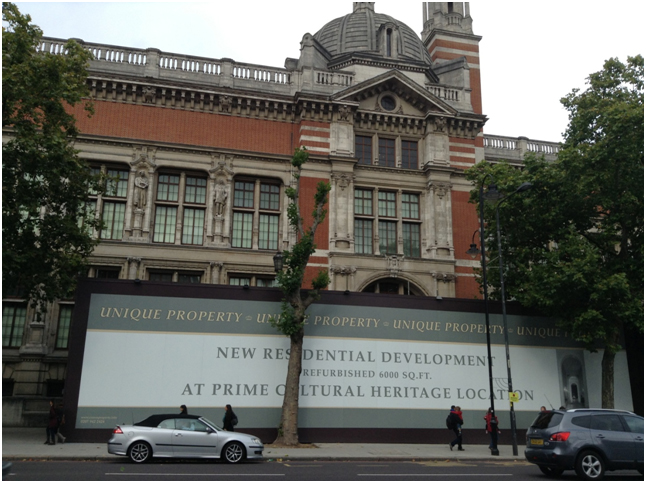
Elmgreen & Dragset: The Installation, V&A Museum, (2013) Photo: Jenny Brownrigg
South Kensington flat, the second house in question, is presented as the residence of 75 year old (fictional) architect Norman Swann, and can be visited at the V&A, on the first floor, past the portrait gallery and through the textile gallery. The museum itself was built in 1852, the year following the Great Exhibition, and was founded to offer access to art for all and to educate working people. Indeed, echoing this vision, a framed poster with the motif ‘Building for the Masses’ hangs on the wall of the architect’s studio of the South Kensington Flat.
This project, entitled ‘Tomorrow’, is by Elmgreen & Dragset[2]. The apartment they have created for Norman Swann and his belongings (drawn from the V&A collection) teeters on the edge of an uncertain future. In amongst the splendor of the surroundings lie unpaid bills; small, treacherous clues of an insolvency that will render his wealth a memory. In the grand drawing room, the first two paintings are missing, with just the markings remaining of where they hung. Other artefacts allude to the failings and anxieties of the absent occupant. Every filing cabinet in Swann’s studio is topped with different architectural models, never realised. Adjacent, the portrait of a worried schoolboy hangs over the fireplace, whilst a wax facsimile of the same uniformed child cowers below the mantelpiece in the empty dark grate, his arms around his knees. A gold vulture roosts on one of the posts of the four poster bed, biding its time. There is further humiliation, (derived from an accompanying script available in book form), that Swann’s errant pupil Daniel Wilder is the person buying his home and contents in a fit of revenge, in order to possess what his old lecturer can no longer have. The steady drip from the ceiling into a bucket in the hall is drowned out by the disquieting sound of over-flowing water behind the locked bathroom door signaling the possible demise of Swann.
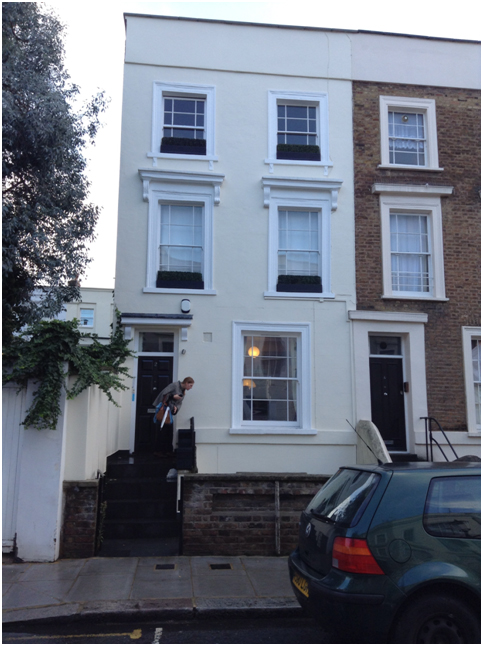
Lonsdale Road, exterior. Photo: Jenny Brownrigg
2 Lonsdale Road in Notting Hill, our third, very real, property, was originally built to house railway workers. Now split into apartments and in private ownership, the ground floor flat belongs to the Fitzpatrick family, who rented the property out to tenants for many years. Following an infestation, the son, Daniel Fitzpatrick returned to sort the problem out. He has continued to live at this property, whilst completing his PhD in Urban Planning. His flat has been the site of the project HOUSE 3[3], the last in a series of art encounters in domestic environments across London, curated by Anne-Marie Watson and Alex McDonald. The artists Renee Vaughan Sutherland and Rachael Champion were invited to respond to the Fitzpatrick home.
In all three houses, we encounter the details of the occupants, both past and present, by proxy, through an intimacy with the art and objects. Up in Arbroath, Patrick Allan Fraser demonstrated his love of art by association. He was in the favorable economic position to commission portraits from The Clique[4] a group of artists he had known from his time in London. This collective rejected academic high art in favour of genre painting, believing that their work should be judged by the public and not by the established elite. As we, the public, were invited to step inside and inhabit Hospitalfield House during this weekend, the four contemporary pieces, also transitory guests, explored different ways of dwelling within worlds created by the artworks themselves. In both Labrovic’s and Cobbing’s pieces, the protagonists and their partners occupy the very material they work with. ‘Mercantile Portraits‘, sees Labrović utilise the formal exchange of street portraiture, inviting a passerby to sit for his or her portrait. However, undermining the crowd-pleasing expectations of likeness and painterly skills, these portraits are blindly undertaken, with the artist placing white plastic bags over his head and the sitter, then painting directly onto the plastic surface, by feeling the sitter’s features through the bag. The results are child-like splodges.
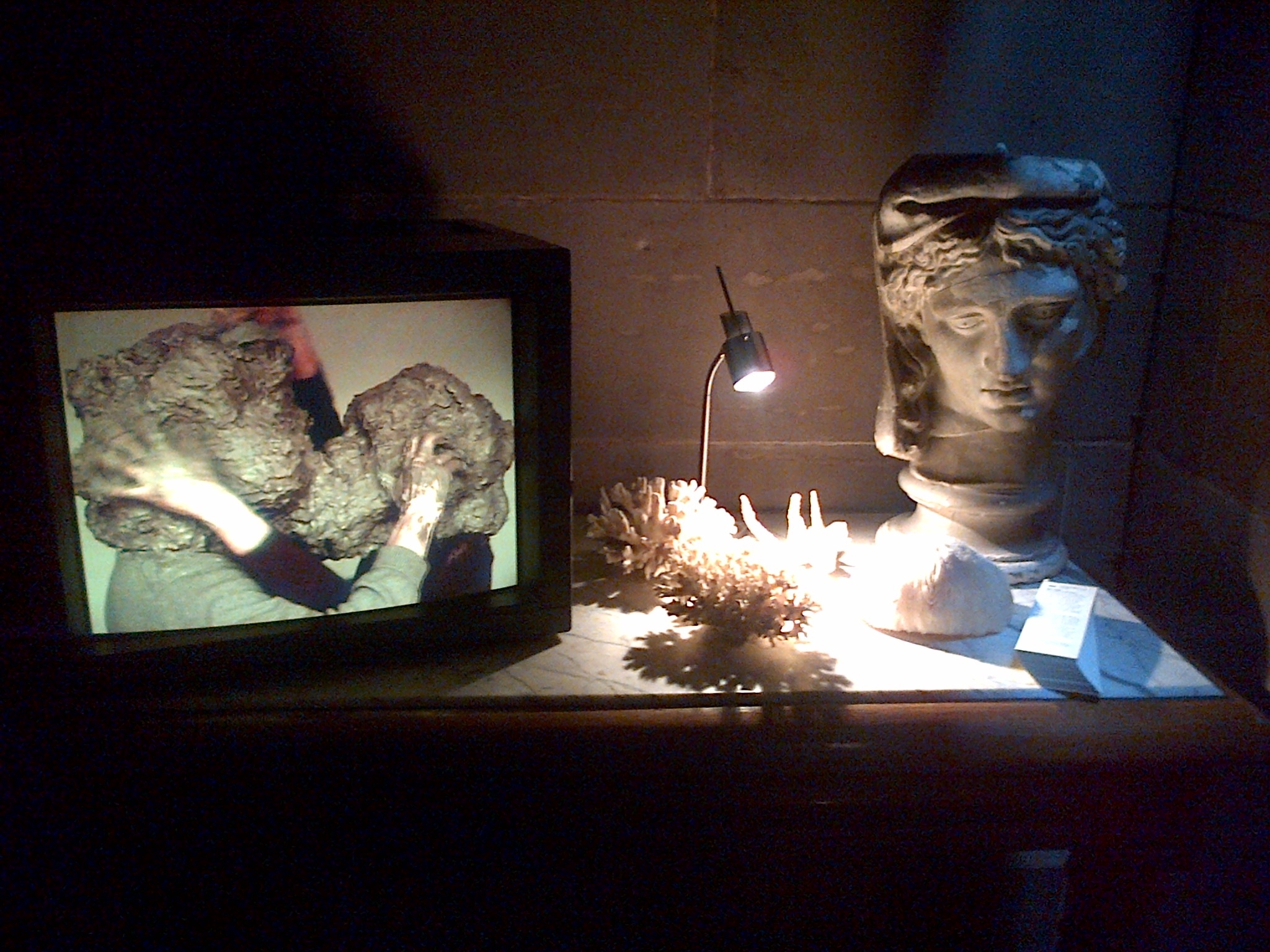
‘The Kiss’, (2004) William Cobbing, single channel video, 3:33 mins. Hospitalfield. Photo: Jenny Brownrigg
‘The Kiss’ William Cobbing’s work, is again a tactile experience, this time with a couple locked together by their amorphous clay heads. The closest they can physically get to each other is with their hands, which slither across the other’s clay surfaces. In Smith and Stewart’s ‘Mouth to Mouth’, the male is submerged, fully clothed, under bathwater; his life reliant on the woman through her performing resuscitation. Anne-Marie Copestake’s ‘trigger tonic’ adopts the talking heads interview format, with Afterall editor Caroline Woodley in conversation with Swiss artist Pipilotti Rist. The film captures the circling conversation of questions and answers between interviewer and interviewee, with the former attempting to get closer and closer, through the spoken word, to inhabiting and understanding the artist’s motivations and intentions.
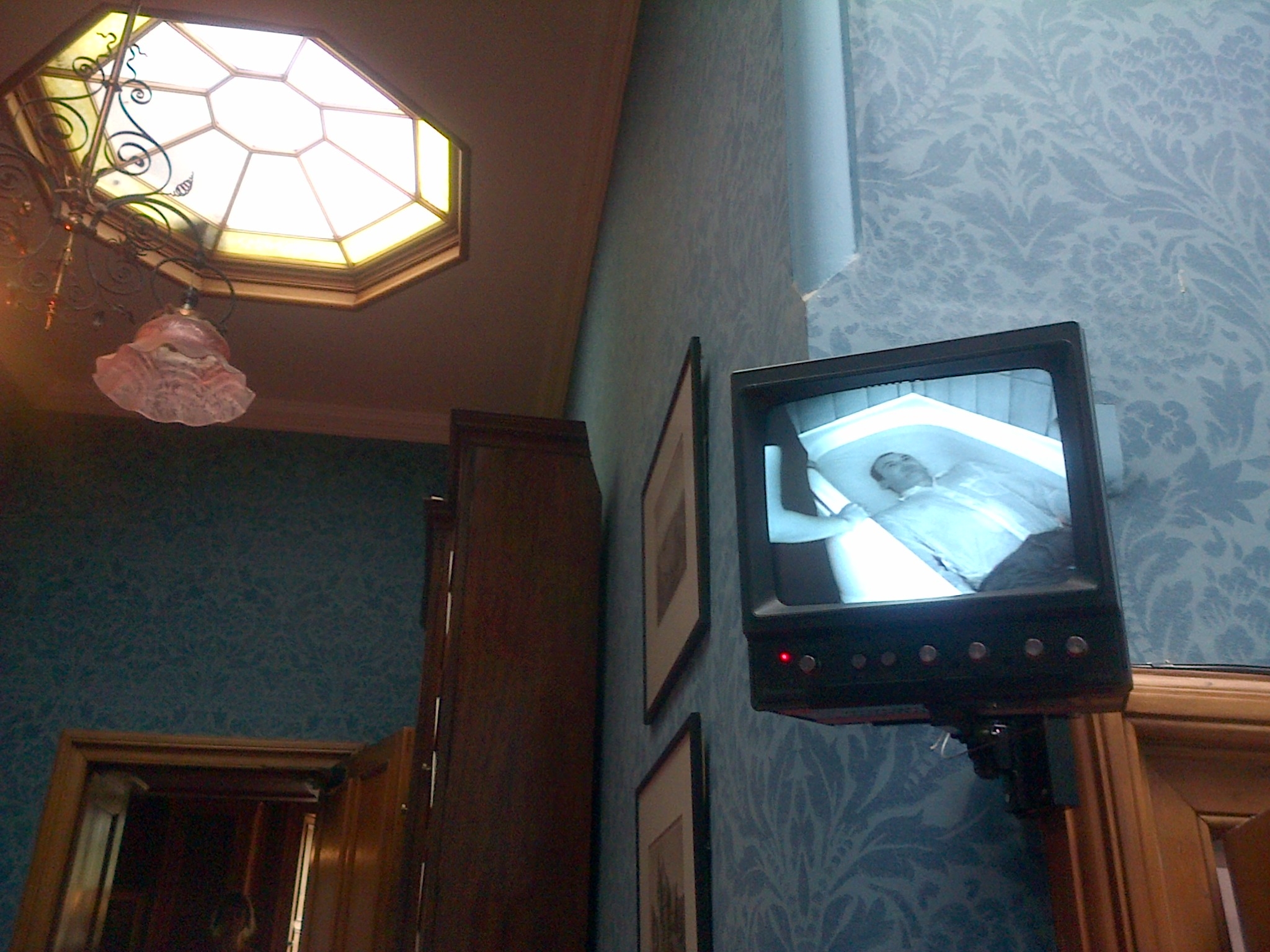
‘Mouth to Mouth’, (1995), Smith/Stewart, single black & white security monitor installation + amplified sound. Looped. Photo: Jenny Brownrigg
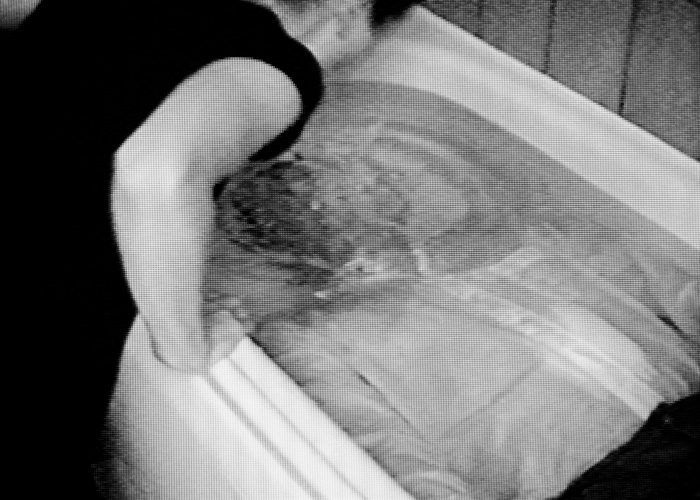
‘Mouth to Mouth’, (1995), Smith/Stewart, single black & white security monitor installation + amplified sound. Looped. Courtesy the artists.
The under-stated exchange between the contemporary artworks and the ornate environment of Hospitalfield House is especially satisfying. Cobbing’s film of clay heads is placed on a reception table in the hall, alongside a small classical bust and a selection of coral. Labrović’s monitor is found on an ornate table in the Picture Gallery, surrounded by the portraits the Allan-Fraser’s commissioned from the Clique. A private domestic room is opened up for the projection of Copestake’s interview, which in its clever editing introduces informal asides to the format, cutting away to show the interviewer’s son at points, needing to be on his mother’s lap. The Smith/Stewart piece is shown on an old CCTV monitor installed above a door in the first floor doorway, against blue flock wallpaper. Behind the door lies the bathroom. The act of viewing four modest scale film works in this grand, historic environment, could have proposed them as interlopers, but combined with the careful placement and curiosities of the house itself, it shows they are no more strange or out of place than the other details, such as the iron cobras as the legs of the grate in the Picture Gallery’s grand fireplace.
At 2 Lonsdale Road, we find recognisable belongings within a present day apartment. A chrome IKEA lamp is angled at a well-loved National Galleries poster reproduction of a classic artwork. The image is one of Picasso’s fractured still lives; one of its details, a circle with lines over it denotes a violin. Below it, the occupant’s own guitar leans against the settee, where a Nepalese rug hangs over the back, and two plump cushions with a similar motif sit in front. On a well stocked cd unit, three DVDs lie flat on the shelf; on the top of this stack is ‘Performance’ (1968) with Mick Jagger, which was partially shot on location in this house’s neighbourhood.

‘Unbuilt Visitors’ (2013) Rachael Champion. Armature, pebbledash, fixings. HOUSE 3, Photo: Mat Jenner
In amongst these familiar objects of 2 Lonsdale Road, a sense of unrest is introduced with a series of strange termite-like structures made out of grey pebbledash that nestle in corners. One sits high in the alcove of the open plan lounge and dining area; another quietly lolls against the skirting board of the stairs that lead down to the basement. The largest of these manifestations is to be found sprouting outside, in the sunken patio area, just below street level. It rises up to meet the exterior wall of the flat. These alien objects, introduced by Rachael Champion mutely announce their invasion to the street; the abstract art equivalent of a pest control van parked outside. When our homes become infested, we against our will co-habit with an element of wildness that is beyond our control.
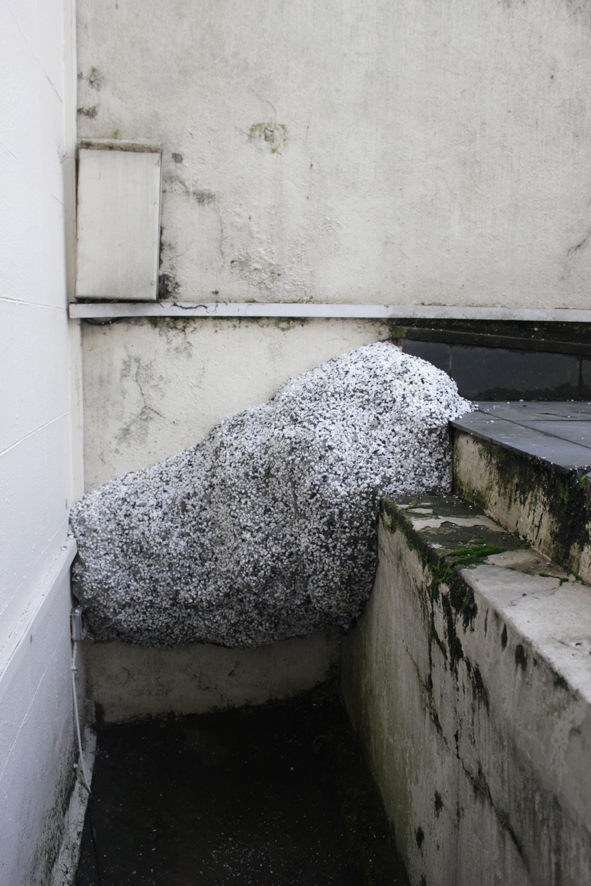
‘Unbuilt Visitors’ (2013) Rachael Champion. Armature, pebbledash, fixings. HOUSE 3, Photo: Mat Jenner
Whilst the gold vulture hovers over the empty bed with its rumpled, monogrammed sheets in the South Kensington flat, the bed is most definitely occupied at 2 Lonsdale Road. In ‘The Poetics of Space’, Gaston Bachelard states:
‘It was reasonable to say we “read a house”, or “read a room”, since both room and house are psychological diagrams… in their analysis of intimacy’.
This aspect of intimacy was explored in HOUSE 3, with Renee Vaughan Sutherland’s one-to-one ‘Performance’ in the bedroom located in the basement of this home. It is important that this performance takes place down in the basement, the dark, primal space of the house. The ritual of preparation for this event and the unknown plays on the visitor’s psyche. Whilst the genial activity of the house carries on above, each person is led downstairs, and after a series of instructions, allowed to open the door and enter. The room is inhabited, with a woman lying in bed and an empty chair to her side. In front of the chair, projected on the bedroom wall to the left, the same woman applies lipstick, increasingly frenetically over her face. On catching the gaze of the real woman in the bed, she benignly rolls down the corner of the duvet and pats the bed, inviting you to move over and get in. People over the course of the two days both declined and accepted, staying however long they wished to in the bed. The woman does not speak to them. Some try to academically understand her reasons. One man brings a pencil and paper into bed with him. Some revert to telling her stories. Others ask her questions which she does not answer. Some actually relax. ‘Performance’ explores the layered identities of both the performer and the visitor. Out of the encounters in the three houses, ‘Performance’ engages the most personal of responses, moving the viewer from their distanced rational position as gallery goer, to an unsteady position through vulnerability.
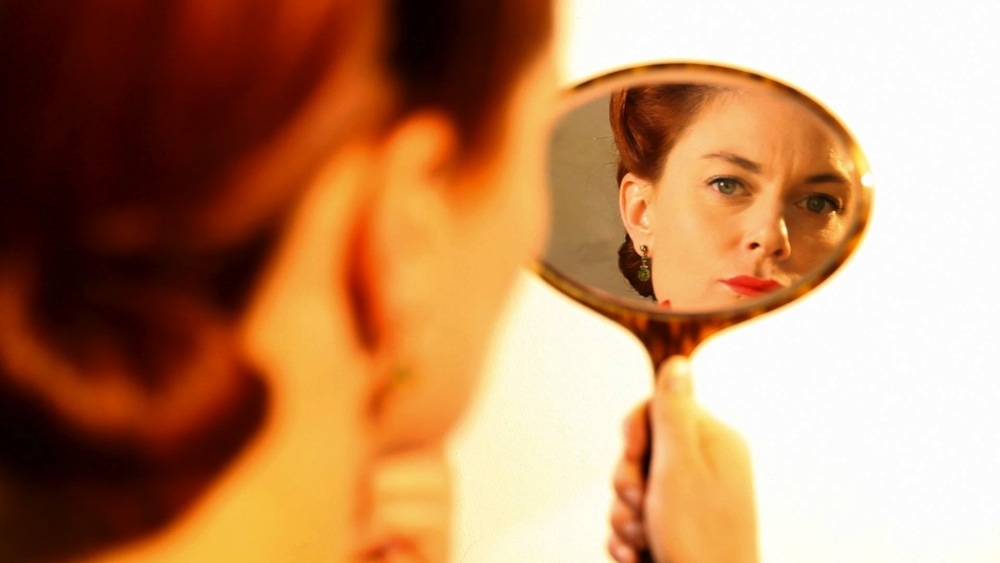
‘Performance’, (2013), Renee Vaughan Sutherland. Film still courtesy the artist.
Daniel and Wendy, two characters from ‘Tomorrow’s script, conclude, “Well in the end, there’s just the cranium”[5]. As a visitor to all three houses, the memory of the experience relies on the unusual nature of the encounter and how we shifted our position, even momentarily, as a consequence:
‘The image of the house is created through co-operation between real and unreal, with the help of the functions of the real and unreal….if a house is a living value, it must integrate an element of unreality. All values must remain vulnerable, and those that do not are dead.’ P.59, ‘Poetics of Space’, Gaston Bachelard
Jenny Brownrigg, December 2013
[1] Scott twice visited Hospitalfield House in 1803 and 1809. ‘The walls of the apartment were partly clothed with grim old tapestries, representing the memorable story of Sir Gawaine’s wedding, in which full justice was done to the ugliness of the Lothely Lady…‘, The Antiquary’, Sir Walter Scott, published 1816.
[2] The South Kensington flat exists between 1st October 2013 and 2 January 2014.
[3] HOUSE 3 was open in the third weekend of October 2013 for people to visit.
[4] The Clique included Augustus Egg, William Powell Frith, Alfred Elmore and Richard Dadd.
[5] P96, ‘Tomorrow: Scenes from an unrealised film’, Elmgreen & Dragset. Printed on the occasion of the exhibition ‘tomorrow’ at Victoria and Albert Museum, Oct 1 2013 – Jan 2 2014.
 Jenny Brownrigg