Unknown's avatar

Encountering Three Houses

Exchange, Hospitalfield House, Arbroath~ Tomorrow, South Kensington flat, Victoria and Albert Museum, London ~ HOUSE 3, 2 Lonsdale Rd, Notting Hill, London

Over the last three months I have visited three houses in which contemporary art projects have existed; an historic house, a fictional apartment built in a national museum and a domestic flat.
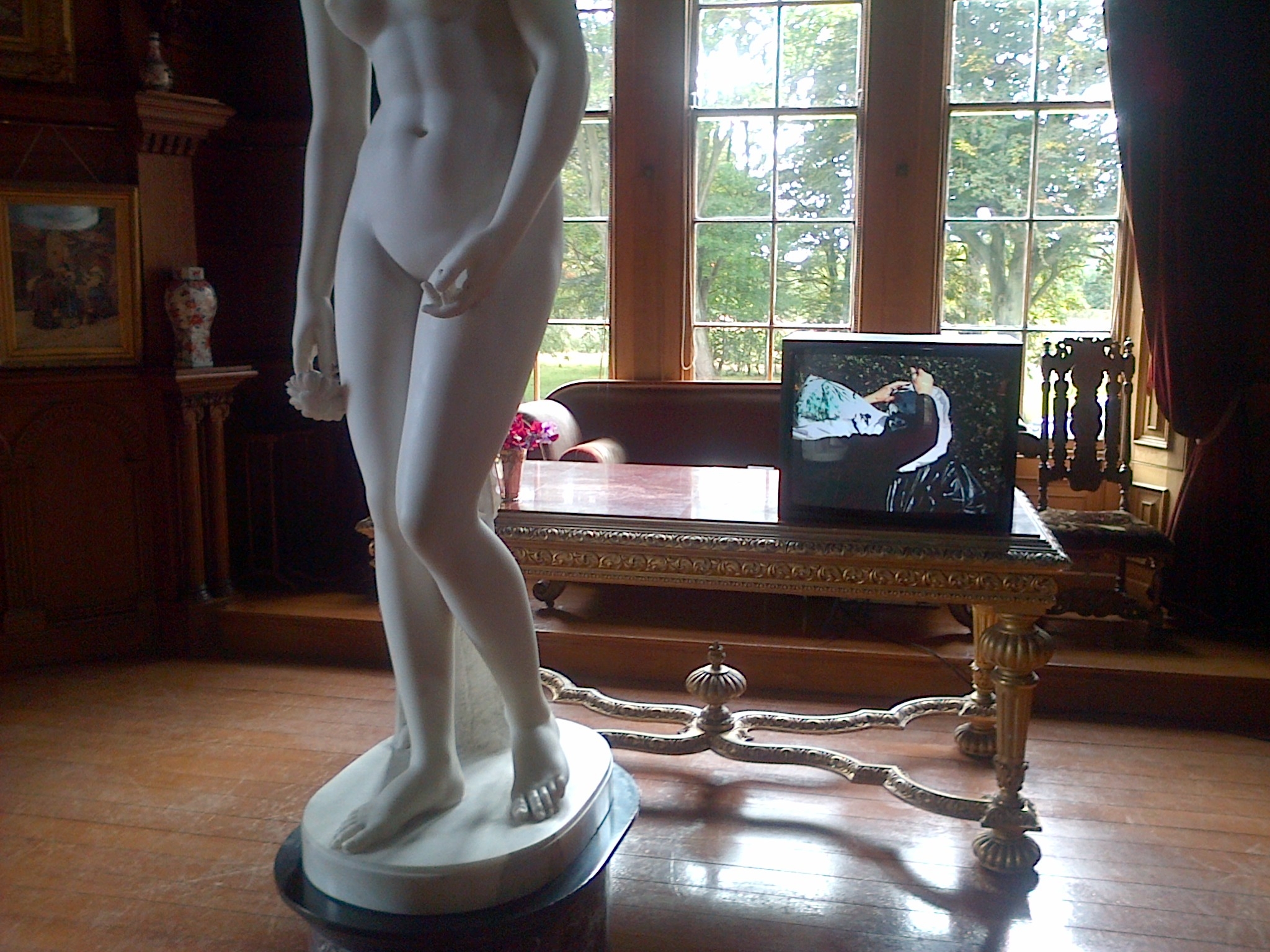
‘Mercantile Portraits’, Siniša Labrović (2005) Performance on video. Hospitalfield. Photo: Jenny Brownrigg
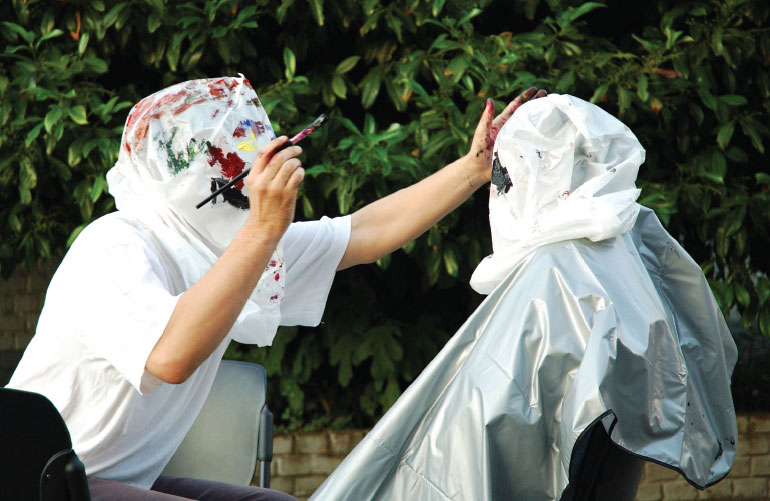
‘Mercantile Portraits’, Siniša Labrović (2005) Performance on video. Hospitalfield. Photo: Jenny Brownrigg

‘Mercantile Portraits’, Siniša Labrović (2005) Performance on video. courtesy the artist.

‘Mercantile Portraits’, Siniša Labrović (2005) Performance on video. Courtesy the artist.

Hospitalfield House was originally founded in the 1200s by monks from Arbroath Abbey as a leprosy and plague hospice. It was purchased and extended by James Fraser in 1665, then further expanded in mid nineteenth century by Patrick Allan-Fraser, who married into the family. He and his wife Elizabeth were patrons of the arts, and with no heir, they left Hospitalfield in trust to support young artists. Hospitalfield House continues as a place for artist residencies. It boasts a fine interior replete with 19th Century collection including tapestries that the Allan-Frasers’ bought, in order to echo a passage from Sir Walter Scott’s[1] novel ‘The Antiquary’. In August 2013, the House and its grounds were opened to the public for ‘Exchange’, an Open Weekend. As part of ‘Exchange’, four video works by William Cobbing, Anne-Marie Copestake, Siniša Labrović and Smith/ Stewart, all referencing themes around dialogue and exchange, were situated within the grand interior of the House.
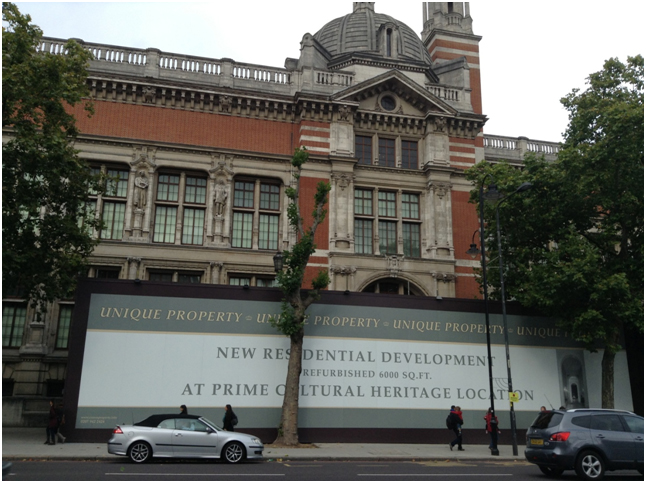
Elmgreen & Dragset: The Installation, V&A Museum, 2013 Photo: Jenny Brownrigg

Elmgreen & Dragset: The Installation, V&A Museum, (2013) Photo: Jenny Brownrigg

South Kensington flat, the second house in question, is presented as the residence of 75 year old (fictional) architect Norman Swann, and can be visited at the V&A, on the first floor, past the portrait gallery and through the textile gallery. The museum itself was built in 1852, the year following the Great Exhibition, and was founded to offer access to art for all and to educate working people. Indeed, echoing this vision, a framed poster with the motif ‘Building for the Masses’ hangs on the wall of the architect’s studio of the South Kensington Flat.

This project, entitled ‘Tomorrow’, is by Elmgreen & Dragset[2]. The apartment they have created for Norman Swann and his belongings (drawn from the V&A collection) teeters on the edge of an uncertain future. In amongst the splendor of the surroundings lie unpaid bills; small, treacherous clues of an insolvency that will render his wealth a memory. In the grand drawing room, the first two paintings are missing, with just the markings remaining of where they hung. Other artefacts allude to the failings and anxieties of the absent occupant. Every filing cabinet in Swann’s studio is topped with different architectural models, never realised. Adjacent, the portrait of a worried schoolboy hangs over the fireplace, whilst a wax facsimile of the same uniformed child cowers below the mantelpiece in the empty dark grate, his arms around his knees. A gold vulture roosts on one of the posts of the four poster bed, biding its time. There is further humiliation, (derived from an accompanying script available in book form), that Swann’s errant pupil Daniel Wilder is the person buying his home and contents in a fit of revenge, in order to possess what his old lecturer can no longer have. The steady drip from the ceiling into a bucket in the hall is drowned out by the disquieting sound of over-flowing water behind the locked bathroom door signaling the possible demise of Swann.
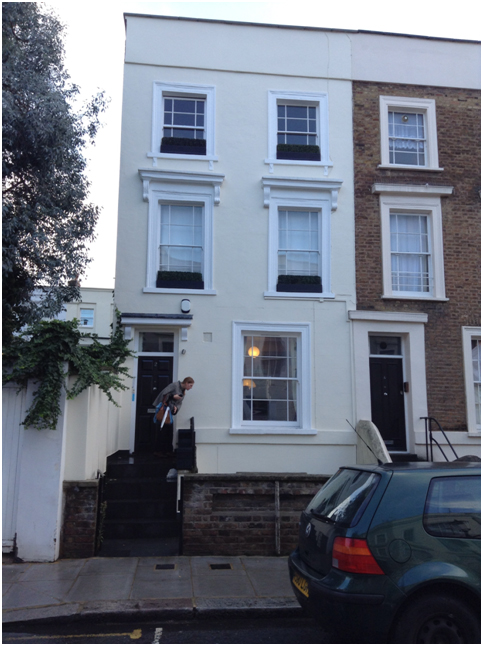
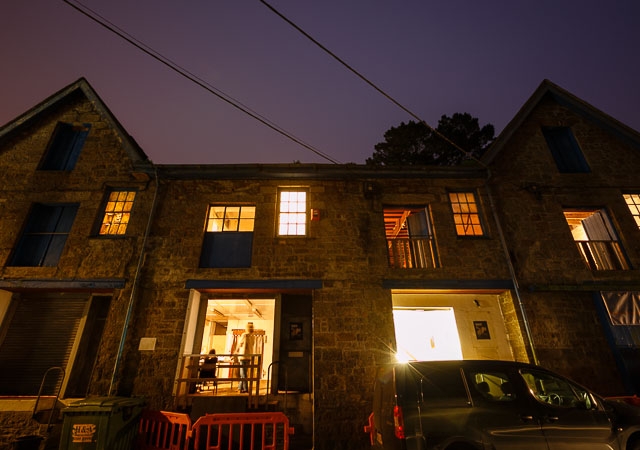
Lonsdale Road, exterior. Photo: Jenny Brownrigg

Lonsdale Road, exterior. Photo: Jenny Brownrigg

2 Lonsdale Road in Notting Hill, our third, very real, property, was originally built to house railway workers. Now split into apartments and in private ownership, the ground floor flat belongs to the Fitzpatrick family, who rented the property out to tenants for many years. Following an infestation, the son, Daniel Fitzpatrick returned to sort the problem out. He has continued to live at this property, whilst completing his PhD in Urban Planning. His flat has been the site of the project HOUSE 3[3], the last in a series of art encounters in domestic environments across London, curated by Anne-Marie Watson and Alex McDonald. The artists Renee Vaughan Sutherland and Rachael Champion were invited to respond to the Fitzpatrick home.

In all three houses, we encounter the details of the occupants, both past and present, by proxy, through an intimacy with the art and objects. Up in Arbroath, Patrick Allan Fraser demonstrated his love of art by association. He was in the favorable economic position to commission portraits from The Clique[4] a group of artists he had known from his time in London. This collective rejected academic high art in favour of genre painting, believing that their work should be judged by the public and not by the established elite. As we, the public, were invited to step inside and inhabit Hospitalfield House during this weekend, the four contemporary pieces, also transitory guests, explored different ways of dwelling within worlds created by the artworks themselves. In both Labrovic’s and Cobbing’s pieces, the protagonists and their partners occupy the very material they work with. ‘Mercantile Portraits, sees Labrović utilise the formal exchange of street portraiture, inviting a passerby to sit for his or her portrait. However, undermining the crowd-pleasing expectations of likeness and painterly skills, these portraits are blindly undertaken, with the artist placing white plastic bags over his head and the sitter, then painting directly onto the plastic surface, by feeling the sitter’s features through the bag. The results are child-like splodges.
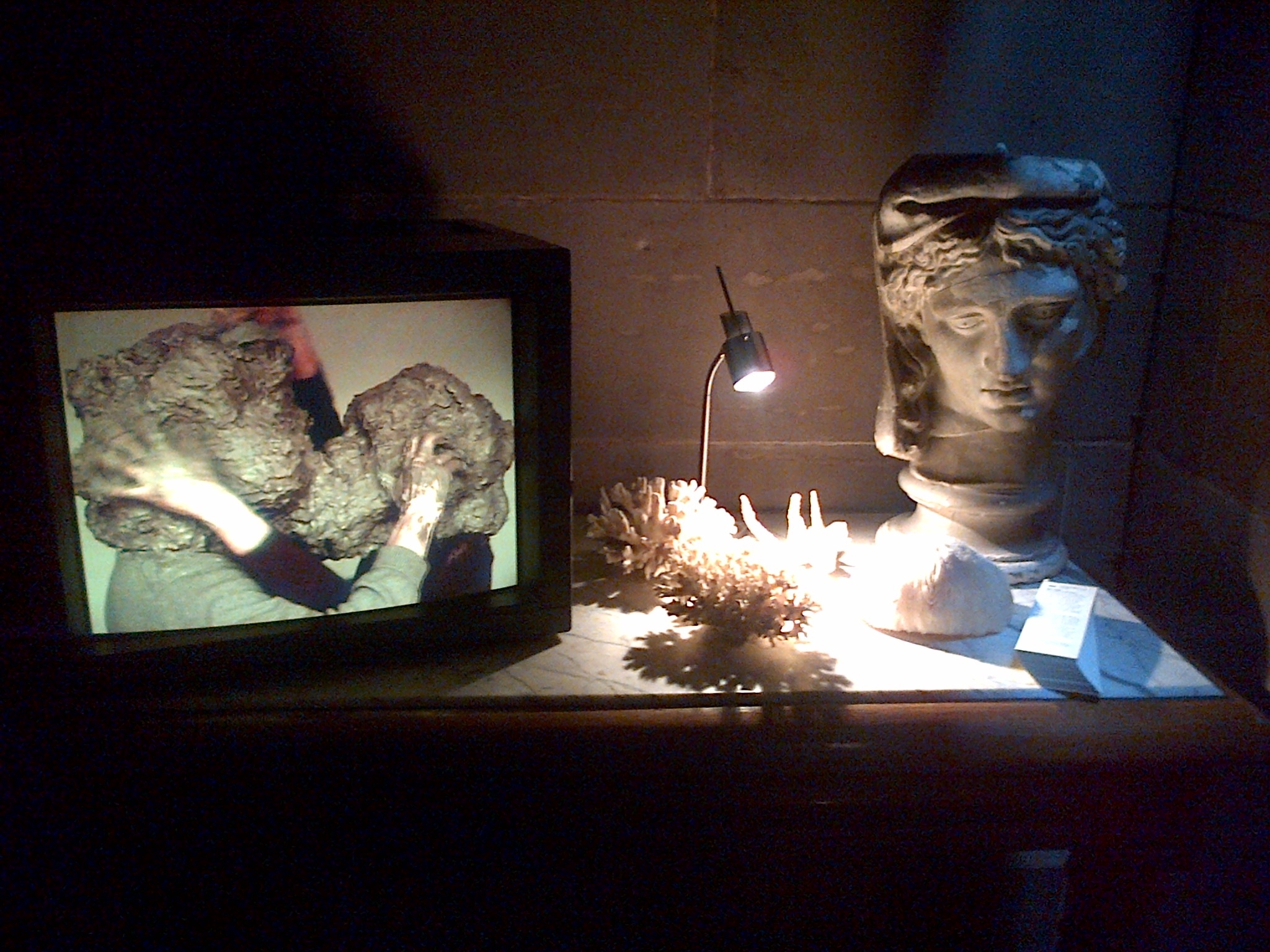
‘The Kiss’, (2004) William Cobbing, single channel video, 3:33 mins. Hospitalfield. Photo: Jenny Brownrigg

‘The Kiss’, (2004) William Cobbing, single channel video, 3:33 mins. Hospitalfield. Photo: Jenny Brownrigg

‘The Kiss’ William Cobbing’s work, is again a tactile experience, this time with a couple locked together by their amorphous clay heads. The closest they can physically get to each other is with their hands, which slither across the other’s clay surfaces. In Smith and Stewart’s ‘Mouth to Mouth’, the male is submerged, fully clothed, under bathwater; his life reliant on the woman through her performing resuscitation. Anne-Marie Copestake’s ‘trigger tonic’ adopts the talking heads interview format, with Afterall editor Caroline Woodley in conversation with Swiss artist Pipilotti Rist. The film captures the circling conversation of questions and answers between interviewer and interviewee, with the former attempting to get closer and closer, through the spoken word, to inhabiting and understanding the artist’s motivations and intentions.
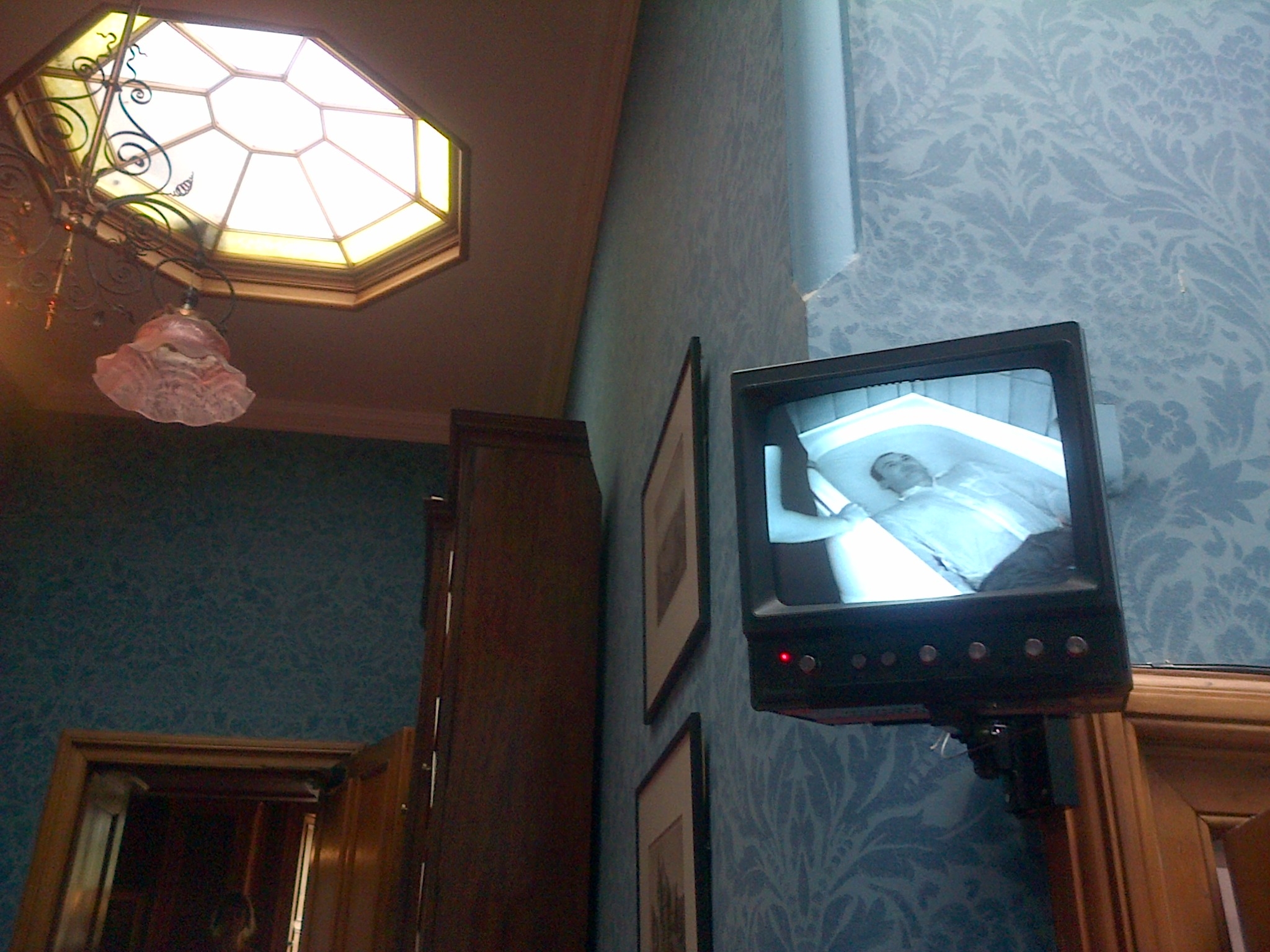
‘Mouth to Mouth’, (1995), Smith/Stewart, single black & white security monitor installation + amplified sound. Looped.

‘Mouth to Mouth’, (1995), Smith/Stewart, single black & white security monitor installation + amplified sound. Looped. Photo: Jenny Brownrigg
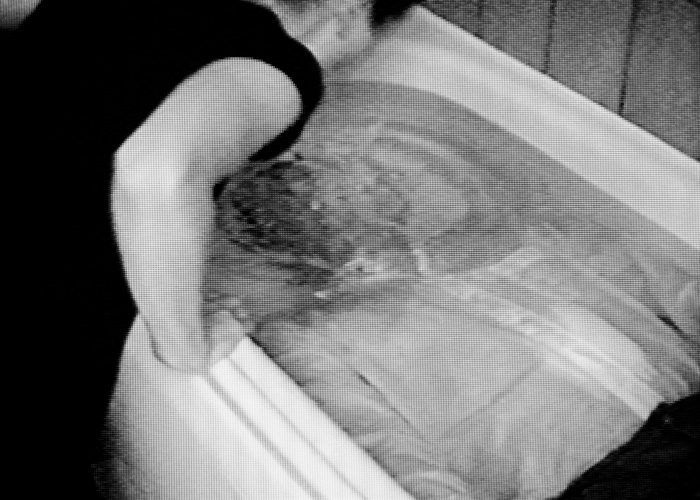
‘Mouth to Mouth’, (1995), Smith/Stewart, single black & white security monitor installation + amplified sound. Looped. Courtesy the artists.

‘Mouth to Mouth’, (1995), Smith/Stewart, single black & white security monitor installation + amplified sound. Looped. Courtesy the artists.

The under-stated exchange between the contemporary artworks and the ornate environment of Hospitalfield House is especially satisfying. Cobbing’s film of clay heads is placed on a reception table in the hall, alongside a small classical bust and a selection of coral. Labrović’s monitor is found on an ornate table in the Picture Gallery, surrounded by the portraits the Allan-Fraser’s commissioned from the Clique. A private domestic room is opened up for the projection of Copestake’s interview, which in its clever editing introduces informal asides to the format, cutting away to show the interviewer’s son at points, needing to be on his mother’s lap. The Smith/Stewart piece is shown on an old CCTV monitor installed above a door in the first floor doorway, against blue flock wallpaper. Behind the door lies the bathroom. The act of viewing four modest scale film works in this grand, historic environment, could have proposed them as interlopers, but combined with the careful placement and curiosities of the house itself, it shows they are no more strange or out of place than the other details, such as the iron cobras as the legs of the grate in the Picture Gallery’s grand fireplace.

At 2 Lonsdale Road, we find recognisable belongings within a present day apartment. A chrome IKEA lamp is angled at a well-loved National Galleries poster reproduction of a classic artwork. The image is one of Picasso’s fractured still lives; one of its details, a circle with lines over it denotes a violin. Below it, the occupant’s own guitar leans against the settee, where a Nepalese rug hangs over the back, and two plump cushions with a similar motif sit in front. On a well stocked cd unit, three DVDs lie flat on the shelf; on the top of this stack is ‘Performance’ (1968) with Mick Jagger, which was partially shot on location in this house’s neighbourhood.

‘Unbuilt Visitors’ (2013) Rachael Champion. Armature, pebbledash, fixings. HOUSE 3,  Photo: Mat Jenner

‘Unbuilt Visitors’ (2013) Rachael Champion. Armature, pebbledash, fixings. HOUSE 3, Photo: Mat Jenner

In amongst these familiar objects of 2 Lonsdale Road, a sense of unrest is introduced with a series of strange termite-like structures made out of grey pebbledash that nestle in corners. One sits high in the alcove of the open plan lounge and dining area; another quietly lolls against the skirting board of the stairs that lead down to the basement. The largest of these manifestations is to be found sprouting outside, in the sunken patio area, just below street level. It rises up to meet the exterior wall of the flat. These alien objects, introduced by Rachael Champion mutely announce their invasion to the street; the abstract art equivalent of a pest control van parked outside. When our homes become infested, we against our will co-habit with an element of wildness that is beyond our control.
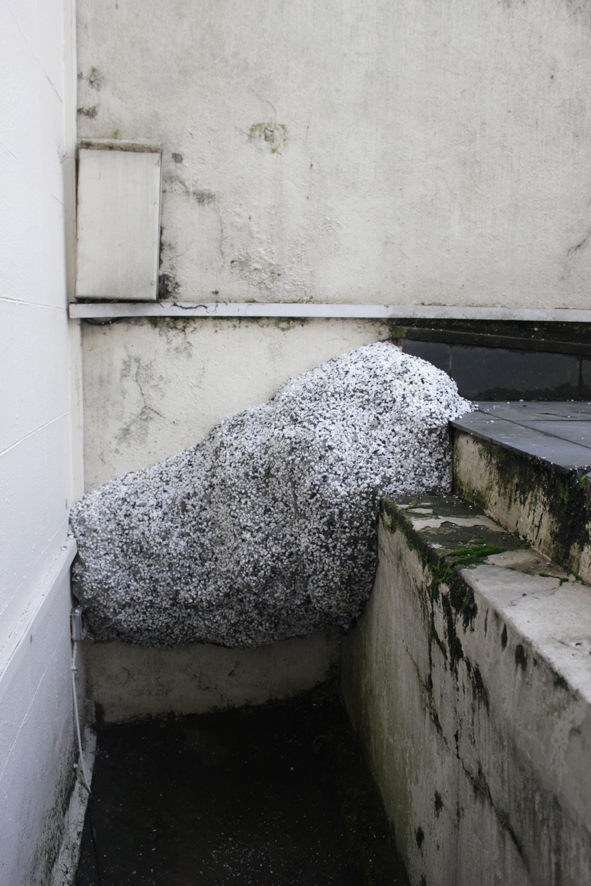
‘Unbuilt Visitors’ (2013) Rachael Champion. Armature, pebbledash, fixings. HOUSE 3,  Photo: Mat Jenner

‘Unbuilt Visitors’ (2013) Rachael Champion. Armature, pebbledash, fixings. HOUSE 3, Photo: Mat Jenner

Whilst the gold vulture hovers over the empty bed with its rumpled, monogrammed sheets in the South Kensington flat, the bed is most definitely occupied at 2 Lonsdale Road. In ‘The Poetics of Space’, Gaston Bachelard states:

‘It was reasonable to say we “read a house”, or “read a room”, since both room and house are psychological diagrams… in their analysis of intimacy’.

This aspect of intimacy was explored in HOUSE 3, with Renee Vaughan Sutherland’s one-to-one ‘Performance’ in the bedroom located in the basement of this home. It is important that this performance takes place down in the basement, the dark, primal space of the house. The ritual of preparation for this event and the unknown plays on the visitor’s psyche. Whilst the genial activity of the house carries on above, each person is led downstairs, and after a series of instructions, allowed to open the door and enter. The room is inhabited, with a woman lying in bed and an empty chair to her side. In front of the chair, projected on the bedroom wall to the left, the same woman applies lipstick, increasingly frenetically over her face. On catching the gaze of the real woman in the bed, she benignly rolls down the corner of the duvet and pats the bed, inviting you to move over and get in. People over the course of the two days both declined and accepted, staying however long they wished to in the bed. The woman does not speak to them. Some try to academically understand her reasons. One man brings a pencil and paper into bed with him. Some revert to telling her stories. Others ask her questions which she does not answer. Some actually relax. ‘Performance’ explores the layered identities of both the performer and the visitor. Out of the encounters in the three houses, ‘Performance’ engages the most personal of responses, moving the viewer from their distanced rational position as gallery goer, to an unsteady position through vulnerability.
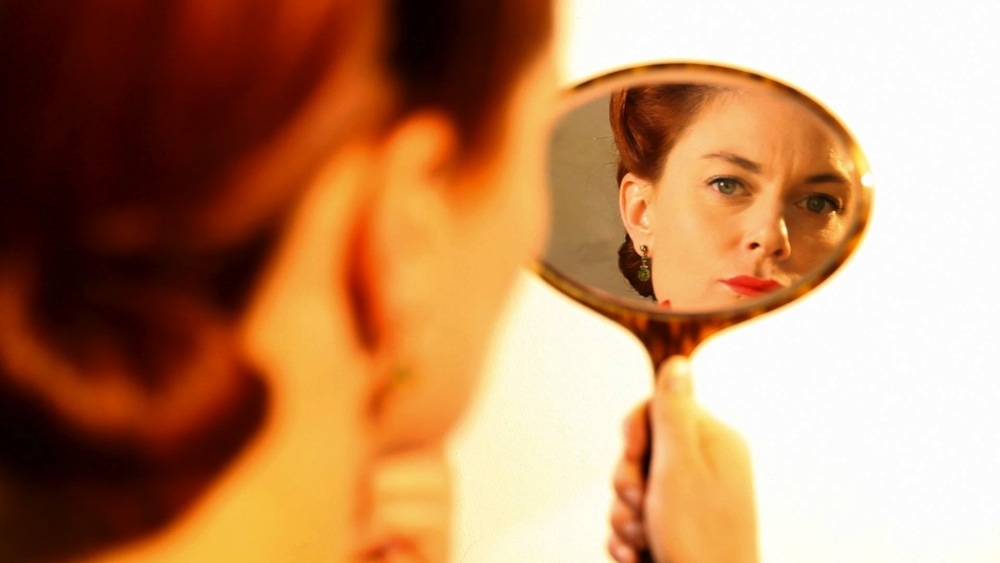
‘Performance’, (2013), Renee Vaughan Sutherland. Film still courtesy the artist.

‘Performance’, (2013), Renee Vaughan Sutherland. Film still courtesy the artist.

Daniel and Wendy, two characters from ‘Tomorrow’s script, conclude, “Well in the end, there’s just the cranium[5].  As a visitor to all three houses, the memory of the experience relies on the unusual nature of the encounter and how we shifted our position, even momentarily, as a consequence:

‘The image of the house is created through co-operation between real and unreal, with the help of the functions of the real and unreal….if a house is a living value, it must integrate an element of unreality. All values must remain vulnerable, and those that do not are dead.’ P.59, ‘Poetics of Space’, Gaston Bachelard

Jenny Brownrigg, December 2013


[1] Scott twice visited Hospitalfield House in 1803 and 1809. ‘The walls of the apartment were partly clothed with grim old tapestries, representing the memorable story of Sir Gawaine’s wedding, in which full justice was done to the ugliness of the Lothely Lady…‘, The Antiquary’, Sir Walter Scott, published 1816.

[2] The South Kensington flat exists between 1st October 2013 and 2 January 2014.

[3] HOUSE 3 was open in the third weekend of October 2013 for people to visit.

[4] The Clique included Augustus Egg, William Powell Frith, Alfred Elmore and Richard Dadd.

[5] P96, ‘Tomorrow: Scenes from an unrealised film’, Elmgreen & Dragset. Printed on the occasion of the exhibition ‘tomorrow’ at Victoria and Albert Museum, Oct 1 2013 – Jan 2 2014.
Unknown's avatar

‘The Fold, A Creative Convention after Colm Cille’, ‘Colm Cille’s Spiral’, 30 Nov – 1 Dec 2013, Derry~ Londonderry

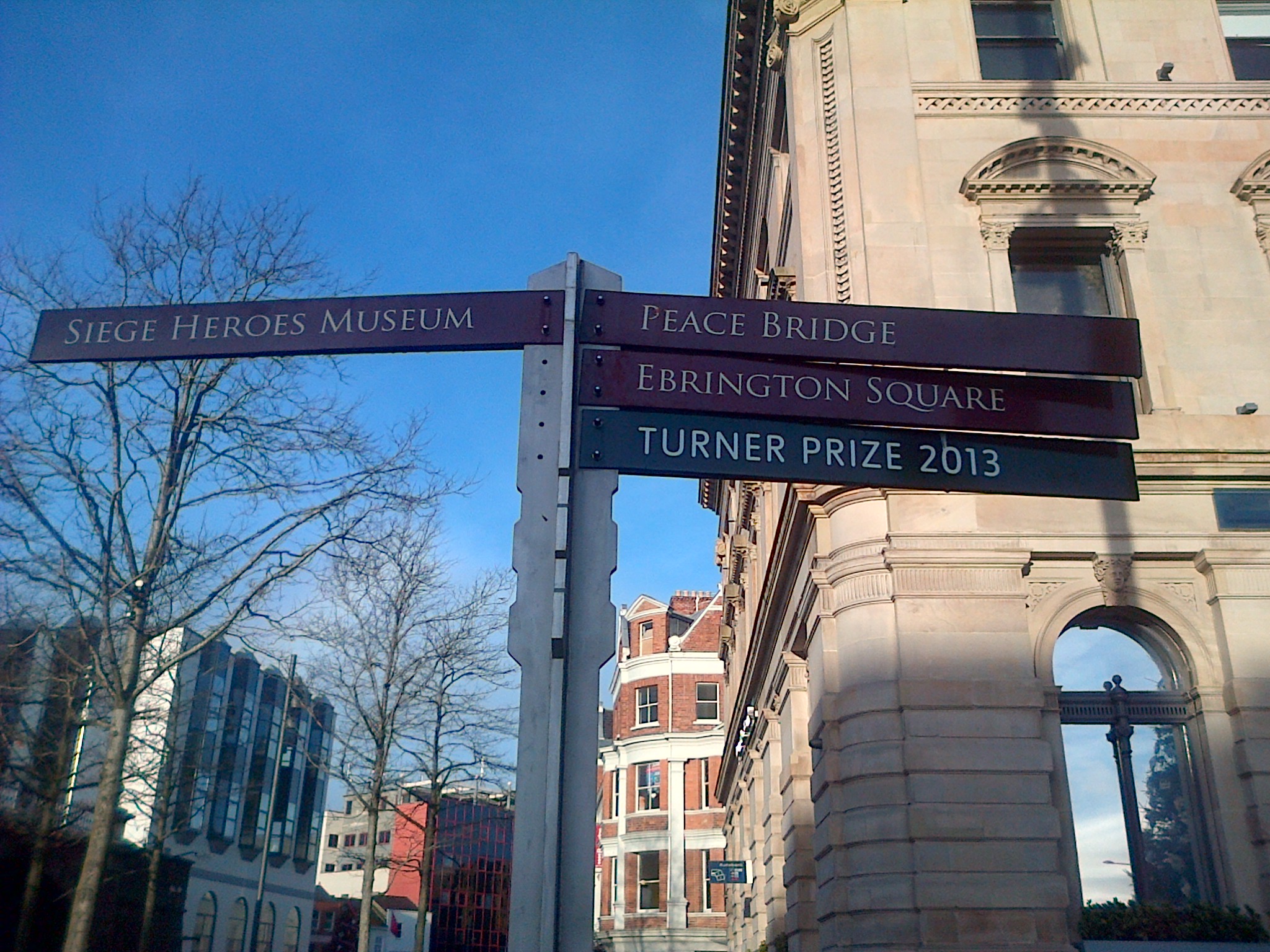
Derrysignpost


‘Colm Cille’s Spiral’ is a project taking place across the UK and EIRE, examining the legacy of 6th Century Saint Colm Cille, from a contemporary creative perspective.  I have been the curatorial lead for the Scottish ‘knot’ called ‘Convocation’, working with CCA (Glasgow), University of Glasgow and ATLAS Arts. ‘Colm Cille’s Spiral’ is a Difference Exchange and Centre for Late Antique and Medieval Studies, King’s College London project that is part of Derry~Londonderry City of Culture 2013.

Here is my blog post for ‘The Fold’, a ‘creative convention’ which brought all 6 projects together in Derry as part of : http://www.colmcillespiral.net/the-fold-a-creative-convention-after-colm-cille-colm-cilles-spiral-30-nov-1-dec-2013-derry-londonderry/ and took place at Verbal Arts Centre, Derry.

Excerpt:

[Colm Cille, the founding father of Derry, is attributed in a poem as describing the city as follows:

“The reason I love Derry /Is its quietness, its purity/ For full of angels white it is/ From one end to the other”.

We arrive in the city for our concluding event, ‘The Fold’, at a time when it could be described as busier than Colm Cille envisaged it in his mind’s eye, with impressive queues for the Turner Prize, nightly gatherings in squares to see the Lumiere Festival projections and generally a city and audience confidently in full swing for all the cultural offerings ofDerry~Londonderry City of Culture 2013. ….]

For further information on the wider project please see http://www.colmcillespiral.net/   and http://creativefutureshq.com/projects/colm-cilles-convocation/ for my blog posts on ‘Convocation’.

Unknown's avatar

Review: ‘Suspended Sentences’. Turners Warehouse, Newlyn, Cornwall

Photo: Steve Tanner
Photo: Steve Tanner

{Excerpt} Exemplifying a community-minded approach, ‘Suspended Sentences’ was a large artist-led group exhibition and series of events including experimental film, music and sound nights, taking place at an old unused fish processing factory, Turners Warehouse in Newlyn, Cornwall 2-22 Sept 2013. The exhibition formed an open response to Armitage’s poetry, after his 2013 walk along the South West coast path from Minehead to Land’s End with his last mainland reading happening at Newlyn Art School. Regional artists were invited by the project’s curators Jesse Leroy Smith and Mark Spray, to take Armitage’s poetry as a departure point or to explore the idea of a journey. The show’s title references poet Simon Armitage’s past employment as a probation officer, or as Armitage added on hearing it, could be reminiscent of poetry being written in zero gravity. 

Here is a link to my full review on ‘Interface: Reviews Unedited’ on anhttp://www.a-n.co.uk/interface/reviews/single/3933778

Photo: Steve Tanner

Photo: Steve Tanner

Marie-Claire Hamon (2013)

Marie-Claire Hamon (2013)

Unknown's avatar

Have You Ever Seen the Rain

In view of it being National Poetry Day today, I scribbled down a conversation I had last night with a Glasgow taxi driver.

Rod Stewart

Have You Ever Seen the Rain 

I am a sinny man yet God loves me
This is unconditional love
If I love Rod Stewart
Why does he charge £70 a ticket?
This is not unconditional love
Rod needs to look at this
I love the rain
With every raindrop there is an angel
The rain falls from so high up
It is from God
Rain is a mercy
If you are ill, if you are hurting
Just ask the rain
And it will help you
I hope to meet you in heaven
And if we do
You will tell me
Taxi driver, you were right


Have You Ever Seen the Rain, Rod Stewart, Composer: John Fogerty (1970 – released 1971, Rod Stewart cover version 2006)


Unknown's avatar

Axisweb Spotlight Feature: Jenny Brownrigg selects Lucienne Cole

Axisweb asked curators from across the country to browse their directory and pick one work to write about. I selected Lucienne Cole’s, ‘Dance to Music’, 2012.   

[excerpt]

Morrissey was not afraid in the 1980s’ to move his body, arms and legs to the music. Upping the confidence of others perceived as misfits, he spawned a generation of young male lone dancers happy to spiral away in their own world on the dance floor….

http://www.axisweb.org/features/default/spotlight/jenny-brownrigg-selects-lucienne-cole/

Lucienne Cole, 'Dance to Music' (2012)

Unknown's avatar

They Had Four Years

Kevin Reid

Kevin Reid

‘K. believes his agenda was firmly in place as soon as he arrived at art school, fresh from 25 years spent in Kelty and the School of Life.’

As this year’s students get set for Freshers Week at The Glasgow School of Art and post-graduate degree shows are happening, it seemed timely to revisit my essay from 2003 for GeneratorProjects’ annual  ‘They Had Four Years’. Graduates are selected from Degree shows and invited back a year later to show developed work at this artist-led organisation in Dundee. My essay looks at the motivations the selected five graduates had for going to art school, their expectations, what was discovered and experiences after the four years are over.

Unknown's avatar

Peregrinatio: Thomas Joshua Cooper

Thomas Joshua Cooper

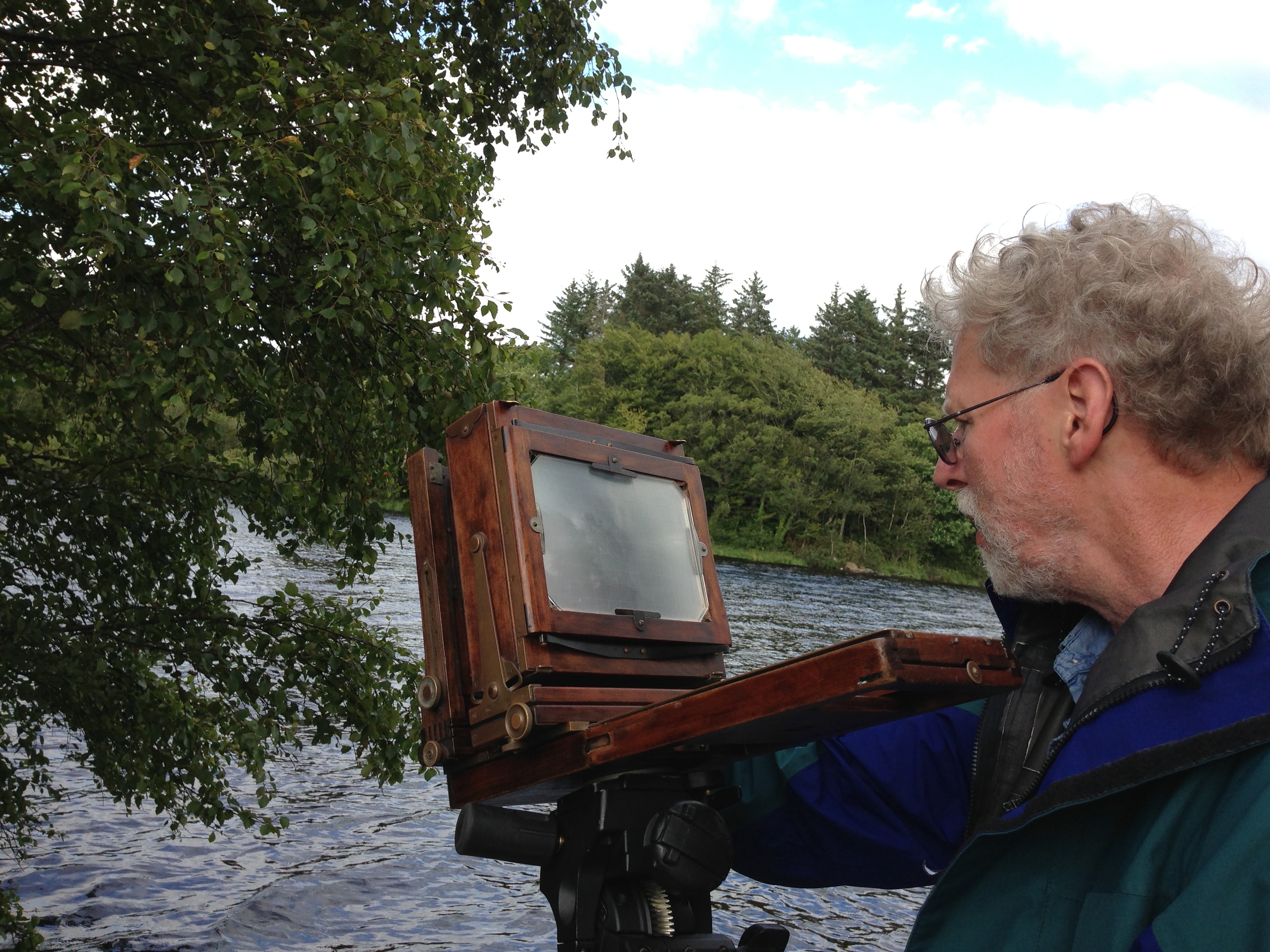
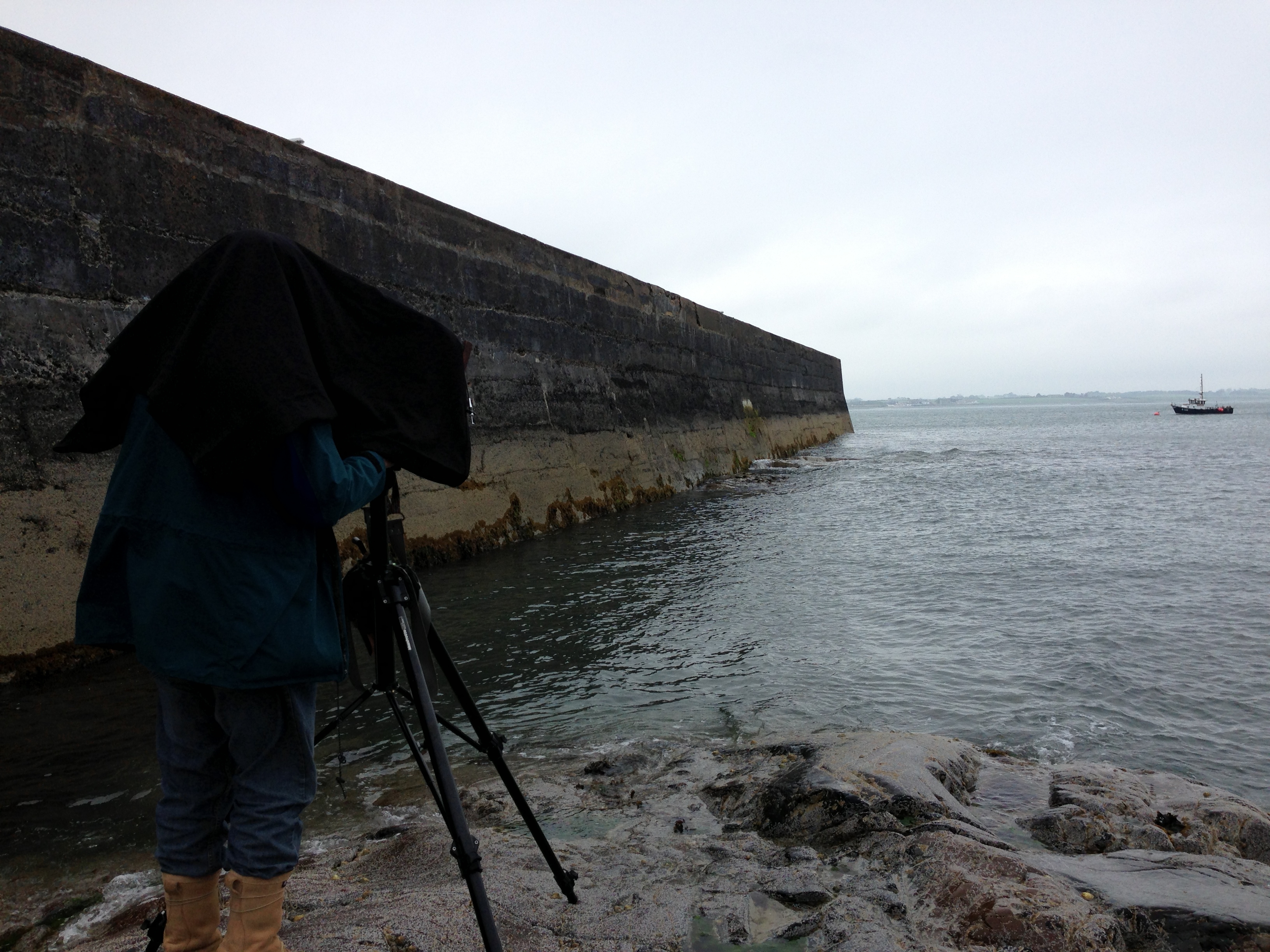
Over an eleven day period, GSA’s Head of Fine Art Photography Thomas Joshua Cooper travelled to Skye, Raasay, Cumbria and Northern Ireland, covering a total of 3135 miles.

He worked on two photographic bodies of work. For the first, he travelled to photograph the birthplaces of Saint Patrick, St Brendan and St Columba. His description of Lough Gartan, St Columba’s birthplace, echoes the mention of trees in Sorley MacLean’s poem ‘Hallaig’. MacLean imagines the cleared village’s absent women as, “ … a wood of birch trees / Standing tall, with their heads bowed.” Cooper speaks of, “Three silver birches, leaning towards the Lough, a trinity picture”.

For his second series, he went to the very edges of land, visiting the cardinal points of Northern Ireland including Benbane Head, County Antrim, the north-west point and then onto the east-most point at Burr Point on the Ards Peninsula.  In particular, with the latter location, he focused on the view from Ireland across the water to Scotland, aiming to echo St Columba’s last view from Ireland, before his exile to Scotland.

A quote from a book brought in during our residency by local Raasay resident Jenifer Burnet, describes who St Columba was in terms of the cardinal points.

‘In the West he [St Columba] was called upon as a bard, a guardian of the magical powers inherent in the literary traditions of the Celtic languages; in the North, he was a prince, a member of a prestigious lineage with a responsibility for the defence of his people; in the East he was a father, an abbot who was a just and tender provider of the many monks under his care and in the South he was a priest who dealt directly with the forces of the Otherworld.’ 1

In an interview after he had returned firstly from Raasay, Cooper explained his relation to the land and how it impacts on his photographic process. In particular, the group’s question on Peregrinatio had a real resonance for Cooper in describing his creative practice, which involves going out to the edges of the world. He described peregrinatio as, “The compulsion to send yourself out on potentially an unending, undestined voyage”. He went on to say, “As soon as I heard it [peregrinatio], it’s one of those words. It creates through syllabic movement a motion, and I have been set in that motion always, since as a boy. I find my way but I never know where the way is”.

Cooper also described the title of our project ‘Convocation’ as having meaning for him in terms of how he works with the land, as he only takes one negative at each site. “Can there be a convocation with the site? In enough silence, things will speak. If there is enough respect and the site is willing to participate, then that for me is a conversation.”

1 P. 252, ‘Anam Cara: Spiritual Wisdom from the Celtic World’, John O’Donahue

Acknowledgement

Thomas Joshua Cooper would like to express his deep thanks to Kate Mooney, Laura Indigo Cooper (who travelled with him to Northern Ireland) and David Bellingham, “for their insights, practical help and kindnesses in helping me take this project to conclusion. “

Photos of Thomas Joshua Cooper at work (2013): Laura Indigo Cooper

Thomas Joshua Cooper

Thomas Joshua Cooper

Thomas Joshua Cooper at work

Unknown's avatar

Di Domhnaich

image

We leave the island today.

Over the course of the week, we have oscillated between the rational and aspects of faith or mystery. The artists in the group are comfortable about using the latter terminology in talking about their practice, with Michail Mersinis talking about “photography as an act of faith”. The group are split however between the two entities when thinking about ‘The Life of St Columba’. “Maybe the book doesn’t want you to know”, Clare Lees said earlier in the week. “The book is its own I”.

As we sat in the waiting room yesterday evening for our last discussion, looking out to the ferry making its way in between Raasay and Skye, it was a good location to highlight that the group are at the start of seeing how the information from the week will filter down into their practice. Distance and the return home seemed to be the next stage that will help us see what we have learnt.

Jennifer Burnet, the woman who helped Jessica Ramm cut peat, has been visiting Raasay House with a wealth of information in forms of books, photocopies and photographs relating to our area of enquiry. A quote from one of the books she brought, sums up our first phase of the Spiral.

“The Celtic mind was never drawn to the single line; it avoided ways of seeing and being which seek satisfaction in certainty. The Celtic mind had a wonderful respect for the mystery of the circle and spiral”1
1 ‘Anam Cara: Spiritual Wisdom from the Celtic World’, John O’Donahue


Unknown's avatar

Thisssssss: Sound and Silence

image

Jessica Ramm and Emma Nicolson


Hallaig


Yesterday was bookended with both a real and a transmitted experience of the same place, Hallaig. In the morning, Emma Nicolson led the group on a walk to this cleared village situated in the south-east of Raasay. In the evening we watched we watched Francis Mckee’s copy of ”Hallaig: The Poetry and the Landscape of Sorley MacLean’ 1

‘Back through the gloaming to Hallaig,
Through the vivid and speechless air,
Pouring down the steep slopes,
Their laughter misting my ear.’ 2

Emma Balkind, one of our illuminators, has been recording the sound of our field trips and conversations. When we interviewed her for the short film we are making about the residency, she said, “I felt I was switched on all the time”. She and her microphone have captured the layers of words and movement of the group, alongside the land and the sea around us. I asked her if she has managed to record silence at Hallaig and she said no. Even when Johnny Rodger, one of the most ebullient in our group, asks for silence on the hill, the put-put-put of a boat out on the Sound can be heard, followed by the musical tone of a button on a digital camera.

In the evening, the cadence of Sorley MacLean’s voice and his delivery of the word ‘Thisssssss….’ sticks in my mind. The letter ‘s’, a spiral in form, fizzes in his mouth, shaping the word into a new sound and entity.

How can something, as Sorley MacLean has it, be ‘vivid and speechless’ at the same time? Much of our discussions have circled around pairs of words that come from different realms but are interwoven in order to exist: Faith and Doubt. Rational and Spiritual. Discipline and Devotion. History and Present. Interior and Exterior. Both Clare Lees and Kathryn Maude from King’s College London talked of the desire for dates in their field to evidence an occurrence or event versus the reality of the gaps that exist. As Clare put it, “My career is half-knowing things”. There are many different ways of learning, from the academic to the intuitive. In our discussions over Raasay, “The landscape has unsettled the theory”. 3 We have referred to the remoteness of the past whilst being surrounded by three billion year old rock.The Spiral is still turning, but it is important to acknowledge “Thisssssss”; that the disjoints, impossibilities, gaps and unknowns occurring are as important as the entities that surround them.

1 ‘Hallaig: The Poetry and the Landscape of Sorley MacLean’, originally produced by The Island House Film Workshop, Alva (1984), a film by Timothy Neat.

2 ‘Hallaig’ by Sorley MacLean, translated by Seamus Heaney.

3 Francis McKee’s observation